Streamosphere update

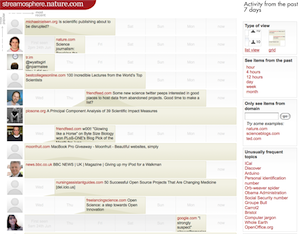
This month’s iteration of Streamosphere is now up. It’s still more a preview than a product but imho it’s approaching usefulness!

grid.png

The main changes are:

  • a new way of exploring the site – the list view shows you the most popular items within a given time frame. It’s sort of like Digg but to vote an item up you need to have commented on it or shared it on a social media site.
  • simplified sidebar, visual cues on the grid / timeline view and a help link will hopefully help new users work out what they’re seeing
  • the aggregation logic now uses Friendfeed’s SUP feed and connects directly to Twitter, so messages are picked up much faster.
  • trending topics – this is a list of topics that are appearing more frequently than you might expect. Bear in mind that it’s generated algorithmically so items are sometimes grouped together in odd (but technically correct ;)) ways…
  • clicking on “see details” in the list view or on an item in the grid view brings up a breakdown of comments and tweets which you can use to jump straight into a conversation on, for example, Friendfeed.

There are still lots of little niggles. On smaller timescales (anything under than four hours) there’s lots of items that aren’t strictly speaking about science, too. Still not sure if that’s a bug or a feature.

The next version will focus on people – both the people being followed by Streamosphere and visitors to the site – and grouping items by topic.

Streamosphere update

This month’s iteration of Streamosphere is now up. It’s still more a preview than a product but imho it’s approaching usefulness!

grid.png

The main changes are:

  • a new way of exploring the site – the list view shows you the most popular items within a given time frame. It’s sort of like Digg but to vote an item up you need to have commented on it or shared it on a social media site.
  • simplified sidebar, visual cues on the grid / timeline view and a help link will hopefully help new users work out what they’re seeing
  • the aggregation logic now uses Friendfeed’s SUP feed and connects directly to Twitter, so messages are picked up much faster.
  • trending topics – this is a list of topics that are appearing more frequently than you might expect. Bear in mind that it’s generated algorithmically so items are sometimes grouped together in odd (but technically correct ;)) ways…
  • clicking on “see details” in the list view or on an item in the grid view brings up a breakdown of comments and tweets which you can use to jump straight into a conversation on, for example, Friendfeed.

There are still lots of little niggles. On smaller timescales (anything under than four hours) there’s lots of items that aren’t strictly speaking about science, too. Still not sure if that’s a bug or a feature.

The next version will focus on people – both the people being followed by Streamosphere and visitors to the site – and grouping items by topic.

Welcome to the Streamosphere

river-of-news.jpgWeb publishing as a discipline has few tenets but I think release early, release often and don’t be afraid to fail are pretty sound. That was the philosophy behind Connotea when Timo and Ben Lund launched it in 2004 and it’s the spirit in which I’ve just put up an early version of Streamosphere.

Streamosphere is a pet side project which I’m running according to what I guess you could call the Paul Graham principles (it’d be disingenuous to say “as a start-up” as most startups don’t have NPG level resources. OTOH we lack a fussball table and free M&Ms). Think of it as a pre-alpha alpha.

The elevator pitch

Streamosphere lets you track scientific discussion on the web, in real time.

What it does

If you visit streamosphere.nature.com/preview.php#24 you’ll see a page of stacked timelines like these:

Picture 5.png

Each timeline shows discussion around a particular item, for now always a web page. The portrait on the left is of one of the people who first started talking about the item. The slice of time in which the discussion was active (people were leaving comments, tweeting, liking or bookmarking it) is coloured a shade of magnolia. Behind the active slice is a graph – this shows you how much activity there was at any one point.

Click on an item’s active slice to pop up more details about it including an activity breakdown and a selection of associated comments and tweets. If the item is a video or photograph it should be embedded in the popup. If the item description is in a foreign language hover your mouse cursor over it to get the English translation.

Picture 6.png

Streamosphere only ever shows the most active items in a given time period. Use the controls on the right hand side of the screen to see the most active items in the past few hours, day, week or month. You can also filter items by domain or by keywords in their description.

In smaller time periods you’ll see some items that aren’t anything to do with science: recently there’s been stuff about Iran and a viral video for example. I’m not sure if this is a bug or a feature, or how to filter out non-science stuff is that’s a requirement – suggestions welcome.

In the future I’d like to see the page update dynamically as new activity gets tracked but for now to refresh the page you need to reload or choose a new time period.

How it works

Streamosphere tracks ~ 4k accounts on half a dozen different social media sites including Friendfeed, Twitter and bookmarking services like Delicious. The account owners have all self-identified (sometimes implicitly) as scientists or people interested in science.

It uses a combination of polling, web hooks (via GNIP) and SUP feeds to aggregate public updates from tracked accounts as soon after they happen as possible. Average latency is ~ 3 minutes for Friendfeed and a few seconds for Twitter.

Right now there’s only one view on the data: by item. Items are the URIs associated with or mentioned in updates: if I tweet “I love https://lolcats.com” and you bookmark it on delicious then the streamosphere database will record a single item (lolcats.com) associated with two updates.

Items are currently always websites but in the future I’d like to add views for users and topics; these are non-trival because of problems with account owner disambiguation and classifying short messages respectively.

Owner disambiguation relies on the Google Social Graph API. We need to disambiguate owners because otherwise the same person could post a single link on multiple services and Streamosphere would believe it’s amazingly popular.

Sometimes users have set up rules to automatically route updates from one service to another (e.g. they share an item on Google Reader which appears in their Friendfeed stream which gets pushed out to their Twitter account). Rules like this are the bane of Streamosphere’s existence – it’s non-trivial to detect this kind of thing and handle them correctly.

I’m collecting hashtags, tags and extracting key terms from all updates but don’t quite know what to do with them yet – still need a good algorithm to detect trending topics. Links are extracted from updates but right now there’s no disambiguation for papers (Buggotea is alive and well in Streamosphere). There’s a best effort attempt to resolve shortened URLs though occasionally one will slip through.

There’s no API but if anybody has a good use for the data I’m happy to set something up using GNIP or long polling to support real time updates if necessary – just send me a use case.

Welcome to the Streamosphere

river-of-news.jpgWeb publishing as a discipline has few tenets but I think release early, release often and don’t be afraid to fail are pretty sound. That was the philosophy behind Connotea when Timo and Ben Lund launched it in 2004 and it’s the spirit in which I’ve just put up an early version of Streamosphere.

Streamosphere is a pet side project which I’m running according to what I guess you could call the Paul Graham principles (it’d be disingenuous to say “as a start-up” as most startups don’t have NPG level resources. OTOH we lack a fussball table and free M&Ms). Think of it as a pre-alpha alpha.

The elevator pitch

Streamosphere lets you track scientific discussion on the web, in real time.

What it does

If you visit streamosphere.nature.com/preview.php#24 you’ll see a page of stacked timelines like these:

Picture 5.png

Each timeline shows discussion around a particular item, for now always a web page. The portrait on the left is of one of the people who first started talking about the item. The slice of time in which the discussion was active (people were leaving comments, tweeting, liking or bookmarking it) is coloured a shade of magnolia. Behind the active slice is a graph – this shows you how much activity there was at any one point.

Click on an item’s active slice to pop up more details about it including an activity breakdown and a selection of associated comments and tweets. If the item is a video or photograph it should be embedded in the popup. If the item description is in a foreign language hover your mouse cursor over it to get the English translation.

Picture 6.png

Streamosphere only ever shows the most active items in a given time period. Use the controls on the right hand side of the screen to see the most active items in the past few hours, day, week or month. You can also filter items by domain or by keywords in their description.

In smaller time periods you’ll see some items that aren’t anything to do with science: recently there’s been stuff about Iran and a viral video for example. I’m not sure if this is a bug or a feature, or how to filter out non-science stuff is that’s a requirement – suggestions welcome.

In the future I’d like to see the page update dynamically as new activity gets tracked but for now to refresh the page you need to reload or choose a new time period.

How it works

Streamosphere tracks ~ 4k accounts on half a dozen different social media sites including Friendfeed, Twitter and bookmarking services like Delicious. The account owners have all self-identified (sometimes implicitly) as scientists or people interested in science.

It uses a combination of polling, web hooks (via GNIP) and SUP feeds to aggregate public updates from tracked accounts as soon after they happen as possible. Average latency is ~ 3 minutes for Friendfeed and a few seconds for Twitter.

Right now there’s only one view on the data: by item. Items are the URIs associated with or mentioned in updates: if I tweet “I love https://lolcats.com” and you bookmark it on delicious then the streamosphere database will record a single item (lolcats.com) associated with two updates.

Items are currently always websites but in the future I’d like to add views for users and topics; these are non-trival because of problems with account owner disambiguation and classifying short messages respectively.

Owner disambiguation relies on the Google Social Graph API. We need to disambiguate owners because otherwise the same person could post a single link on multiple services and Streamosphere would believe it’s amazingly popular.

Sometimes users have set up rules to automatically route updates from one service to another (e.g. they share an item on Google Reader which appears in their Friendfeed stream which gets pushed out to their Twitter account). Rules like this are the bane of Streamosphere’s existence – it’s non-trivial to detect this kind of thing and handle them correctly.

I’m collecting hashtags, tags and extracting key terms from all updates but don’t quite know what to do with them yet – still need a good algorithm to detect trending topics. Links are extracted from updates but right now there’s no disambiguation for papers (Buggotea is alive and well in Streamosphere). There’s a best effort attempt to resolve shortened URLs though occasionally one will slip through.

There’s no API but if anybody has a good use for the data I’m happy to set something up using GNIP or long polling to support real time updates if necessary – just send me a use case.

Which web 2.0 services do scientists use?

Which web services are scientists actively contributing to?

There are ~ 1,240 Friendfeeders in science related rooms (the-life-scientists, scienceapps, science-2-0, science-online…). What percentage have listed usernames associated with the science related tools supported by Friendfeed?

Picture 10.png

Service Count
citeulike 41
connotea 31
delicious 431
digg 208
googlereader 394
reddit 68
slideshare 143
twitter 675
youtube 341

Why this dataset isn’t very good…

There’s a bias towards services formally supported by Friendfeed – it’s easy to add feeds from supported services. Connotea and CiteULike aren’t formally supported though you can add your library RSS feeds manually. Many Friendfeed users won’t bother to do this.

People may be contributing to services (like YouTube…) for reasons that have nothing to do with science.

People who use Friendfeed aren’t a representative sample of scientists (though they may well be a representative sample of blog friendly, web savvy scientists).

People sometimes remove their Twitter feeds from Friendfeed to help keep the conversations that they start there in one place.

I picked the set of services to look at which is why you don’t see, say, Wikipedia or OpenWetWare above (some preliminary analysis suggested that the numbers would be negligible).

That said…

We can still use it to guess at broad trends.

Almost a third of Friendfeed scientists have delicious bookmarks. Don’t discount non-academic bookmarking services as a source of paper metadata.

A similar number use the share functionality in Google Reader.

Despite rumors to the contrary not everybody is on Twitter.

A surprising (to me) number of people are uploading and favouriting items on Slideshare.

Which web 2.0 services do scientists use?

Which web services are scientists actively contributing to?

There are ~ 1,240 Friendfeeders in science related rooms (the-life-scientists, scienceapps, science-2-0, science-online…). What percentage have listed usernames associated with the science related tools supported by Friendfeed?

Picture 10.png

Service Count
citeulike 41
connotea 31
delicious 431
digg 208
googlereader 394
reddit 68
slideshare 143
twitter 675
youtube 341

Why this dataset isn’t very good…

There’s a bias towards services formally supported by Friendfeed – it’s easy to add feeds from supported services. Connotea and CiteULike aren’t formally supported though you can add your library RSS feeds manually. Many Friendfeed users won’t bother to do this.

People may be contributing to services (like YouTube…) for reasons that have nothing to do with science.

People who use Friendfeed aren’t a representative sample of scientists (though they may well be a representative sample of blog friendly, web savvy scientists).

People sometimes remove their Twitter feeds from Friendfeed to help keep the conversations that they start there in one place.

I picked the set of services to look at which is why you don’t see, say, Wikipedia or OpenWetWare above (some preliminary analysis suggested that the numbers would be negligible).

That said…

We can still use it to guess at broad trends.

Almost a third of Friendfeed scientists have delicious bookmarks. Don’t discount non-academic bookmarking services as a source of paper metadata.

A similar number use the share functionality in Google Reader.

Despite rumors to the contrary not everybody is on Twitter.

A surprising (to me) number of people are uploading and favouriting items on Slideshare.

Wolfram|Alpha has potential, but I can’t see scientists using it for a while yet

hal9000.jpgWolfram|Alpha should have launched officially by the time you read this, though it has been live since Friday evening. The execution is slick. The different result visualizations are a great idea. It’s loaded up with cool widgets and APIs. Most of the time the servers don’t fall over (despite some glaring security holes). To quote FriendFeeder Iddo Friedberg it’s “a free, somewhat simple interface to Mathematica”. Free for personal, non-commercial use, anyway. If you’ve got any questions about the GDP of Singapore then wolframalpha.com is the place to go.

I think that it’s a very interesting project and that it’s important to bear in mind that as the homepage says:

Today’s Wolfram|Alpha is the first step in an ambitious, long-term project to make all systematic knowledge immediately computable by anyone

(emphasis mine)

WA certainly has lots of potential but was anybody who used it over the weekend not left mildly let down? You’d have thought that we’d all have learned not to believe interweb hype after the Powerset and Cuil launches but even if you took all the pre-launch media guff with a liberal sprinkling of salt it was hard not to expect much from Alpha. A breathless Andrew Johnson suggested that it was “the biggest internet revolution for a generation” in The Independent: “Wolfram Alpha has the potential to become one of the biggest names on the planet”.

Personally I was disappointed because I’d been expecting the wrong thing. I’d assumed that WA was akin to Cyc, which is a computational engine that takes a large manually curated database of “common sense” facts and relations and uses it to infer new knowledge. For example: searching photos for “someone at risk for skin cancer” might return a photo captioned “girl reclining on a beach”. Reclining at the beach implies suntanning and suntanning implies a risk of skin cancer.

A few years back a Paul Allen venture called Project Halo took the engine behind Cyc and taught it facts and rules from chemistry textbooks; it took a lot of time and money but the resulting system had a good go at answering college level chemistry exam questions.

It turns out that WA doesn’t do anything like this. One of the most interesting posts about the system that I’ve read comes from Doug Lenat who perhaps not coincidentally is the founder of Cyc. Lenat was impressed by WA but notes that it’s a different beast altogether:

It does not have an ontology, so what it knows about, say, GDP, or population, or stock price, is no more nor less than the equations that involve that term"… [it’s] able to report the number of cattle in Chicago but not (even a lower bound on) the number of mammals because it doesn’t know taxonomy and reason that way

If a connection isn’t represented by a manually curated equation it isn’t represented at all. Apparently the Mathematica theorem prover is currently turned off as it’s too computationally expensive.

One example of this is: “How old was Obama when Mitterrand was elected president of France?” It can tell you demographic information about Obama, if you ask, and it can tell you information about Mitterrand (including his ruleStartDate), but doesn’t make or execute the plan to calculate a person’s age on a certain date given his birth date, which is what is being asked for in this query.

It might seem harsh to criticize WA for not being what people (OK, I) wanted it to be but bear in mind that Wolfram’s About and FAQ pages suggest that WA is an amazing leap forward that brings “expert level knowledge” to everybody and “implements every known model, method, and algorithm” – it’s not like they were managing expectations particularly well.

Even if the computational inference part is lacking the system is still potentially useful as a well presented structured data almanac – but I’m not convinced that it’s a winner for life sciences data.

Wolfram|Alpha for genetics questions

If I search for “DISC1” I get back information about the human gene (genetics coverage in WA is lacking, despite Stephen Wolfram using a sequence search in the video demo. Only the human genome is available). It tells me the transcripts, reference sequence, the coordinates of DISC1, protein functions and a list of nearby genes.

That data is useless without proper citations, though. What genome assembly release are the gene coordinates on? Are the “nearby genes” nearby on the same assembly, or do they come from a different source? Who and what predicted the transcripts, and what data did they use? Were the protein functions confirmed by work in the lab or just predicted by algorithm (if so, what’s the confidence score)?

The “sources” link at the bottom provides a bunch of high level papers describing different genome databases but doesn’t specifically match these to elements of data on the page: furthermore there’s a disclaimer suggesting that actually the data could be from somewhere else entirely that isn’t listed. Not much help.

What happens with contradictory data? The GDP of North Korea varies depending on who I ask. How does WA – or rather whoever curates that data for WA – decide which version of the answer to show?

I’m also worried about how current the data is. Lenat mentions that:

In a small number of cases, he also connects via API to third party information, but mostly for realtime data such as a current stock price or current temperature. Rather than connecting to and relying on the current or future Semantic Web, Alpha computes its answers primarily from [Wolfram’s] own curated data to the extent possible; [Stephen Wolfram] sees Alpha as the home for almost all the information it needs, and will use to answer users’ queries.

I can see why you wouldn’t want to rely on connections to third party data sources for anything that looks like a search engine; users expect a quick response. But in fast moving scientific fields the systematic knowledge that’s useful to researchers isn’t static like dates of birth or melting points – datapoints get updated, corrected and deleted all the time. Does Wolfram bulk import whole datasets regularly? If I correct an error in a record at the NCBI when will Wolfram pick it up?

Can a monolithic, generalized datastore run by Wolfram staff work as well as smaller specialized databases run by experts? What’s the incentive for the specialized databases to release data to Wolfram in the first place, given that WA will be a commercial product?

(for more science tinged coverage there’s lots of Wolfram|Alpha chatter on Friendfeed, a new room dedicated to collecting life sciences feedback for Wolfram and Deepak has a good blog post out)

Wolfram|Alpha has potential, but I can’t see scientists using it for a while yet

hal9000.jpgWolfram|Alpha should have launched officially by the time you read this, though it has been live since Friday evening. The execution is slick. The different result visualizations are a great idea. It’s loaded up with cool widgets and APIs. Most of the time the servers don’t fall over (despite some glaring security holes). To quote FriendFeeder Iddo Friedberg it’s “a free, somewhat simple interface to Mathematica”. Free for personal, non-commercial use, anyway. If you’ve got any questions about the GDP of Singapore then wolframalpha.com is the place to go.

I think that it’s a very interesting project and that it’s important to bear in mind that as the homepage says:

Today’s Wolfram|Alpha is the first step in an ambitious, long-term project to make all systematic knowledge immediately computable by anyone

(emphasis mine)

WA certainly has lots of potential but was anybody who used it over the weekend not left mildly let down? You’d have thought that we’d all have learned not to believe interweb hype after the Powerset and Cuil launches but even if you took all the pre-launch media guff with a liberal sprinkling of salt it was hard not to expect much from Alpha. A breathless Andrew Johnson suggested that it was “the biggest internet revolution for a generation” in The Independent: “Wolfram Alpha has the potential to become one of the biggest names on the planet”.

Personally I was disappointed because I’d been expecting the wrong thing. I’d assumed that WA was akin to Cyc, which is a computational engine that takes a large manually curated database of “common sense” facts and relations and uses it to infer new knowledge. For example: searching photos for “someone at risk for skin cancer” might return a photo captioned “girl reclining on a beach”. Reclining at the beach implies suntanning and suntanning implies a risk of skin cancer.

A few years back a Paul Allen venture called Project Halo took the engine behind Cyc and taught it facts and rules from chemistry textbooks; it took a lot of time and money but the resulting system had a good go at answering college level chemistry exam questions.

It turns out that WA doesn’t do anything like this. One of the most interesting posts about the system that I’ve read comes from Doug Lenat who perhaps not coincidentally is the founder of Cyc. Lenat was impressed by WA but notes that it’s a different beast altogether:

It does not have an ontology, so what it knows about, say, GDP, or population, or stock price, is no more nor less than the equations that involve that term"… [it’s] able to report the number of cattle in Chicago but not (even a lower bound on) the number of mammals because it doesn’t know taxonomy and reason that way

If a connection isn’t represented by a manually curated equation it isn’t represented at all. Apparently the Mathematica theorem prover is currently turned off as it’s too computationally expensive.

One example of this is: “How old was Obama when Mitterrand was elected president of France?” It can tell you demographic information about Obama, if you ask, and it can tell you information about Mitterrand (including his ruleStartDate), but doesn’t make or execute the plan to calculate a person’s age on a certain date given his birth date, which is what is being asked for in this query.

It might seem harsh to criticize WA for not being what people (OK, I) wanted it to be but bear in mind that Wolfram’s About and FAQ pages suggest that WA is an amazing leap forward that brings “expert level knowledge” to everybody and “implements every known model, method, and algorithm” – it’s not like they were managing expectations particularly well.

Even if the computational inference part is lacking the system is still potentially useful as a well presented structured data almanac – but I’m not convinced that it’s a winner for life sciences data.

Wolfram|Alpha for genetics questions

If I search for “DISC1” I get back information about the human gene (genetics coverage in WA is lacking, despite Stephen Wolfram using a sequence search in the video demo. Only the human genome is available). It tells me the transcripts, reference sequence, the coordinates of DISC1, protein functions and a list of nearby genes.

That data is useless without proper citations, though. What genome assembly release are the gene coordinates on? Are the “nearby genes” nearby on the same assembly, or do they come from a different source? Who and what predicted the transcripts, and what data did they use? Were the protein functions confirmed by work in the lab or just predicted by algorithm (if so, what’s the confidence score)?

The “sources” link at the bottom provides a bunch of high level papers describing different genome databases but doesn’t specifically match these to elements of data on the page: furthermore there’s a disclaimer suggesting that actually the data could be from somewhere else entirely that isn’t listed. Not much help.

What happens with contradictory data? The GDP of North Korea varies depending on who I ask. How does WA – or rather whoever curates that data for WA – decide which version of the answer to show?

I’m also worried about how current the data is. Lenat mentions that:

In a small number of cases, he also connects via API to third party information, but mostly for realtime data such as a current stock price or current temperature. Rather than connecting to and relying on the current or future Semantic Web, Alpha computes its answers primarily from [Wolfram’s] own curated data to the extent possible; [Stephen Wolfram] sees Alpha as the home for almost all the information it needs, and will use to answer users’ queries.

I can see why you wouldn’t want to rely on connections to third party data sources for anything that looks like a search engine; users expect a quick response. But in fast moving scientific fields the systematic knowledge that’s useful to researchers isn’t static like dates of birth or melting points – datapoints get updated, corrected and deleted all the time. Does Wolfram bulk import whole datasets regularly? If I correct an error in a record at the NCBI when will Wolfram pick it up?

Can a monolithic, generalized datastore run by Wolfram staff work as well as smaller specialized databases run by experts? What’s the incentive for the specialized databases to release data to Wolfram in the first place, given that WA will be a commercial product?

(for more science tinged coverage there’s lots of Wolfram|Alpha chatter on Friendfeed, a new room dedicated to collecting life sciences feedback for Wolfram and Deepak has a good blog post out)

Google, Obama and God: good. H1N1, Elsevier and Merck: bad.

(see the previous post for background on these tables)

Entities associated with negative emotions

Term Sum score Blogs mentioning entity
H1N1 -7.50 15
Elsevier -4.52 5
Merck -3.79 8
CDC -2.34 7
Dana -2.00 2
Japan -2.00 2
McCaffery -2.00 2
WSJ -2.00 2
Sci -1.98 3
Jacqui Smith -1.54 2
James Corbett -1.51 2
Israel -1.50 2
iPhone -1.33 2
Alzheimer -1.19 2
HIV -1.12 2

H1N1 is the subtype of the “swine flu” influenza virus.

Elsevier and Merck published fake journals in Australia, “Dana” is Dana McCafferty, who tragically died of whooping cough because of the low vaccination rates in New South Wales.

WSJ” is the Wall Street Journal which published a flawed explanation of quantum entanglement that got picked up by physics bloggers. Jacqui Smith is the UK’s home secretary, currently under fire for (amongst other things) keeping the DNA of innocent people on file for six years after their arrest.

James Corbett is the teacher in California who told his students that creationism was “superstitious nonsense” – he was later sued by a student who believed that their first amendment rights had been violated.

The iPhone is in there because of changes to App Store policies that may impact smaller developers.

Positive emotions after the break.

Continue reading

Google, Obama and God: good. H1N1, Elsevier and Merck: bad.

(see the previous post for background on these tables)

Entities associated with negative emotions

Term Sum score Blogs mentioning entity
H1N1 -7.50 15
Elsevier -4.52 5
Merck -3.79 8
CDC -2.34 7
Dana -2.00 2
Japan -2.00 2
McCaffery -2.00 2
WSJ -2.00 2
Sci -1.98 3
Jacqui Smith -1.54 2
James Corbett -1.51 2
Israel -1.50 2
iPhone -1.33 2
Alzheimer -1.19 2
HIV -1.12 2

H1N1 is the subtype of the “swine flu” influenza virus.

Elsevier and Merck published fake journals in Australia, “Dana” is Dana McCafferty, who tragically died of whooping cough because of the low vaccination rates in New South Wales.

WSJ” is the Wall Street Journal which published a flawed explanation of quantum entanglement that got picked up by physics bloggers. Jacqui Smith is the UK’s home secretary, currently under fire for (amongst other things) keeping the DNA of innocent people on file for six years after their arrest.

James Corbett is the teacher in California who told his students that creationism was “superstitious nonsense” – he was later sued by a student who believed that their first amendment rights had been violated.

The iPhone is in there because of changes to App Store policies that may impact smaller developers.

Positive emotions after the break.

Continue reading