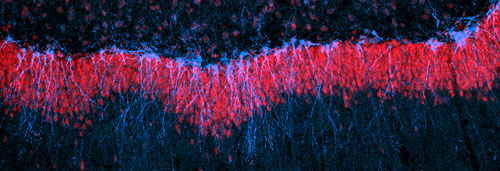
Saving the Best (Neurogenesis) for Last

blue dcx

This is a guest post in our #NPGsfn11 blog series and posted on behalf of Jason Snyder. This is cross-posted at Functional Neurogenesis.

Previously, I wrote about new SfN data on the role for newborn neurons in regulating emotion. The second half of the SfN meeting rounded out the story because the bulk of the functional presentations focused on the role of new neurons in that other, classic function of the hippocampus: memory. Spanning synaptic plasticity, circuit function, and then linking it all to behavior, we have quite a complete story here.

Continue reading →

#Winning at SfN Poster Lotto with Vodka and the Vacillating Voles

This is a guest post in our #NPGsfn11 blog series and posted on behalf of Zen Faulkes.

Browsing through the Neuroscience poster session, I was stopped by an unusual title. Almost all the posters around me featured mice, but I spotted “vole” in the title of this poster. I had to find out why these scientists zigged when all the others zagged.

The presenter, A.M. Anacker, had a great answer. Prairie voles are well known for pair bonding. This is the vole equivalent to going steady or marriage. This has been the subject of some very elegant neuroethology, which was partly responsible for the rise in people’s awareness of oxytocin.

This lab was trying to use the vole’s monogamous pair bonds to test for the potential effects of alcoholism on social relationships.

“I’m guessing your hypothesis is that the effect of alcohol on relationships will be bad.” They replied that they didn’t necessarily hypothesize that. I was thinking about severe alcohol use, but the presenter pointed out to me that in humans, alcohol has a reputation as a social lubricant. I couldn’t help but to think of the B.A.N.T.E.R. party later that evening.

Continue reading →

Synchronized Anxiety

This is a guest post in our #NPGsfn11 blog series and posted on behalf of Lucas Glover.

In 1999, the functional organization of the hippocampus became a little more complicated. A functional double dissociation was identified (also here) between the two parts of this structure, the dorsal (dHPC) and ventral hippocampus (vHPC.) Since then, much research has focused on the dHPC and its role in spatial memory processing, but much less has been done on the vHPC. The vHPC is known to be involved in mediating anxiety-like behaviors and I sought out a cutting edge update on this proposed functional role here at the Society for Neuroscience Annual Meeting. The emerging story: vHPC and prefrontal cortex (PFC) synchronize to a network oscillation known as “theta” to regulate anxiety behaviors.

Continue reading →

Your Introspective Insula

This is a guest post in our #NPGsfn11 blog series and posted on behalf of Sandra Upson. This also appears on Scientific American’s Observations blog.

Bicycle Race

You’re struggling up a hill halfway through a ten-mile race. Your breathing is ragged, and your footfalls seem heavy. You lurch toward the water station, grab a cup, and gulp it down. Back in the middle of the pack, you feel strengthened and pick up the pace.

Your decision to lope over to the water station relied on your interoceptive sense—the ability to sense your internal state. When you talk to your physician about a nagging pain or discomfort, you are also acting on information passing through your brain’s interoceptive system. Facing a major mental and physical challenge, however, requires you to do more. You need to match your internal sensations with an assessment of what the environment will demand of you. Do you need to slow down to summit the hill, or can you power through to the next water station?

Continue reading →

What Were You Doing on July 10, 1991? Some People Remember Like It Was Only Yesterday

This is a guest post in our #NPGsfn11 blog series and posted on behalf of Gary Stix and is cross-posted at the Scientific American Observations blog.

A group of researchers from the University of California, Irvine reported in 2006 on a woman named Jill Price who could remember in great detail what she did on a particular day decades earlier. James McGaugh, Larry Cahill and Elizabeth Parker put the woman through a battery of tests and ascertained that she was not using any of the memory tricks that have been known to mnemonists for millennia.

Word got out, the media descended and the lab now receives calls every day from people who say they have the same ability as Price. Of the hundreds of people interviewed, 22 appear to exhibit what the researchers call highly superior autobiographical memory (HSAM), the detailed recollection of events that occurred in the distant past.

Continue reading →

Serotonin and Motivation for Food Intake = Sci’s New Hotness

This is a guest post in our #NPGsfn11 blog series and posted on behalf of Scicurious.

One of the interesting things that you get to see when you go to the Society for Neuroscience meeting is what’s up and coming, what’s hot, and what’s kind of fading from the forefront of the hivemind of neuroscience. As Sci walks around, seeing posters, hearing talks, seeing colleagues and friends, I hear words bandied around. Optogenetics is the new hotness. Oxytocin? A little last year.

And then there’s food and reward. It’s a quiet murmur, but it’s getting stronger. Things like “food addiction” and “sucrose reward” start to go around. And my ears perk up, because I personally find this subject FASCINATING. And you should, too. After all, there is a veritable symphony controlling what, and when, and how much you eat.

And to that symphony we can add the soft oboe modulating sound of the serotonin receptors in the nucleus accumbens.

You are currently viewing a placeholder content from YouTube. To access the actual content, click the button below. Please note that doing so will share data with third-party providers.

More Information

Pratt et al. “Selective serotonin receptor stimulation of the medial nucleus accumbens alters appetitive motivation for sugar reinforcement within a progressive ratio task” Wake Forest University. 103.15.

Continue reading →

Career Development Topics: How to Meet a Mentor

This is a guest post in our #NPGsfn11 blog series and posted on behalf of Paola Giusti Rodríguez.

As the majority of the 30,000+ attendees of the Society for Neuroscience (SfN) 2011 meeting scurried off to all numerous satellite events and social gatherings, a few hundred mobilized on Saturday night towards Hall E at the Washington Convention Center for the “Career Development Topics: A Mentoring and Networking Event”. The event was organized by the Society’s Professional Development Committee to provide mentoring opportunities and professional guidance to neuroscientists across all educational levels.

Meeting a mentor among the 30,000+ attendees may seem daunting, especially for younger attendees, so accessibility is key at this event. Participants were welcomed by 40+ enthusiastic mentors spread out amongst 24 topic-based tables, covering diverse topics centered around research (from getting a postdoc, to setting up your own lab, and developing collaborations), funding (grants and fellowships), careers (alternative careers, career transitions and networking), and service, as well as other topics (science policy, work-life issues, science writing, etc.) Attendees were encouraged to visit multiple tables during the two-hour event to maximize their experience. This type of event, which is complimentary in many ways to the mentor matching service offered by the Society, allows its participants direct and unencumbered access to multiple mentors in a short amount of time in a somewhat familiar setting (i.e. Neuroscience 2011); a sort of career speed-dating, if you will.

Continue reading →

For “Super Agers,” Bodies Age As Brains Stay Young

The Shadow Puppeteer from Kalabhavan

Early research on the sharpest octogenarians reveals unusually youthful brain regions

This is a guest post in our #NPGsfn11 blog series and posted on behalf of Sandra Upson and is cross-posted at Scientific American’s Observations blog.

A nasty affliction sets into humans as they advance in years. The hair either disappears or thins into a fuzzy halo, the skin sags and bunches, while inside the brain, changes set in that slow our reaction times and cause our memories to fade. A steady, widespread thinning out of the brain’s cortex, the outermost layer of the brain, is thought to underlie some of this cognitive transformation.

But not everybody ages the same way—and not everyone, it turns out, suffers from memory decline and cortical thinning. The 48 octogenarians in the Northwestern University Super Aging Project were selected for having met or bested the average performance of a 50- or 60-year old on standard tests of recall. Magnetic resonance imaging scans of their brains corroborate their superior abilities: not only do super agers act the same as their younger counterparts, their brains look the same. “To see no change whatsoever was really surprising,” says Theresa Harrison, one of the researchers who presented preliminary findings from the project at a poster session at the 2011 Society for Neuroscience conference.

Continue reading →

I Am Judging You While You Wait To Buy Coffee

This is a guest post in our #NPGsfn11 blog series and posted on behalf of Dr. Becca.

There may be no better spot for people watching in all of the convention center than the leather sofa that faces the Starbucks line, and that is exactly where I am sitting. It’s perfect—I’ve got a constant stream of people going by, but that stream is slow-moving enough that my not-fully caffeinated brain is actually able to make an observation or two. One thought that occurs to me: with a few highly-notable exceptions, SfN-goers appear to be better-dressed this year than last. But before you go patting yourselves on the back too long over your new-and-improved sartorial prowess, let’s think this through a little.

Continue reading →

Big ‘O’ Studies

This is a guest post in our #NPGsfn11 blog series and posted on behalf of Gary Stix and is cross-posted at Scientific American’s Observations blog.

The pop psychology section of Barnes & Noble is filled with self-help books that dutifully explain how the brain is the body’s primary erogenous zone. Now researchers have spliced together a series of fMRI images to make a movie that shows the extent to which that clichéd adage rings true. A video, shown on an iPad this afternoon in a poster session at SfN 2011, indicates that more activity exists in the brains of women during “self-stimulation” to orgasm (this is a family blog so we’ll stick with geek speak) than anything short of an epileptic seizure. Barry Komisaruk, a Rutgers University psychology professor marvels “It seems to activate all of the major brain systems, which we didn’t know before. I don’t know of any other behavioral process that is so powerful.”

orgasm image.jpg

A still from the “Brain Symphony” movie, courtesy of Dr.Barry Komisaruk.

The movie, labeled by the researchers in Komisaruk’s laboratory as a “brain symphony” and presented to the press in a book called “hot topics,” shows the buildup to orgasm and the subsequent ebbing of activity during a five-minute period. A series of colored lines—each of which represents a two-second “snapshot”—descend down the screen, evolving from dark red (lowest activity) to (white, highest level) as a woman’s brain progresses toward the Big O. Each line is subdivided into 80 columns that represent the left, midline and right regions. (The poster presentation includes scans of six women, though only one was used for the movie.)

Continue reading →