Heinz award to Chris Field

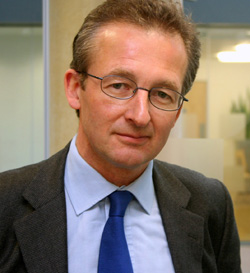
One of this year’s Heinz awards – a $100,000 prize for achievement in environmental science and leadership – is going to Chris Field, the Stanford ecologist and leading carbon-cycle expert who became co-chair of IPCC Working Group 2 in 2008.

“Chris Field receives a Heinz Award for his contributions towards understanding the impacts of climate change on Earth’s ecosystems, as well as for his national and international leadership in bringing science to the policy process,” the Heinz foundation said. “He has played a critical role in the emergence of global ecology as a unique discipline, applying it to diverse questions concerning the scientific foundations for a sustainable future.”

Congratulations to Chris!

Anna Barnett

Wonder weed plans fail to flourish

jatropha.JPGThis week in Nature you can read the first (subscription) of four articles unpicking the business of biofuels. First up is jatropha – the shrub that promised to give drought-ridden countries boundless oil supplies. The reality has turned out to be somewhat different. After a period of hype and over enthusiasm, investments have dried up, somewhat like the promise of oil from arid land.

Jatropha definitely still has a future, but the plant genetics really need to be better developed and a number of companies are now doing this, including London-based D1oils – a company which hit trouble earlier this year when a deal with oil giant BP fell through.

We also catch up with Pushpito Ghosh, director of India’s Central Salt and Marine Chemicals Research Institute. Nature first encountered Ghosh in 2007 when jatropha was still promising the Earth. His project seems to have benefited from a realistic approach from the start. Here we see a photo taken just last week at a CSMCRI plantation in Mahuda, Orissa. Each plant in this kind of harvest gives 1.75–2.25 kg of seeds, which have the oil extracted and the waste turned into briquettes.

The series continues next week with a look at bioalgae as a potential fuel source. After that comes cellulosic bioethanol, followed by the potential for a ‘green gasoline’ to be used as a simple drop-in-fuel replacement.

Katharine Sanderson

Image: CSMCRI

Q&A: France unveils carbon tax

Over on Nature News, Declan Butler has a detailed briefing on the new carbon tax unveiled in France last week:

France is set to become the first major European economy to implement a carbon tax — a levy on activities that emit substantial amounts of carbon dioxide.

Nicolas Sarkozy, the French president, announced on 10 September that the tax would come into effect at the start of 2010. The tax draws largely on recommendations made on 28 July by an expert panel commissioned by the government, and chaired by the former Socialist prime minister, Michel Rocard.

Nature discussed the tax with Jean Jouzel, a member of the Rocard panel, director of the Pierre-Simon Laplace Institute near Versailles, and also the French representative on the executive of the International Panel on Climate Change.

The French carbon tax will be levied at a rate of €17 (US$25) per tonne of CO2 — the current market price. Is that enough to change people’s carbon-emitting habits?

What’s most important is that a carbon tax of some sort is going to be introduced. Starting at €32 per tonne, as our report recommended, would have been more courageous. The economists on the panel considered that €40 was the minimum for the carbon tax to be effective in changing consumer behaviour, so €32 was itself already a compromise. It’s true that the plan is to phase in higher carbon prices over time, but Sarkozy failed to give further details. In the longer term, by around 2020, we need to reach a price of €100–€200 per tonne.

Read the full interview here.

Anna Barnett

Sunburnt Southern Hemisphere in 2095

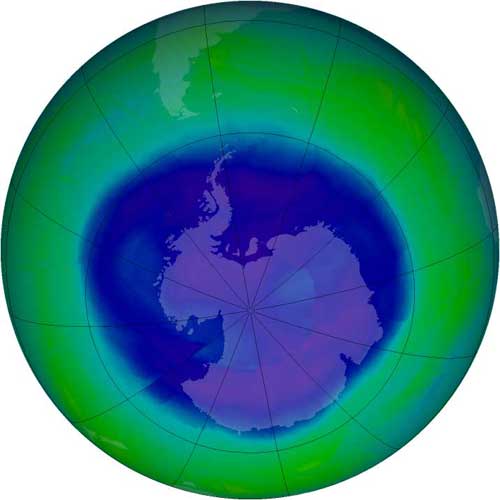
NASA_ozonehole.jpgGlobal warming doesn’t just change the weather, it also affects the ozone layer. According to a detailed new modelling study, by 2095 the springtime UV index (UVI) could go up by as much as 20% on the southernmost section of the planet, as altered atmospheric circulation pushes more stratospheric ozone into the Northern Hemisphere. That’s nearly half the UVI increase caused by ozone-eating pollutants in the late twentieth century – but coming from climate change alone.

In a study published in Nature Geoscience this week (subscription), Michaela Hegglin and Theodore Sheperd at the University of Toronto used the Canadian Middle Atomosphere Model, which fully resolves stratospheric circulation, to project ozone changes under the IPCC’s medium-emissions A1B scenario. As climate change unfolded, the model showed increased atmospheric upwelling in the tropics, and what went up in the tropical stratosphere came down disproportionately on Earth’s northern half. As a result, even though the damage done last century by chlorofluorocarbons and other nasties is expected to heal in the next several decades, the ozone layer over the Southern Hemisphere will remain thinner than its pristine state circa 1965.

Continue reading

Interview: Dieter Helm

climate.2009.86-i1.jpgOxford economist Dieter Helm co-edits an upcoming book, The Economics and Politics of Climate Change, that he says takes “a colder and harder look at the challenge”. In a Q&A on Nature Reports Climate Change this week, Helm gives his take on a long-term strategy for reducing emissions. Here’s an excerpt:

Where, in your view, has policy gone wrong?

Let’s remember what lies behind Copenhagen. The Kyoto Protocol measures countries’ production of carbon, not consumption. It’s no accident the Europeans like Kyoto. It’s a set of measures which, as they de-industrialize and production moves to countries like China, makes them look good. But the carbon consumption record of Europe, once you take those imports back, is pretty awful. That’s why Kyoto looks like a success, and yet it hasn’t caused even a blip in the emissions path.

Do we also need to re-think climate economics?

What we have learnt is that politicians tend to choose the most expensive options first. Faced with climate change, what’s our solution? In Europe, it’s to devote most of our energies to a rapid build-out of wind power. This is the sort of thing that makes nuclear power look cheap. Climate change is about the massive increase of coal burning internationally, especially the growth of China and India fuelled by coal-based energy — and America too, where the Obama plans are also small relative to the problem.

What exactly will windmills across Europe do to address that overwhelmingly dominant effect? Of course they’ll play some role, but it’ll probably take a couple of weeks for China to add sufficient new coal power stations to cancel out any renewables effort in Britain. It’s time to grow up. It’s time to realize that coal is where the core of the problem lies, and to think cleverly about solutions towards that.

Read the full interview here.

Anna Barnett

Ones that got away

“People are going to be scratching their heads and saying, ‘Wow, that’s really sensitive.’”

Ken Buesseler of Woods Hole on a new finding that if the ocean’s main carbon-recycling zone sank just 24 metres, seas would soak up significantly more CO2.

“When you decide how you invest money for climate adaptation, you should quickly come to the conclusion that ecology provides the best bangs for bucks – and that’s even without taking into account the added benefits of saving biodiversity.”

Pavan Sukhdev – an Deutsche Bank economist on secondment at UNEP – has translated damage to coral reefs and forests into multi-trillion-dollar financial losses.

“This is not something Japan will do on its own. The premise is an agreement that includes other countries such as China and India.”

Katsuya Okada, secretary-general of the Democratic Party of Japan, on the party’s campaign pledge to cut greenhouse gas emissions to 25% below 1990 levels by 2020.

“The results should set at rest any apprehensions that India’s greenhouse gas emissions are poised for runaway increase over the next two decades.”

Government-backed report projects that India’s emissions will more than triple by 2031, to between 4 billion tonnes and 7.3 billion tonnes.

Why a climate crisis is like an epileptic seizure

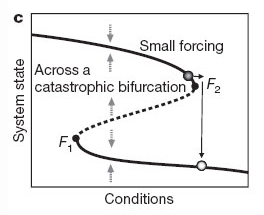
tippingpoint.bmpTipping points – those critical thresholds in a complex system where a small nudge can cause a catastrophic response – are perhaps the most fearsome threats to the Earth’s climate, but they also haunt ecosystems, financial markets, and even sufferers of medical conditions such as epilepsy and asthma. A fascinating review in Nature today (subscription) sketches out the mathematical patterns on which many of these instances seem to be based, and describes giveaway signs that might warn us to change course before the system tips.

One common warning sign, for example, is flickering between the pre-tipping point state and the post-tipping point state. In climatology, abrupt changes traced in records of the Earth’s past suggest the planet has regularly gone through tipping points, such as the sudden warm-ups that change glacial periods into deglaciations. Earlier this year researchers reported in Nature Geoscience that rapid flickering signaled the end of Earth’s most recent cold spell, the so-called Younger Dryas period. The authors of the new review, led by Marten Scheffer of Wageningen University in The Netherlands, say that in a similar way, debilitating epileptic seizures can be preceded by frequent small symptomless seizures – the ‘flickers’ of the epileptic brain.

Continue reading

Geoengineering report baffles reporters

Cross-posted from Geoff Brumfiel on The Great Beyond

Yesterday the Royal Society, Britain’s premier scientific body, delivered its official view on geoengineering. Scientists analyzed a dozen different approaches and weighed their pros and cons. Then, being scientists, they plotted their results in a bizarre phase space that nobody could understand. Many a reporter, myself included, were scratching our heads when co-author Ken Caldeira popped this little gem up onto the screen:

Geoengineering Corrected.JPG

(Note: error bars are purely symbolic. Huh?)

Now I want to be fair, the Royal Society report is actually very well written and it contains a lot of good information about the geoengineering proposals out there. But it’s a nuanced take on a complex issue. So it’s not surprising that you saw a range of headlines. The most inaccurate enthusiastic one by far, came from those lovely folks at the Register:

Boffins: Give up on CO2 cuts, only geoengineering can work

The Financial Times landed on the other end of the spectrum:

Hopes dashed for geo-engineering solutions

And in between came everybody else:

Study says ‘geoengineering’ to flight climate likely, but risky (USA Today)

Royal Society warns climate engineering ‘could cause disaster’ (the Times)

World must plan for climate emergency-report (Reuters)

Investment in geo-engineering needed immediately, says Royal Society (the Guardian)

These headlines make the report look like a Kurosawa film, but most of the actual stories are pretty accurate in my opinion. The bottom line is that the Royal Society felt that the only sure way to save the planet is to reduce greenhouse gas emissions. But in the event of a global climate emergency, we should at least know the consequences of geoengineering.

You can read our coverage here.

Update: The Register headline was referring to an article in Physics World that came out the same day.

Update: I’ve included the updated diagram off the Royal Society website.

Geoff Brumfiel

The high cost of adaptation

Adapting to climate change will cost many times more than the UN has estimated, according to a report by former IPCC working group co-chair Martin Parry and colleagues, published by the International Institute for Environment and Development and the Grantham Institute for Climate Change at Imperial College London.

In 2007 the UNFCCC calculated that the bill for adaptation would run to $49-171 billion per year by 2030, and these figures show up regularly in international policy negotiations. In a press release, Parry says the true cost will be 2-3 times higher in the sectors the UN looked at – and impacts in sectors that have been ignored will raise the total even further.

Though the report notes the UNFCCC commissioned six studies to get its numbers, Parry says the work was done in haste. “Many of the previous estimates, it would be fair to say, were based on back-of-the-envelope calculations. In fact, one person said they were written on the back of a metro ticket,” he tells The Independent.

He worries that lowball back-of-a-metro-ticket numbers create the illusion that adaptation is a cheap alternative to mitigation. He says in Nature News’s story, “Sceptics could argue we should just walk into the future adapting as we go.”

Continue reading