Neutralizing the flu

I had the flu once. Just once. It was horrible. There was no coughing, no sneezing, little to none of the typical common cold symptoms. There was just pain, fever, and misery. Complete and utter misery for a week straight. Many people call their severe colds the flu, but they are mistaken – the former is caused by the relatively mild rhinovirus, while the latter is the havoc wreaked by the influenza virus – which I am slightly obsessed with, and am writing about for the second time.

The flu is far more unpleasant than the common cold and luckily, there is a vaccine. Unluckily, this vaccine is not always fully effective and takes a lot of (educated) guess work to design. So begins a recent paper by Sui et al. in Nature Structural and Molecular Biology, the result of a collaboration between investigators at the Dana Farber Cancer Institute in Boston, the Centers for Disease Control in Atlanta, and the Burnham Institute in La Jolla. From first glance, I could tell that this is one of the best-written papers I have come across in a long time. It was a pleasure to read, and is now a pleasure to relate.

The authors took a brute force screening approach to identifying human antibodies which could neutralize influenza virus. They had previously constructed a library of antibodies derived from 57 people – this library numbered over 27 billion individual antibodies. They then applied this library of antibodies to an immobilized influenza hemagglutinin (HA) trimer, the viral protein responsible for binding and entry of the viral particle into host cells. From the huge screen, 10 antibodies were identified and further characterized. Based on neutralization potency, the field was further narrowed to three unique antibodies which recognized similar sites on the HA trimer. These antibodies were found to protect mice against influenza infection and to prevent the spread of the virus post-infection, likely by preventing entry, but not binding, of the virus into the host cell.

Once of the neutralizing antibodies was crystallized along with an HA trimer, the mechanism of inhibition became clear – the heavy chain of the antibody bound near the HA fusion peptide, the portion of HA necessary for fusion. This in itself would not be earth shattering. The really cool part of this finding is that the part of HA bound by the neutralizing antibody is highly conserved among different strains of influenza – it is so important to the virus that it hardly ever mutates, maintaining the same amino acid sequence and likely, conformation, throughout the antigenic shift and drift that characterizes the influenza virus. Basically, this antibody sticks to influenza’s Achilles heel, one that can’t shake off the antibody by mutating, for fear of negatively impacting the virus itself. The same antibody can potentially prevent infection by most (though not all) different versions of influenza. Combined with a small molecule inhibitor, this antibody could serve as the universal vaccine from all misery-inducing strains of the flu. That’s a ways off yet, but the promise is oh so sweet, especially once you have experienced the real flu for yourself.


ResearchBlogging.org

Sui, J., Hwang, W., Perez, S., Wei, G., Aird, D., Chen, L., Santelli, E., Stec, B., Cadwell, G., Ali, M., Wan, H., Murakami, A., Yammanuru, A., Han, T., Cox, N., Bankston, L., Donis, R., Liddington, R., & Marasco, W. (2009). Structural and functional bases for broad-spectrum neutralization of avian and human influenza A viruses Nature Structural & Molecular Biology, 16 (3), 265-273 DOI: 10.1038/nsmb.1566
Harvard’s drug ethics

An article in yesterday’s New York Times focused on the relationship of Harvard Medical School (HMS) to drug companies had some harsh words to say about their influence on medical education and research. The author of the article took the position that the large sums of money provided to HMS professors by drug companies in the forms of research grants, speaking fees, and compensation for sitting on the board, affects the education provided by skewing toward certain classes of medications, such as the anti-cholesterol drugs. The article also highlights a recent failing grade assigned to HMS by “American Medical Student Association [AMSA, a national group that rates how well medical schools monitor and control drug industry money.” Overall, the article serves a powerful and indignant indictment of the practices of a leading medical school concluding with the sentiment that if Harvard doesn’t behave itself, who will?

The Dean of Harvard Medical School, Jeffrey Flier, responded to the article with some equally harsh words which he emailed to HMS faculty and staff. Dean Flier pointed out discrepancies between the information and quotes he provided (and later verified) to the NYT reporter, saying that his words and facts about the HMS conflict of interest policy were misrepresented in the article, effectively pitting journalistic ethics against medical ones. Responding point by point to issues raised in the article, Dean Flier provided some background on the AMSA-awarded F grade, saying that the failing grade was awarded “due to an oversight during a transition in leadership, [in which] HMS did not submit materials to AMSA. AMSA representatives specifically told us that this was the reason for the grade. This was clearly communicated to the reporter on multiple occasions by both me and other staff members, but the fact was not reflected in the article.”

Interesting points brought up by this situation are fodder for gobs of discussion. How much drug company influence is too much? Where does one draw the line and who does the drawing? Secondly, what is the recourse for someone who feels incorrectly represented in an article? And how did this happen? A newspaper as renowned for their superb writing and journalistic integrity just elicited the ire of a seriously important person. How and why? Was is for greater impact?

As a blogger, I obviously have an opinion on this matter (and many, many others). I found the NYT article to be horribly one-sided with hardly an attempt at objectivity. I thought it judgmental and accusatory. It didn’t feel like news, it felt like a nightly news expose. Thoughts?

Glimpse into the Systems Biology clique

Systems biology is one of those scientific disciplines that made me feel like an outsider. It was a like a clique I didn’t understand, but really wanted to be a part of nonetheless. Systems has become a bit of a buzz word in the biology community, one that has not been thoroughly defined. Last week I finally had the chance to take a look behind the buzz at a talk by Pamela Silver, Professor of Systems Biology at Harvard Medical School.

Silver started out by saying that “systems biology aims to understand what evolution has given us.” Systems biology labs combine biology and engineering to figure out why certain experiments didn’t work and to engineer biological constructs to serve our ends (synthetic biology). The goal of the talk was to give a broad overview of the field, using examples of projects from Silver’s own lab.

The first of such projects was the generation of a yeast cell line that can count the number of times they have divided and remember their age. Fluorescent markers are placed under the control of complicated combinations of promoters and transcriptional activators that drive transcription only after cell division, coloring the daughter cells. This technique could allow the isolation of a population of cells of the same age, but unfortunately, the cells can currently only count to two. The lab also works on engineering fuel production from microbes, such as cyanobacteria, by harnessing the power that goes into forming C-C bonds and using it to generate hydrogen, and on understanding genome structure by assessing the role of introns in gene expression.

Pam Silver seems to be part of a new wave of scientists that fully embrace the internet to further their research and communication goals. Her lab has a wiki, she praised the virtues of YouTube in hosting data (though she said that Twitter is becoming better for that purpose), she reads Wired, and believes in reaching out to students to convince them of the cool factor in science and takes part in iGEM.

After hearing the talk, I have a much better grasp on the science behind the systems buzz. It’s a new kind of science, more exploratory, occasionally less hypothesis driven, always technology forward and sometimes internet friendly. No wonder it’s the popular clique.

The point of the NEIDL

Much has been made of the construction of the National Emerging Infectious Diseases Laboratories (NEIDL, pronounced ‘needle’) in Boston’s highly populated South End neighborhood. These labs will house and harbor the study of the most dangerous human pathogens, such as Ebola, anthrax, and smallpox. The proximity of these infectious agents to city dwellers has been cause for understandable concern. The NIH has yet to rule whether or not the facility is safe to open, though the construction is complete, hirings for faculty have begun, and a tentative opening date has been set for April 2009. I have been monitoring the Boston biosafety level 4 (BSL4) lab story with detached interest, not entirely understanding of what kinds of work will be performed at the NEIDL and what the risks and rewards of this facility will be. Now, for the first time since the beginning of this whole debacle, I got a glimpse of the science behind all the fuss and worry.

I attended a talk by Elke Mühlberger, a new hire for the NEIDL. Mühlberger’s expertise lies with the Ebola and Marburg hemorrhagic fever viruses. She came to the NEIDL from Marburg, Germany, appropriately enough. Her talk focused on the work she had done at a BL4 in Germany and ended with a description of the NEIDL, the facilities, types of work that will be done and why it’s a unique, important, and fascinating institution.

The key thing about the NEIDL is its provenance – it is a non-government, non-military, academic institution. This means it is able to hire non-US citizens, which government and military institutions cannot do. That’s a biggie. While I understand that the hiring restrictions have been put in place for security reasons, they shut out the expertise of the entire world. If all US labs were restricted in such a manner, they would stand practically empty.

In addition, a number of facilities will be available for use with BSL4 materials at the NEIDL that don’t exist at other BSL4 labs, such as microarray analysis, whole animal and tissue culture cell imaging, and an indoor animal vivarium. Other BSL4 labs are much smaller and can house a only limited amount of equipment and people. They require pathogens in infected samples to be inactivated before the samples can be removed to other, non-BSL4 labs with the required equipment. Often, this inactivation is so harsh that it ruins the sample for subsequent analysis. The NEIDL is (relatively) huge, and will have the facilities to process infected samples under BSL4 conditions, allowing immunofluorescent staining of infected cells, imaging of whole infected animals, and microarray/PCR on RNA from infected cells. These are basic techniques necessary to tease apart the basic biology of the pathogens .

The NEIDL is in a privileged position of having the money, the facilities, and (soon) the talented people to make huge strides toward understanding and getting a handle on some seriously scary infectious agents. Both the NEIDL staff and South End residents are waiting for the NIH ruling with bated breath. I was conflicted about the point of the NEIDL before (and am still the choice of location), but I am now really excited to see the science it will yield.

The Miracle of a Science brunch

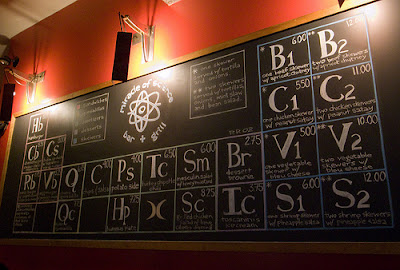
It’s hard to walk more than three feet in Cambridge without bumping into a clinician, researcher, engineer, or a combination of all three in one. Every second building* houses a lab, every third has some classrooms or a diagnostics lab. So where do all these scientists go to eat when they have a free moment? The Miracle of Science of course, the most sciencey eatery in the city.

The menu is written on a giant chalk periodic table of elements, color coded by appetizer, sandwich, skewer, dessert, etc.

Photo by Scott Beale/Laughing Squid

The molecular weight of the menu item elements? That’s the price. Yea, it’s kitchy, but not tacky. Strangely, it works. In addition to award winning burgers, Miracle of Science also serves a great, easy, and comfortable brunch.

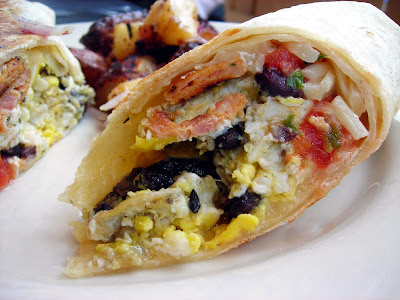
The star of the brunch show (not up on the board, sadly, but printed on a separate menu) is a breakfast burrito, with chicken jalapeno sausage, eggs, black beans, salsa and cheese. Not jumbo sized, like so many breakfast burritos, fresh tasting, light yet satisfying. I loooved it. I loved it even more than I love a clean Western blot, and that’s saying something.

There was also a breakfast egg sandwich-

And the obligatory as-you-like-it omelette with homefried potatoes-

There is not much science in the food, thankfully. It relies on freshness and careful preparation. But the aura? All science, all geek, all the time.

*hyperbole at work

Scientific Intuition

I am about a million years late to the lab lit party. Better late than never, right?

I just finished reading Allegra Goodman’s Intuition, a novel about science and ethics, set in a fictional Cambridge, Mass lab. Trying to mentally trace the paths the characters took through the city was frustrating and exciting at the same time, as was attempting to identify which research institution served as a model for Intuition’s Philpott Institute (though this comment on Amazon sheds a healthy dose of light). There was something strangely rewarding about recognizing the streets and landmarks mentioned in the novel, something childishly exciting in seeing my city as the foil for an author’s creativity and events in her characters’ lives.

That being said, I will admit that I didn’t love the book. Which isn’t to say that it wasn’t a page turner – I finished it in a matter of hours (Nabokov this was not). I was irked by the lack of an obvious protagonist. I disliked all the characters equally. The other, more nitpicky problem, was that I found a number of inaccuracies in Goodman’s version of life and work in a lab. I have never worked in or seen a lab that is run in the manner she presented (not offering too many details here, for fear of giving away too much of the plot).

In the novel, an entire lab was put to work on one project and post-docs lived in fear of being fired. Fired? Post-docs? Short of murder in the lab – not outside the lab, that could be overlooked – I don’t know what it would take for a post-doc to be fired for performance/personal issues.

I decided that these discrepancies could be accounted for by the fact that the lab in Intuition was headed (in part) by an MD. And that got me to thinking – are there clear differences in the way MDs approach research as opposed to PhDs? After all, they are not raised/trained in the same environment. Their focus and often their goals are entirely different, with perhaps more emphasis placed on applied science as opposed to the basics. Am I off base in this assumption? I have never been in an MD-run lab. Has anyone? Any opinions on the MD vs PhD-lead labs?

Overheard at Harvard’s Museum of Natural History

Troop leader to troop of ~8-10 year old boy scouts –

“What’s a fossil?”

An enterprising youngster replied,

“Something that’s dead!”

Fair enough little one, but not quite.

Aside from the glass flowers and eyeballs, Harvard’s Museum of Natural History also has a large section devoted to fossils of modern animal ancestors and their extinct relatives. They have models of Tiktaalik – the fossil as well as the reconstructed animal (it’s way bigger than I had imagined!) and other seemingly mythical creatures, like this predecessor of the modern armadillo, with funny droopy bones on either side of the skull,

an amazing pattern on its giant, segmented tail

and its overall enormity-

The coolest thing about it though – and maybe this is just me – but it didn’t seem all that dead to me. Yes, it was a fossil. Yes, it has been extinct for many, many moons, but posed and described and put in context, it didn’t seem so cold dead and remote anymore. And I guess that’s the beauty and the purpose of the Natural History Museum – it brings all the irrelevant fossils and dead stuff into the modern day, rendering them real even to enterprising youngsters, I hope.

Advancing science, one drop at a time

Another one of the cool things about science in the Boston area? It’s not just the star power of the scientists, it’s what that power is applied to.

A little while ago, I attended a talk by David Weitz (Harvard) on the promise of droplet-based microfluidics devices, a new technology which promises to make DNA sequencing, cell sorting high throughput drug screens cheaper, smaller, faster, and better. Promise is quickly becoming a reality at RainDance Techonologies, a biotech company based in Lexington, MA, founded by Weitz and a few other high wattage stars.

Jonathan Rothberg, the founder and chairman of RainDance, also happened to invent the technology behind 454, responsible for sequencing James Watson’s complete genome and cracking the bee colony collapse disorder. As if that’s not enough weight, three Nobel Prize Laureates sit on RainDance’s scientific advisory board.

RainDance, which was founded in 2004, was recently awarded a $250,000 cooperative research grant by The Massachusetts Life Sciences Center to develop a droplet-based fluorescence assisted cell sorter (FACS), an instrument which sorts individual labeled cells based on desired characteristics – a very common technique used in research and diagnostics labs worldwide. FACS machines on the market today cost on the order of $100,000 each (depending on the machine). If RainDance can make a tiny FACS machine for a fraction of the price, they will make a huge contribution to laboratory research, both in the States and in developing countries, where dropping 100 grand on a single machine is often not an option.

Not only that, but RainDance developed the RDT 1000, a microfluidics-based instrument for DNA sequencing. The Broad Institute is one of the early recipients of this machine and all its accoutrements, prior to its official release. In addition to genome sequencing, researchers at the Broad will test RDT 1000 for applications including characterizing the human microbiome.

That’s the power of a tightly-knit scientific community. Ideas born in academic research labs can be translated into technology and fed back into the labs, all in a few years.

Starstruck by science

One of the many good things about being associated with a research lab in the Boston area is the caliber of speakers that the schools attract. I remember being in absolute awe at my first few seminars in graduate school – I felt like I was sitting through a Mariah Carey concert a few times a week. That’s how the star power of scientists translated to me. After a while, the wattage seemed to dim, and the powerhouse speakers became an everyday occurrence, something I started to take for granted.

Yesterday, I got another jolt of awe and wonder, while sitting at a seminar by Victor Ambros, at Harvard Medical School. Ambros, an MIT-educated professor at UMass Medical School in Worcester, was funny, down to earth, and super charismatic. You would never guess that he is a recent recipient of the Lasker Award, that he discovered microRNAs (miRNAs) and that he will likely win the Nobel prize in the next couple of decades. And to top it all off, I got to have lunch with him after the talk! Alright, it was me and 10 other post-docs and grad students, but I was there, in his presence. I am now, officially, a science groupie.

The seminar and Ambros’ fame are both a result of his discovery of miRNAs, short strands of RNA with extensive secondary structure which regulate gene expression by either leading to the degradation of messenger RNA or to the inhibition of translation. In the course of the seminar, Ambros discussed the role of two well-characterized miRNAs, lin-4 and let-7, in the regulation of C. elegans development. He went on to give an overview of the roles of miRNAs in disease and his personal favorite direction in miRNA research – the presence of miRNA in human serum. There is very little support for this and no demonstration of function, but it was the most exciting part of the talk.

Recently, stable, RNAse resistant miRNAs were found in human serum. This is of particular interest considering the instability of RNA in general. Some hypothesize that the miRNAs in human serum are stabilized by microvesicles of indeterminate origin. Ambros predicts that it may be possible to use these serum miRNAs as markers of human disease and other states. PCR-based assays for the presence of miRNAs are exquisitely sensitive and readily available in diagnostic labs. Some miRNAs have been associated with certain cancers, and one miRNA, called miR-527, is found at significantly higher levels in the serum of pregnant women. A lot has to happen before this is feasible – the levels, origin, and function of these stable serum miRNAs has to be demonstrated before any diagnostics can be considered, but Ambros has made it a point to bring up the possibility in his talks. He encouraged all investigators with human serum sitting around from other trials to take a look, to further investigate serum miRNAs. He even referred to himself as a type of evangelist, traveling the world to spread the word about the possibility and promise of miRNAs. He sold me. Now we just wait and see what solid proof he and others can come up with. The legions of science groupies are sure to increase.