
Since my recent visit to Lord Stern’s talk at LSE, I’ve been thinking about what all this climate change malarkey might mean for us Londoners. Given that cities are responsible for approximately three-quarters of the world’s energy consumption, they obviously play a major role in climate change.
I’ll admit that I try to do my best where energy efficiency is concerned, but I can’t help feeling that my worrying about whether I’ve left my TV on standby is more than offset by the office block opposite me that insists on leaving its lights on all night. Now this may be a pessimistic attitude, but it appears I’m not alone; there have long been plans in the pipeline for when all the promises and conventions based on Kyoto (and soon Copenhagen) fail, and global catastrophe looms within decades.
You may have read about the proposal to put a 600,000 square mile “mirror” between the Earth and sun, an idea which senior scientist Lowell Wood has been working on for more than a decade. There was also an initial experiment in 2002, which involved dumping 6000 pounds of iron powder into the Southern Ocean to trigger the growth of blooms of CO2-consuming plankton; a method of increasing photosynthetic material which may prove useful at a later date. These last-ditch contingency plans may seem far-fetched but the reality is that many top scientists are having to come up with more and more “Duct Tape” methods to protect the Earth. Still, even with its massive size, viewed from London the mirror would look like a small black dot on the surface of the sun, and as far as I’m aware, the Thames does not contain enough valuable nutrients to warrant covering it in iron filings.
One technology which may become more applicable to London, especially if global warming continues to the extent that some scientists have predicted, is solar power. To all those who complain about the eyesore of wind turbines, consider the residents of Seville.
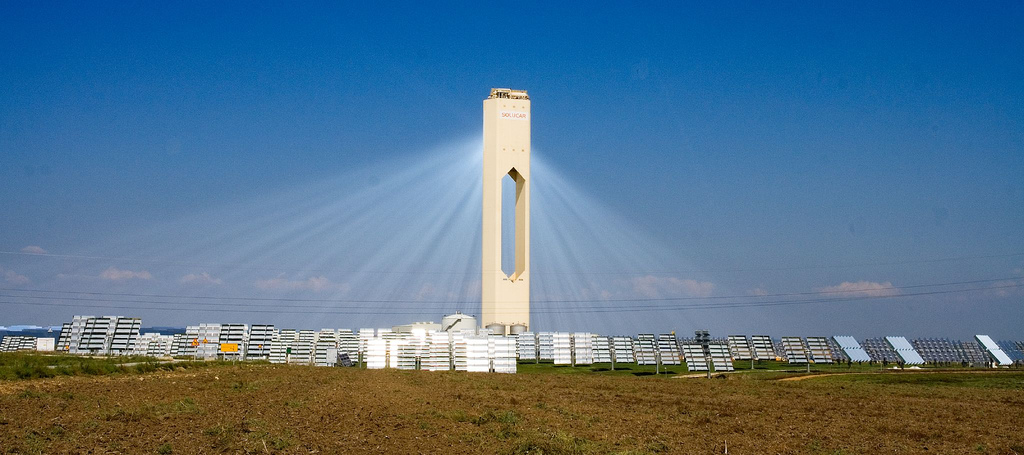
Picture courtesy of Wikipedia
15km to the west of the city lies the Abengoa Solar Power Tower. This power station is the first of its kind; a field of Heliostat mirrors focus sunlight onto the receiver, a graphite block the size of a shipping container, which then converts the solar energy into thermal energy. A solar power station of this size is not currently a feasible technology for London, but proposals for a structure of this magnitude would surely anger local residents more than an offshore wind farm.
The technologies currently being considered for London seem a little simpler. At Imperial College, the Energy Futures Lab is investigating the integration of urban energy systems, in order to reduce the costs, energy and environmental impacts of cities. Current projects involve modelling the benefits of heating homes with the heat from waste water, or arranging business and residential areas to reduce the impact of commuters.
One key location where these ideas are being put into action is the new Olympic site, which will be converted into a neighbourhood for 4,000 families post-2012. Here, developers really have the opportunity to plan for the future, and make an area as environmentally-friendly as possible. Housing will be highly-efficient and powered partly by a wind turbine and biomass plant, and many shops and services will be within walking distance of residential areas. Some planning firms argue that this thinking on a whole-city scale is what’s needed if we are to make cities such as London at all energy efficient.
As for me, I’ll keep doing my washing at 30°C, and putting an extra jumper on when I get cold, but I think that until big changes start to be made, I’ll probably still feel like I’m fighting a losing battle. I just hope that we don’t have to resort to iron filings in the sea, or giant mirrors in the atmosphere.