Aerospace engineers win global innovation challenge, virtually

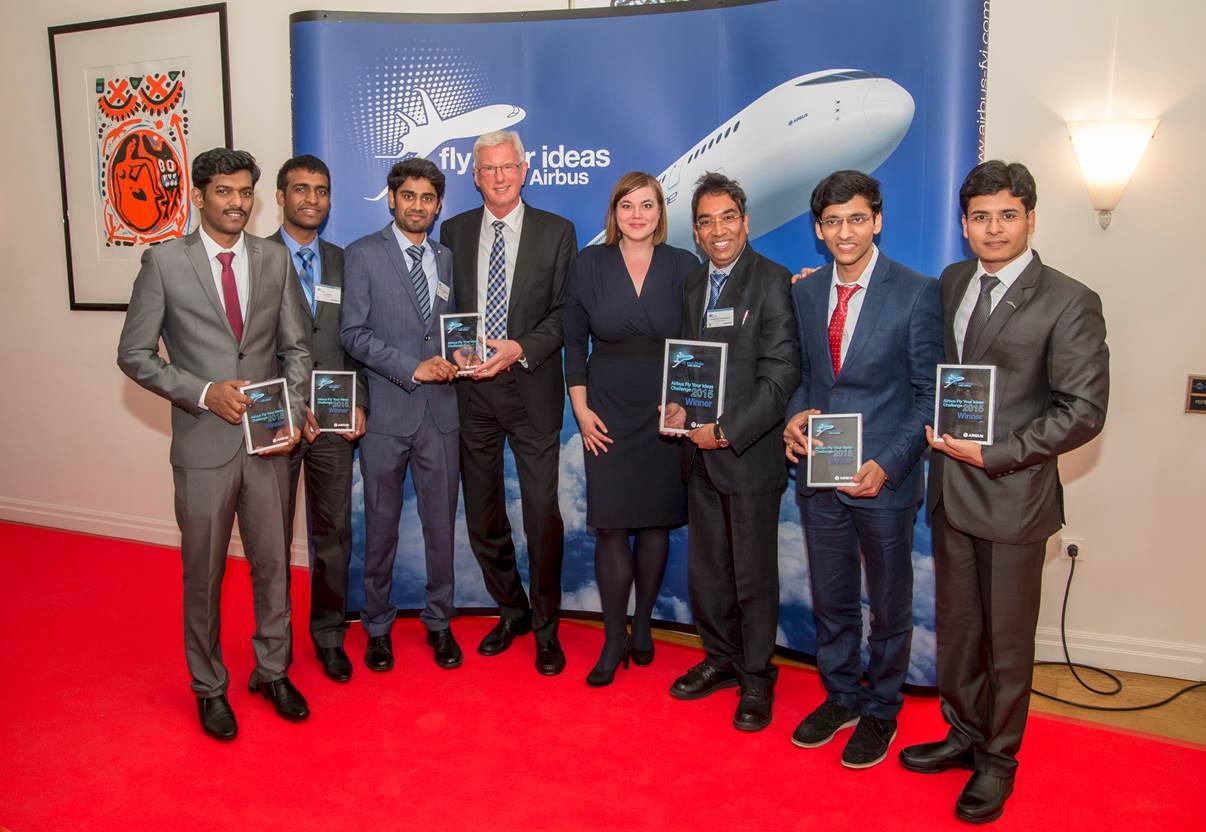
A virtually connected team of Indian aerospace engineers — based in India, USA, UK and The Netherlands — have emerged champions in a global biennial innovation challenge organised by UNESCO and the passenger aircraft manufacturing company Airbus.

Interestingly, members of the team, which aptly calls itself MultiFun, met in person for the first time only for the final round of the event last week (May, 2015). Their winning entry for the ‘Fly Your Ideas (FYI)’ competition held in Hamburg, Germany was a “hybrid battery-piezoelectric composite structure for next generation aircraft”. Simply put, they designed aircraft wings dressed in a “composite skin that harvests energy from natural vibrations” or flex in the wings.  MultiFun bagged €30,000 as prize money along with the coveted trophy.
The winning team

The winning team{credit}MultiFun{/credit}

“Piezoelectric fibres gather electrical charges from even the smallest movements during flight, storing the energy generated in battery panels integrated in the fuselage and using it to power auxiliary in-flight systems, such as lighting and entertainment systems. This reduces the energy footprint of aircraft during flight and could even replace the entire power source for ground operations,” the jury said calling MultiFun’s entry a ‘path breaking’ innovation.

The idea was sprouted in the Department of Aerospace Engineering, Indian Institute of Science (IISc), Bangalore. The chief mentor for the project was Dineshkumar Harursampath, lab head of the  Nonlinear Multifunctional Composites — Analysis & Design Laboratory at IISc. Harusampath got this globally-placed team of IISc alumni and current IISc students together through video-conferencing and virtual platforms. Team leader, Sathiskumar A. Ponnusami, a doctoral student in TU Delft, and Dhamotharan Veerasamy, a doctoral student in City University London, are IISc Masters alumni. Shashank Agrawal and Ajith Moses are current doctoral students at NMCAD Lab. And the youngest, Mohit Gupta, a Masters student at Georgia Tech, Atlanta, was an intern at NMCAD Lab a year ago.

The Indian team’s entry was shortlisted in the top five from among 518 teams representing 104 countries.  FYI is designed to identify and encourage the next generation of innovators and uncover futuristic and unconventional yet promising solutions for the evolution of flight.

Team leader Sathiskumar says the “long umbilical cords” of IISc inspired them to design and develop multifunctional materials for next generation aerospace applications. “The lab provides an environment conducive for out-of-the-box thinking and uninhibited multimedia communication without space-time limitations amongst team members,” he said in a release. “Only half the time was spent on technical issues. The rest was inspirational yet unplanned chatting leading to team bonding, true to the name MultiFun!”

The team was able to work 24 hours a day by interacting across physical boundaries from four different locations around the world and managed to present the most disruptive idea for the future of aviation at the competition. “… the winning idea is all about good vibrations,” the jury noted.

Indeed a brilliant example of virtual networking for science and innovation.

Heart phone

There’s a promise that India’s teeming millions sitting on a cardiovascular epidemic of sorts can now benefit from a easy-to-use smartphone application that will tell them exactly how their heart is faring.

Once this large-scale public health project funded by the Global Alliance for Chronic Diseases Research Grants takes off in India, it would be easy to screen cardiovascular risks using a handy, intelligent smartphone device. The project is expected to use World Health Organization guidelines through a smartphone application that will guide health workers in rural India through a series of questions to assess a patient’s blood pressure, blood sugar, weight and height.

Putting your smartphone to more uses than one.{credit}Subhra Priyadarshini{/credit}

The application is called Health Tracker, and will calculate a comprehensive risk profile that can be uploaded to a secure electronic health record. High risk individuals will then be referred to see a doctor who follows a management plan for the patients long term care. According the George Institute, India, which will implement the project, it will build capacity in primary healthcare in rural India. Australia’s national health and medical body,The National Health and Medical Research Council, will spend Rs 15 crore on this project and a couple more.

David Peiris, the principal investigator for the heart phone project, feels that it will be a practical intervention to address the growing cardiovascular epidemic in India. The pilot findings, he says, will be used to inform a large scale trial in rural India.

Apart from cardiovascular health, The George Institute will use the grant for a national salt reduction programme, investigate affordable drug treatment strategies to treat hypertension and assess innovative smartphone healthcare technology, executive director of the institute Anushka Patel informs.

Here’s hoping the project reaches out to at least a fraction of the over 30 million people with cardiovascular disease living in India .

Satellite launch

This week, the Indian Space Research Organisation (ISRO) is all set to launch its radar imaging satellite RISAT-1 on board the organisation’s workhorse, the Polar Satellite Launch Vehicle (PSLV).

Pre-launch tests on RISAT-1 at Sriharikota. © ISRO

Early on April 26 morning, RISAT-1, a microwave remote sensing satellite carrying a synthetic aperture radar (SAR), will be launched into space. RISAT-1 weighs around 1858 kg — the heaviest satellite to be lifted by the PSLV thus far — and is scheduled to be put into a 536 km orbit, according the ISRO chairman K. Radhakrishnan. It’s life span is five years.

The 71-hour countdown for the launch of  started this morning at the Satish Dhawan Space Centre at Sriharikota in Andhra Pradesh.

India currently depends on images from a Canadian satellite as its domestic remote sensing spacecraft can’t take pictures of the ground during cloud cover. RISAT-1 being launched at a mission cost of Rs. 498 crore  will operate in a multi-polarisation and multi-resolution mode to provide images with coarse, fine and high spatial resolutions. Pictures beamed from RISAT-1 would be used to estimate crop yield, assess acreage and predict crop health during monsoons, when the sky is covered with clouds. The images can also be used for disaster management during cyclones and floods.

ISRO had launched RISAT-2 in 2009 with an all weather capability to take images of the earth. The satellite was aimed to enhance ISRO’s capability for disaster management applications.


Post updated on April 26:

PSLV C-19 lift off with RISAT-1. © ISRO

PSLV-C19 was launched into space from Sriharikota early this morning (April 26, 2012) putting RISAT-1 in a polar circular orbit. It was a successful lift-off, according to ISRO chairman K. Radhakrishnan.

RISAT-1 will start beaming images in five days.

Notably, PSLV C-19 is the third in this series of launch vehicles to involve the high-end version PSLV-XL (XL meaning extra large). It is equipped with six extended strap-on motors, each carrying 12 tonnes of solid propellant. ISRO’s Chandrayaan-1 was also launched on board a PSLV-XL.

Spam killer

It was great hearing about this new software that ruthlessly kills unwanted text messages delivered to your cellphone by sundry real estate agents, spa and gym owners, coaching classes and who not! The fact that it is a software made specifically for Indian cellphone users in mind makes it even more interesting. The Telecom Regulatory Authority of India estimates that 100 million spam messages go around the country every day!

Ponnurangam Kumaraguru and colleagues at the Indraprastha Institute of Information Technology in New Delhi have developed ‘SMSAssassin’ that uses the crowdsourcing spam marker method to identify spam.

Since it is not as easy to identify SMS spam, the crowdsourced spam markers — spam keywords collected over a period of time from such text messages — are a good way to track them. The researchers plan to put these markers on a central server or by creating a distributed network via Bluetooth. This means during Christmas or New Year or Diwali, your phone can identify spam elements in the effusive ‘wish messages’ and react quickly to block them off. During quieter times, the most abused spam words will be the markers.

The software works for phones using Nokia’s Symbian operating system but will also be available for those with

Google Android and Windows Mobile soon.

Good riddance to bad text!

Low cost computing

The news of the Rs 1500 (~ $ 35) laptop is making waves in India. Next year it is expected to become an ubiquitous equipment, strewn across the length and breadth of the country — every child under the Union government’s literacy programme clutching one. Provided all that is promised is delivered, on course on time. Also if issues of connectivity and mass production face no roadblocks.

comp.jpg

Before I digress into more cynical questions, here are some essential details of the touchscreen device, being hailed as a cross between an I-Pad and a tablet PC. Designed by IIT techies from Kharagpur, Kanpur and Madras and the Indian Institute of Science, Bangalore, it is a green product powered by a solar panel, has 2 GB RAM memory and no hard-drive but can be fitted with one via its USB port. It supports video-web conferencing facility, has a multimedia content viewer, a searchable Pdf reader, unzip tool, computing capabilities, printing support and a media player. Besides the inexpensive use of material, it will employ open-source technology to cut down costs.

It’s officially called a “low-cost computing-cum-access device” and will be manufactured in Taiwan as of now. Isn’t it the same one earlier announced to be priced at Rs 500 and manufactured at the government-owned Semiconductors Complex in Chandigarh? The government, of course, has promised to bring the price down gradually from Rs 1500 to Rs 500 with more innovation and private participation.

We will wait for 2011 to see how this pans out.

E-book woes

Makes me sad that digital book reading technology would cost Indians far more than book lovers in the western world. A slew of new technology tools being launched in the west will be priced far more in India, a country whose tech-savvyness and love for books match any western nation. Add to that the higher cost of acquiring a book online.

But first the details, and then a little more crib.

e-book.jpg

Among many such devices, Google Inc. is hoping to launch a new online service that will let readers buy electronic versions of books and read them on gadgets — cell phones, laptops and possibly e-book devices. Google Editions will make millions of printed books available online, abiding by all copyright laws.

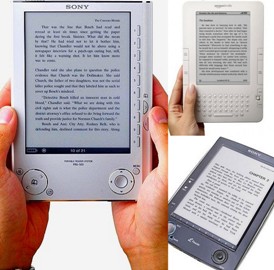
Google faces competition from Amazon.com Inc.‘s Kindle e-book reader and Sony Corp.’s new Reader Pocket Edition. Kindle weighs less than 300 grams and gets you a book to read within a minute. Sony’s eBook Store includes more than 100,000 books, as well as a million free public-domain books available from Google. The Kindle Store currently has more than 330,000 available titles, according to an Associated Press report.

Indian bibliophiles will have to wait a while to be able to afford these ‘lighter than the lightest paperback’ devices. Or hope that someone kindles a flame here to develop an indigenous e-book reader! The latter sounds more like it, what with a country abounding in world-class software experts. Or maybe, we have an indigenous version already that has escaped my keen eye.

Pluck an innovation

I read with sheer delight this piece of news from Kerala, the coconut country. The state’s industries minister Elamaram Kareem has gone public with the urgency to fulfill a long-standing need of his people –- a state-of-the-art coconut plucking machine! The Kerala government has announced an award of one million rupees for anyone who comes up with a commercially viable coconut plucking machine.

coconut.jpg

For those of us from coastal states, the sight of a loincloth-clad coconut plucker expertly scaling the tall tree is common. But apparently, there’s a dearth of such skilled manpower across the coastal state, where coconuts are ripe for the picking every 45 days. My colleague Jacob Thomas, from God’s own country, tells me that earlier the climbers used to charge three rupees to climb up once and bring back the bounty. Blame the inflation for this, but today’s coconut pluckers would settle for nothing less than twenty five rupees per climb!

Earlier the government tried to meet this acute shortage of tree climbers and farmhands in the state by setting up a training school for coconut-plucking and tree climbing. In Kerala, a large large number of coconut-pluckers are actually from the coastal state of West Bengal or from Bihar. The state has over 16 crore coconut trees while most villages have only one or two climbers, grossly insufficient during harvest time. However, the plan to create a pool of trained agricultural workers does seem to have clicked. Some experiments with ad-hoc machines have also not yielded much result.

So the only way forward is innovation! It is coincidental that Raghunath Anant Mashelkar wrote on Nature India recently why innovation has to be at the forefront for a country with such peculiar needs — the need for a national innovation ecosystem.

I will be happy to hear such need-based innovation stories from all corners of this huge country. Have you heard of an innovation that has changed the lives of the people around you?

Bhuvan on terra firma

I just checked out the much-hyped beta version of Bhuvan, India’s answer to Google Earth, and have to say it will need some more meat under its skin to make a true impact. I am sure the Indian Space Research Organisation (ISRO) will go live with the final version only when it if fully satisfied, what with all the hoopla surrounding it. Or at least lend an ear to feedback from users.

For starters, despite its promise to be ‘bandwidth-friendly’, the time taken to open Bhuvan’s homepage itself faces stiff competition from Google Earth. And now that Google has Caffeine under its belt, it’s all the more reason why ISRO needs to buck up! Also the site opens on internet explorer and is flash enabled only leaving users like me who prefer Firefox or javascript looking at a blank screen or being prompted to click on more buttons.

However, ISRO itself is not as competition conscious since it feels Bhuvan is a niche product specific to India.

Competition or not, the promise of Bhuvan sounds fairly good: better 3-D satellite imagery of India than available now on the web, country weather information as well as administrative boundaries of states and districts. There are interactive tools on offer for you to measure, draw, save and print information. The images are from the Indian Remote Sensing (IRS) satellites and there’s talk of providing real time images as well, though how it would be achieved is apparently still being worked out.

With Bhuvan, ISRO will try to get the Indian record straight on political and territorial boundaries while protecting strategic data — a bone of contention between Google Earth and the Indian government on a number of occasions.

Feedback welcome.

Rs 500 laptop

So what do you think it’s going to be? The innovation of the century or another government-backed exercise that basks in the limelight for a while and flickers away?

A lot has been written about the 10 dollar laptop. First up, I fail to understand why we should give it a US dollar tag if it is an indigenous product being subsidised by the Indian government? Why not call it the Rs 500 laptop instead like the one lakh rupees car by the Tatas?

As of now, all we know is that the laptop will have a two gigabyte memory and wireless internet capability. A prototype (of a slightly higher cost) has been demonstrated to the Union minister of Human Resource Development but even that sounds like a marvel. The rest will perhaps come from subsidies, but who knows? The government has reportedly earmarked more than 46 billion rupees to develop the low-power gadget to work in rural areas with unreliable power supply and poor internet connectivity.

The laptop, being developed by Indian Institute of Science, Bangalore and Indian Institute of Technology, Madras will be manufactured at the government-owned Semiconductors Complex in Chandigarh. It will reportedly use a cheap microprocessor and do away with the hard disk, CD/DVD drive and other costly and problem-prone components. The wonder machine, being eagerly awaited by rural school administrators, will be a basic keyboard-screen-USB port model.

Let’s wait for the miracle to happen.

All-women tech school

There are murmurs in Vigyan Bhavan about a proposal to set up the country’s first all-women engineering and technology institute in President Pratibha Patil’s hometown in Maharashtra. The HRD ministry is mulling over the proposal for this exclusive women’s technology school in Amravati near Nagpur on Patil’s recommendation. The country’s first woman president was apparently worried about the small number of girl students getting into the IITs.

The proposal has met criticism on these accounts: 1) Will there be enough women qualifying to fill up one IIT-type school if there aren’t enough in the existing ones? 2) WIll the standard of students not suffer if the target is to fill the school up somehow? 3) Is it prudent to make technical education gender-specific?

What are your views?