How to cope when things go wrong in academia

Sometimes, things go wrong in academia. The experiment isn’t working; you can’t find your results; the money is running out and you haven’t got any more. What can you do about it?

At the Naturejobs Career Expo in London this September, a panel of four academics got together to discuss their wildly different careers. Jim Usherwood from the Royal Veterinary College only spends his time doing research. Anita Hall from Imperial College London only does teaching. Lorraine Kerr and Louise Horsfall from the University of Edinburgh split their time (with different percentages) between research, teaching, business and management.

In this short film, Usherwood and Horsfall give some great advice on how to deal with things when they go wrong.

Usherwood recommends building a support network around you that can serve two purposes. One will be a group of friends that will come to the pub with you and commiserate with you. The other will be someone (your partner, perhaps) who can help you see the bigger picture in life.

Horsfall has been forunate and has not had anything go wrong…. yet! Come the end of 2014/beginning of 2015, she will be coming to the end of two grants. At the moment, she’s got two “irons in the fire” but they aren’t confirmed. “Make sure that you’ve always got something,” she advises.

Read more about How to navigate an academic career and about all the other conference sessions and workshops at the Naturejobs Career Expo in London.

Other Q&A videos from the Naturejobs Career Expo, London 2014

How important is having a mentor in your academic career?

How do you achieve work/life balance in academia?

Should I apply for a fellowship or a postdoc after my PhD?

What’s the biggest challenge you’ve faced as a woman in science?
How important is it to move between academic institutions?

The postdoc search timeline

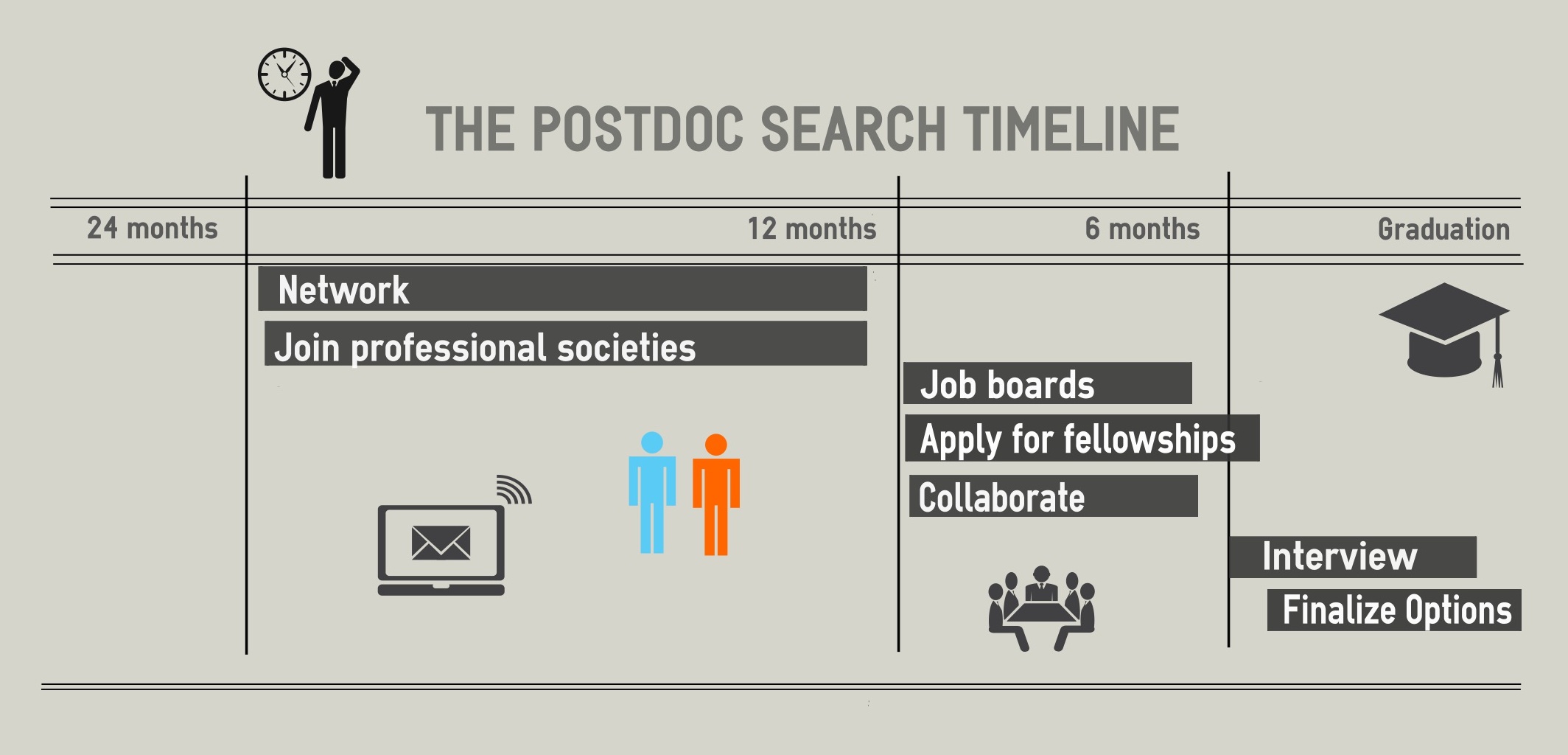
Looking 2 years ahead when it comes to a job/postdoc search can help scientists prepare more thoroughly.

Contributor Shimi Rii

“It’s never too early to be looking, so always be looking,” advises Ty Samo, postdoctoral scholar at the Center for Microbial Oceanography: Research and Education (C-MORE) at the University of Hawaii.

Whether your ultimate goal is to become a tenure-track professor or not, if you like research, becoming a postdoc is still a common next step for many graduating PhD students. By becoming a postdoc, new PhDs can (finally) receive a full-time salary to conduct research and diversify their skill set, making themselves more marketable for future job searches. As I started preparing to seek out postdoc and job positions for next year, I asked five postdocs for advice. It seemed that many followed a general timeline, set before prospective graduation.

shimi-rii-postdoc-timeline

{credit}Image credit: Shimi Rii{/credit}

1-2 years: Start making a list of potential postdoc advisers and laboratories of interest

Have conversations with your professors. Talking to prospective employers to see if you’ll be happy working with them is as important as the research they’re doing. Samo started emailing professors he met through summer programmes 2 years before defending his thesis. Stuart Goldberg, postdoc with the Hawaii Ocean Time-series programme, spoke to one of his thesis committee members because he felt that he could see himself working with her, and because she employed skills in her research that would help further his career. Continue reading →

How to publish your data in a data journal

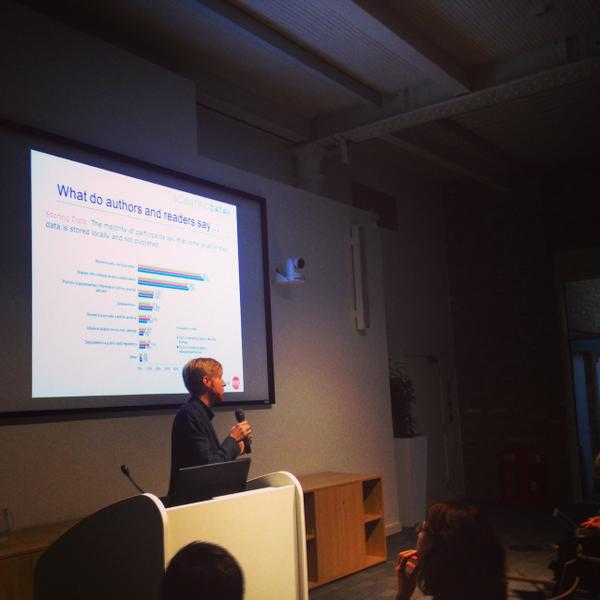
A big picture view for researchers on data repositories and data journals from Andrew Hufton at Publishing Better Science through Better Data.

andrew-hufton-scidata14

{credit}Image credit: Scientific Data{/credit}

More and more, funding bodies are requiring scientists to make their data open-access and available to the research community and others. So, why not wrap a publication around it at the same time, build your CV and get credit for all the hard work you’ve done?

Andrew Hufton, Managing Editor of Scientific Data, gave a great talk on the big picture view of publishing your data. I’ve reproduced some of it below for your reading pleasure along with further advice from Hufton. Have a read and tell us what you think – do you agree with the list? Do any ring particularly true for you? Are there any others you would add? Share your views in the comments section below.

Before even thinking about finding a repository to store your data, you need to make sure that your data is fit for storing. Hufton suggests a three-point checklist where you should:

–          Make sure that your data is well structured

–          Have lots of metadata to aid others’ understanding of your data

–          If dealing with human data, have the appropriate consent forms organised

When you’ve prepared your data, it’s time to think about finding a repository for it. Continue reading →

From academia to policy with David Carr

An interview with David Carr about his transition from academia to science policy.

David-Carr-Wellcome-Trust

David Carr, Policy Advisor at the Wellcome Trust

Staying in touch with science was the one thing David Carr wanted when he left academia in 1998. After spending a year working  in a scientific consultancy organisation whilst also writing up his masters, Carr joined the Wellcome Trust. Since joining he has become more and more involved in science policy. In this interview I ask Carr why science policy is important, why he enjoys it and what advice he has to offer to those who wish to work in this field.

Why did you initially decide to pursue a PhD?

I was interested in and passionate about genetics (which I specialised in during the final year of my undergraduate degree), and at the time it seemed like the logical next step to continue to postgraduate research. Looking back, I really drifted into it – I didn’t really look enough at other options or really consider what the day-to-day work involved in doing a PhD would be. I thought that getting a PhD would be a good thing to do in terms of keeping open career options within science and outside, and that it would be a natural continuation of my undergraduate studies, but quickly discovered the reality was quite different! Continue reading →

How important is it to move between academic institutions?

Should you stay or should you go? The Careers in Academia panel discuss the merits of mobility within academia.

At the Naturejobs Career Expo in London this September, a panel of four academics got together to discuss their wildly different careers. Jim Usherwood from the Royal Veterinary College only spends his time doing research. Anita Hall from Imperial College London only does teaching. Lorraine Kerr and Louise Horsfall from the University of Edinburgh split their time (with different percentages) between research, teaching, business and management.

In this short Q&A film three of the panellists give their opinions (based on their experiences) about the challenges they’ve faced as women in academia.

Kerr has been at Edinburgh for a long time, due to personal constraints. She worked in different labs, with different colleagues and funders and never felt that she had to leave to gain more experience.

Hall went to the Karolinska Institutet in Stockholm, but regrets not keeping up with the research discussions back home. “So they had forgotten about me.” If you go abroad, she suggests that you don’t lose the network you leave behind.

Usherwood suggests you go. “There will be a dip in productivity… but you’ll be doing something you didn’t do before and it makes you distinctive.” It’s an opportunity to meet new people and make new connections within your field, which can ultimately be beneficial in your future career.

Read more about How to navigate an academic career and about all the other conference sessions and workshops at the Naturejobs Career Expo in London.

Other Q&A videos from the Naturejobs Career Expo, London 2014

How important is having a mentor in your academic career?

How do you achieve work/life balance in academia?

Should I apply for a fellowship or a postdoc after my PhD?

what’s the biggest challenge you’ve faced as a woman in science?