
Obama’s prescription for medication shortage
US President Barack Obama today issued an executive order aimed at battling shortage of important and sometimes crucial prescription drugs that are impacting patient care and clinical trials of new medications.
Government defends forensic service closure
The British government has defended its decision to close a world leading forensics agency, following fierce criticism from a cross-party group of politicians.

Satellite to bridge gap in environmental data, if only for a while
NASA successfully launched a new polar-orbiting satellite today, a small but notable success that should stave off a much-feared gap in basic weather and climate measurements for at least a few more years. Read more

Mexico’s biodiversity oasis faces destruction
Time is running out for Mexico’s Cuatro Ciénegas basin faster than researchers had thought.

Chile’s Hudson volcano threatens to erupt
Chile’s Hudson volcano (Cerro Hudson) awoke from a twenty-year slumber on Wednesday 26 October and is now pouring smoke and ash high into the sky, threatening a major eruption.
.jpg)
ESA probe finds halfway house asteroid
An asteroid known as 21 Lutetia may be a missing link between Earth-like worlds and more primitive space rocks known as chondrites.
Connecticut approves $290 million for Jackson Lab
The long-awaited new branch of the Jackson Laboratory (JAX) may have finally found a home. Last night, the Connecticut legislature approved $291 million in bonds to fund the new laboratory, which will use computer and animal models to study complex diseases.
Sequencing projects bring age-old wisdom to genomics
The nonprofit X-Prize Foundation has launched a $10 million competition to accurately sequence 100 genomes from 100 centenarians over the course of one month.
Nature Podcast: 27 Oct 2011
On this week’s Nature Podcast, how brains change across the lifespan, the biggest threat from climate change and Pluto’s new best friend. Plus, the best of the rest from Nature. Read more
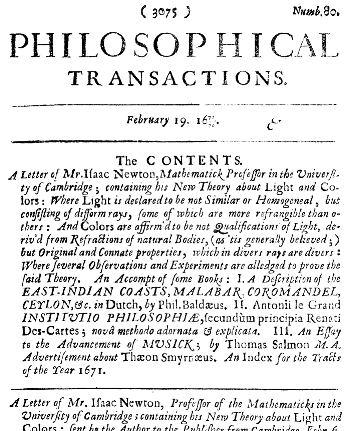
Royal Society frees up journal archive
Ben Franklin’s account of his electric kite experiment (1752) and Isaac Newton’s first ever paper (1672) are among 60,000 historical scientific papers now freely accessible online, after Britain’s Royal Society opened up its journal archive.