Reactions: Yi Lu

Yi Lu is in the Department of Chemistry at the University of Illinois at Urbana-Champaign, and works in the areas of bioinorganic, bioanalytical, and biomaterials chemistry.

1. What made you want to be a chemist?

My choice to being a chemist was not as glorifying as many others who choose chemistry as a major or career. When I was in high school, I was pretty good at all subjects. When it came down to choosing a major when I applied for colleges, I had a hard time making a decision. I ended up choosing chemistry as a major by a slim margin, partly due to the fact that it is the subject that I did not have to study very hard and still can get a top grade. In retrospect, I realized I had an excellent chemistry teacher who was not tough to students and yet was good at inspiring them. I think I benefited from his influence.

2. If you weren’t a chemist and could do any other job, what would it be – and why?

When I was a child, I wanted to be a librarian, because I loved reading all kinds of books, fictions or non-fictions, and I thought, naively, that librarian was an ideal job because I would be paid to read books that I love (and will always to be the first to get the sought-after books so that I don’t have to be put on the waiting list). My favourite weekend activity was to go to either local bookstores or local libraries to read and borrow books for the coming week. I also tried to figure out better book catalogue systems in the library, and systems so that I can get the book I want faster. Now with my busy schedule, I have not had much time to read much other than papers in science journals. I am longing for the quiet days so that I can read those novels that I have missed. So I would realize my childhood dream of being a librarian if I weren’t a chemist.

3. What are you working on now, and where do you hope it will lead?

My group members are working on three exciting areas. In the bioinorganic chemical area, we are working on designing functional metalloenzymes involved in biomass conversions, biofuel cells, photosynthesis and water oxidation. We have already found many non-covalent interactions that are responsible for high enzymatic functions. We hope this research will lead to efficient and cost-effective alternatives to native enzymes for alternative energies.

In the bioanalytical area, we are developing novel biosensors for on-site and real-time environmental monitoring and point-of-care medical diagnostic tests. This research has already lead to two startup companies that are commercializing sensor products, one of which uses the widely available personal glucose meter to detect many non-glucose targets (a paper published in Nature Chemistry last year).

Finally, we are exploring genertic codes using different combination of DNA sequences for abiological nanomaterials. We believe this research may lead to fine-control of nanomaterials assembly at an unprecedented level, similar to what DNA can do to control biological materials such as protein structures and functions.

4. Which historical figure would you most like to have dinner with – and why?

Linus Pauling. Among the many brilliant scientists, Linus Pauling has amazing deep insights into chemical principles and theories from many complicated data, and he is also very good at summarizing and explaining the principles and theories in ways that are quite accessible to non-specialists.

5. When was the last time you did an experiment in the lab – and what was it?

Embarrassingly, I have not done an experiment in the lab for a while. The last time I did an experiment was a few years ago when I tried to prepare and give a demo to high school students using research results carried out in my group — we have developed dipstick tests for toxic metal ions such as lead and organic molecules using DNAzyme or aptamer-functionalized gold nanoparticles. It is very cool that we can use what we have accomplished in the lab to inspire a young generation of students.

6. If exiled on a desert island, what one book and one music album would you take with you?

With so many books that I want to read, it is really difficult for me to decide on one book. May I bring a book series, such as Encyclopedia Britannica? I hope to know every entry in the encyclopedia by the time I am rescued from the desert island. For music album, I like classic music and would like to bring a complete album from Beethoven—it is the kind of music I have never been tired of hearing many times.

7. Which chemist would you like to see interviewed on Reactions – and why?

I have two suggestions. The first is Harry Gray from Caltech, my postdoc advisor. He is in my mind the Linus Pauling of today. The second is Joan Valentine, my Ph.D. advisor. She is an ideal mentor and I always learn new things from her.


Reactions: Matt Rattley

Matt Rattley is in the Department of Chemistry at the University of Oxford, and works on cascade catalysis in heterocycle synthesis — and is also one of the winners of our In Your Element essay competition.

1. What made you want to be a chemist?

I think it had a lot to do with my teachers in school – my first A Level teacher in particular (a brilliant man called John Luton) was very passionate about science and definitely passed on the bug. It might also be a bit of rebellion, as my parents repeatedly refused my requests for a chemistry set for birthdays or Christmas.

2. If you weren’t a chemist and could do any other job, what would it be – and why?

If I were more talented, I’d enjoy doing music – I’ve played the bassoon in quite a few orchestras at school and university, but I don’t think I could make a career out of it. I’d also quite like to open a bakery – baking, after all, is just edible chemistry that always works (and it definitely smells better!)

3. What are you working on now, and where do you hope it will lead?

At the moment I’m not in the lab – I’ve just finished my Masters project, which involved making cinchona-derived phase-transfer catalysts with H-bonding groups incorporated into the scaffold. They were a bit tricky to prepare, but thankfully they worked on the first thing we tried (the nitro-Mannich reaction), and having screened that, some of the others in the lab are finding some new reactions that it can also catalyse. In a few months I’ll be working on some cascade reactions to stereoselectively prepare saturated heterocycles for my doctorate.

4. Which historical figure would you most like to have dinner with – and why?

I’d quite like to meet Gibbs – considering the massive contribution he made to physical chemistry, he’s barely known at all outside of chemistry, so I’d be interested to talk to him about his work and how/why he kept himself so hidden away.

5. When was the last time you did an experiment in the lab – and what was it?

The last experiment for my Masters a month or two ago was attempting to prepare a dialkoxyborane – it didn’t work too well, it just ended up making a polymer mess. To add insult to injury, my borane source (as the dimethylsufide complex) led to some unpleasant smelling waste, my labmates weren’t too impressed…

6. If exiled on a desert island, what one book and one music album would you take with you?

The book would probably have to be Roger Penrose’s “Road to Reality” – it’s as easy to read as good pop-sci, but it’s a very challenging look through the maths & science that underpins the universe – being exiled on a desert island might give me enough time to read and understand it all! As for the music – that’s pretty tough, but I’d probably go for the soundtrack to Bernstein’s “West Side Story” – the symphonic version is one of the best pieces I’ve ever played, I don’t think I could get tired of listening to it.

7. Which chemist would you like to see interviewed on Reactions – and why?

Prof Yujiro Hayashi gave a lecture at Oxford last year on some remarkable one-pot syntheses – he seemed like an interesting man with some very clever ideas, it’d be great to hear from him.

Reactions: Richard Wilson

Richard Wilson is in the Heavy Elements and Separation Sciences Group at Argonne National Laboratory, and works on the fundamental inorganic chemistry of the actinide elements. His work focuses on correlating periodic chemical trends found in the actinide elements with their molecular structure and chemical properties to better understand the nature of bonding in these elements.

1. What made you want to be a chemist?

Chemistry was a field that I initially struggled with quite a bit. Like a lot of other college freshman I wanted to become a physician, so I put my nose to the grind stone in my freshman chemistry courses and found out that I actually kind of liked the subject. I had the good fortune of having some pretty good chemistry professors as well. It turned out that counting the number of bees visiting a flower in a biology class wasn’t my thing. It is the hands-on nature and the challenge of laboratory work that makes being a chemist fun for me.

2. If you weren’t a chemist and could do any other job, what would it be – and why?

Well if everything were to fall into place somehow, I would definitely love to make wine. Chemistry you can drink. It’s no doubt hard work, and certainly not easy, but I think there is a thrilling selflessness (or narcissism) in crafting something truly exceptional for others to enjoy – and of course for me to enjoy as well.

3. What are you working on now, and where do you hope it will lead?

I’m gearing up to start a new project with protactinium. A lot of people in the f-element community stopped working on protactinium many years ago. It’s tricky to work with and very very rare. But, what is puzzling to me is that many computational treatments of the actinides ignore Pa, as if the actinide series goes Th, U, Np, Pu etc. I’m optimistic that we’ll find some interesting chemistry here since it treads a fine chemical line between transition metal behaviour and actinide behaviour. It will no doubt be exciting to see where this research goes.

4. Which historical figure would you most like to have dinner with – and why?

Dmitri Mendeleev. I want to know if his three traits of a good chemist (none of them fit for print) as told to me by a colleague are true.

5. When was the last time you did an experiment in the lab – and what was it?

I was last in the lab a couple weeks ago. We were working on synthesizing and crystallizing some plutonium coordination complexes for study using Raman spectroscopy.

6. If exiled on a desert island, what one book and one music album would you take with you?

So, I’d definitely take Stravinsky’s “Rite of Spring”, as for reading material I think I should probably be forced to finish “The Brothers Karamazov”.

7. Which chemist would you like to see interviewed on Reactions – and why?

I’d like to see Richard Andersen from U.C. Berkeley interviewed. He’s pretty colorful and knows a little something about molecules. He always has a good story to tell whether you like it or not. No, I don’t think he’s Russian.

The Molecular Olympics

The creation of well-known macroscopic objects in molecular form is something that usually leads me to mutter under my breath and roll my eyes. Every now and then, a paper or a press release will herald the synthesis of a molecular ‘X’, where X = pretzel, wheelbarrow, car, tie fighter (yes, really), and so on — I’m not going to link to these, your favourite search engine will do you proud if you really want to know more about these things. In some cases, if you tilt your head to one side and perhaps squint a bit, you can maybe understand the analogy; and admittedly, sometimes the analogy is one of function rather than form. Because of a certain major sporting event that is happening in London at the moment, however, I’m going to make an exception — and be slightly less grumpy about such things.

Olympic, er..., rings!

The iconic image associated with the modern Olympic Games is one that many people know well — it consists of five rings linked together to form a chain. I presume it would be OK to reproduce the symbol here on the blog, but I’m not taking any chances, considering the somewhat overzealous manner in which the Olympic family protect their rights… So, I’ve put a bit of a chemistry twist on it: look, hexagons! (And it’s actually easier to draw in ChemDraw that way too…).

Our first competitor (over there on the left) is a molecule that has been named ‘olympicene’ (Wikipedia link here) — and it has received a fair amount of coverage over the past few months, so I’m not going to describe the project in any detail (follow those links for lots of great stories). Particularly striking, however, are some of the AFM images of the actual molecule, which can be found on Flickr. As pointed out by Prof. Martyn Poliakoff of the Periodic Table of Videos, however, it’s fairly obvious that the five six-membered rings in olympicene are not linked together as they are in the Olympic logo. They are fused together to form something that, at first glance, has a passing resemblance to the Olympic rings.

If you look closely at olympicene, you will see that the top-middle ring is fused with all of the other four rings. If you number the individual rings from left to right, the structure has a row of three fused rings along the top (1, 3 and 5) and two fused rings at the bottom (2 and 4). Go back and look at the Olympic rings themselves, and you’ll see that (using the same numbering scheme), ring 1 is only connected to ring 2, ring 2 connects with rings 1 and 3 and so on. Perhaps picene (shown above to the right – Wikipedia link here) would be a better match for the actual Olympic rings?

Alternatively, how about making a molecule that contains five interlocked rings — just like the Olympic symbol? This idea was actually first proposed way back in 1960 by van Gulick (more on this at the end of the post) and the experimental realization was reported in the international edition of Angewandte Chemie in 1994. It came out of the labs of Fraser Stoddart (disclaimer: I did my PhD with Fraser and worked is his lab for many years, so I have a soft spot for interlocked molecules), but the main protagonist stood at the lab bench was David Amabilino, who is currently at the Institut de Ciència de Materials de Barcelona. The title of the paper is simply ‘Olympiadane’ (don’t you love scientific papers with one-word titles?). The structure of this [5]catenane is shown below – Wikipedia link here.

This molecule obviously has the same topology as the Olympic rings, but looks very different on paper (and also in the X-ray crystal structure, which was reported in this JACS paper). Each of the five rings is made up of smaller rings joined together to form closed loops. And three different types of ring make up olympiadane. Rings 2 and 4 (the red ones) are the same, as are rings 1 and 5, but ring 3 (while similar to rings 1 and 5) is different yet again. So, if we’re giving out medals for molecules that best resemble the Olympic rings, which molecule (picene, olympicene or olympiadane) gets the gold, and where do silver and bronze go? As I pointed out above, I’m biased, so I’ll leave it to you lot to fight it out in the comments.

And now back to van Gulick… he wrote a manuscript back in 1960 about ‘theoretical aspects of the linked ring problem’ that was circulated as a preprint, but ultimately rejected from the journal Tetrahedron for ‘not being chemistry’. The paper was finally published in the New Journal of Chemistry in 1993 (I can’t find this online anywhere, but the reference is New J. Chem. 17, 619–625 (1993) if you are interested) and in the same issue, there is a preface written by David Walba explaining the story behind the van Gulick paper (again, I can’t find that either, but it’s page 618). Funny how times change, and what was dismissed as ‘not chemistry’ over 50 years ago, is now being used to promote chemistry in the mainstream media!

Stuart

Stuart Cantrill (Chief Editor, Nature Chemistry)

Reactions: Xiaogang Liu

Xiaogang Liu is an associate professor in the Department of Chemistry at National University of Singapore. He also holds a joint appointment as senior research scientist with the Institute of Materials Research and Engineering, Agency for Science, Technology and Research. His research interests include nanomaterials synthesis, lanthanide luminescence and surface science for catalysis, sensing, and biomedical applications.

1. What made you want to be a chemist?

I was trained in the fields of chemical engineering when studying in college. But after I moved to the States to pursue my graduate study, I was largely influenced by my former Masters supervisor John Sibert. His enormous passion and dedication to organic chemistry played a pivotal role in influencing me to pursue chemistry as a career. My former PhD supervisor Chad Mirkin also influenced me tremendously with his enthusiasm for knowledge in nanochemistry. He really taught me how to get my work up to standard.

2. If you weren’t a chemist and could do any other job, what would it be – and why?

I would probably be a physician. My mother is a retired doctor (internal medicine) and I have always envisioned myself to follow in her footstep.

3. What are you working on now, and where do you hope it will lead?

I am currently working on developing approaches to the synthesis of luminescent rare-earth nanomaterials, particularly photon upconversion nanocrystals that are able to convert two (or more) low energy pump photons to a higher-energy output photon. These nanomaterials, which are approximately 20 nanometers in diameter, are biocompatible and mix rapidly with biomolecules in water. When illuminated with a near-infrared laser, they give rise to multicolored visible luminescence. I am also interested in mechanistic investigation of fascinating energy transfer between different lanthanide ions confined within a nanoscopic region. I hope these studies could lead to substantial impacts on fundamental science and biotechnology.

4. Which historical figure would you most like to have dinner with – and why?

There are quite many people I would like to have dinner with. If I have to choose one, I would ask Albert Einstein to join me for dinner. I would ask him to share his violin experience and pass on some of his music. Many scientists have fallen in love with music. But this love is not always rewarded with perfect mastery.  My personal hobbies are playing the harmonica and guitar, and I am desperately seeking a balance between research and time for my instruments.

5. When was the last time you did an experiment in the lab – and what was it?

It was about a year ago when I taught my student how to grow organic single crystals suitable for X-ray diffraction studies. If I have more time on hand, I would certainly enjoy spending time carrying out more experiments with my students.

6. If exiled on a desert island, what one book and one music album would you take with you?

This is a hard one. I might prefer to relax and indulge in the beauty that nature has endowed on the island. Not everyone has such opportunity to enjoy sounds and music of the nature peacefully.

7. Which chemist would you like to see interviewed on Reactions – and why?

My former MSc supervisor John Sibert. His own research work and personality have inspired me over the years. And I have not heard much from him more than a decade.

August 2012 issue

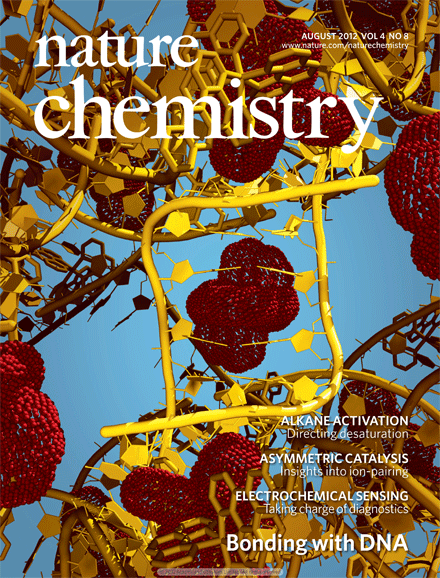
Our August issue went live today and so I thought I’d give you all a quick tour and point out some notable content and a few ‘firsts’. The issue includes a focus on small molecules that bind to DNA, specifically metal complexes. All of the content that makes up the focus (the editorial, an interview with Claudia Turro, an Article from Jackie Barton and co-workers, an Article from Christine Cardin and co-workers, and a News & Views article from Stephen Neidle that looks at those two research papers) is free until August 23rd. And if that’s not enough, Christine Cardin has posted a short video to YouTube about her Article.

Elsewhere in the issue (and all of this is subscriber only – sorry!) there is a guest Thesis article from Jean-François Lutz, who suggests that chemists should slow down a little in the pace of their research. Here’s a short excerpt to whet your appetite:

The quantity of new information published every week in chemistry and closely related disciplines has become so great that today a rapid glance at table-of-content graphics has often replaced in-depth reading of articles themselves. A recurrent question in this context is whether all of this literature is necessary? It seems obvious that many newly published articles are routine studies that are often a repetition, with small variations, of existing concepts.

In addition, there is also a Review article from Dean Toste and co-workers about the use of chiral anions in asymmetric catalysis, lots of great research Articles on a wide range of topics (total synthesis, organic electronics, synthetic methodology, electrochemical sensing, reaction dynamics, and more), and another competition-winning In Your Element essay — this one from Michael Tarselli on nitrogen (this should be free to nature.com registrants).

And now, those ‘firsts’. We’ve reviewed books and TV shows before in the Books & Arts section, but in this issue we review an app for the first time. Jon T. Njardarson reviews SANROS (Strategic Applications of Named Reactions in Organic Synthesis) by László Kürti & Barbara Czakó. And finally, we have another first in the Blogroll column, written by Paul Bracher. The column includes mentions of Dr Rubidium, Excimer, ScienceGeist, Chemjobber and Derek Lowe. But that’s not the new bit… Paul’s written a blogpost explaining what is somewhat unique about his column (strong language included in that link).

We hope you enjoy the issue!

Stuart

Stuart Cantrill (Chief Editor, Nature Chemistry)


IMAGE: CHRISTINE CARDIN AND JAMES HALL

COVER DESIGN: ALEX WING

Reactions: Katharina Fromm

Katharina M. Fromm is in the Department of Chemistry at the University of Fribourg, Switzerland, and works on coordination chemistry, in particular on mixed metal precursors for oxidic materials as well as coordination polymers with applications in materials science as well as medicine.

1. What made you want to be a chemist?

Chemistry is for me the ideal science, combining theoretical with practical aspects. I always loved natural sciences in general, but also wanted to work with my hands on matter, to apply directly what we learned in the class room. Chemistry had the ideal balance in this respect. Finally, it is, together with Physics, at the basis of all transformations of matter.

During my studies, I always wanted to combine it with foreign languages, hence I did part of my studies in Strasbourg, France. In Fribourg, Switzerland, I can keep up this combination, as our University is bilingual (French and German) on the Bachelor level, while the Master is taught in English. Today, research in Chemistry is so interdisciplinary, that one can learn a lot about other fields of science, in e. g. physics and biology.

2. If you weren’t a chemist and could do any other job, what would it be – and why?

I admire creativity in art: music, painting, literature or cooking. So I guess, I would have enjoyed being active in one of these fields. In the mid-90s, when the job situation was not so good, with some friends, we used to make plans for a theme restaurant, of course, this theme would have been chemistry….

3. What are you working on now, and where do you hope it will lead?

We have two main research activities in the group. One deals with the synthesis of new precursors for oxidic materials. Oxides are still made via classical solid state reactions, using high temperature and very long reaction times. With the current energy issues, we hope to bring down production costs by lowering the production temperatures and time. For example, we succeeded in reducing the production temperature for LiCoO2 – the high-temperature phase – from 850°C to 450°C. And maybe we can even get better at that. Related to this, we work on nano-scale Li-ion battery electrode materials.

Our second research field implies silver coordination chemistry which we use to make new antimicrobial coatings for e. g. implants. With increasing bacterial resistance to antibiotics, we hope that silver can help to combat bacterial infections. This leads us currently into the field of bioinorganic chemistry of silver, trying to understand the molecular mechanisms of action of silver in bacteria as well as in eukaryotic cells.

4. Which historical figure would you most like to have dinner with – and why?

I would have been thrilled to participate at a dinner of the 5th Solvay Conference in 1927. What a high concentration of genius scientists there were, discovering and discussing the fundamentals of what we teach today…

5. When was the last time you did an experiment in the lab – and what was it?

Fortunately, I still do experiments from time to time and with great enthusiam when it comes to prepare our annual Christmas lecture / show, or when we have school classes to visit our Department. The last experiment performed just two days ago was the silver mirror experiment.

6. If exiled on a desert island, what one book and one music album would you take with you?

For the book, it would have to be a last minute decision between “The Buddenbrooks” by Thomas Mann, “Crime and Punishment” by Fyodor Dostoyevsky (excellent recent German translation be the late Svetalana Geier) or “Le Comte de Monte-Cristo” by Alexandre Dumas in French. As for the music, this would probably be “Die Zauberflöte” by Mozart.

7. Which chemist would you like to see interviewed on Reactions – and why?

Jean-Marie Lehn from Strasbourg, Ada Yonath from Weizmann Institute and Carl Djerassi from Stanford have recently been to Fribourg on behalf of the Fribourg Chaim Weizmann Lectureship (Chaim Weizmann received his PhD in Chemistry from our University in 1899) and would be great personalities to interview.

Reactions: Tiberiu Moga

Tiberiu Moga is an undergraduate student in Medical Education at the University of Toronto Faculty of Medicine, studying to complete a medical degree — and is also one of the winners of our In Your Element essay competition (we’ll be featuring the winners on Reactions over the coming months).

1. What made you want to be a chemist?

In some ways, chemistry chose me and not the other way around. As an undergraduate, I was drawn to chemistry because it allows one to understand life on the most fundamental (i.e. atomic) level. By understanding medicine at the molecular level, one can develop creative new approaches to treating and curing diseases, ultimately saving lives. I have also had good professors (in chronological order: P.A. Jacobi, R.B. Grubbs, R.P. Hughes, F.J. Kull (senior and junior), D.S. Glueck, G. Gribble, J.E.G. Lipson, J.S. Winn, E.V. Pletneva, D. Wilcox and R.S. Cantor) who challenged me to do my best and nurtured my passion for chemistry.

2. If you weren’t a chemist and could do any other job, what would it be – and why?

If I could not study chemistry, I would probably study the Classics, with a focus on ancient Greek and Roman history. I took Latin in high school and have always been fascinated to learn more about the ancient world.

3. What are you working on now, and where do you hope it will lead?

At the moment, I’m taking a break from doing research to study medicine. If I chose a career in academic medicine, I hope the knowledge of chemistry I have gained will help me develop new therapies for currently intractable diseases. If not, at least chemistry will allow me to understand the mechanisms of action of the medicines I prescribe.

4. Which historical figure would you most like to have dinner with – and why?

Given the choice, I would like to have dinner with Hippocrates, in order to better understand medicine in his day.

5. When was the last time you did an experiment in the lab – and what was it?

My most recent experiment was in the summer of 2011. For that experiment, I was trying to determine the effects of different compounds on the molecular biology of brain tumors.

6. If exiled on a desert island, what one book and one music album would you take with you?

If exiled to a desert island, I would take History of the Peloponnesian War by Thucydides as my one book. As for the music album, it would probably be a selection of music by Mozart.

7. Which chemist would you like to see interviewed on Reactions – and why?

My preference would be to see Robert H. Grubbs (2005 Nobel Laureate in Chemistry) interviewed on Reactions. When I was an undergraduate at Dartmouth College, he came once to give a lecture about his research but I could not attend due to a time conflict. I sorely regretted missing that talk as I would later go on to study the very subjects he discussed. His son, Robert B. Grubbs (future Nobel Laureate in Chemistry?), was also one of my undergraduate chemistry professors and inspired me to study chemistry further, to the point of completing a Bachelor of Arts in the subject.

Reactions: Russell Morris

Russell Morris is in the EaStChem School of Chemistry at the University of St Andrews and works on the synthesis and characterisation of porous materials such as metal organic frameworks and zeolites, and their applications in medicine and industry.

1. What made you want to be a chemist?

I have no idea! When I was young I wanted to be a scientist but it was musical chairs as to what flavour of scientist I wanted to be. One week it was an astronomer, the next it would be a palaeontologist or a neurosurgeon and so on. Of course in secondary school I had an inspiring chemistry teacher and he shuffled me in the direction of Chemistry as my first choice for University and I have never looked back. Basically science is interesting, fun and creative – what more could you want?

2. If you weren’t a chemist and could do any other job, what would it be – and why?

Something physical and outside would be good.  Having said above that I always wanted to be a scientist my alter ego dreamed of being a professional sportsman, and it would be great to play rugby for Wales.

3. What are you working on now, and where do you hope it will lead?

Lots of things, from the use of ionic liquids in the synthesis of different materials to the disassembly and reassembly of zeolites, which I hope will lead to new materials that we cannot prepare right now. In terms of more immediate applications we are preparing porous materials for the delivery of medically active gases, and we are well on the way to developing real therapies for various diseases based on this technology.

4. Which historical figure would you most like to have dinner with – and why?

I like the idea of a lone genius fighting against the conventional wisdom. So I would like to invite someone like Galileo to dinner.

5. When was the last time you did an experiment in the lab – and what was it?

Actually only a couple of months ago, checking the hydrothermal stability of a catalyst (it wasn’t very stable!).

6. If exiled on a desert island, what one book and one music album would you take with you?

Now this is the really difficult question. One book? I think it should be something pretty useful – 101 Gourmet Meals from Coconuts would be ideal but I don’t suppose it has been written. In that case I’ll go for a book where I will learn something – A History of the World in 100 Object by Neil MacGregor would fit the bill. As for music, that’s easy, I’ll take Queen Live at Wembley Stadium.

7. Which chemist would you like to see interviewed on Reactions – and why?

Mmm, a big choice of interesting chemists out there. I think either Stacey Zones from Chevron in the US or Susumu Kitagawa from Kyoto would be good interviewees.

Thomas Hager – a chronicler of chemistry

The April issue of Nature Chemistry sees the publication of our first-ever interview in the journal. I was delighted when Thomas Hager, author of books such as ‘The Alchemy of Air‘ and ‘The Demon Under the Microscope‘ agreed to field some questions from me. For the full interview, you’ll need to be a subscriber, but here are some snippets from the piece.

Thomas_Hager

Image courtesy of Thomas Hager

Is the chemistry theme in many of your books simply a by-product of your interest in food and medicine or is there an underlying fascination with chemistry, too?

I was not a chemistry fan. I majored in biology as an undergraduate, and then did my graduate work in medical microbiology, molecular biology and immunology. Along the way I took the standard slate of chemistry courses, but didn’t really take to them. Organic chemistry was torture. Then I took a class on molecular orbital theory that was close to incomprehensible — it might as well have been Sanskrit. I was clever enough to pass the course, but I learned nothing. I appreciated the field only later, while working with Linus Pauling on his biography. Interviewing Pauling was like taking the world’s best class on the development of twentieth-century chemistry. I’ve been hooked ever since.

In both The Demon Under The Microscope and The Alchemy of Air you don’t shy away from the fundamental chemistry that underpins the story in each case. Did this make it harder to write the books for a general audience?

The short answer is yes. The challenge comes from the fact that the typical non-specialist reader has close to zero chemical knowledge. The trick is to find a structure for the book that will introduce the reader first to a compelling story, then move them through the often-difficult science from square one, along with the story, carefully and progressively, not overwhelming the reader with too much at once, giving them time to digest the science by embedding it in a dramatic narrative with strong characters, challenges, mystery and so on.

You’ve written about sulfa drugs and ammonia synthesis — arguably two of the most significant breakthroughs of the twentieth century underpinned by chemistry. If you had to pick just one of these, which would you say had had the greatest impact on society, and why?

I am drawn to discoveries that have enormous direct impact. We increasingly live in a world that is as much technological as it is natural — often more so. We swim through technology all day, yet most people do not appreciate or understand the science that made it all possible, any more than we appreciate the atmosphere every time we take a breath. We take it for granted that we can flip a switch and make it as bright as day all night long, or get a shot for a disease that would have killed us (and most of our family, and maybe our town) a century ago, or fly through the air like gods. We accept these miracles as commonplace and have lost the exhilaration of that moment of first appearance, when these discoveries were seen for what they were: life-altering breakthroughs, watersheds in history. The Haber–Bosch method of nitrogen fixation, on the other hand, remains after 100 years the world’s major way of making nitrogen fertilizer; the products made by this method consume more than 1 per cent of all the energy on earth and feed around 40 per cent of the world’s population. I would argue that Haber–Bosch is, in terms of direct societal impact, the most important chemical discovery ever made.

Why is it important to tell story of the history of the science that is now part of our everyday lives?

Without understanding the history of science, it is difficult to fully understand the beneficial and not-so-beneficial roles it plays in modern life, the things it might do (and might not do) in the future, and why supporting it is so important. Science history tells scientists where they came from and who they are; and tells the general public important things about how the modern world came to be.

———-

To find out more about why Hager became a writer, how he views Pauling’s legacy, and what projects are potentially in the works, the full interview can be found here ($).

Stuart

Stuart Cantrill (Chief Editor, Nature Chemistry)