
<img alt=“304px-Lost_City_(hydrothermal_field)00.jpg” src=“https://blogs.nature.com/news/thegreatbeyond/304px-Lost_City_%28hydrothermal_field%2900.jpg” width=“180” height=“354” align = “right”/>Accurately reconstructing the history of the Earth’s atmosphere is a tricky process. Of particular interest to scientists are oxygen levels at various points in the planet’s history, because these have implications for the evolution of complex life. It is generally assumed that until atmospheric oxygen reached a critical level, the evolution of complex animals would not have been possible.
A large-scale oxygenation event, which coincides with increasing diversity and complexity in the fossil record, is generally believed to have occurred around 800 million years ago.
However, evidence from sulphur isotopes – different forms of the same element – in seawater, reported in Science in 2005, suggests that there may have been enough oxygen in the earth’s atmosphere to support complex animal life about 400 million years earlier than was thought, reaching the critical level around 1.2 – 1.3 billion years ago.
Now direct evidence from sulphur isotopes in terrestrial rocks that were once submerged in a lake supports the idea that oxygen levels were high enough to support complex life at that time. A study published in this week’s Nature and led by John Parnell of the University of Aberdeen, looked for signatures of bacteria that obtain their energy by reducing sulphur in ancient rocks near Lochinver in the north-west highlands of Scotland.
“These bacteria have been around for a long part of Earth’s history,” says Parnell. “What happened at this critical time is that the community processing sulphur became more complex. It was now able not only to reduce sulphate, but also to oxidise the sulphide produced by reduction.”
This ability to oxidise sulphide alters the proportions of sulphur isotopes seen in the rocks, leaving a ‘signature’ and suggesting that there may have been plentiful oxygen in the atmosphere around 1.2 billion years ago – enough for complex animals to evolve.
“We’re seeing a level of oxygen which is not just going to be in the atmosphere. It’s going to permeate down into the sediments, and this is opening the way for the evolution of more complex life”, says Parnell. “We’re talking about not just evolution in life, but evolution in habitat and evolution in behaviour.”
 Earlier this year, a large-scale
  In a potential blow to US national pride the world’s fastest supercomputer is now Chinese, beating the Americans into second place for the first time since 2004 with a machine which is smaller and more energy efficient than its closest US rival.
 The
The  Several hundred scientists and supporters of science gathered outside the UK Treasury in London on Saturday afternoon to protest imminent cuts to government science funding – an unusual move by a community that rarely takes to the streets to voice its displeasure.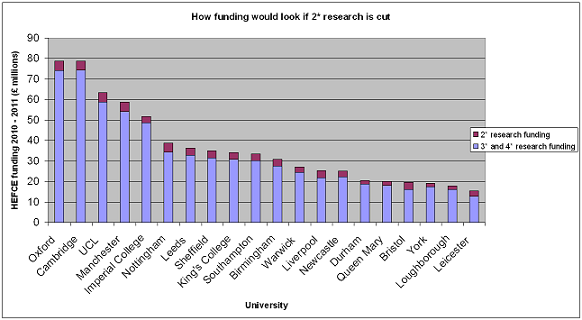
 Continuing the pre-emptive strike by British scientists against forthcoming research budget cuts, the Royal Society of Chemistry (
 Following yesterday’s