Ruth’s Reviews: Alex’s Adventures in Numberland

Ruth Francis, Nature’s Head of Press, is reviewing all the entries shortlisted for the Royal Society’s science book prize. She’ll be reading one per week and posting her thoughts on the news blog every Tuesday between now and the prize ceremony on 17 November

Alex's adventures- cover.jpg

Did you know that pi has inspired a literary subgenre; the piem, in which the number of letters per word is determined by pi? Or that crochet helped glean insights into a counterintuitive type of geometry? Did you ever believe the rumour that mathematics could be playful, or even beautiful?

Alex Bellos has had more than a decade to rehabilitate since his degree in mathematics and philosophy. He finally felt able to revisit the world of maths, exploring it with a new and childlike appreciation – he even renamed it ‘Numberland’. In his own words: “Entering the world of maths as an adult was very different […] the requirement to pass exams means that often the really engrossing stuff is passed over. Now I was free to wander down avenues just because they sounded curious.”

The mix of history, anecdote and equation is captivating and rarely pitched above the head of the lay reader, or indeed math-phobic.

Over twelve chapters – numbered from zero to eleven of course – Bellos covers a heady range of topics from puzzles and games to the evolution of counting and the emergence of zero with an infectious energy and humour. The inhabitants we encounter in Numberland are often kooky, and described with affection – pi-hunting brothers Gregory and David Chudnovsky are reminiscent of Tweedle Dum and Tweedle Dee; speech overlapping, never in disagreement.

Maths has a bad reputation; carrying a book about maths around for the last week caused colleagues and friends to question my sensibilities. But Bellos communicates brilliantly the wonder and excitement of mathematical discovery and I recommend following him down the rabbit hole.

Though I remain equation-averse I did catch my first glimpse of the previously elusive beauty of numbers.

Ruth’s Reviews: ‘Life Ascending’ scoops Royal Society prize

101021_252.jpgNick Lane’s Life Ascending has won the annual Royal Society Book Prize, beating the other shortlisted titles to a £10,000 reward. His book is eloquent and elegant, guiding the reader through the authors’ chosen top ten great inventions of evolution.
Lane joins a list of accomplished authors, including Steve Jones, Steven Rose and Bill Bryson in winning the prize.

His book was released 2009, a year in which we celebrated two big Darwin anniversaries, and was timely in this sense. From complex cells to consciousness, movement to sex, the book is a genuine page turner, which contains reams of information described in an accessible, warm voice.

“Writing is my way to understand the world. I tried to get across the boundary between what we know and what we don’t know,” Lane explained. “It’s a thrilling tapestry that writing can take you across – you can ask any question you want, but there’s responsibility that goes with that.”

Maggie Philbin, Chair of the Judges said: “Life Ascending is a beautifully written and elegantly structured book that was a favourite with all of the judges. Nick Lane hasn’t been afraid to challenge us with some tough science, explaining it in such a way that we feel like scientists ourselves, unfolding the mysteries of life.

Sadly however the prestigious book prize, which has run for more than 20 years may be in its last year due to problems with raising the necessary funds necessary.

Martin Rees, President of the Royal Society, said: “Science is an integral part of our culture and it is immensely important that the joy, wonder and excitement of scientific discovery is effectively communicated to all. The Royal Society Prize for Science Books has celebrated the very best science writing since 1988 and helped to encourage engagement with science from audiences young and old in the UK and internationally. The Royal Society greatly values the Prizes, however, in these tough economic times we have to secure a sponsor to ensure the Prizes can continue in future years.”

“A lot of my heroes have won in the past. When you receive a prize like this it does inspire you,” Lane said. “I hope the funding materializes.”

Read the Great Beyond review here: Ruth’s Reviews: Life Ascending

and Lewis Wolpert reviewed Life Ascending when it was published in 2009. Read his review here: Great inventions of life

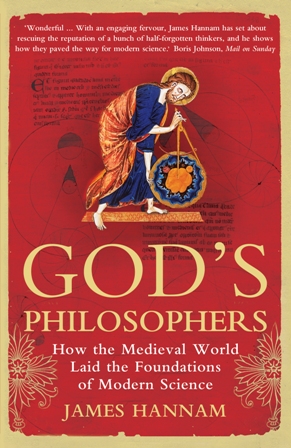
Ruth’s Reviews: God’s Philosophers – James Hannam

God's Philosophers.jpgRuth Francis, Nature’s Head of Press, is reviewing all the entries shortlisted for the Royal Society’s science book prize. She’ll be reading one per week and posting her thoughts on The Great Beyond every Friday between now and the prize ceremony on 21 October.

Far from their reputation as ‘dark’, the Middle Ages were a period of huge technological and cultural advance. So argues James Hannam in his vivid depiction of the 11th to 17th centuries.

God’s Philosophers condenses six hundred years of history and brings to life the key players who pushed forward philosophy and reason.

Along with debunking the ‘Dark Ages’ myth, one of Hannam’s key arguments is that the church was not as anti-science as is now commonly understood. Many of the book’s cast of characters were church figures, including the famous philosopher Thomas Aquinas who was so devout he eschewed all honours the church tried to give him and remained a humble friar throughout his life. His most famous work Summa Theologiae is still considered a classic.

Aquinas was made a saint, but others were punished by the church. One heretical thinker, Amaury of Bene, was not only forced to recant his beliefs but three years after his death was dug up and burned along with some of his unrelenting followers.

Rich with such stories, this book describes often short, dramatic lives while reminding us just how far society travelled in Europe between the time of the Norman conquest of England and the trial of Galileo.

In his conclusion Hannam suggests: “It would be wrong to romanticise the period and we should be very grateful that we do not have to live in it. But the hard life that people had to bear only makes their progress in science and many other fields all the more impressive. We should not write them off as superstitious primitives.”

This period has been poorly documented, and I think this makes Hannam’s account all the more extraordinary. It is engaging, informative and I heartily recommend it.

Ruth’s Reviews: We need to talk about Kelvin

Ruth’s Reviews: Life Ascending

Ruth’s Reviews: Everyday Practice of Science

Ruth’s Reviews: Why does E=MC2

Ruth’s Reviews: A World Without Ice

Ruth’s Reviews: A World Without Ice – Henry Pollack

WorldWithoutIce_PB-9781583334072.jpg

Ruth Francis, Nature’s Head of Press, is reviewing all the entries shortlisted for the Royal Society’s science book prize. She’ll be reading one per week and posting her thoughts on The Great Beyond every Friday between now and the prize ceremony on 21 October.

A World Without Ice should, more precisely, be renamed a history of a world full of ice. Pollack leads us through centuries of Arctic and Antarctic exploration, informing us about the movements of ice and continents long ago. As with the best science writing, he uses stories to draw readers into the science, occasionally including observations from his own childhood.

After this exploration and adventure come the various impacts of the ice melting – which is far less fun, but no less engaging.

Pollack’s descriptions of best and worst case scenarios will strike fear into the heart of his audience. But the tone throughout is informative, and the reader learns about ice, people, and our fragile relationship. In the last three centuries the human population has exploded, and our use of fossil fuels has wrecked havoc with the balance previously maintained for millennia.

The final chapter deals with an uncertain future and weighs up the options for the planet. It ends with a call to arms, an appeal to act boldly to change the course that is plotted out for us. Quoting sixth century BC philosopher Lao Tzu, Pollack clearly believes we can and should change our route: “if you do not change direction, you may end up where you are heading”.

This is certainly not a happy read, but one which I wholeheartedly recommend.

Ruth’s Reviews: We need to talk about Kelvin

Ruth’s Reviews: Life Ascending

Ruth’s Reviews: Everyday Practice of Science

Ruth’s Reviews: Why does E=MC2

Ruth’s Reviews: Why does E=mc2? (and why should we care) – Brian Cox and Jeff Forshaw

Why Does E_web.jpg

Ruth Francis, Nature’s Head of Press, is reviewing all the entries shortlisted for the Royal Society’s science book prize. She’ll be reading one per week and posting her thoughts on The Great Beyond every Friday between now and the prize ceremony on 21 October.

Mark Haddon’s The Curious Incident of the Dog in the Night Time is a work of fiction that features an awful lot of complicated mathematics. Understanding the maths isn’t crucial in enjoying the book, fortunately, and it was a runaway hit back in 2003.

Brian Cox and Jeff Forshaw pull off a similar trick in their explanation of Einstein’s famous equation, tackling maths that could intimidate some readers. The authors are gentle from the off, and reassure that following the sums isn’t crucial to following the book, but do urge the reader to give it a try.

Why does E=mc2? takes the reader on a journey from space and time, via spacetime to the warping of spacetime – black holes. At each step maths underpins the theory, and each step becomes more complicated. Many readers will begin to skim the maths as they go, as I did in the later chapters, but will experience some of its beauty.

The penultimate chapter about the Standard Model of Particle Physics may not bring the so called ‘Ionian enchantment’ described by mathematicians upon realising that the world is orderly and can be explained by a small number of laws but It does break down the equation for the lay reader and this brings a certain satisfaction.

Equations and symbols aside the authors’ explanations throughout are clear, accessible and enjoyable. Although I gave up on the maths somewhere along the way I did learn a lot, and enjoyed the tone of the authors. In places they could have been more brief, and acknowledged our 21st Century desire for speedy gratification.

It may not achieve the popularity of Haddon’s novel, but Why does E=mc2? will be well received by non-specialist readers. Although it can be tough going it is an enjoyable and educational read.

Previously on Ruth’s Reviews:

Ruth’s Reviews: Life Ascending

Ruth’s Reviews: We need to talk about Kelvin

Ruth’s Reviews: Everyday Practice of Science

Ruth’s Reviews: Everyday Practice of Science – Frederick Grinnell

Everyday Practice.jpg

Ruth Francis, Nature’s Head of Press, is reviewing all the entries shortlisted for the Royal Society’s science book prize. She’ll be reading one per week and posting her thoughts on The Great Beyond every Friday between now and the prize ceremony on 21 October.

Science comes in three different versions: the facts, the linear model and what really happened, says Frederick Grinnell in his introduction. His aim is to shed light on the third, the reality of practice.

Everyday Practice of Science: Where Intuition and Passion Meet Objectivity and Logic offers the reader a glimpse behind the linear descriptions in papers and reports. This reality is sometimes seen in biographies of big-name scientists, and is familiar to members of the scientific community, but misunderstood by those on the outside.

Grinnell’s avuncular tone lends his depictions authority, and in choosing a supporting cast of Nobel Prize winners to quote, he reinforces this clout.

With the first half focused on science itself and the second on science and society, Grinnell, a cell biologist and bioethicist at the University of Texas in Dallas, offers insight into practice, discovery and credibility, integrity, informed consent and faith. The second half is meatier than the first, dealing with issues surrounding ethics and embryos, religion and evolution, and genetics and disease, presenting the opposing arguments gently and clearly.

But it puzzles me who this book is aimed at. Grinnell writes that it is for “a broad audience, including students, scholars and the public interested in science”.

The Royal Society, in it’s eligibility guidelines, says that it is looking for books that are: “stimulating, engaging, clear, accessible, high-quality, and/or that might challenge people’s views about science being too difficult, boring, or inaccessible to be of interest or relevance to them.” Further, “The judges’ interpretation of ‘popular science books’ excludes books published primarily for scientific or other professional or specialist audiences.

I enjoyed The Everyday Practice of Science, and agree with the judges about its accessibility. But I I can’t see it having appeal outside of the community.

Previously on Ruth’s Reviews:

Ruth’s Reviews: Life Ascending

Ruth’s Reviews: We need to talk about Kelvin

Ruth’s Reviews: Life Ascending – Nick Lane

Ascending_web.jpg

Ruth Francis, Nature’s Head of Press, is reviewing all the entries shortlisted for the Royal Society’s science book prize. She’ll be reading one per week and is posting her thoughts on The Great Beyond every Friday between now and the prize ceremony on 21 October.
Last year was a year of Darwin celebrations, with two big anniversaries about six months apart. It’s unsurprising, then, that an explosion of books on evolution hit the shelves in 2009. I am surprised that only one made it onto the Royal Society’s shortlist.

Nick Lane’s Life Ascending is eminently deserving of its place, offering readers insightful tours through ten great inventions of evolution.

He outlines his criteria as follows: the invention had to revolutionise the living world, and the planet; it had to be of surpassing importance today; it must be a direct outcome of evolution by natural selection; and finally the invention had to be iconic in some way. Some readers may disagree with his ten choices, as the introduction acknowledges, but I went with the flow and it made sense to me.

Beginning with DNA and the complex cell, building to sex, consciousness and death, via movement and sight, Lane’s picks certainly tick the four boxes. What’s more, the reader is taken on a journey, gaining knowledge as the facts unfold, with each chapter building on what’s gone before.

Lane’s writing is elegant and his narrative thread clearly thought through. Occasionally he asks the reader to hold one thought while he explains something else first, or reminds you that you met a researcher before in chapter x.

As I read I fold down the corners to remind myself of quotable passages, or well-described theory. The book I have in front of me has many, many turned-down pages and it’s impossible to choose one passage to quote.

From start to finish, origin of life to death, this book is a pleasure to digest. As I turned the final page it crossed my mind to go back to the beginning and enjoy it all over again.

Previously on Ruth’s Reviews:

Ruth’s Reviews: We need to talk about Kelvin

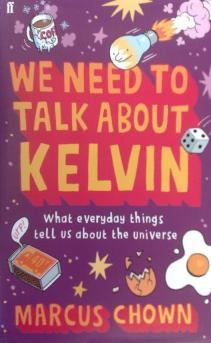
Ruth’s Reviews: We need to talk about Kelvin

Kelvin_small.JPG

Ruth Francis, Nature’s Head of Press, is reviewing all the entries shortlisted for the Royal Society’s science book prize. She’ll be reading one per week and is posting her thoughts on The Great Beyond every Friday between now and the prize ceremony on 21 October.

Cartoons on the cover, large font and a chatty, easy writing style belie a complex subject matter and the sheer amount of information in this volume.

In his introduction Chown says: “The idea of this book is simple: to take familiar features of the everyday world and show how […] they tell us profound truths about the ultimate nature of reality.”

Sounds simple enough? Despite the premise, this is a rather muddled investigation. Whether it’s how the everyday world is telling you about atoms, stars or the universe, the author divulges the history of the theory, the characters involved, wrong turns and layman’s examples.

Seeing both your face reflected and what’s on the other side of a window reveals something of the behaviour of light, explains the first chapter. And using a matchbox and a 40 tonne truck to illustrate the size difference between the wavelength of visible light and an atom is tangible too. But just how many examples and anecdotes are needed to get to the simple truth?

The early chapters are hard going the second half seems an easier ride – perhaps because the later chapters focus on newer subject matter with less history or because the groundwork is done and some basic concepts have been explained previously.

But it feels somewhat laboured – in last year’s Royal Society shortlist a couple of the books tackled tough subject matter in great detail but somehow more smoothly. Neil Shubin’s Your Inner Fish, took on the 3.5 billion year old history of the human body, using the famous Tiktaalik fossil as a narrative thread running through the book, bringing readers back to a familiar focus with each chapter.

Instead, Chown zips through a series of theories without one unifying narrative. They say that you should never judge a book by its cover. Don’t judge this one by its title either – there are only three pages that mention Kelvin.

Achieving global coverage for science – a workshop

A room full of sweaty press officers, at the World Conference of Science Journalists, eager to learn more about the international media climate and how achieve ‘Global Coverage for Science’ weren’t expecting to hear about powerful and rich PRs in Nigeria. But these sessions often contain surprises, and after being lulled into the international media scene with case studies on outreach to international media by British Antarctic Survey’s Linda Capper we met journalists Mohammad Kaswar Uddin from Bangladesh and Diran Onifade who took us further from our comfort zones.

According to Uddin science journalism is not yet recognised in much of South Asia, and media often reel out the government line. Health and science are more likely to be translated versions of UK, US, Canadian or Australian news articles. But this seems tame compared to Diran Onifade’s depiction of a corrupt media where in order to achieve coverage money needs to change hands. PR, it seems, can involve more negotiation skills than many of us currently employ.

With costs increasing and the PR middlemen benefiting more than anyone else in the equation, some are earning more than their CEOs. Diran tells us that we can write as many press releases as we like but a great photo of your CEO with, say, Bill Gates, would make more of a splash as you could pay to have it appear on the front pages.

But, let’s not forget this is a skills building workshop, intended to help find solutions rather than wallow in problems. What are the answers? How can this grim picture improve?

Continue reading

Achieving global coverage for science – a workshop

A room full of sweaty press officers, at the World Conference of Science Journalists, eager to learn more about the international media climate and how achieve ‘Global Coverage for Science’ weren’t expecting to hear about powerful and rich PRs in Nigeria. But these sessions often contain surprises, and after being lulled into the international media scene with case studies on outreach to international media by British Antarctic Survey’s Linda Capper we met journalists Mohammad Kaswar Uddin from Bangladesh and Diran Onifade who took us further from our comfort zones.

According to Uddin science journalism is not yet recognised in much of South Asia, and media often reel out the government line. Health and science are more likely to be translated versions of UK, US, Canadian or Australian news articles. But this seems tame compared to Diran Onifade’s depiction of a corrupt media where in order to achieve coverage money needs to change hands. PR, it seems, can involve more negotiation skills than many of us currently employ.

With costs increasing and the PR middlemen benefiting more than anyone else in the equation, some are earning more than their CEOs. Diran tells us that we can write as many press releases as we like but a great photo of your CEO with, say, Bill Gates, would make more of a splash as you could pay to have it appear on the front pages.

But, let’s not forget this is a skills building workshop, intended to help find solutions rather than wallow in problems. What are the answers? How can this grim picture improve?

Continue reading