Panel: reproducibility issues in 2D heterostructure research

On 21st July 2020, editors from various Nature journals who handle 2D materials research gathered in an online discussion with Joshua Lui (UC Riverside) , Cecilia Mattevi (Imperial College London) and Matthew Yankowitz (University of Washington)  to discuss the reproducibility issues currently faced by the 2D materials research community.

Since the isolation of graphene in 2004, and then other 2D transition metal dichalcogenide materials, research in 2D materials has been flourishing. Yet as new materials are discovered and characterized, it is increasingly clear to the community that one of the key growing pains of this field is the issue of reproducibility. 

2D materials are notoriously sensitive to growth conditions, processing techniques and even sustained  measurement over multiple thermal cycles. A huge range of different factors can affect the physical properties of a 2D heterostructure including twist angle, strain, defects, external crystal alignment and pressure, all of which are near impossible to replicate between samples. 

The event kicked off with a presentation by Joshua Lui who spoke about his work on optical studies of twisted bilayer systems. He showed multiple data sets indicating moire trions and commented that although qualitatively the results were similar, the detailed features varied even between different parts of the same sample. 

Then came a talk by Cecilia Mattevi on growing 2D crystals. In the growth process, the specific reactor architecture is important, and often equipment is “home-made” by a research group. She suggested that using standardised, commercially available equipment would reduce variability. Another important consideration is the type of raw ingredients (precursors) used and a deep understanding of how this affects the samples remains an open question. 

This was followed by Matthew Yankowitz who spoke about electronic measurements on 2D heterostructures. He emphasised that although some results may be difficult to reproduce between samples, the signatures of some phenomena (such as the quantum anomalous Hall effect) are so clear that even seeing it in one device consists of a useful result. He even commented that in some cases he could accurately guess which group the measurements were from just by looking at a plot of the data!

After the talks, a lively conversation moderated by Giulia Pacchioni (Nature Reviews Materials) began. 

Unsurprisingly, a hot topic of discussion was twisted bilayers. It emerged that not only is it difficult to know how many samples out of a batch are suitably twisted to display moiré characteristics, but even measuring the precise twist angle remains a big challenge. Samples are also inhomogenous and often different parts of the same sample will show variable results.It is often difficult to compare results from different groups, as there is no standard technique for characterising the interface between two layers.  

So what can the community do?

Lui calls for increased dialogue between experimentalists, theorists and journal editors. Often theorists consider information like the twist angle as being trivial, rather than an almost impossible value to calculate. Not only can this make collaboration difficult, but can also lead to misunderstandings during the peer review process. 

Mattevi proposes that information about the exact precursors used in a growth process is included in the methods section of a paper. This would enable easier comparison between different samples and encourage more standardised characterisation methods for samples. 

Yankowitz advocates for providing detailed supplementary information with each paper, including measurements between *all* sets of contacts in a given bilayer device in order to characterise the twist angle homogeneity – not just those with the interesting results.  
Reproducibility is at the heart of science, but in this budding field, insisting on strictly reproducible results over a statistically significant number of devices or samples would hamper many results from being published and shared. Researchers and editors both agree that this would greatly slow down the growth of the field.

Instead, as editors, we commit to being more mindful of the issue of reproducibility and encouraging greater transparency when results are presented. It’s okay if only one device worked, but please do tell the reader (and also mention how many you tried!). If the single working device consequently broke after a few days of measurement, that is also precious advice for the next researcher reading the paper and trying to replicate something similar. 

We hope that by increasing transparency in the presentation of results and encouraging honest dialogue between research groups, we can support researchers as they work on these tricky, yet fascinating, new materials. 
 

Interactions: Conversation with Katie Mack

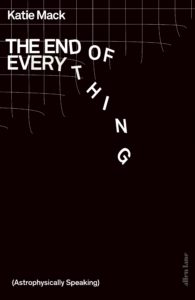
In her new book, “The End of Everything (Astrophysically Speaking)”, Katie Mack takes us on a journey through cosmology to find out how it will all end. Will the Universe collapse into itself in a Big Crunch? Or will a vacuum bubble slowly swallow up everything?

Mack shares with us an accessible and intuitive picture of what we know about universe so far, while providing a sharp analysis of each theory. Her writing is engaging and witty and feels like a cosy fireside chat, with enthusiasm seeming to bubble out of every page.

We asked Katie some questions about her book.

{credit}Penguin Random House, UK{/credit}

This is your first book, but you are well-known for your outreach in the form of talks, articles, interviews and twitter. What is your favourite way of doing outreach? And what do you find rewarding about it?

Writing is always fun, as is social media. It’s fun to be creative in that way. But I also really like giving talks, and doing Q&As. Public speaking doesn’t scare me, and having an audience out there and being able to blow their minds with cosmology ideas is a lot of fun. Q&As are always great because people have wonderful questions, and I love the challenge of having to come up with an answer on the spot if it’s something I haven’t really thought about before. I think the thing I find rewarding about all of it is just that thing where I get to share my enthusiasm and let other people feel it too. And when I can help someone have an epiphany, a eureka moment — that’s really the absolute best.

What advice would you give to someone wanting to write their first book?

I think it’s important to have a through-line — some kind of narrative or story you want to tell that’s not just a collection of facts. It also helps to be really excited about the topic! I had a great time writing the book, because it was something I just really loved talking about. Also, when it comes to the actual writing part, that thing that all the writing advice articles tell you, that you should write every day, preferably first thing in the morning: that is totally true. I’m not a morning person AT ALL but starting my day with some tea and oatmeal and my laptop at the local cafe made a huge difference for getting my book written.

In the book you write “Would I want to uncover the secrets of the universe, even if I didn’t get to share that knowledge, or keep it? I would.” Yet you have shared your knowledge with us – thank you! What inspired you to write an accessible book about the end of the universe?

I’ve done a lot of writing about astronomy and physics over the years, and my motivation is always that I find the universe absolutely fascinating and I am just totally incapable of keeping that enthusiasm to myself. As for tackling the end of the universe specifically — that was motivated by a few things. One was the fact that there are just not very many books on the topic. Lots of books discuss the beginning of the universe, but not so many really dig into the possibilities for the end. So there was definitely room for that discussion. But also, it’s something that I think people are generally really curious about — our ultimate fate, the end of the story — and it seemed like it would be a really great hook for also talking about all my favourite cosmology topics. You have to get into a lot of weird physics and astronomy stuff in order to describe the kinds of things that might happen at the end of the universe.

{credit}Nerissa-Escanlar{/credit}

I think my favourite fact from the book is learning that galaxies that are further away look bigger. What’s your favourite astrophysics fact/story to share at a cocktail party?

I think my very favourite thing to tell people about is the fact that we can SEE the Big Bang. The cosmic microwave background is often described as the “afterglow” of the Big Bang, which is correct, but it’s also a *direct view* of parts of the universe that are so distant from us that from our perspective, they are STILL ON FIRE — still experiencing the final stages of the cosmic fireball stage that was the early universe during the Hot Big Bang. I love that so much.

 Most readers of the book will have their minds absolutely boggled by the ideas you talk about. Thinking about the universe is mindblowing. In the course of your daily research, do you find yourself reflecting on this vastness regularly, or do you prefer to focus on the maths?

Most of my research focuses on smaller parts of big questions (like how dark matter might have affected the first stars and galaxies) and so it’s easy to get caught up in those details, calculations, and code, and not to think much about the bigger picture. But every once in a while, especially if I’m discussing the work with someone outside the field, I do have moments of what people sometimes call “cosmic vertigo” where I’m overwhelmed by the scale of the cosmos or the realization that these bizarre distant things I’m studying are real and incredibly powerful.

Reading this book during a pandemic and at a time of global social and political unrest, I found the book weirdly calming. How do you find working with such grand ideas affects your outlook on life?

It’s been a very interesting thing, to spend a couple years so engrossed in the idea of ultimate cosmic destruction. It does weird things to your outlook sometimes. But I’ve had the same experience; lately, I have found it calming to think about something so much bigger than us, and in some sense very abstracted. It can be a really useful change in perspective, to think about how we fit into this much larger cosmic story, and how insignificant we are. That insignificance is actually important to me, because it makes it much more impressive how much we are able to know. I think it’s astonishing that we can see the Big Bang, watch the expansion of the universe, contemplate our cosmic future. And thinking about how even the universe will someday end is a way of reminding us to appreciate what we have now. For me, it makes it more important to find meaning in the moment, rather than waiting for it all to be somehow justified after the fact.