Interactions: Ghina M. Halabi

Ghina Halabi

Ghina M. Halabi is an astrophysicist and social entrepreneur, whose work lies at the intersection of science, entrepreneurship and education. During her PhD and postdoctoral work, her research was on internal structure and evolution of stars. Now, working at Cambridge Judge Business School Entrepreneurship Centre, ​she creates and leads​ impactful opportunities for scientists and academics to thrive beyond the lab. The first person to gain a PhD in astrophysics from a Lebanese university, she is a strong advocate for public engagement, particularly through storytelling. In 2018, Ghina founded She Speaks Science, a multilingual social enterprise for public engagement. Since 2020, she has been a mentor on the United Nations Space for Women Network.

Could you tell us a bit about your research?

There is hardly any region in the Universe less accessible to human investigation than stellar interiors. For more than a decade, my work probed exactly that: the interiors of stars, vital regions of our Universe and the seed to human life. My research looked at the evolution of these enigmatic objects, their interactions with their nearby companions, and the nucleosynthesis processes taking place through their lifetimes. I developed computational codes to model stellar evolution, by tracing the progression of a star’s properties throughout its life cycle and model its structure and element formation. This allowed me to predict the abundances of chemical elements on a star’s surface.

What inspired you to become an astrophysicist?

Unlike many astrophysicists who start marvelling at the mysteries of the cosmos from a very young age, I never thought I’d become one. In the small mountainous Lebanese village where I grew up, an urban legend has it that counting stars causes warts on your fingers. As any child would, I counted stars all the same but not without a creeping sense of thrill and apprehension of the curse that might befall me. The only affliction I ended up with instead is an unshakable spell of always seeking a good challenge.

Born in the 1980s in a country riddled with a raging civil war, the sounds of artillery, missiles and sonic booms were almost a daily reality. I was intrigued about flying, and as a teenager, I wanted to become a fighter pilot. However, to a 15-year-old with no role models breaking clouds, this path seemed cordoned off and even trying seemed like trespassing.

Perhaps when reality disappoints and limitations shackle one’s dreams, defiance becomes a life-affirming act. So I dismissed the thought of becoming a fighter pilot, but not the skyward dreams. I took to studying physics which seemed like a hearty challenge, then worked hard for a PhD in astrophysics. One would think it can only get easier from there. However, no one had attempted that degree in Lebanon before so there was no clear path to tread or role model to aspire to. I had to blaze that trail myself, yet another challenge I daringly accepted.

What was the motivation behind She Speaks Science?

My own experience and the barriers I faced fuel my work on broadening access so that young people don’t miss out on becoming engineers or pilots or astronauts because of lack of mentorship or role models. So I founded She Speaks Science in 2018. Our work aims to promote women and minority scientists in STEM, and create a positive STEM identity among young people.

Why is the idea of storytelling important to you?

My consultancy work in science communication made me realise that not every role model inspires, and not every outreach approach works to promote STEM. On She Speaks Science, we take a storytelling approach for three reasons:

  1. Stories featuring characters, change, struggle and adventure spark imagination and motivate girls and young women to explore science. Girlhood is changing, being an 11 year old these days is different from what it used to be. Girls today are individualistic and socially conscious. They have a message and want to make impact, they want to change the world. Our stories show them how through science they can do that.
  2. Stories help normalise failure. One factor that deters young people from pursuing a scientific career is the notion that to be a scientist, one has to be a “genius”. Our stereotypical role models seem to have enforced a normative idea of who does STEM, overlooking struggle and resilience as essential aspects of being a scientist. A study published in 2016 in the Journal of Educational Psychology finds that students who are exposed to scientists “struggle stories” recorded higher science grades and levels of motivation than those who weren’t. Thus narrating the struggle of a scientist, as a protagonist searching for the truth, is effective in normalising failure and building resilience among young explorers.
  3. Stories help bring about a culture change. They normalise the idea of a woman scientist to boys and young men so they come to view it as commonplace rather than exceptional.

She Speaks Science features writing in many languages, why is that important?

She Speaks Science’s readership now spans more than 180 countries across the globe. Offering our stories in five languages (English, Arabic, Spanish, German and Italian) is crucial to ensure wider accessibility and to cater for a global audience. Although the English language dominates global scientific activities and using a single international language facilitates the dissemination of scientific knowledge across national and cultural borders, the English language shouldn’t be a gatekeeper to scientific discourse. More critically, to face the threats of the coming decades humanity requires the understanding and support of science at a global scale. This makes science communication in multiple languages crucial to ensure a larger reach and effectiveness. That’s what we’re trying to do through our team of dedicated translators.

We will also soon be offering our stories in audio format, as a podcast initially, for an even wider accessibility and inclusivity.
Continue reading

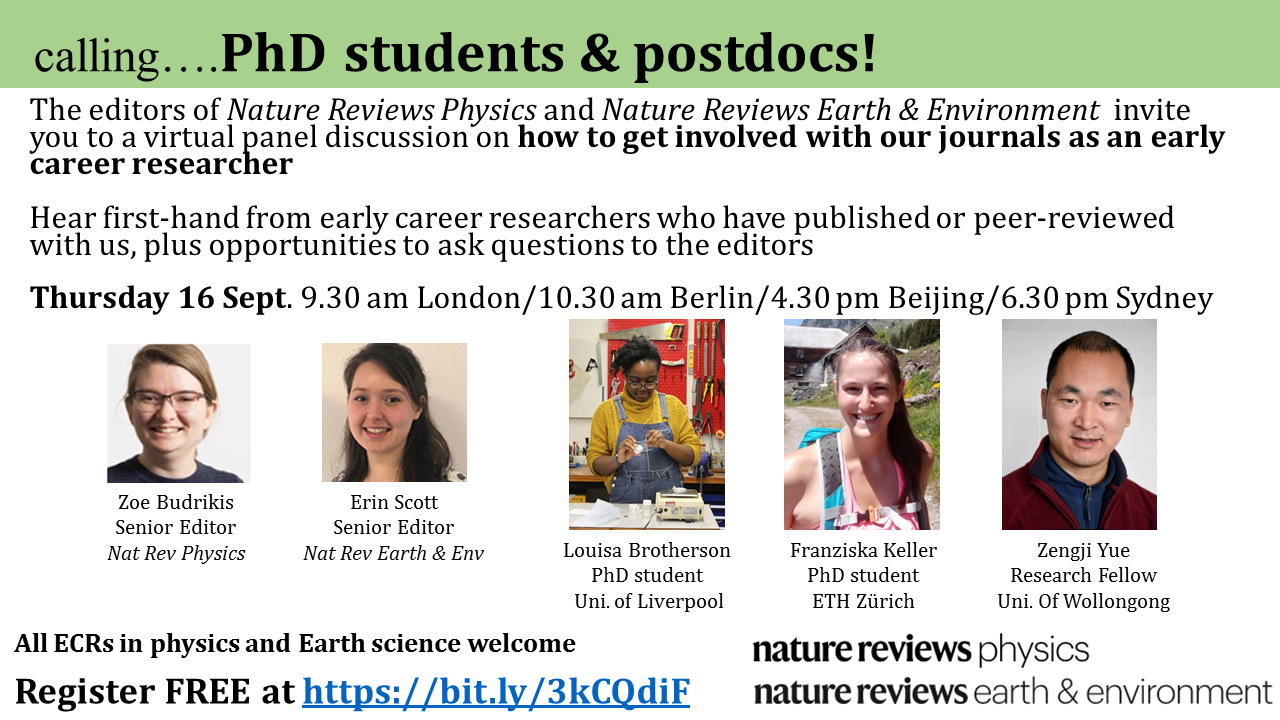
How you can get involved with Nature Reviews as a PhD student or postdoc

On 16 September 2021, Nature Reviews Physics and Nature Reviews Earth & Environment  hosted a webinar, “How you can get involved with Nature Reviews as a PhD student/postdoc”.

The event featured panellists Louisa Brotherson (University of Liverpool), Franziska Keller (ETHZ) and Zengji Yue (University of Wollongong) alongside editors Erin Scott (Nature Reviews Earth & Environment) and Zoe Budrikis (Nature Reviews Physics).

The panel discussed topics like their experiences with writing Tools of the Trade articles and peer-reviewing as ECRs, how publishing works, and what career advice they’d give.

You can watch the recording of the event here.

Attending the APS March Meeting 2021

Guest post by Andrea Richaud, recipient of the Communications Physics 2020 Early Career Researcher grant which enabled him to attend a conference or scientific school of his choice.

In December 2020, I had the pleasure to receive the 2020 Training Grant for Early Career Researchers from the journal Communications Physics. After defending my doctoral thesis in February 2020, I joined SISSA (International School for Advanced Studies, Trieste, Italy), where I am now post-doctoral researcher in the Condensed Matter section.  The focus of my research is on SU(N) fermionic systems, their possible topological phases, and their possible use as quantum simulators of multiband solid-state models. This is an active research field, as ultracold-atom-based platforms illuminate the intimate physics of strongly-correlated systems, by getting rid of a number of spurious effects (like crystal defects) which are inevitably present in standard solid-state systems.

As an awardee of the ECR training grant, I decided to attend the APS March Meeting 2021, a very important conference which involved more than 11,000 different researchers from all over the world. Despite its virtual form (due to the persistent pandemic situation), attending this conference was a very positive and stimulating experience, as I had the possibility to watch tens of very interesting seminars encompassing several aspects of my current research activity. In particular, I found it useful to attend seminars focusing on experimental aspects of the topics which I investigate at the theoretical level. Even as a theoretician, I think that being up to date with experimental advances is really crucial, as one can get valuable ideas and correctly interpret the open problems.

{credit}Andrea attending the conference{/credit}

In spite of the virtual form of the conference, I managed to have a good interaction with many speakers, asking them questions and sharing ideas about common research topics. This was possible thanks to the presence of “Zoom networking rooms”, which were made available at the end of each session. Of course, they could not fully replace a good traditional coffee break, but l think that they worked well enough for this pandemic situation.  Among the advantages of attending such a large meeting virtually, the online platform made switching between rooms pretty easy (compared to running down corridors in a conference centre) and every seminar was recorded and made available to the attendees to re-watch. I am very grateful to the journal Nature Communications Physics for awarding me the prize which allowed me to take part to the APS March Meeting 2021. I definitely think that this experience has been very beneficial for my career as a young researcher.

Hawking Hawking: author Charles Seife on how he cracked the cosmologist’s myth

The British cosmologist Stephen Hawking (1942–2018) was probably the most recognizable scientist of the last 50 years. Many of his greatest contributions were in the study of black holes. In particular, he discovered in 1974 that black holes emit what came to be known as Hawking radiation — which shows that black holes are not truly black and appears to contradict quantum mechanics.
His public persona was forged by his popularization work, beginning with the wildly successful 1988 book A Brief History of Time and his appearances on television shows such as Star Trek: The Next Generation and The Big Bang Theory. Later, he was the subject of the 2014 biographical film A Theory of Everything.

Part of the public’s fascination with Hawking lay in his stoicism in the face of adversity. When he was 21, he was diagnosed with amyotrophic lateral sclerosis, and his doctors gave him two years to live. In the later decades of his life, he was almost completely paralyzed and spoke through a voice synthesizer, which became part of his mystique.

In the media, Hawking was often portrayed as a genius on a par with Albert Einstein or Isaac Newton, but it was an exaggeration that Hawking himself often resisted to. With his new biography, Hawking Hawking: The selling of a scientific celebrity (Basic Book, New York, US$30.00), Charles Seife wants to set the record straight.

Seife is a professor of Journalism at New York University and the author of six previous books. He has covered Hawking the researcher during his year as a reporter for Science.

Davide Castelvecchi, reporter from Nature, interviewed Seife to go behind the scenes. The following was edited for length and clarity.

Charles Seife {credit}Sigrid Estrada{/credit}

What motivated you to write this book? 

I never thought of myself as a biographer, even though my first book [Zero: Biography of a dangerous idea] was nominally a biography of a number. But when Hawking died and I saw the outpouring of grief, I was surprised by how little of it was about his science. There was more to the human than the simple picture people had. I had encountered him a few times, and I was tapped into the social circle of cosmology, so I knew how he was assessed. I decided it was worth doing a real, probing biography that got to Hawking as a human, as opposed to Hawking as a symbol.

What did you know before you started researching the book?

It was a complex picture. Perhaps the clearest event where I was watching from the inside was his 2004 announcement in Dublin that he had solved the black hole information paradox [which suggests that Hawking radiation violates quantum mechanics because it erases information from the Universe]. In speaking to people who were there, almost no one was convinced. There was this poignancy I was picking up, that you had this man who was beloved — his students really loved him, and he’d made some major contributions — but then he got up in front of people and no one bought it. People were wondering why he did it.

But for the public at large, he had this status as an oracle, and it really didn’t matter what he was talking about.  Continue reading

International Women’s Day

Women’s Day was originally conceived at the turn of the 20th century and used in many countries as a focal point for the women’s suffrage movement, and other equal rights for women. 8th of March became a national holiday in the Soviet Union in 1917 after women gained suffrage there. It was recognised by the United Nations in 1977 and continues to be celebrated around the world in different ways. Today we commemorate the lives of three inspiring women physicists.

Florence Martin (1867-1957)1,2

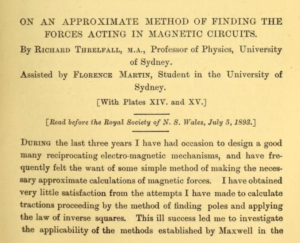
Florence Martin enrolled at the University of Sydney in 1891 and successfully completed a year of physics classes. During her second year, she began working as an unpaid research assistant to Richard Threlfall who was a family friend. In 1893 she wrote her first paper with Threlfall, verifying Maxwell’s equations in magnetic circuits (pictured). 

{credit}Journal and Proceedings of the Royal Society of New South Wales {/credit}

After this, Threlfall introduced Martin to his old friend, J J Thomson at the University of Cambridge and Martin sailed to England to spend three years working with Thomson at the Cavendish Laboratory. Here she took undergraduate practical classes and pursued her own research on the gas expansion caused by electric discharge. When Martin returned to Sydney she worked with Threlfall for another two years, until he left for England. This signalled the end of Martin’s career in physics. 

In 1905, Martin met a wealthy American couple and spent the next few years travelling the world with them. When the couple died in 1918, she inherited their estate in Denver, Colorado. She settled there, and spent the rest of her life as a patron of the arts.

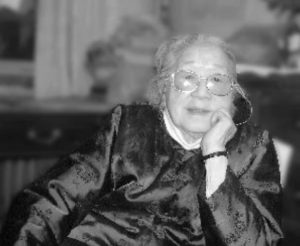
Wang Ming-Chen (1906-2010)3,4,5

{credit}Baidu Bai Jiahao{/credit}

Wang Ming-Chen studied physics at Ginling College, Nanjing and at Yanjing University in Beijing. After receiving her Master’s degree from Yanjing University in 1932, she applied for a scholarship to study abroad. Despite gaining top marks in her class, she did not qualify and had to return to teach in Ginling College. She remained there until the Japanese invasion of 1937, when she fled to Wuhan. In 1938, Wang was able to move to the USA for doctoral work and earned her PhD in statistical mechanics from the University of Michigan in 1942. For the remainder of the second World War, Wang worked at the MIT Radiation Laboratory (where wartime radar research was taking place). During this time, she published “On the theory of Brownian motion II” with G.E. Uhlenbeck.

After the war, Wang returned to China and became a professor at Yunnan University in 1946. However, she only stayed for a few years and returned to the USA in 1949 to work at the University of Notre Dame. However, as political tensions between the US and China increased during the period of McCarthyism in the US, Wang was regularly harassed by the FBI. She applied to return home in 1953, but it took two years for this to be approved and she only came back to China in 1955. 

Wang became a professor of physics at Tsinghua University in Beijing. At this time there was a strong focus on teaching in China, and Wang stopped her research in order to teach courses on statistics and thermodynamics. During the Cultural Revolution of 1966, she was arrested and imprisoned for seven years, on account of her husband being a political target. Later, she told a friend that she focussed on exercising every day in prison to “remind myself that I can’t die, I must live, and I must restore my innocence.” Released in 1973, she continued working at Tsinghua University until her retirement in 1976. 

Carolyn Parker (1917-1966)6,7

{credit}Who’s Who in Colored America 1950{/credit}

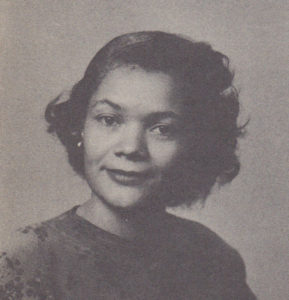
Carolyn Parker graduated magna cum laude with a Bachelor’s degree in mathematics from Fisk University, Tennessee, and went on to receive a Master’s degree from the University of Michigan in 1941. This made her the first African-American woman to receive a postgraduate degree in physics. After her graduation she taught physics and mathematics in various public schools for a couple of years. 

In 1943, Parker started working in the Manhattan project, which was developing atomic weapons during the second World War. She was based in Ohio, at the Dayton project, conducting research on using polonium as an initiator for atomic explosions. Due to the secretive nature of the research, not much is known about her work in this period. After the war ended, Parker left the Dayton project and continued further study at the University of Ohio. 

Parker earned a second Masters in physics from MIT in 1951 . She continued research, partially fulfilling the requirements for a doctorate, however, she did not go on to defend her dissertation. Parker died at the age of 48, from leukemia, believed to be caused by her exposure to polonium during her time at the Dayton project.


References

  1. Florence Martin, Australian National Dictionary of Biography https://adb.anu.edu.au/biography/martin-florence-7504. Accessed 08.03.21.
  2. Journal and Proceedings of the Royal Society of New South Wales, Biodiversity Heritage Library, https://www.biodiversitylibrary.org/item/130154#page/211/mode/1up Accessed 08.03.21.
  3. Ming-Chen Wang, Rackham Graduate School, University of Michigan https://rackham.umich.edu/project/ming-chen-wang/ Accessed 08.03.21
  4. Ming Chen Wang, Kai Zhang personal website, https://sites.google.com/site/kaizhangstatmech/chinese-scientists/mcwang Accessed 08.03.21
  5. Wang Ming-Chen, Wikipedia https://en.wikipedia.org/wiki/Wang_Ming-chen Accessed 08.03.21
  6. A. Powers, The First African American Woman To Obtain A Graduate Degree In Physics Was Involved In A Top Secret US Mission, Forbes 2020 https://www.forbes.com/sites/annapowers/2020/01/31/the-first-african-american-woman-to-obtain-a-graduate-degree-in-physics-was-involved-in-a-top-secret-us-mission/ Accessed 08.03.21
  7. Carolyn Parker, Wikipedia https://en.wikipedia.org/wiki/Carolyn_Parker Accessed 08.03.21

Light and matter in sync

Contributed by Saar Nehemia and Ido Kaminer – Technion, Israel Institute of Technology.

In 1934, Pavel Cherenkov discovered that when charged particles surpass the speed of light in matter, they generate an electromagnetic shockwave. A well-known analogue for this phenomenon is a sonic boom – shockwaves of sound generated when jet planes surpass the speed of sound in air. This new understanding of light–matter interactions led Cherenkov to share the 1958 Nobel Prize in Physics with Ilya Frank and Igor Tamm for his experiment and their theory. The Vavilov–Cherenkov effect has been studied extensively since then and besides being of fundamental science importance, it has led to applications in particle identification, medical imaging, quantum cascade lasers, optical frequency combs, laser-driven particle acceleration, and other areas of nonlinear optics and nanophotonics

In 2020, our paper in Nature Physics demonstrated an experimental signature of a quantum Cherenkov effect. In this post, we take you behind the scenes of our experiment.

The quantum Cherenkov effect

The Cherenkov interaction and analogous effects were mainly studied in the context of classical physics; however, some scientists were interested in their quantum description. The first to study the quantum nature of the Cherenkov effect were Ginzburg and Sokolov in 1940. The conclusion from their work was that quantum corrections to the Cherenkov effect are negligible and irrelevant. In a later paper from 1996, Ginzburg even states that “In 1940, L D Landau told about my work stated that it was of no interest. It follows from the above, that he was fully justified in drawing this conclusion, and his comment hit the mark as was usual with his criticism”. For many years, this statement and related beliefs created a conception that kept scientists away from studying the quantum Cherenkov effect.

A series of theoretical papers from the past 5 years revisited the quantum Cherenkov effect and ignited a new interest in its consequences, starting with our theoretical paper from 2016. These papers predicted interesting consequences for a quantum treatment of Cherenkov-type effects and envisioned that modern experimental capabilities and advances in electron microscopy and in quantum optics could lead to the demonstration of quantum Cherenkov-type phenomena.

Over the last couple of years, other scientists began to predict similar theoretical features in related effects, such as the Smith-Purcell effect (see work by Talebi, Gover, Arie, Polman, and Garcia de Abajo). All these effects can be considered as Cherenkov-type because they all share the same underlying principle: an enhanced interaction between a charged particle and light that occurs when the velocity of the particle matched the phase velocity of light – also termed phase-matched particle–light interaction. These theoretical findings increased the general interest in building an experiment to test these theoretical predictions.

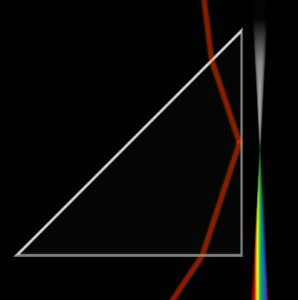
Illustration of the electron-laser interaction, inspired by Pink Floyd’s cover art of Dark Side of the Moon. Each electron is coherently split into a wide energy spectrum (rainbow). The laser light (red) has to be coupled at a precise angle to achieve the strong interaction, in which the electron simultaneously absorbs and emits hundreds of photons from the laser. {credit}Morgan H. Lynch and Saar Nehemia, Technion AdQuanta lab. {/credit}

There exist three types of quantum effects that can occur in phase-matched particle–light interactions.

  1. Recoil corrections due to the quantization of the electromagnetic field. The emission occurs in quantized packets, creating a deviation from classical theories of radiation emission. This effect was first analyzed in 1940 by Ginzburg and Sokolov, in the context of the Cherenkov effect.
  2. Intrinsic changes to both the charge dynamics and the emission properties due to higher-order processes in QED. These effects include photon re-absorption that causes an electron mass correction (analogous to Lamb shift in renormalization theory), all being effects that cannot be explained classically.
  3. Phenomena due to the quantum wave nature of the charged particle, with features that cannot be explained by a classical point-charge description, such as the emergence of discrete energy peaks in the electron energy distribution. This is what we measured in 2020.

Our paper

In our recent work, we measured the third type of the quantum effects described above. To demonstrate the Cherenkov-type interaction, we launched a laser pulse through an optical medium (see prism, below) to synchronize its velocity with a highly-collimated electron beam passing nearby. Using a very accurate electron energy spectrometer (as used in the EELS technique), we measured the electron energy distribution and revealed the discrete energy peaks discussed above. The longitudinal profile of the electron wavefunction altered the interaction. Analogous quantum corrections also arise from transverse features in the electron wavefunction, as its orbital angular momentum (OAM) or its transverse spatial profile.

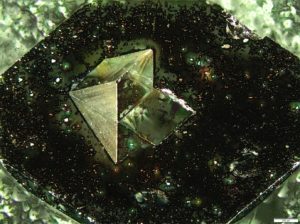
An optical microscope image of the prism used in the experiment. This 0.5 mm prism was attached to a 3 mm surface (darker background) with a square hole (center of image). The prism alignment was extremely precise to ensure that the electrons interact resonantly with the light in the prism. These electrons then pass through the square hole at the center of the surface. {credit}The Technion AdQuanta lab.{/credit}

Our experiment demonstrated a Cherenkov-type interaction between light waves and an electron wavefunction: the Cherenkov conditions are satisfied between an electron pulse and an incoming laser pulse that stimulates the interaction. This stimulated-Cherenkov effect is also known as the inverse-Cherenkov effect. The excitation laser pulse interacts with the electron at the Cherenkov angle (the same angle at which the radiation is emitted in the Cherenkov effect), resulting in a phase-matching between the electron and the laser light that leads to their strong interaction – causing both energy gain and energy loss – occurring simultaneously by each individual electron. In our experiment, this interaction is sustained over hundreds of wavelengths, causing the electron to become a coherent superposition of hundreds of energy levels.

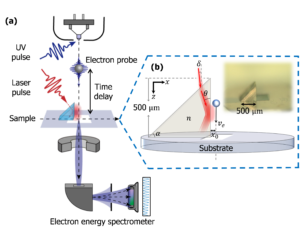
Our setup is based on the ultrafast transmission electron microscope (UTEM), which utilizes femtosecond lasers for pump probe experiments. The microscope offers several degrees of freedom to measure the interactions between light and free electrons: controlling the delay between the light (“pump”) and the electron (“probe”), in addition to the light wavelength and polarization. The microscope allows us to control the electron wavefunction in space and time through its interaction with the laser.

Illustration of the UTEM set-up, showing the grazing-angle interaction with a prism. {credit}Dahan et al. Nat. Phys. 16 1123–1131(2020){/credit}

Our Cherenkov experiment required a unique configuration that has never been achieved in a UTEM system, or in any transmission electron microscope: we needed to align the electron beam to graze the surface of our prism over 500 microns, while remaining at a distance of just 100 nanometers from the surface. To understand how complex this achievement is, consider that even samples that are 10,000 times thinner (nanometer scale, about the size of the corona virus or a couple of DNA strands) are considered quite thick in transmission electron microscopy.

To explain our results, we used the theory that was originally developed for a technique called photon-induced nearfield electron microscopy (PINEM), and extended it to describe our grazing-angle interaction. While all previous PINEM experiments dealt with localized interactions (in which the electron-light interaction spans over a single light wavelength or much below), our grazing angle experiment enabled the electron-light interaction to extend over hundreds of field cycles and hundreds of wavelengths. By satisfying energy–momentum matching over a long interaction distance and a prolonged interaction duration, the interactions become stronger by orders of magnitude compared to localized interactions – this opens the way to creating strong and ultrastrong coupling phenomena with free electrons.

Going back to the types of quantum effects that can arise in electron-light interactions, the PINEM interactions (see work by Carbone, Ropers and others) can be seen as an occurrence of the quantum effect of the third type – since it depends on the electron wavefunction. However, PINEM interactions before our work did not reach the Cherenkov-type interaction because they relied on localized fields (interestingly, even the acronym PINEM includes the word “nearfield”, although other types of fields can also create the effect).

The Cherenkov effect is only one example of phased-matched particle–light interactions. The energy–momentum phase-matching condition that is famously found in the Cherenkov effect also occurs in the Smith-Purcell effect, their inverse effects and a wide range of electron–light interactions that satisfy similar phase-matching conditions.

Looking Ahead

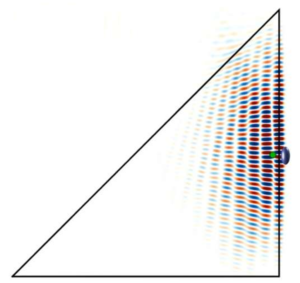
Simulation of the electron-laser interaction. The laser light (red-blue wave) interacts with the electron wavefunction (elongated sphere). This setup assures that the electron exchanges energy with the laser in a resonant manner – achieving the precise conditions of the Cherenkov effect. {credit}Dahan et al. Nat. Phys. 16 1123–1131(2020){/credit}

In another recent study by our group in 2020, published in Nature, we measured the interaction of free electrons with light captured inside a photonic cavity (also measured at the same time here). Looking ahead, we envision combining the Cherenkov phase-matched interaction with an elongated photonic cavity as a route to achieving efficient electron-photon interactions. The cavity will channel emitted photons that can then be resonantly reabsorbed by the elongated electron, creating a strongly-coupled electron–photon hybrid. This hybrid will enable the exploration of extreme conditions such as single-electron–single-photon interactions, which can serve as a novel mechanism for number-resolved single photons detection.

Reaching this regime of physics would open previously unknown processes like free-electron Lamb shifts, controllable free-electron mass renormalizations, and potentially even cavity-mediated Cooper pairs of free electrons. These exciting prospects rely on the quantum interaction of free electrons with photons that are dressed by their optical environment – which enables the Cherenkov effect and many other future ideas.


A number of pictures

Posted on behalf of Nina Meinzer, senior editor at Nature Physics

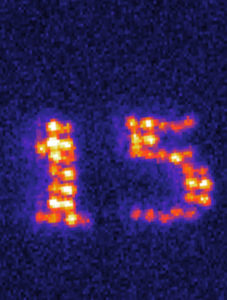
The October issue of Nature Physics marks the journal’s 15th anniversary, complete with a cover on which four experimental images are arranged in such a way to form the number ‘15’. Here Nina Meinzer tells the story of how the images that make the cover were created.

Earlier this year, the Nature Physics editors started to think about ways to mark the journal’s 15th anniversary. Little did we know then that, by October, we would not be able to come together and raise a glass to the occasion, and so the celebration had to be confined to the pages of the journal. We knew early on that we wanted to give our past and present editors a chance to reminisce about their time at the journal, and that turned into a collection of memories of their favourite papers.

But how do you turn those assorted papers into a visual concept to make a cool cover? Once we started thinking about it, it struck us that it’s not unusual to see experimental methods, especially imaging methods, demonstrated with the help of numbers or letters as simple test objects. So we asked some of our authors if they had any images of a 15 (or a 1 and a 5) on their hard drives that we might use for the cover. We were deeply moved by the response: although nobody had the sort of thing we were looking for on file, they offered to take some data especially for us — in August, in the middle of a pandemic.

Our art editor then took four of these images and arranged them into a collage to create one big number 15. Bringing together methods from different areas of physics reflects the aim of Nature Physics itself to be a platform for the entire physics community.

What are the methods used to create the images that eventually made up the anniversary cover?

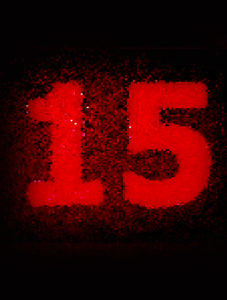
Credit: Hugo Defienne, Daniele Faccio and Alex Wing

Quantum holography (Hugo Defienne & Daniele Faccio, University of Glasgow)   

“Holography is a widely used imaging technique that can be applied to the full electromagnetic spectrum, from X-rays to radio waves and relies on the coherence properties of these waves to extract information from interference patterns.

We have recently extended holography to the case of intrinsically incoherent waves, so that no phase information can be retrieved from a classical interference measurement. Instead, the phase information is now encoded and decoded using entanglement. Entangled photon pairs are used to probe complex objects of which amplitude and phase components are retrieved by imaging the spatial structure of entanglement. As an example, the image on the cover shows the quantum holographic image of the number 15 imprinted onto a spatial light modulator. See also the preprint for more details”

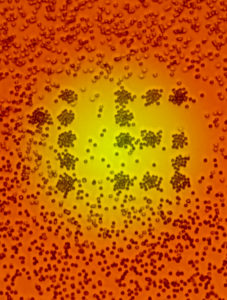
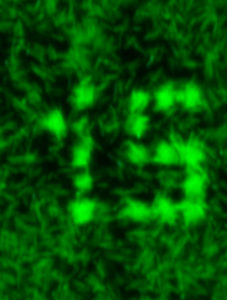
Self-assembly (Serim Ilday, Bilkent University – UNAM) 

Credit: Serim Ilday and Alex Wing

Credit: Serim Ilday and Alex Wing

 “These are microscopy images. Each dot forming the number ‘15’ is a laser beam. Laser pulses that get absorbed by the liquid heat it. The rest, untouched by the laser pulses, remains cold. The liquid starts flowing from the hot to the cold regions, just like in a steam engine. The flows carry polystyrene spheres (red image) and E. coli bacterial cells (green image) towards the beam spots. When they exceed a threshold number, particles and cells slow down the flow the same as the water slows down when you drain it over a sieve. Then, their numbers grow further and write ‘15’.

The recipe? Couple an ultrafast laser to a microscope through a series of optical elements, including a spatial light modulator, which divides a single beam into multiple beams. Cinema projectors have at least one of these for precisely the same reason. Sandwich a thin liquid layer containing the material of interest between two glass slides. Put it under the microscope and shine the laser. Record using a camera. Enjoy!”

Quantum gas microscope (Immanuel Bloch, Max Planck Institute of Quantum Optics)

Credit: Immanuel Bloch and Alex Wing

“The ‘birthday candles’ forming the ’15’ are individual atoms fluorescing in ultra-high vacuum. Lithium-6 atoms are cooled down to around a billionth of a degree above absolute zero and trapped using laser beams. By interfering three pairs of beams, an optical lattice is created which forces the atoms onto a micrometre-spaced regular grid.

An additional custom-shaped laser-pattern coaxes them into the shape of the ’15’. Visible light is then scattered off the atoms and collected with a microscope objective and a single-photon sensitive camera. During illumination, the atoms need to be hindered in heating up via continuous laser cooling. The resulting black-and-white photo is finally coloured. When the atoms are not sending special birthday greetings, they simulate the quantum mechanical behaviour of complex many-body systems.”


Five inspiring women

Ada Lovelace (1815-1852), was an English mathematician and is regarded as the first person to recognise the potential of computing power and programming. Since 2009, the second Tuesday of October has been commemorated as Ada Lovelace day, an international celebration of the achievements of women in science, technology, engineering and maths (STEM). Here we celebrate the stories of five pioneering physicists.

 Caroline (Lili) Bleeker1,2 (1897-1985) 

University Museum Utrecht / Public domain

Caroline Bleeker was a Dutch physicist and entrepreneur. She earned her PhD in 1928 from the University of Utrecht, in the Netherlands. Her thesis was on spectral measurements of alkali metals. After her PhD, she started a consultancy to advise companies on scientific instruments. This project then evolved into opening her own factory to produce equipment, particularly focussing on optical components.

During the German occupation of the Netherlands in the second world war, Bleeker hid Jewish people in her factory. In 1944, the factory was raided by German troops, but Bleeker, who spoke fluent German, was able to distract the soldiers while those who were hiding escaped through the garden. After this, the factory was closed down by the Germans and Bleeker herself had to go into hiding for the remainder of the war.

After the war, the factory reopened and Bleeker worked with her long-term friend Fritz Zernike to produce the world’s first complete phase contrast microscopes. They filed the patent on this together, and in 1953, Zernike won the Nobel prize for this invention.

Elizaveta Karamihailova3  (1897-1968)

Physmuseum / Public domain

Elizaveta Karamihailova was a nuclear physicist and the first woman to become a professor in Bulgaria. She earned her PhD in 1922 from the University of Vienna in Austria. After this, she worked at the Institute of Radium Studies in Vienna with Marietta Blau. Together, they observed a previously unknown radiation from polonium in 1931. Later, this was confirmed by James Chadwick as neutron radiation, which led to him winning the Nobel prize in 1935.

After further postdoctoral work at the Cavendish Laboratory in Cambridge, UK, Karamihailova returned to Bulgaria in 1939, where she set up the first atomic physics course at the University of Sofia. She no longer had the equipment to continue her previous work on ionisation, and so she turned to studying cosmic rays using photographic plates. In 1944, a left-wing uprising took place in Bulgaria and the authorities labelled Karamihailova “unreliable” due to her anti-communist views. She could no longer travel abroad and spent the rest of her career in Bulgaria.

湯浅年子, Toshiko Yuasa4 (1909 –1980) 

朝日新聞社 / Public domain

Toshiko Yuasa earned a degree from Tokyo Bunrika University in 1934 to become the first female physics graduate in Japan. She started teaching there and began her research career in molecular spectroscopy. In 1940, Yuasa moved to France to continue her research, despite the beginning of the second world war. She worked with Frederic Joliot-Curie (son-in-law of Marie Curie) on radioactivity, earning her PhD in 1943.

After the Allied liberation of France in 1944, Yuasa had to leave for Berlin, where she built a double-focussing beta spectrometer. In 1945, Soviet troops ordered Yuasa to return to Japan. She made her way back through Siberia, carrying the spectrometer on her back, arriving in Japan just before it surrendered. However, the US occupying forces in Japan would not allow her to continue her research in nuclear physics, so she could only teach. In 1949, she returned to France as a researcher for the Centre national de la recherche scientifique (CNRS), where she remained for the rest of her career.

سميرة موسى‎, Sameera Moussa5,6,7 (1917–1952) 

Al Ahram Daily news Paper / Public domain

Sameera Moussa was an Egyptian nuclear physicist who worked on atomic energy and was the first women to be a lecturer at the University of Cairo. In the 1940s, Moussa discovered a way to split up atoms of cheap metals, such as copper, which would make the medical applications of nuclear technology much more affordable. However, against the backdrop of the second world war and the detonation of the first nuclear bombs, Moussa was keen to advocate for the regulation of nuclear technology. In 1952, she organised a conference on “Atomic Energy for Peace” which inspired the US program “Atoms for Peace”.

Moussa received a Fulbright scholarship and travelled to the University of California for further research. She was the first non-US citizen to be given access to the top-secret US atomic facilities, which caused some controversy. In 1952, she died when her car was driven off a cliff. Moussa is believed to have been assassinated as the driver was not found, and it is thought that he jumped out of the car. Raqia Ibrahim, an Egyptian-Israeli actress, was accused of murdering Moussa on behalf of the Israeli Mossad who were concerned at the idea of Egypt acquiring a cheap atomic bomb.

পূর্ণিমা সিনহা, Purnima Sinha8,9 (1927–2015) 

https://www.livehistoryindia.com/herstory/2019/05/26/dr-purnima-sinha-pioneering-physicist / CC BY-SA

Purnima Sinha studied physics at the University of Calcutta in the late 1940s. During her time as an undergraduate, she was taught by Satyendra Nath Bose, who encouraged her to join his research group and undertake a PhD in X-ray spectroscopy. Sinha became the first Bengali women to receive a doctorate in physics in 1956. The PhD students worked together to collect scrap army surplus equipment which was readily available after the second world war to build equipment for their research. Sinha studied the structure of clay; later, she joined a biophysics department at Stanford University and found structural similarities between the geometries of clay and of DNA.

In addition, to her scientific pursuits, Sinha was an accomplished musician, painter and translated many science books into Bengali. In 1970, she published an anthropology book on Indian folk music. Sinha was actively involved in Bengali Science Association, which had been set up by Bose. After retirement, she also created an informal school for children of ethnic minorities.


References

  1. Dr. Caroline Emilie Bleeker, physicist and businesswoman. Accessed 12.10.2020
  2. Lili Bleeker, Wikipedia Accessed 12.10.2020
  3. Elizaveta Karamihailova, Wikipedia Accessed 12.10.2020
  4. Toshiko Yuasa, Wikipedia Accessed 12.10.2020
  5. Sameera Moussa, Wikipedia Accessed 12.10.2020
  6. Abdulaal, M. The Story of Sameera: World-Renowned Egyptian Nuclear Scientist, Egyptian Streets (2018) Accessed 12.10.2020
  7. Al-Youm, A. Raqia Ibrahim: Egyptian Jewish actress recruited by Israel to prevent Egypt owning nuclear bomb. Egypt Independent (2014) Accessed 12.10.2020
  8. Purnima Sinha, Wikipedia  Accessed 12.10.2020
  9. Katti, M. Dr Purnima Sinha: Pioneering Physicist. Live History India (2014) Accessed 12.10.2020

Achieving a Bose–Einstein Condensate from my living room during lockdown

During the COVID-19 lockdown which led to the closure of many labs around the world, Dr. Amruta Gadge, a postdoctoral researcher in the Quantum Systems and Devices group at the University of Sussex*, made headlines for remotely setting up a Bose–Einstein condensate from her living room. Here, she tells us her story.

When the UK government announced the national lockdown on 23rd March due to the pandemic, my lab at the University of Sussex was forced to temporarily close its doors.  We of course had a strong inkling this was coming, and rushed to get ourselves in order before it happened. In my laboratory, we were determined to keep our experiments going as best we could although we had never run them remotely before. Without being able to set foot in the labs, bar a few essential maintenance visits, the only way to continue working on our experiments was to use dedicated remote control and monitoring technology.

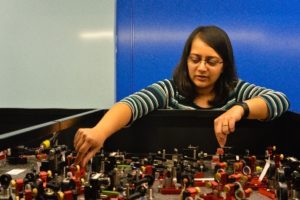
Dr Amruta Gadge adjusting a laser pre lockdown{credit}Rebecca Bond{/credit}

Pre-lockdown, I was part of a team building an apparatus to produce Bose-Einstein condensates (BECs).  A BEC consists of a cloud of hundreds of thousands of rubidium atoms, which have been cooled down to nanokelvin temperatures using lasers and magnetic fields.  At such temperatures the cloud suddenly takes on different characteristics, with all atoms behaving together as a single quantum object. This object has such low energy that it can be used to sense very low magnetic fields, a property we are making use of to probe   novel materials such as silver nanowires , silicon nitride nano membranes or to probe ion channels in biological cells.

We had started assembling this system just a few months before, and were looking forward to reaching a big milestone in the lab – producing our first BEC.  Time was short!  To run such an experiment from home was no easy feat, with large and complex laser and optics set-ups in state-of-the-art labs – which couldn’t just be transported.  In the days leading up to lockdown, equipment, chairs, and computers were being ferried to various homes, deliveries of equipment were diverted and protocols for remote access and online control were put in place.

Ultra-cold atom experiments are very complex. Obtaining a BEC involves a large amount of debugging and optimising of the experimental sequence. When not in the lab, at times it felt almost impossible to debug. We set up software control for the equipment, such as oscilloscopes, vacuum pumps, and others. However, the tool that played the most important role was our environmental monitoring system. Trapped cold atoms are extremely sensitive to any variations in the environmental conditions. Changes in the ambient temperature of the lab, humidity, residual magnetic fields, vacuum pressure, and so on, result in laser instability, polarisation fluctuations or changes in the trapping fields. All of these effects lead to fluctuations of the number of trapped atoms, as well as their position and temperature.

Debugging the system is a long process, but this can be greatly helped by monitoring the environmental conditions at all times. This may sound elaborate, however with the rising popularity of time series databases and data visualisation software, it is possible to develop a convenient monitoring system. We made use of cheap and easily programmable microcontrollers for data collection, and two popular open source platforms, InfluxDB and Grafana, for storing and visualising the data, respectively. We set up a large network of sensors throughout the labs, aimed at monitoring all the parameters relevant to the operation of the experiments. If atom numbers fluctuated, or something wasn’t performing well, we could quickly narrow down the problem by looking at our Grafana dashboards. This meant that our experimental control sequence could be quickly tweaked from home for compensating the environmental fluctuations, and the monitoring system proved to be an extremely useful tool in achieving BECs remotely.

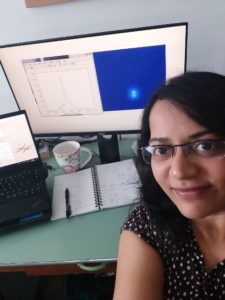
Dr Amruta Gadge working from home with an image of her BEC on screen{credit}Amruta Gadge{/credit}

We were installing a new 2D magneto-optical trap atom source in the lab, and managed to see a signal from it just the day before the lockdown. I remember clearly that I was very worried that lockdown was going to delay the progress of our experiment significantly.  .  However, thankfully we could keep operating remotely, and managed to achieve our long-awaited first BEC from my home.

I was very excited when I saw the image of our first BEC. I had spent the whole day optimising the evaporation cooling stage. It was past 10pm, and I was about to stop for the day and suddenly the numbers started looking promising. I continued tweaking the parameters and in just few attempts, I saw the bimodal distribution of the atoms — a signature of a BEC. It was strange to have no one there to celebrate with in person, but we instead got together to hold celebrations virtually — something we are all getting used to now. I was really hoping to get the first BEC of our experiment before moving to my next post-doc, and having it obtained remotely turned out to be even more gratifying.


*Dr. Amruta Gadge is now a post-doctoral researcher in the cold atoms and laser physics group at the Weizmann Institute of Science, Israel.


Return to the lab

As coronavirus restrictions have been easing over the past few months, increasing numbers of researchers are starting to return to labs and begin experimental work again. Nature Reviews Physics organised a photo competition, inviting submissions of photos which depict lab-life in the era of COVID-19.

Here are some of our favourite entries:


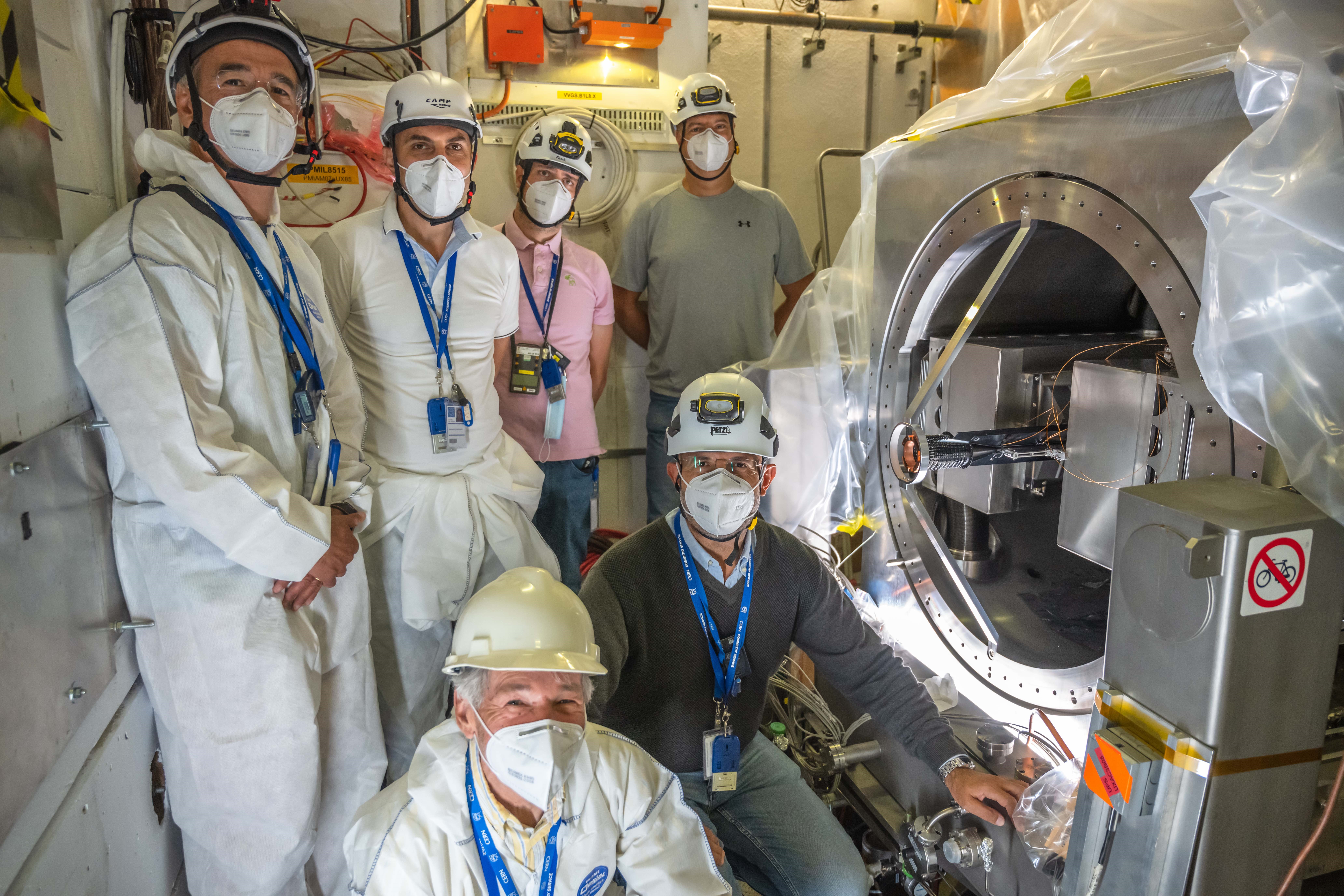
Safety first – particles from outer space second! In this picture you see Claire Antel (left) and Lydia Brenner (right) in the lab of the FASER Experiment at CERN. This new dark matter detector will be installed 100 meters underground before the end of this year. This picture was taken on the 10th of July when we for the first time managed to test the detector by measuring cosmic ray particles. You can see the normal protective gear we always have to wear, such as steel-reinforced work boots and helmets, as well the face-masks that are now mandatory in all indoor work areas at CERN. You can also see that we have to maintain distance at all times, which makes working on the same small machine, between us in the picture, slightly more complicated, but we managed. Submitted by Lydia Brenner


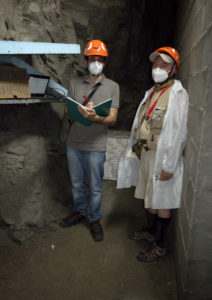
Luca Naticchioni (INFN) and Maurizo Perciballi (INFN) working on the installation of a new underground seismic station at the candidate site for the Einstein Telescope in Sardinia, Italy (Sos Enattos – Lula, August 2020). Submitted by Maurizio Perciballi.


Marco La Cognata is mounting experimental set-up for a Nuclear Astrophysics experiment at INFN Laboratori Nazionali del Sud (in Catania, Italy). The 27Al beam for this experiment was the first delivered in Italian laboratories after the lock-down. Taken in May 2020. Submitted by Sara Palmerini.


Part of the SMOG2 group installing, in front of the LHCb detector, the first gas fixed target at the LHC. LHC will have not only beam-beam but also beam-gas interactions. A new frontier for quantum chromodynamics and astroparticle physics, LHCb cavern, CERN 6th of August 2020. Submitted by Pasquale di Nezza.

And finally, our winning photo is:


Optical alignment of microscopy setup at IIT GENOVA. Immediately after Italy announces a little relaxation (mid of May 2020) for the researcher to continue their research activities following the strict norms and regulation advisory. Submitted by Rajeev Ranjan

Congratulations Rajeev! Rajeev will be receiving a one-year personal subscription to Nature Reviews Physics. Stay tuned for our next photo competition which will announced soon via Twitter – follow us @NatRevPhys for more information!