Interactions: Max McGinley

Max is a first year PhD student at Cambridge University. He works in the Theory of Condensed Matter group, supervised by Professor Nigel Cooper, and studies the theory behind certain interesting phases of matter which are known as ‘topological’. Max was awarded a poster prize sponsored by Nature Reviews Physics at the Quantum Dynamics of Disordered Interacting Systems conference in Trieste last June.

 1.    Can you briefly explain the results for which you got the award?

Topological phases of matter, unlike the familiar solid, liquid, and gas phases, are unconventional because they are inherently quantum mechanical. Their name refers to some `twist’ in the wavefunction that cannot be undone even if the system is deformed – much like how the hole in a torus (doughnut shape) can’t be removed continuously. In our work, we considered what happens to these topological wavefunctions when they are far from equilibrium and undergo some dynamics, for example if the environment suddenly changes. We found that whilst some topological phases stay topological after time evolution, others will ‘untwist’ as time goes on. We also proposed some ways in which this untwisting could be measured in experiments.

2.    What do you hope will be the impact of your research?

As well as being interesting for fundamental physics, researchers are currently discussing how these topological phases can be used to engineer quantum computers, which is an ambitious but exciting prospect. Although our work is more on the theoretical side, I hope that it can aid future work on topological quantum computers, especially since non-equilibrium dynamics will be unavoidable if such a computer is actually operated.

3.    What made you want to be a physicist in the first place?

I think what I most enjoyed about physics to start with was the idea that nature could be understood with a few neat mathematical ideas, even if I didn’t understand exactly what those ideas meant at the time. I find it extremely gratifying to see these elegant concepts show up not just in fundamental physics, but also in the study of real materials and (hopefully!) future technologies.

4.    If you weren’t a physicist, what would you like to be (and why)?

At school I was always torn between studying science and music, and in the end physics won, but a career in the music industry would be really exciting. I think there’s a mathematical side to music that I find quite appealing, so maybe they’re not quite as different as they seem.

5.    What’s your favourite (quasi-)particle?

Seeing as it mediates sound, I’d have to go for the phonon (see above).

6.    If you could have an effect or equation named after you, what would it be?

Every time I visit home, my parents always ask me if I’ve discovered a new element `McGinley-um’ yet, so it would have to be that. Although I think `Maximili-um’ might sound better.
Interactions: Amanda Lewis

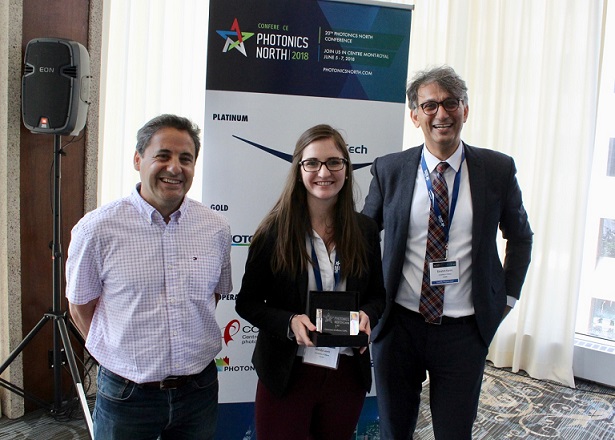
Mandy is a graduate student at the University of Ottawa working in the SUNLAB, a group focused on high-performance photovoltaic devices, photovoltaic systems, and electrical utility grid-edge applications. She recently won a poster prize sponsored by Nature Reviews Physics at Photonics North.

1.       Can you briefly explain the results for which you got the award?

Regular solar panels only absorb light that is incident on their front face. In contrast to those monofacial panels, bifacial solar panels can absorb light illuminating both the front and rear faces. Our group at the SUNLAB has developed modelling software to estimate the electrical energy yield of bifacial solar panels based on solar resource and environmental data,

with a focus on their potential impact in Canada’s North. We predicted an energy yield increase of over 24 percent using bifacial solar panels over monofacial panels for northern locations in Canada.

2.      What do you hope will be the impact of your research?

I hope to demonstrate that bifacial solar panels are a viable technology for Canada that performs in many environments – not only in hot, sunny locations. In fact, as these results show, the advantages of bifacial technology are even greater in Northern regions where solar power is conventionally assumed to be not as effective. This can allow remote communities to replace existing diesel-based power generation; many remote communities require diesel fuel to be flown in to generate power, which is inefficient, expensive, and polluting. Green alternatives like bifacial solar panels present a good opportunity to help achieve climate change objectives by reducing emissions.

3.      What made you want to be a physicist in the first place?

I chose to pursue research in order to make a positive impact, socially and environmentally. The work that the SUNLAB does with next-generation solar technology is really exciting, and I believe that breakthroughs in solar energy research will help to reduce our society’s reliance on fossil fuels. I also love an intellectual challenge, which is easily found in the work that we do.

4.       If you weren’t a physicist, what would you like to be (and why)?

It would be really interesting to work as a scientific educator or reporter, learning about new developments in a variety of fields and making them accessible to the public. I’m a big fan of podcasts, and I envy the work that the Stuff You Should Know hosts and the Economist’s Babbage get to do.

5.      What is your non-scientifically accurate guilty pleasure (could be film/series/book)?

I have a soft spot for Joss Whedon’s Firefly. It’s a really fun space/western story with lots of implausible technology, but the characters are charming.

6.    What would be your physics superpower?

I would love to have the power to teleport through time and space, like Hiro Nakamura or Doctor Who. I would want to visit all the most interesting times and places in history.

Beyond Einstein with neutrinos

Post by Teppei Katori, Janet Conrad and Carlos Argüelles.

The original paper in Nature Physics can be read here.

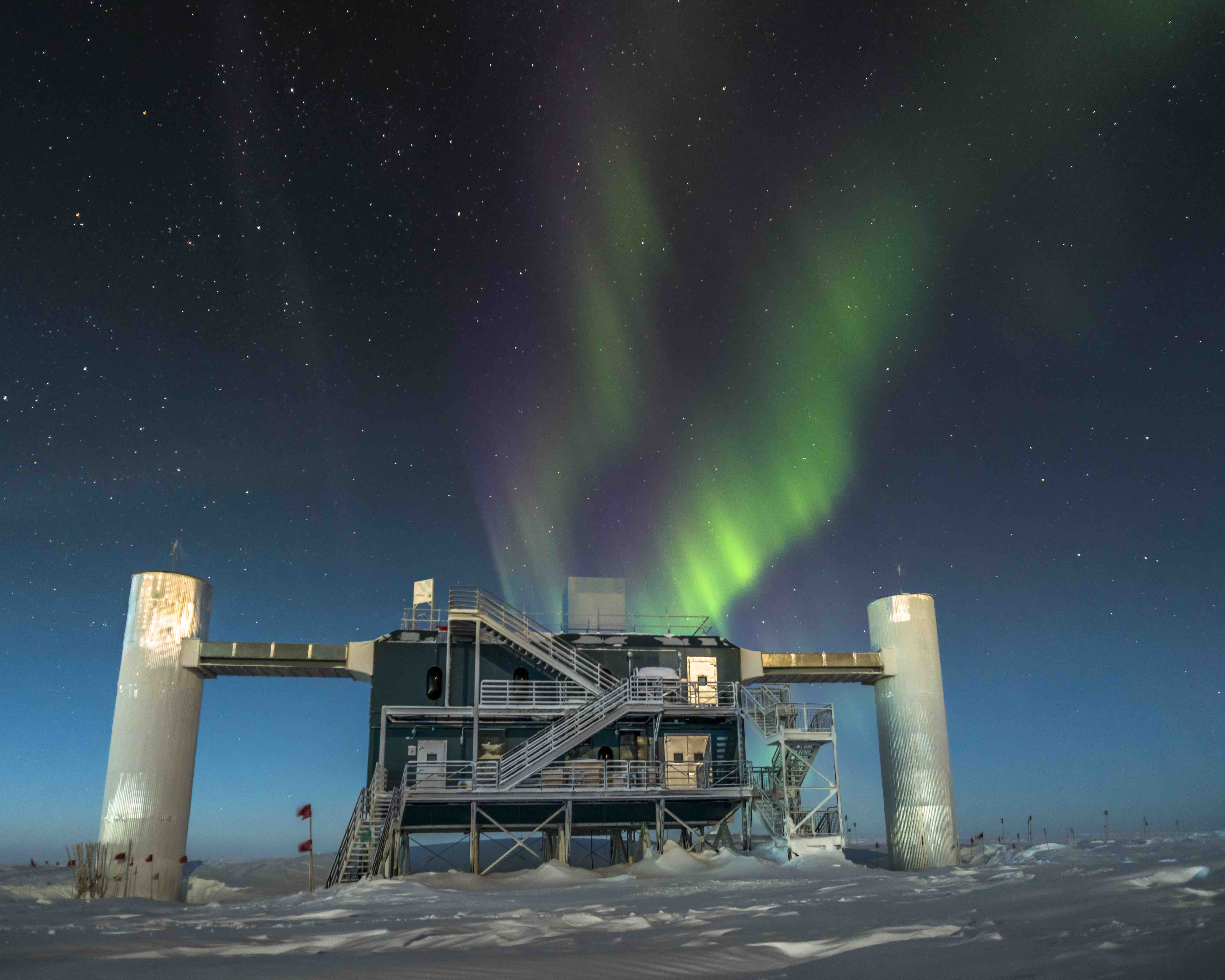
The IceCube Laboratory at the South Pole with the aurora australis. Photo courtesy: Martin Wolf (IceCube, National Science Foundation)

There is a website well-known to physicists that asks, “Are you a Crackpot?”  A leading question in the test is:  “Does your paper start with: Einstein is wrong?”  It’s a good cautionary tale to those of us who search for Lorentz violation.  The ground is littered with false claims that Einstein was wrong.

In fact, by the requirements of science, Einstein was clearly right.  His theory of space-time has withstood many, many tests, to very high precision.  It is a great description of our universe and still accessible today.  At this point, the question is not, “Was Einstein wrong?”  The real question now is, “Is Einstein’s theory sufficient?”

There is a famous example of a beautiful theory that was not wrong, but was not sufficient, and that is Maxwell’s equations.  These equations are a perfect description of how light behaves.  Since the 1800s, they have not been proven wrong.  What was proven wrong, by the influential Michelson and Morley experiment, was the worldview in which these equations were being interpreted:  light does not travel through an ether — its speed is the same from all directions.  Just because Maxwell’s equations are right, it does not mean there is an ether.

We love the Michelson and Morley experiment for many reasons.  First and foremost, of course, is the world-changing view of the meaning of Maxwell’s equations that this experiment demanded.  In fact, that changing worldview led directly to Einstein’s space-time theory.  But also, the interferometry of this experiment is a great analogy to the approach we use in our paper.  In addition, Michelson and Morley demonstrated the power of limits — although it found nothing, this is one of the most consequential experiments ever.  Limits are as important as signals. Continue reading

How advances in active noise cancellation unlocked a new form of waves

Post by Romain Fleury, commissioned by David Abergel.

The original paper in Nature Physics can be read here.

{credit}Credit: Jamani Caillet, EPFL{/credit}

Imagine you are playing the popular Nintendo game Mario Kart, and as you try to win the race one of the other players suddenly drives into the worst possible item box you can imagine: it covers the road in front of you with a very, very large number of banana peels, making it extremely unlikely for you to avoid these obstacles. If waves could have feelings, this is probably what they would think when a scientist tries to transmit them through a strongly localized disordered medium.

Yet, imagine now that you have the possibility to install some sort of magic boosters, or conveyor belts, that auto-pilot your kart seamlessly through these obstacles, while maintaining your precious velocity. This is certainly not possible in the game, but for our team of physicists and engineers, it made perfect sense to try this for waves in disordered media.

In our recent Nature Physics article, we have used acoustic boosters, or relays, to guide sound through a very nasty series of obstacles, and turned an Anderson-localized opaque medium into a perfectly transparent one by doping it with gain and loss. Interestingly, these acoustic boosters were made possible by recent advances in active noise control devices, similar to the ones you may use in your noise cancellation headphones during your next flight. Here is the story of how this idea came to life. Continue reading

Frequency scanning optoelectronic oscillator

Post by Ming Li, commissioned by Heather Partner

The original paper in Nature Communications can be read here.

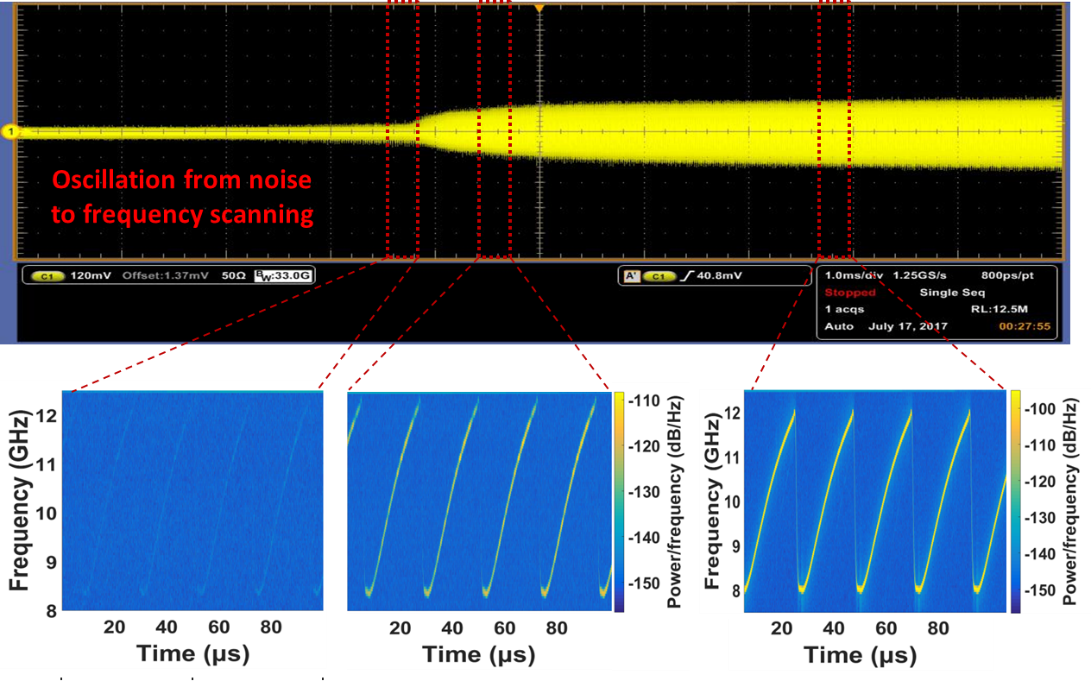
Radar and microwave communication systems have been invented many decades ago, but are still a growing area of research. For example, it is important for modern communication systems to be able to create microwave signals with fast-varying frequencies, called chirps. Optoelectronic oscillators are one way to produce ultra-low-noise microwave signals, but using them to produce a fast-varying signal with high quality is difficult, because a cavity-like component is used to reduce noise within these oscillators, and when the frequency is changed it takes time for a new low-noise frequency signal to build up in the cavity. In work published last month, we showed it is possible to have many frequencies oscillating in the system at once, so that the frequency can be changed rapidly without waiting for this build-up time. These simultaneous oscillations, all with locked phases, are made possible in a scheme known as Fourier-domain mode locking, which was previously applied to optical signals in lasers, but in this work is applied to microwaves using an optoelectronic oscillator .

An optoelectronic oscillator is like a laser, except that it has an optoelectronic cavity rather than a pure optical cavity. Although frequency-tunable optoelectronic oscillators have been widely studied, it is still a challenge to achieve continuous frequency scanning. Following the demonstration of frequency scanning lasers based on the Fourier domain mode locking technique in recent years, we wondered if it would be appropriate to extend this mode-locking principle to an optoelectronic oscillator.

In order to apply this technique to an optoelectronic oscillator, we needed a filter that could scan the selected frequency very rapidly — faster than what is made possible by most electrical schemes — so we decided to employ a microwave photonics solution that could perform faster tuning than electrical solutions.

One of the research interests of our group is semiconductor lasers. It is known that the lasing frequency of certain kinds of semiconductor lasers can be tuned by changing the driving current in a fast way. Fortunately, the passband of a microwave photonics filter based on phase-modulation to intensity-modulation conversion is related to the lasing frequency of the signal laser. Thus we achieved a fast frequency scanning microwave photonics filter by sweeping the frequency of the signal laser. Continuous frequency scanning microwave waveforms with very large time-bandwidth product are generated based on a Fourier domain mode locked optoelectronic oscillator. We run simulations that show that a Fourier domain mode locked optoelectronic oscillator oscillates in the same way as a conventional single-mode optoelectronic oscillator that uses the same optical and electronic components, except that the energy is shared by the many oscillation modes.

The employment of a Fourier domain mode locking technique in an optoelectronic oscillator provides an effective solution to generate frequency scanning microwave signals with large time-bandwidth product, which can find applications in radar and communication systems.

Ming Li

Reference: Hao T. et al, Breaking the limitation of mode building time in an optoelectronic oscillator. Nat. Commun. 9, 1839 (2018)

Built on instability 

Post by Daniel Rayneau-Kirkhope and Marcelo Azevedo Dias

Built-in motion

From hierarchical architectures to complex composites, nature’s inventive use of geometry yields remarkable functionality from some rather unremarkable construction materials. This same control of geometry alongside a mastery of mechanics is used to transform elastic ‘failure’ into a crucial ingredient in the inner working of plants and organisms. Nature employs elastic instability so that large-scale motions can be triggered by the smallest and most specific stimuli. The Venus flytrap is perhaps the best-known example of this design philosophy — swelling induces an elastic instability that allows its leaves to snap between two stable configurations [1]. Using this snap-through behaviour, the plant moves quickly to capture its prey, allowing for the slow process of digestion to begin. Bacteria exhibit another beautiful example of this design paradigm, whereby their flagella, which are used to create thrust, buckle into a secondary configuration allowing the bacteria to control direction [2].

It is only recently that designers have started to use loss of structural stability in a similar manner. From merely being a mode of failure, buckling has become an increasingly well-trodden route to introducing novel functionality in the design of man-made structures and materials on many different length scales. This transition in perspective has been encapsulated as a move from ‘buckliphobia’ to ‘buckliphilia’ [3].

A powerful example of this paradigm is the use of buckling to turn simple geometries into mechanical machines: work in Physical Review Letters recently demonstrated that the buckling-unbuckling transitions in a hollow spherical shell can be used to create thrust in spherical swimmers [5]. It is well known that a spherical shell will buckle into a new geometry when the internal and external pressures are sufficiently different; as this deformation is elastic, the structure can return to its initial configuration when the pressure differential is removed. It was found that the asymmetry of geometries in the process of buckling and unbuckling allows for a net thrust to be created by cycling through these geometries while the structure is immersed in liquid. Continue reading

DIY science: open source and low-cost instruments

Post by Michael Paolillo.

Without hardware there is no science. Equipment, reagents and consumables are all paramount for the execution of experiments, collection of new data and generation of new knowledge. Coupled with the movement for open science, many groups and initiatives are pushing to make Open Science Hardware the new norm in labs worldwide. We interviewed one of the founders of one such initiative, Prometheus Science, that is working to develop easily accessible and usable open science hardware starting from published academic research.

Can you introduce yourself and tell me what are Prometheus‘ goals as a company?
I am André Maia Chagas and I have been with Prometheus since the first tinkering phases. I work on this project with Dr. Maira Bertolessi. Together, we aim to increase the availability of science and education tools by creating affordable, open-source, scientific-grade equipment. We are heavily involved in the open-source and do-it-yourself movements. We are proud to say that our product, the FlyPi, can now be found across the world in more than 10 countries, such as Chile, Argentina, Nigeria, USA, Sweden, France and Germany.

Picture courtesy of Pierre Padilla

You mentioned the FlyPi, what is that?
The FlyPi is our ‘proof of principle’ product, started as a collaboration with the NGO Trend in Africa. It is an open-source compact modular imaging system built out of 3D-printable parts and off-the-shelf electronic components. It is highly modular, so it can be adapted to unique experimental conditions. We have published work demonstrating that the FlyPi can be used for diagnostics and state-of-the art methods in neuroscience, such as optogenetics, calcium imaging, behavioural tracking and fluorescence imaging. As far as the price goes, even after building all the modules, it is still 10−20 times cheaper than traditional systems.

Tell me more about the open-source movement.
Well, the open-source movement started a while ago, mainly with software. The basic idea is that all plans/blueprints describing a piece of software, a protocol, a recipe or a piece of laboratory equipment are made freely available for people to comment, share, modify, improve and customize. This leads to the creation of communities where everyone can build off each other’s ideas and creations. We have held workshops in various countries in Europe and Africa to teach people how to build and use the FlyPi. We also focus on showing people how to use the available open-source technology out there to build their own scientific equipment. It has been an inspiring experience to see how access to a dynamic and powerful new tool like the FlyPi can transform a community and inspire a group of young scientists. We believe that by empowering people with these scientific tools we can increase access to science education and improve the way research is done. For example, we now have an online forum consisting of people from around the world who are develop tools to improve upon the FlyPi’s design.

Can you tell us about what your plans are now?
Of course. There are a lot of published scientific papers describing new open-source equipment, but  normally the researchers who publish the articles are not interested in bringing the tools to a wider market. This is due mostly to the large time commitment and to the fact that academics’ main concern is to do more research. This is a problem, since many people do not have the necessary skills to build these tools from the original blueprints, or have time to spend doing so. This is what we at Prometheus want to do next. We aim to identify interesting open-source equipment described in the literature and to work with the researchers to find a way to bring their designs to market. Researchers interested in bringing their designs to a wider audience can contact us directly at andre[at]prometheus-science.com.

Where can we learn how to get involved with Prometheus?
You can find us at prometheus-science.com and we welcome conversations with open arms on our forum. Come check us out!

Michael Paolillo is a PhD student in Biochemistry and Neuroscience in Tübingen, Germany and he is passionate about science communication. He also created the website Neuromag.net, a science communications website that accepts interesting articles about science around the world.

Picture courtesy of Aga Pokrywka

Spreading the love of light

Post by Nina Meinzer and Heather Partner

If you have been following this blog for the last few weeks you will already know that some of us at Nature Research really love the science of everything light and its applications. But we didn’t want to stop at talking about different wavelength ranges on the internet, we also wanted to go out there and talk to people directly; and this being the International Day of Light (IDL), we didn’t limit our outreach events to only one country either.

Enlightening the next generation

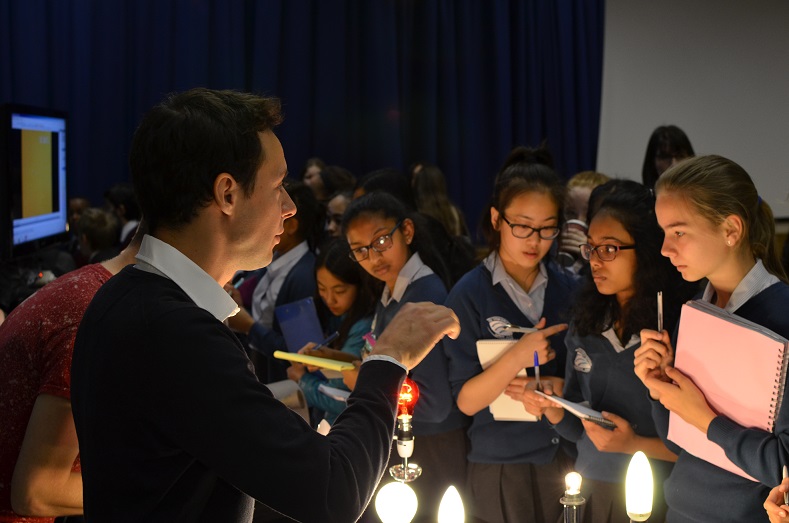
In London, we went on a journey to the (for us editors) fairly undiscovered country of schools outreach. Thankfully, we found a great partner in UCL who soon took the lead in organising the lectures and the hands-on science stations.

The three short lectures nicely showcased the interdisciplinarity of the IDL. For the first one Andrea Sella joined us from the chemistry department and, after asking the house lights in the lecture theatre to be turned down completely for a moment, talked about how light is generated by fluorescence. But instead of reaching into the chemicals cabinet, he reached into the kitchen cupboard and demonstrated fluorescence from olive oil, chlorophyll (extracted from greens) and even Marmite. The archaeologists Charlotte Friersen and Anne de Vareilles then recapped a million years of humans controlling light, which until the late 19th century meant light from fire. Finally, we delved underwater with Danbee Kim to learn about the vision and the variable colouring of cuttlefish, who can see polarization and whose skin pattern shows their success in hunting shrimp.

Of course, 240 11- to 13-year-olds won’t sit in lectures for a whole day, and science isn’t that much about listening to other people telling facts anyway. The lectures were therefore embedded in two interactive sessions where the students could get more involved in a range of demonstrations: changing the colour of an LED to one of their choice, learning about spectroscopy and its uses for astronomy, getting their brain imaged while doing some maths, and playing with reflection, diffraction and polarization (among other things). Here, they could also speak to active scientist and — unknown to them — a few of our editors who revisited their own research days by helping out on a station. The students also found out that they could get more involved with science themselves in one of the many citizen science projects at UCL.

The day was an enormous success and both the teachers and students told us that they enjoyed themselves greatly and at the same time learned a lot. For us volunteers, seeing the fascination on their faces when they heard about some of the fun and interesting things scientist can do with light, was the best reward we could have wished for.

Bright lights, bright people

Volkhard Kempter — True Lite Standard II (1998) and Don’t look now! – 50 Hz (2017)

In Berlin, we celebrated the Day of Light with an evening at the Springer Nature building. The main event was a public lecture A Closer Look: Seeing atoms with a Laser by Professor Oliver Benson of the Humboldt University of Berlin. He shared his knowledge about lasers with us by first discussing some of the history of their development and the basic concepts behind coherent light. He went on to explain how we use lasers to see the basic pieces of matter — atoms and molecules — including an acoustic analogue demonstration of how monochromatic waves can be coupled resonantly into an atom. Finally, during the questions, Professor Benson shared his views about which future technologies could become as influential as the laser.

As a pre-programme, 5 PhD students met our challenge for them to describe their PhD projects to the audience in 3 minutes each, which as one organiser pointed out, is equivalent to reducing the novel War and Peace to a few words. From research on magnetic memories, biological imaging and flexible displays to measuring gravity and recycling plastic — all using light as a key ingredient — the students managed to explain the essence of their work in only a few minutes. The most popular pitch, selected by the audience via smartphone voting, was Juggling atoms to measure gravity presented by Bastian Leykauf of the Humboldt University of Berlin. As a thank you, all speakers received the very fitting memoir of Theodore Maiman.

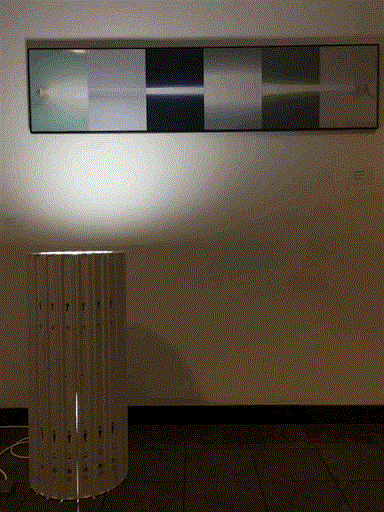
Light is not only a topic of science; it also influences our daily lives and culture. To complement the scientific programme, through the Centre for International Light Art in Unna, Germany we joined forces with an artist, Volkhard Kempter, based in Berlin. His work uses light and darkness, and the question of how one evokes the other, as a central element. He brought two installations to our venue for the event: True Light Standard II, a circle of irregularly flashing fluorescent tubes facing inward to form a flickering, very bright source which attracts attention, but is too bright to look into, and Don’t look now! – 50 Hz, a photomontage of 6 different states that a fluorescent tube goes through while being switched on, that we wouldn’t usually notice in the brief moment it takes for the light to arise. These displays provided an opportunity to contemplate how pervasive artificial light is in our lives, which we hope our guests took home with them after they left.

Interactions: Conversation with Serhii Plokhy

Post by Christine Horejs

Plokhy Serhii_photo by Tania DAvignonSerhii Plokhy is professor of history at Harvard University and author of the book ‘Chenorbyl – The history of a nuclear catastrophe’, released last week. In his book, he tells the complete history of the nuclear disaster of Chernobyl, from the Soviet excitement about nuclear energy, to the details of the explosion of unit 4, the clean-up, the devastating effects for the people living in Pribyat and the political consequences, culminating in Gorbachev’s policies of glasnost and perestroika and ultimately, the end of the Soviet Union. In Serhii Plokhy’s book, the reader gets to know the personalities involved in the Chernobyl disaster – the director of the nuclear power plant and his family, the operators, the firemen known as liquidators, the doctors in the hospitals trying to handle a disease that they were not trained to treat and the Russian and Ukrainian politicians, who tried their best to hide what had happened. Serhii Plokhy’s book is as compelling as a novel and describes this tragedy not only from a scientific, but also from a political and personal perspective, which makes it a strong testimony to the good and bad of science, and to what can happen if political and scientific responsibility is not taken seriously.

We talked to Serhii Plokhy about his new book and the stories behind it. 

How did the idea for the book ‘Chernobyl’ take shape?

I was interested in the topic for quite a while — after all as someone who lived in the Ukraine in 1986, I knew very well that my own life and the life of many of my friends were affected by the catastrophe. The final decision came on a trip to the Chernobyl Exclusion Zone. I realised then that I had to tell the story of Chernobyl for those who were not around at the time.

How was your visit to Pripyat? Would you recommend it?

It was a useful experience, not only for me as a historian and a writer, but also as a human being. You have to see this place to understand the enormity of what has happened and to feel how vulnerable we are as humans. Continue reading

Radio frequencies: The many lives of radio waves

Post by Patrick Michelberger

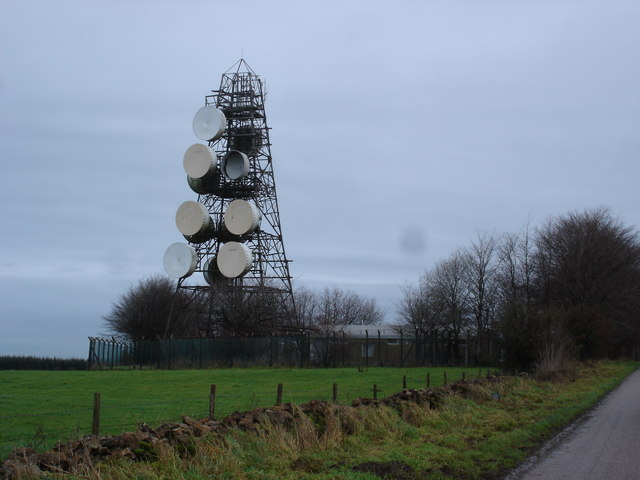
microwave-link

The radio frequency (rf) range is one of the most technologically exploited portions of the electro-magnetic spectrum. Although the definition is not strict, the rf spectrum commonly refers to waves with frequencies between 20 kHz and 300 GHz. This also includes microwaves, which have frequencies stretching from 300 MHz to 300 GHz. Rf technology was discovered in the early days of modern physics, and it quickly became the cornerstone of mass media broadcasting. Unlike optical signals at higher frequencies, rf waves are generated with electronic circuits comprising a capacitor and an inductor. In these so-called LC circuits, electronic charge carriers can be made to oscillate and, as a consequence, emit electromagnetic radiation at the desired frequency. The faster the oscillation and the smaller the corresponding circuit, the higher the frequency of the emitted waves; amplitude and frequency modulation of the produced waves enables the encoding of information.

Today, nearly all of the rf region plays a role in some form of human communication. Waves in the low (below 30 kHz) to middle (below 300 kHz) range, for instance, bend around the earth and penetrate deeply into water: they are used to contact submarines and set radio clocks. Other well-known examples are television and mobile phone signal transmission, which relies on waves at higher frequencies (below 3 GHz). In the latter – densely populated – portion of the rf spectrum, a recent switch from analog to digital television (which is less demanding in terms of bandwidth) has freed up some bandwidth for mobile data services. Until the 1980s, transmission lines for large amounts of data – the backbones of communication networks preceding the internet, in a sense – operated on microwave links (corresponding to frequencies below 300 GHz). This changed with the advent of solid-state lasers and optical fibres: thanks to the larger bandwidth offered by short laser pulses, optical fibre networks are now the prime technology for the internet. As a result, microwaves seem to have gone somewhat out of fashion – or have they not?

In fact, microwave links have recently enjoyed a revival of interest thanks to a lucrative application known as high-frequency trading. In this area of finance, profit derives from a speed advantage in buying and selling financial instruments such as stocks and currencies. For instance, high-frequency traders will try to profit from small discrepancies on the prices for a single asset traded on different trading venues: if you buy at the cheaper venue and ‘simultaneously’ sell at the more expensive one, you will make a positive return. This sounds surprisingly simple, yet such trading strategies strictly require fast access to both venues in order to detect an opportunity and exploit it before anyone else does. Standard optical fibre networks do not live up to this tight requirement, mainly because fibres do not necessarily run in straight lines between venues such as stock exchanges – for which reason light pulses have to travel additional distances and pick up undesired time delays. Even if there were direct connections, optical fibres’ higher refraction index means that light travels through fibres 1.5 times slower than microwaves propagate in air. To ensure an advantage in this high-stakes game of micro- and nano-seconds, traders have thus reverted back to building private direct microwave links between exchanges: examples of existing links can be found between London and Frankfurt or between Chicago and New York. So beware – never underestimate the reach of radio waves.

Patrick Michelberger
Associate Director – Quantitative Research
Record Currency Management
Morgan House, Madeira Walk,
Windsor, SL4 1EP