Talk about Citations

Last night the British Library held the first of their Talk Science events. The topic of the evening was ‘Citation in Science – don’t quote me on that’ and it was hosted by Tim Birkhead, is Professor of Evolutionary Biology at the University of Sheffield. Back in January Tim wrote a piece for the Times Higher Education suppliment

discussing citation in science, and specifically mis-citation in science. This formed the core of the

discussion last night. Tim chatted about his views on the topic for about 20 minuets and then opened it up to the floor. There were a great diversity of people present, from publishers, funders, senior academics, journalists, PhD students

to library staff. There may even have been some elusive members of the genreal public (if so they were keeping quiet.) The discussions mainly revolved around the burden of perr review, the way that citation metrics change the practice of science, and how citation should be viewed and practised. I found the discussions very informative. It’s a big topic, and one that is bound to get most academics animated, one way or antoher. One area the we have discussed on this blog from time to time is how people can get credit for work outside of the traditional peer reviewed literature, and this didn’t really

come up last night, but that again is a topic worth spending more than a little time discussing. They also served some free booze, and we all got a choclate bar (which I am polishing off as I type this). The discusison has rolled over to Nature Network so you can head over and join in if you wish.

Talk about Citations

Last night the British Library held the first of their Talk Science events. The topic of the evening was ‘Citation in Science – don’t quote me on that’ and it was hosted by Tim Birkhead, is Professor of Evolutionary Biology at the University of Sheffield. Back in January Tim wrote a piece for the Times Higher Education suppliment

discussing citation in science, and specifically mis-citation in science. This formed the core of the

discussion last night. Tim chatted about his views on the topic for about 20 minuets and then opened it up to the floor. There were a great diversity of people present, from publishers, funders, senior academics, journalists, PhD students

to library staff. There may even have been some elusive members of the genreal public (if so they were keeping quiet.) The discussions mainly revolved around the burden of perr review, the way that citation metrics change the practice of science, and how citation should be viewed and practised. I found the discussions very informative. It’s a big topic, and one that is bound to get most academics animated, one way or antoher. One area the we have discussed on this blog from time to time is how people can get credit for work outside of the traditional peer reviewed literature, and this didn’t really

come up last night, but that again is a topic worth spending more than a little time discussing. They also served some free booze, and we all got a choclate bar (which I am polishing off as I type this). The discusison has rolled over to Nature Network so you can head over and join in if you wish.

Thinking our way to the future

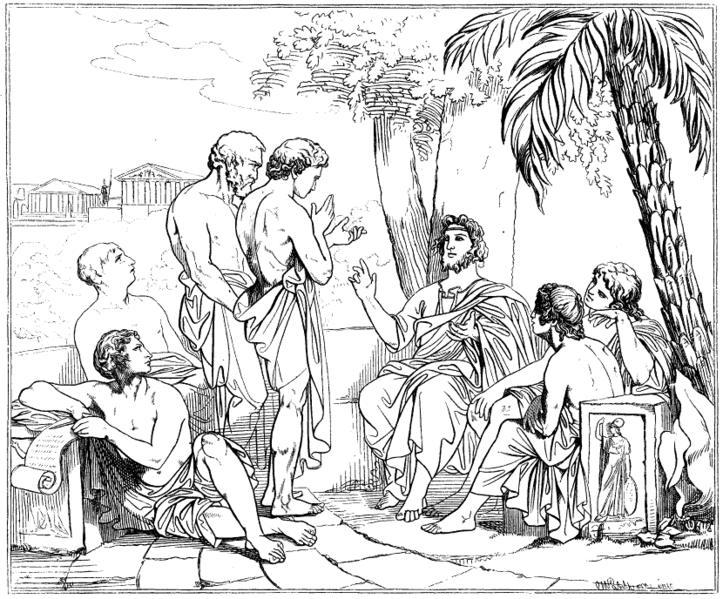
723px-Plato_i_sin_akademi_av_Carl_Johan_Wahlbom_ur_Svenska_Familj-Journalen.png

Prediction Markets

have had an interesting role to play in many areas of business and in some cases

have produced interesting results

about the markets, not least the predictions.

We experimented with Inklinkg for a while to run a

very small prediction market amongst web publishing people a few months ago, and we correctly

predicted that it was going to snow, but we only got about 5 people using it so it sort of

died off quietly. In spite of this there was a strong feeling that this kind of thing

could be really interesting for science and so a few weeks ago when I came across the

X2 club I was really intrigued. It’s a project from

the Institute of the Future group which is an independent

research group based in Palo Alto.

The X2 club is named after the X club, a dinner club

of influential scientists in London in the 1850’s. The aim of the project is to assemble predictions about the near

and medium future through crowdsourcing. You can add a signal

to the site, which is essentially a link to a piece of news with a short explanation of why this news points to some future trend.

That’s not so novel, but what is is that you can then assemble together signals that come in to the site to create a

Forecast about the future. What is also really innovative is that

editors on the site pull together specific signals and forecasts and present games to the community. A game is an invitation

to write about the future form a perspective imagining that that future had come into existence.

The amount of content on the site is currently quite small, a few hundred members signed up, a few dozens of signals contributed, but the quality of the contributions to date has been very high.

Thinking our way to the future

723px-Plato_i_sin_akademi_av_Carl_Johan_Wahlbom_ur_Svenska_Familj-Journalen.png

Prediction Markets

have had an interesting role to play in many areas of business and in some cases

have produced interesting results

about the markets, not least the predictions.

We experimented with Inklinkg for a while to run a

very small prediction market amongst web publishing people a few months ago, and we correctly

predicted that it was going to snow, but we only got about 5 people using it so it sort of

died off quietly. In spite of this there was a strong feeling that this kind of thing

could be really interesting for science and so a few weeks ago when I came across the

X2 club I was really intrigued. It’s a project from

the Institute of the Future group which is an independent

research group based in Palo Alto.

The X2 club is named after the X club, a dinner club

of influential scientists in London in the 1850’s. The aim of the project is to assemble predictions about the near

and medium future through crowdsourcing. You can add a signal

to the site, which is essentially a link to a piece of news with a short explanation of why this news points to some future trend.

That’s not so novel, but what is is that you can then assemble together signals that come in to the site to create a

Forecast about the future. What is also really innovative is that

editors on the site pull together specific signals and forecasts and present games to the community. A game is an invitation

to write about the future form a perspective imagining that that future had come into existence.

The amount of content on the site is currently quite small, a few hundred members signed up, a few dozens of signals contributed, but the quality of the contributions to date has been very high.

Where are we, where are we now?

screen-capture-1.png

When Jeff Jonas came in a few weeks ago to give a talk he stressed the

importance of what – where – who – when questions for understanding

what is going on within corporations. Science too is generally

concerned with figuring things out, and earlier this month Nature ran an

editoral pointing out that “Among the basic elements of scientific

record-keeping, too often the ‘where?’ gets neglected. Now advances in

satellite-positioning technology, online databases and geographical

information systems offer opportunities to make good that neglect”, so

it was coincidentally very timely that in the same week we had Tom Coates and

Seth Fitzsimmons come in to talk to us about some of the work that they

have been doing at Brickhouse, the Yahoo! R&D incubator located in San

Francisco. They specifically came in to talk about Fire Eagle, a location

brokerage service, but before getting into the specifics of Fire Eagle

Tom talked a little about Brickhouse and some of the stuff that is

coming out of there.

Continue reading

Where are we, where are we now?

screen-capture-1.png

When Jeff Jonas came in a few weeks ago to give a talk he stressed the

importance of what – where – who – when questions for understanding

what is going on within corporations. Science too is generally

concerned with figuring things out, and earlier this month Nature ran an

editoral pointing out that “Among the basic elements of scientific

record-keeping, too often the ‘where?’ gets neglected. Now advances in

satellite-positioning technology, online databases and geographical

information systems offer opportunities to make good that neglect”, so

it was coincidentally very timely that in the same week we had Tom Coates and

Seth Fitzsimmons come in to talk to us about some of the work that they

have been doing at Brickhouse, the Yahoo! R&D incubator located in San

Francisco. They specifically came in to talk about Fire Eagle, a location

brokerage service, but before getting into the specifics of Fire Eagle

Tom talked a little about Brickhouse and some of the stuff that is

coming out of there.

Continue reading

Barcamb2 announced

screen-capture-4.png

Barcamb 2 has just been announced. This is a bar camp that is hosted by the Sanger institute in Cambridge with a focus on technologies related to science. Last year’s was a blast, and you can read a writeup of that event.

The organisers have set up a Meetup Page where you can sign up for the meeting, and a Barcamb Wiki describing the event.

If you have a chance to make it you should definitely try to get along.

Barcamb2 announced

screen-capture-4.png

Barcamb 2 has just been announced. This is a bar camp that is hosted by the Sanger institute in Cambridge with a focus on technologies related to science. Last year’s was a blast, and you can read a writeup of that event.

The organisers have set up a Meetup Page where you can sign up for the meeting, and a Barcamb Wiki describing the event.

If you have a chance to make it you should definitely try to get along.