Science on the mall

It was truly stirring to be in Washington DC on the national mall during the inauguration. No matter what your politics, it’s difficult to not be moved by the presence of so many people who want the best for their country.

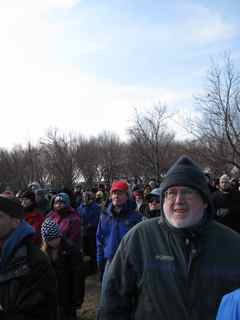
I slipped in the back, near the Lincoln memorial, where the crowd was happy but low-key. No huge “Obama” chants, like the hard-core fans pressed in closer to the capitol, but a lot of rapt listeners, cheering at lines like Obama’s pledge to uphold the bill of rights.

I had my own cheers. Funny, nobody joined me in the chant for Steve Chu, our new energy secretary, when he appeared in the lineup before the speech. Then he said it: “Science!”

Obama said the word right up front, when he laid the groundwork of what his new administration would be about:

We will restore science to its rightful place and wield technology’s wonders to raise health care’s quality and lower its costs.

I started the science-O-meter during the presidential debates. Obama handily beat McCain, using the word “Science” at least twice as often. But while the inauguration was historical in many respects, it was not as measured by the Science-O-meter. The word has been used in inauguration speeches before, for instance by Woodrow Wilson and John F. Kennedy, who wielded it with more sinister undertones:

Finally, to those nations who would make themselves our adversary, we offer not a pledge but a request: that both sides begin anew the quest for peace, before the dark powers of destruction unleashed by science engulf all humanity in planned or accidental self-destruction.

Let both sides seek to invoke the wonders of science instead of its terrors.

I like to think by using the word Obama also meant something broader, that his policies will be driven more by facts than ideology. That seems evident in the phrasing he used to convey his core governing philosophy:

The question we ask today is not whether our government is too big or too small, but whether it works, whether it helps families find jobs at a decent wage, care they can afford, a retirement that is dignified.

After the inauguration I walked along the river towards Georgetown. Waved goodbye to Bush’s helicopter and went and ate lunch at Clyde’s restaurant. I drank and talked late into the night with my friends, wondering how anyone could manage to go to one ball, much less ten.

Now the work begins—and the science-O-meter keeps on ticking.
inauguration.jpg

Leave a Reply

Your email address will not be published. Required fields are marked *

Display Your Connotea Bookmarks on your Site.

We have developed a little piece of javascript so you can now show off your recent Connotea bookmarks on your site! You can check out how to do it here, and you can keep up to date with our updates and new features on the Connotea Blog. Below is a screen shot, and you can see it live (but unstyled, cos I’m old skool like that) my own homepage.

screen-capture.png

Leave a Reply

Your email address will not be published. Required fields are marked *

EGU: World’s “water towers” under threat

398px-Reservoir_in_the_Rocky_Mountains.jpg

I’m in sunny Vienna this week for the European Geosciences Union general assembly, a yearly gathering where several thousand scientists abandon their field and lab studies for an entire week to get together and talk earth, planets and space.

With over 8,000 participants, this year’s meeting, held at the Austria Vienna Centre on the banks of the Danube, will be the society’s largest yet.

Climate change and energy occupy sizeable slots on this year’s programme; hence my schlep across to Austria to meet with some of the authors behind the 12,000 abstracts.

Following from a spate of recent coverage in Nature and on NRCC, the threat of a warming world on global water resources emerged here today as one of the issues du jour. This time, the question was whether the world’s water supplies from mountains and highlands, known as the world’s natural “water towers”, will still be able to quench our thirst in fifty years.

Speaking at a press conference here this afternoon, hydrologist Daniel Viviroli of the University of Bern in Switzerland explained that these “water towers” supply on average three to five times more runoff to rivers than do lowland areas and are a primary water source for most of the world’s major rivers.

This is especially important in dry regions where water is in short supply and in mountainous regions with glaciers that supply runoff from snowmelt in spring.

On a global level, 7% of mountain regions have a key role in supplying water to lowlands and their dependant populations. From the Rocky Mountains supplying the Colorado River Basin to the Lesotho highlands supplying South Africa, the water runoff from such “hotspots” is likely to diminish in the future, the scientists warned.

A further 37% play a crucial supporting role, said Viviroli, and may also be under threat, though he added that the timescale and nature of such changes are, as of yet, highly uncertain.

One of the issues, highlighted by Bruce Molnia of the US Geological Survey, is that in some regions such as North America and Afghanistan, the period of runoff is now shorter because snow arrives later and melts earlier.

Given that 70% of the world’s population is based in lowland regions with natural “water towers” providing both drinking water and faciliatating food production, many millions could be affected.

Carmen de Jong, a research scientist who works on the Europena Alps, said that in some areas where glaciers are small, the water supply from high elevations could be gone in 30 years time unless there is enough precipitation in summer time to compensate for the loss.

Philip Mote, research scientist at the University of Washington, warned that we need to be careful about specifically attributing all such changes to anthropogenic warming, adding that the most serious human impacts in fifty years time will likely be south of 50 degrees latitude.

I’ll be blogging throughout the week until the conference ends on Friday, so tune in here daily for the highlights on climate change and energy from EGU 2008. My colleague Quirin Schiermeier will also be blogging over on the Nature’s In the Field blog with coverage from the climate and energy streams and more.

Olive Heffernan

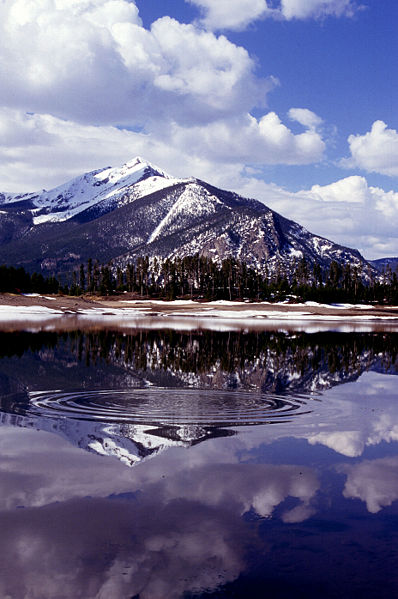
Photo: Snowmelt runoff fills a reservoir in the Rocky Mountains near Dillon, Colorado. Credit: Scott Bauer, US Agricultural Research Service.

Leave a Reply

Your email address will not be published. Required fields are marked *

Nature Podcast 23 Aug 2007

This week the Nature Podcast discovers that diamonds really are forever, meets a mouse with obsessive compulsive disorder and a new species of ape, and discusses what to do with overabundant elephants in Africa.

Listen | About

To SUBSCRIBE to the Nature Podcast for FREE copy and paste this URL into iTunes or your preferred media player or RSS reader:

https://www.nature.com/nature/podcast/rss/nature.xml

Leave a Reply

Your email address will not be published. Required fields are marked *

Nature Podcast 23 Aug 2007

This week the Nature Podcast discovers that diamonds really are forever, meets a mouse with obsessive compulsive disorder and a new species of ape, and discusses what to do with overabundant elephants in Africa.

Listen | About

To SUBSCRIBE to the Nature Podcast for FREE copy and paste this URL into iTunes or your preferred media player or RSS reader:

https://www.nature.com/nature/podcast/rss/nature.xml

Leave a Reply

Your email address will not be published. Required fields are marked *

I am the Lorax. I speak for the trees…

While flipping through yesterday’s issue of Nature, I came across the special report on toxicology/toxicologists in the Naturejobs section… After struggling to get that infernal Britney Spears song out of my head, I read through the article, which really made toxicology sound like an interesting career…

Ricki Lewis wrote that a “career in toxicology might take a scientist to a contaminated well, a crime scene, a courtroom, an analytical chemistry lab or a political hearing” and “it isn’t uncommon for a seasoned scientist to have spent time in academia, industry and government, and finish with private consulting.” Considering how successful shows like CSI and Numb3rs are, I’m a bit surprised that no one’s produced a prime-time TV drama starring toxicologists (I can see it now – EPA: Risk Assessment Unit…)

There’s also a nice News & Views article by Robert Crabtree on a recent Science paper from the Goldman and Brookhart laboratories – in the presence of an iridium catalyst and a Schrock metathesis catalyst, the authors reported that a tandem alkane dehydrogenation/olefin metathesis reaction could be used to elongate inert hydrocarbon chains (technically, it’s a tandem alkane dehydrogenation/olefin metathesis/alkane hydrogenation reaction, but that’s a bit of a mouthful…)

The authors hope that this system could be used “”https://www.sciam.com/article.cfm?articleID=0000F6F4-B7D4-143E-B7D483414B7F0000">turn coal, leftover oil refinery products or even plants into diesel fuel and other functional hydrocarbons." But Professor Brookhart acknowledged that “”https://www.unc.edu/news/archives/apr06/brookhart041106.htm">considerable improvements in the catalyst systems are required before they become practical."

Joshua

Joshua Finkelstein (Associate Editor, Nature)

Leave a Reply

Your email address will not be published. Required fields are marked *

Linda Stone visits Nature

Linda Stone, formerly of Apple and Microsoft (but not at the same time ;), and now of “continuous partial attention” fame, came to visit Nature’s office in London last week and delivered a great talk about how we can use technology to feel more fulfilled and less overwhelmed. It contained some similar themes to her excellent ETech talk in March, but also some new stuff. Here are my rough notes to give a feel for what Linda spoke about.

(more…)

Leave a Reply

Your email address will not be published. Required fields are marked *