Science Stories From Around Town

A trio of unrelated snippets that reached me this week.

I’ve had a busy week of previews. As well as the new James Watt exhibition at the Science Museum and Wellcome Collection’s new show about Dirt, I also attended a long-lead preview about the British Library’s forthcoming Science Fiction exhibition. It’s going to be a corker, trust me. They’re digging right back to the earliest roots of the genre, with copies of a 17th century story that first speculated on weightless spaceflight. Other exhibits will tackle possible futures, cyberspace, end-of-the-world scenarios and more. The show will be supported by Discovery Channel, whose TV tie-ins include a new show called Through The Wormhole with Morgan Freeman. Which made me snigger, if not the stoic journos sitting next to me. The exhibition doesn’t open till May, which is two months away for most of us, or this afternoon if you have a time machine.

Frank Norman, late of this parish, sends me a link to an archaeological dig at the future UKCMRI site. The plot of land behind the British Library will shortly be developed into a world-class biomedical research facility. In the meantime, however, it’ll be scrutinised by trowel-wielding archaeologists. They’re not sure what they’ll find. The site has a long industrial heritage, but is also close to the ancient (as in early Saxon) site of old St Pancras church, and close to the banks of the River Fleet. The public will get a chance to view the dig and learn more about the plans for the site at various dates in late April.

Finally, the Standard picks up on a story about UCL researcher Kevin Pickering, whose team are working on a project to help predict earthquakes in the regions around Japan. In a huge project involving many international scientists, a hole will be dug four and a half miles below the sea bed, allowing monitoring equipment to get data on plate movements.

Dirt, Filthy New Exhibition At Wellcome Collection

I’m not sure I’ve walked into a room full of excrement before. Five slabs of faecal matter, arranged under mood lighting like some scatological Take That tribute act. Very strange. Such is the wont of the Wellcome Collection, which habitually lines its galleries with unlikely wonders.

I’m walking around their new exhibition Dirt. It opens to the public today, and is their best show for a while. The sculpted rhomboids of poo are the least of it.

Dirt might seem a rather limiting theme, but the curators insist they had the opposite problem. As they sat down to plan the exhibition, they discovered that just about everything on earth has some connection to dirt.

To try and build in some kind of focus, the show is split into six zones — like a feculent version of the Crystal Maze. The most interesting, to me at least, was the section on London’s grimy history. You can probably guess most of the content. The Great Stink, Bazelgette’s sewers, and the oft-told story of John Snow’s cholera investigations are all given prominent billing. You might not have been aware, however, that Nature’s London offices were built right next door to this mountainous pile of Victorian crap.

It’s pretty much where King’s Cross Station sits today. Some of the dust was used to make the bricks that went into the station. The rest was transported to Moscow to help rebuild the city after a war. Remarkable.

Elsewhere in the exhibition, you’ll find ideas as diverse as Nazi racial purification, 18th Century Dutch cleanliness, early antiseptics, micrographs of bacteria and the conversion of the world’s largest landfill (on Staten Island, since you ask) into a giant park.

As you’d expect, the exhibition is supported by a long series of events. Check out the programme here.

Dirt at Wellcome Collection runs until 31 August and entrance is free.

James Watt’s Magical Retreat Opens At Science Museum

The Science Museum seems to be opening new galleries at a rate of knots. Appropriate, then, that its latest exhibition features the life and works of that hero of steam and power James Watt.

wattworkshop.jpg

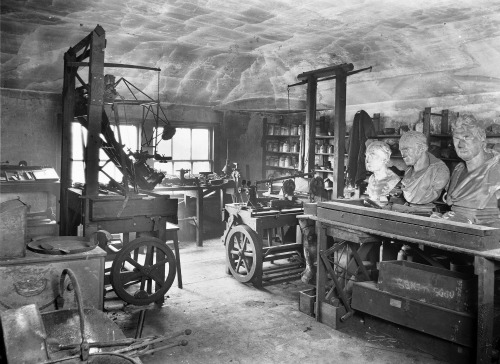
The attic workshop of the industrial icon has been reassembled as the centrepiece of the new exhibition. And, unbelievably, it’s all genuine:

When Watt died in 1819, his workshop at his home near Birmingham, was locked and its contents left undisturbed as an ‘industrial shrine’. Then, in 1924, the complete workshop, including its door, window, skylight, floorboards and 6,500 objects used or created by Watt, were carefully removed and transported to the Science Museum. Although the workshop has previously been displayed at the Museum, visitors have never been invited inside until now.

The objects include the earliest surviving sandpaper and the world’s first circular saw. It’s remarkable that the museum has been sitting on such a treasure trove all these decades.

Here’s brains-about-town Adam Hart-Davis to introduce the exhibition:

You are currently viewing a placeholder content from YouTube. To access the actual content, click the button below. Please note that doing so will share data with third-party providers.

More Information

James Watt and Our World opens on 23 March at the Science Museum.

Science Events In London This Week

Monday

Come along to the Royal Institution tonight (7pm) to take part in the bi-monthly scientific ‘pub’ quiz. It’ll be co-hosted by the RI’s Martin Davies and me (assuming my cold doesn’t get worse).

Tuesday

Derek Yellon delivers UCL’s free lunchtime lecture (1.15pm), describing what happens to the cells of the heart during cardiac arrest and how surgeons might improve the patient’s condition without causing further damage. In the evening, Peter Atkins is at the Royal Institution to discuss the limits of science. That starts at 7pm and will set you back a tenner.

Thursday

Tonight’s Bakerian Prize lecture at the Royal Society (6.30pm) sees Cambridge’s Prof Herbert Huppert talking about carbon storage technologies. Entrance is free and on a first-come first-served basis. On a related theme, long-serving weatherman Michael Fish is at Kew Gardens to give a talk on climate change. Tickets are £5 and can be bought on the door.

Friday

Back to the Royal Society for a free lunchtime lecture (1pm) on the history of autism, with Adam Feinstein. In the evening, the Royal Institution welcomes Tim O’Brien, who will talks about the wonders of modern astrophysics. Note that this discussion is only open to RI members.

Please let me know if I’ve missed anything.

Remember, these and many other events are listed in the Nature Network London events calendar.

Wellcome Trust Want To Buy The Olympic Park

The Wellcome Trust, one of the world’s largest medical charities, has reportedly put in a £1 billion bid for the freehold to the 2012 Olympics site.

The 513-acre park includes the Olympic Stadium, Aquatics Centre and Media Centre. The Trust is separately bidding to take over the Athletes Village following the games.

Were the bid to be accepted, it would greatly ease the financial situation for legacy chiefs. Money to build the park was borrowed from various bodies. Instead of paying these debts back over decades, the Wellcome (and welcome) £1 billion would allow much of the repayment to take place up front.

Such a deal would put the Trust – which has a track record of seeding science and technology business – in the driving seat to help realise David Cameron’s dream of turning the Olympic Park into a tech startup powerhouse.

The Financial Times has an in-depth account of this exciting possibility, with a few caveats.

The Scientific Tourist In London: #17 Alan Turing’s Birth Place

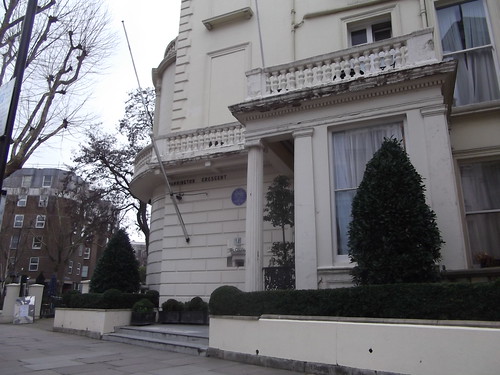
The streets of Maida Vale and Little Venice are a pleasant place to stroll. The area is characterised by wide (for London) boulevards lined with grand, immaculate houses. In one such property, on 23 June 1912, a boy named Alan came into this world. Almost 100 years on, the world is a very different place, thanks partly to Alan Turing.

The story of Turing’s life is now reasonably well known. He’s essentially famous for two great achievements: leading the successful efforts to break the German Enigma code in WWII, and laying many of the foundations of what we now know as computer science. He’s also remembered as a victim of prejudice; he was prosecuted and ‘treated’ for homosexuality during an era that took a dim view of same-sex relationships. His life ended in 1954, aged just 41, in an apparent cyanide suicide.

But everything began here, on Warrington Crescent. The birth is commemorated by a blue plaque, unveiled on 23 June 1998 (which would have been Turing’s 86th birthday). The building was a hospital at the time of Turing’s birth, but was converted into a hotel in the 1930s. According to Wikipedia, famous guests included Sigmund Freud, Liam Gallagher and Woody Harrelson.

You are currently viewing a placeholder content from Default. To access the actual content, click the button below. Please note that doing so will share data with third-party providers.

More Information

View The Scientific Tourist in London in a larger map

Drag the map around for other instalments in this series.

Science Pub Quiz: Next Monday

Just a reminder that the next science-themed ‘pub’ quiz takes place at the Royal Institution next Monday. Turn up for a 7pm start (although I’d advise getting there around 6.30-6.45 to be sure of a table in the main room. As usual, I’ll be co-hosting with Martin Davies from the Royal Institution. Entry costs £2 per person and you can take part in teams of up to five. The winners get a big old pot of money. Hopefully see some of you there (and that means you, Nature staffers).

Science Events In London This Week

Tuesday

UCL’s lunchtime lecture looks at how well neuroscience has integrated with other disciplines to produce new insights into consciousness. It starts at 1.15pm and entrance is free. In the evening, Chief Scientific Advisor John Beddington is at the British Library to discuss scientific advice during emergencies with journalist Mark Henderson. Alternatively, the Dana Centre have an evening devoted to big wild cats (free entry). Finally, in a busy day of science events, I recommend you head along to the new Grant Museum to help celebrate its big reopening.

Wednesday

An evening event at the Dana Centre called Public Bodies examines whether huge databases of medical information should be created to better understand human health and genetic makeup. Free entry. Round the corner at Imperial, David Edgerton examines the multitude of inventions created during WWII, going beyond the famous bouncing bombs and Enigma machines. Over at UCL’s Petrie Museum, meanwhile, Greenwich Observatory’s Marek Kukula discusses astronomy both ancient and modern.

Thursday

Another UCL lunchtime lecture, this time focusing on the use of Twitter for conversation, research and communication. Damn, I’ve gone over my 140 characters. In the evening, the Linnean Society has a talk on British mammals, Imperial College has a lecture on chance and gaming, and the Royal Geographical Society assesses the value of citizen science.

Friday

History of Science fans might enjoy a lunchtime talk at the Royal Society, examining the relationship between science and the church in the middle ages.

Science Fiction Movie Quiz

Schemes and Memes blog is running a short series focusing on science on the screen. By way of contribution, here’s a fun science fiction movie quiz for you to get your robotically enhanced teeth into. The questions come courtesy of the Bigger Boat Film Quiz, who put on regular movie-based pub quizzes in Brixton and Highgate. Their next event is also a sci-fi special, and takes place on 29 March in Brixton’s Ritzy.

On with the questions. Let us know in the comments how many you got right:

1. By what film title is the sci-fi character Ben Richards better known?

2. Which post-apocalyptic sequel ends with the line: “He lives now, only in my memory…” (a line stolen by James Cameron for Titanic!)

3. Which alien invasion movie begins with the line: “If this isn’t an insanely beautiful woman, I’m hanging up…”

4. What is the name of Cillian Murphy’s ship in Sunshine?

5. How much electricity is needed to power the DeLorean time machine in Back to the Future?

6. In Forrest Gump, Gary Sinise says that the day Forrest becomes a shrimp boat captain, he’ll be an astronaut. In which film did they both play astronauts?

7. Which sci-fi cult classic received the following Christian movie review: There is little content to concern parents. If you have a problem with evolution being portrayed as the origin of man, simply fast-forward the first 25 minutes and pick up from there. You’ll hardly miss a thing.

8. Which Star Wars character’s name is derived from the Sanskrit word for "warrior?

9. Which author’s works have been adapted into films starring: Claude Rains, Tom Cruise, Guy Pearce and Val Kilmer?

10. By what name is the character Strategic Artificially Intelligent Nuclear Transport (SAINT) Prototype No. 5 better known?

11. What was the first movie to be tied in with a McDonalds Happy Meal promotion?

12. What is the name of the planet ruled by Ming the Merciless that Flash Gordon lands on?

13. What is the lifespan of a Tyrell replicant in Blade Runner?

14. Which actors play the unfortunate scientist in the 80s remake of The Fly, and in the original?

15. In a poll of hundreds of scientists about science fiction films, which 2003 movie was voted the worst for crap science?

16. What is the name of the computer in 2001: A Space Odyssey?

17. War of the Worlds and I Am Legend are the top two most successful science fiction remakes so far. What’s the third?

18. By what film title is the character Leeloominaï Lekatariba Lamina-Tchaï Ekbat De Sebat better known?

In Pictures: Grant Museum Prepares To Reopen

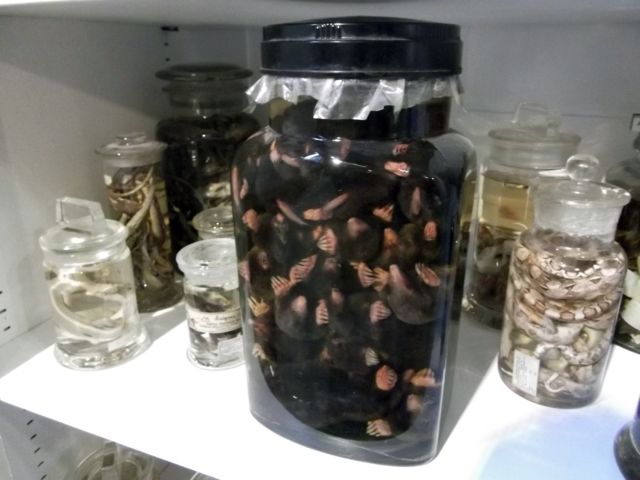
Your first task is to guess how many moles are in this jar:

GrantMolesinajar_640x480.jpg

Just one of many bizarre encounters in UCL’s Grant Museum of Zoology, almost ready to reopen after a year’s closure.

I wandered over yesterday to see how preparations are going for the big reopening. The museum’s been busy moving thousands of zoological specimens from their former Gower Street basement to an old medical library in the Rockefeller Building across the road.

The new setting is stunning. The old library fittings are intact, with skeletons, skulls, shells and pickled creatures of every persuasion crammed into wooden cabinets (some dating back to the Great Exhibition of 1851).

Your second task is to identify this mammal skeleton.

Grantanimal_640x480.jpg

All the old favourites are there: the walrus penis bone, the quagga skeleton, Elkie the giant deer, along with thousands of other specimens. The new gallery is much more spacious than the previous venue, providing better facilities for the museum’s regular events programme.

Grantskeletons_640x480.jpg

Slightly shaky image of some skeletal librarians.

Although the museum maintains an endearing Victorian air, the new venue comes with a technological twist. Ten of the more intriguing exhibits will be accompanied by interactive iPad displays, using a custom app made by UCL’s Centre for Advanced Spatial Analysis. Curators think this may be the first application of iPads to museum exhibitions. Twitter hashtags and QRCodes will also bring the museum’s curiosities into the virtual world.

Your third task is to visit this treasure of a museum at the first opportunity.

Grantspace_640x480.jpg

The museum opens to the public on 15 March. Entrance is free.