And It’s Goodbye From Me…

After more than four years writing this blog, I’ve decided it’s time to move on to other things. I’ve thoroughly enjoyed those years, making so many friends and joining in conversations with some of the sharpest minds in science. Nature Network remains an incredible collection of voices, discussions and opinions and I will, of course, still drop by from time to time.

As a final farewell, here are my 10 most memorable experiences from my days on Nature Network – some of them wonderful, some of them deeply cringeworthy.

1. Science Online London. This annual conference is now planning for a fourth year. I’m guilty of sparking the whole series after convincing my boss that we really should have a ‘small get-together’ for Nature Network bloggers. I still have the original T-shirt, faded and shrunk but still the nerdiest piece of apparel I own. Apart from a Foursquare superswarm shirt.

2. Monthly pub meetups. The precursors to Science Online in which we invited lots of local scientists to the pub for booze and chat. We normally packed the venue out, especially when one event was gatecrashed by Brian Cox, James Randi, Gia Milinovich and Phil Plait.

3. Meeting the queen. Well, almost. I stood right behind her as she reopened the Royal Institution and watched as she politely rejected some fancy ice cream from Heston Blumenthal. Princes Philip and Michael lapped the stuff up, however.

4. Leading a bunch of scientists on a scientific pub crawl round London. I did this twice as a fringe event for Science Online conferences.

5. Royal Institution quizzes. I’m still doing these. Every couple of months, it’s my pleasure to co-host a science-themed pub quiz for the RI. Come along! Next one on 16 May.

6. Getting locked in the Nature building with some important scientists. After a late-evening focus group, we took a wrong turning in Nature’s labyrinthine offices, ending up in a fire escape with self-locking doors. After a few minutes of hammering, a late-worker let us out.

7. Getting a panda stuck on my head in Second Life. After visiting the WWF’s island in Second Life, I accidentally acquired a pet panda who somehow became attached to my avatar’s left eyeball. We walked around the virtual world with the panda dispensing environmental advice to anyone who didn’t run away. I only just figured out how to remove my ursine passenger before giving a short talk on Nature’s Second Life island.

8. Accidentally asking the heads of Cancer Research UK and the Medical Research Council about their views on a particularly deviant sexual practice (nothing to do with pandas). Ask me about it in the pub sometime. I guarantee that you won’t have a more embarrassing tale.

9. Attending Sci Foo. The annual conference at Google’s headquarters in Mountain View will always be with me. In just two days I got to discuss alien life with the Astronomer Royal and Google CEO Eric Schmidt, sit in a flying car, share a bus ride with Carl Sagan’s widow Ann Druyan and meet a hundred other incredible people.

10. Ten thousand other wonderful conversations, meetups, beers, and interactions with the many special people whom I’ve met on these pages and in real life thanks to the connecting power of Nature Network.

I may occasionally pop back for a guest post or two, but this is essentially my final post. The London blog will continue, in the very capable hands of Joanna Scott. You’ll find me, every day of the week, over on Londonist.com, a website about London and everything in it (including science). And you can follow me on Twitter as @MattFromLondon.

So long and thanks for everything.

M@

Science Events In London This Week

Monday

The Science Museum shows off its latest exhibit, a giant time-eating clock known as the Midsummer Chronophage. Learn more here.

Tuesday

The Royal Institution have a discussion about empathy. Prof. Simon Baron-Cohen presents some new theories about why we help – and harm – each other. The event starts at 7pm and tickets are £10.

Thursday

Hear from a ‘brittle bones’ sufferer who has, with the help of modern medicine and an enormous amount of courage, lived into her 50s. This free Wellcome Collection event explores the doctor-patient relationship, and starts at 7pm.

Saturday

The Sci-Fi London Festival blasts off today, 10 days of events and screenings devoted to all things science fiction. Today’s events include a screening of Constantine with panel discussion about the comic book inspiration, and a show by comedy mathematician Matt Parker and Timandra Harkness about the mathematics of death and risk. Dr Who fans will also be celebrating the start of the new series. Watch with fellow fans in the Mad Hatter pub, Southwark.

Sunday

More action from the Sci-Fi festival, with a costumed parade along the South Bank and various screenings.

Shoreditch Company Offering Bursaries For Space Science

London’s Old Street area is abuzz with young startups and techheads, nestled around an unprepossessing road feature ironically dubbed the ‘Silicon Roundabout’. But it’s not all PHP programmers and MySQL database manipulation.

Avanti Communications, based on Rivington Street, have just announced an initiative to help produce the next generation of space scientists. They’ll offer annual bursaries of £3000 to five students entering courses in astrophysics, astronomy, space science or physics, as well as providing work experience and mentoring. The students will also receive a half-year contract with Avanti once they graduate.

The company are hot property at the moment, after launching a broadband satellite last November. They hope this new initiative will help fill gaps in the UK’s space sector, which is a world leader in satellite technology. Four of the bursaries will be granted to young people from low income backgrounds.

While we’re talking space, here’s a bit of Friday fun. As part of the Yuri Gagarin celebrations last Tuesday, I delivered a short quiz about space travel. The top score (from a room of about 80 people), was 9 out of 10. See how well you can do:

1. Which country is usually credited with the invention of the rocket in the 13th Century?

2. The Nazis were the first to reach the edge of space, with their V2 rockets that rained down on London and other cities during WW2. But what unlikely vegetable did they distil the alcohol fuel from?

3. What was the name of the mission that launched Yuri Gagarin into space 50 years ago today?

4. The first Americans in space included Alan Sheperd, Virgil Gus Grissom, John Glenn, Scott Carpenter and Gordon Cooper. Which popular TV series featured five characters with the same first names as these men?

5. What class of missions came between the Mercury 1-man flights and the A. Apollo 3-men flights in the US space programme?

6. In what year did Neil Armstrong and Buzz Aldrin land on the moon?

7. The first space shuttle flight took place 30 years ago today. Which space shuttle made the maiden flight?

8. Name the Russian-built space station constructed between 1986 and 1996.

9. Which nation became the third to independently launch a human into space in 2003?

10. Why might space fans be interested in number 6 Half-moon Street, Mayfair?

TIEBREAKER: To the nearest metre, how Space Station along its longest axis?

Science Events In London This Week

Monday

Jenny Rohn’s Lablit book club roles around again tonight at the Royal Institution (7pm, free). Discussion swirls around The Hungry Tide by Amitov Ghosh.

Tuesday

An intriguing event at ZSL tonight (6pm) looks at how forensic CSI-style techniques can be used to help conserve wildlife. This one’s free with no advance booking required. Another free event takes place at the Royal Society (7pm), where James Gleick reveals the history of information, stretching right back to when ‘every thought and utterance vanished as soon as it was born’.

I may be somewhat biased, but the big event of the night is upstairs at the Camden Head pub, where I’ll be co-hosting a night of space-themed variety with comedian Helen Keen. It’s all in celebration of Yuri’s Night. Tickets (on the door) are £3 and the fun begins at 8pm. A different Gagarin even takes place at the Institution of Electrical Engineers (6pm, free), where space scientist John Zarnecki, film maker Chris Riley and David Williams of the UK Space Agency put the Gagarin flight in historical perspective.

Thursday

Imperial’s Brian Hoskins speaks at the Society of Chemical Industry on the scientific evidence for climate change (6pm). It’s free, but you need to pre-book.

Friday

Today’s lunchtime lecture at the Royal Society (1pm, Free) concerns itself with Sir John Soane and the learned societies of Somerset House (which once included the RS itself, of course).

Euston, We Have A Problem: London’s Connections To Space

With the 50th anniversary of Yuri Gagarin’s space flight just a few days away (12 April), I decided to dig into London’s spacey secrets.

1. The space shuttle once came to London, strapped to the back of a 747. Atmospheric test vehicle Enterprise flew over Windsor and central London before landing at Stansted Airport.

2. In the 1980s, the government seriously considered knocking down Bankside Power Station (now Tate Modern) and building a space centre with simulated Martian colony. The scheme was the brainchild of Michael Young, who also invented the Open University and sired headline-grabbing author Toby Young. Here’s a concept image:

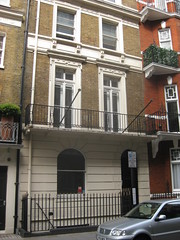
3. Virgin Galactic, Richard Branson’s space flight company, is registered at 6 Half Moon Street in Mayfair. Here:

4. The Royal Observatory in Greenwich contains the UK’s largest refracting telescope in the UK.

5. London will receive a new statue of Yuri Gagarin later this year, to be placed on the Mall.

6. The Science Museum contains the Apollo 10 capsule, which circled the moon on the mission before the first landing.

7. The space station has very few connections to London. However, its scale is best emphasised by comparing it to a London red bus and City Hall:

If that’s whetted your appetite, come along to my Spacetacular! space-themed variety evening on Yuri’s Night. Expect comedy, space science, space quizzing, tin foil and possibly some biscuits.

Science Events In London This Week

Tuesday

Harvard’s Martin Nowak and New Scientist’s Roger Highfield speak at the RSA tonight on the subject of altruism, dabbling in the maths of cooperation. It’s free, but you need to pre-book.

Thursday

The Royal Society hosts a late afternoon talk (4.30pm) about Britain and international science in the 1970s. Later, Ted Nield is at the Royal Observatory in Greenwich to discuss why we should love meteorites. Also this evening, dermatologists Paul Matts and Mark Birch Machin are at the Royal Institution to discuss the daily assaults on our skin from UV, and other dermo-ponderings. Both evening events are £10 and start at 7pm.

Friday

Another event from the Royal Society today, this time a lunchtime lecture (1pm) on the scientific aims of the Great Exhibition of 1851. Free, but prebook. The big event of the week takes place at Wellcome Collection this evening. The venue will remain open until 11pm for an evening devoted to the elements. See your reflection in a pool of mercury. Breath pure oxygen. And find out how to tell the time with iodine. Doors for this free event open at 7pm.

Saturday

The London premier of futurology film Transcendent Man is fully booked, but you can still catch a debate about the ideas of Ray Kurzweil at Birkbeck College, 1.45pm.

Time-Eating Clock Coming To London

One of my absolute favourite bits of Cambridge is coming to the Science Museum in April…sort of. The ‘chronophage’ is a magnificent golden clock, with no hands or numbers, and featuring a temporally ravenous beast:

Walking atop the 1.5 metre golden face is a large kinetic sculpture of a mythical creature. The creature, an integral part of the mechanics of the clock, appears to devour time … The hour is tolled by the sound of a chain clanking into a small wooden coffin concealed in the back of the clock to remind us that our time on earth is limited.

The original is permanently on show outside Corpus Christi College Library in Cambridge. Here’s my photo:

The new version, dubbed the Midsummer Chronophage, looks a little something like this:

MChronophage.jpg

Both were designed by inventor John Taylor. The new version will go on display at the Science Museum from 18 April alongside a pioneering marine chronometer by John Harrison.

Science Museum Lates: Tonight

It’s that time of the month again, when sensible, everyday Londoners QUEUE TO SEE SCIENCE. Yes, it’s the Science Museum’s popular Lates evening, an adults-only event where you get to peruse the venues copious holdings with a glass of wine in your hand.

Tonight’s programme includes a talk about the paranormal from the energetic Richard Wiseman. Sit in the Chair of Doom in a show themed around childish fun. Build a prize-winning contraption to hurl Barbie dolls as far as possible. Plus the usual mix of pub quiz, speed dating, music and cockroach tours.

It’s also a good opportunity to visit the museum’s new exhibition about James Watt.

Doors open at 6.45pm and close at 10pm. Full programme here (PDF).

Yuri’s Night: Celebrate 50 Years Of Human Space Flight

April 12 marks two important anniversaries: 50 year’s since the first human space flight by Yuri Gagarin and 30 years since the first space shuttle flight. The day has long been celebrated worldwide as Yuri’s Night, but this year carries particular numerological importance.

I’m going to be co-hosting one of the London events to mark the occasion, alongside comedian Helen Keen whose current Radio 4 series – It Is Rocket Science – is definitely worth checking out.

Spacetacular will be (possibly) the first ever fancy-dress variety show themed around outer space. Throttle up for astro-comedy, space science, a show-and-tell of space memorabilia and a cosmic quiz. Maybe biscuits.

We’ve lined up a series of speakers, including local space scientists and comedians.

Dress code: whatever you like, including normal civilian clothes, but outfits involving tin foil are particularly encouraged.

Get to the Camden Head (upstairs) for an 8pm start. If you have any space memorabilia or anecdotes, bring them along for the show-and-tell. Entrance is £3.

See you there!

Other events for Yuri’s Night can be found here.

Science Events In London This Week

Rather a quiet week for science events. Let me know if I’ve missed anything.

Monday

Chiropractor-conquering Simon Singh comes to Kingston Market House to talk about the use of alternative medicines on the NHS. The talk starts at 7pm and is organised by the South West London Humanists.

Wednesday

The second London Science Question Time takes place at UCL’s Wilkins Old Refectory and is themed around science education. Nature Network will be there to report on proceedings. The free event begins at 6.30pm.

Over at the Royal Society, astronaut Piers Sellars will be in conversation with playwright Rona Munro and scientist John Zarnecki. This free event will also be webcast live for those who can’t make it.

Friday

The Royal Society’s lunchtime lecture looks back on the life of Frederick Gowland Hopkins (1861-1947), discoverer of vitamins and one of the founders of biochemistry. The talk accompanies a small exhibition about Hopkins currently running at the RS.