The art of abstracts

[This post is based on the editorial in the August 2011 issue — the full text can be accessed here, available for free to all registered users. We welcome feedback on our editorials in the comments section below.]

An abridged version of the editorial is usually featured in these posts, but I thought I’d tell a little of the story behind the story in this case (and after you’ve read this, you can go and read the editorial!). The team here at Nature Chemistry follow the literature predominantly through RSS feeds and so we’re quick to see (and comment on) graphical abstracts that catch the eye – particularly those that confuse and/or amuse rather than instruct.

I’ve also seen a few blog posts here and there in the last year or so lauding the introduction of this wonderful new publishing innovation (I’m paraphrasing here, but that was the general gist). Now, graphical abstracts might be new in some fields, but they’ve been in chemistry journals for quite some time. And this got me thinking — just how long have they been around and who started the trend? Now, the internet is a marvellous thing, but I thought I might find out more if I went to a real chemistry library at a university; one with real journals and real books.

I’m now going to sound like I am very old to some of you, but e-mail only really became a popular and widespread tool during my undergraduate years. Looking something up in the scientific literature meant leaving the chemistry department, walking to the library in the middle of the campus (remembering to take my photocopying card with me) and flipping through bound volumes of journals. During my PhD, more and more scientific literature found its way on to the web, but trips to the library were still necessary. So, fondly reminiscing about my student days, I set off to the chemistry library at the University of Cambridge (with thanks to Oren for arranging access).

I spent a happy morning browsing row upon row of nicely bound journals and occasionally lifting one from its home on a shelf. There were quite a few other people in the library, but in the two or three hours I was there, I don’t recall seeing anyone else venture over to the journals. Students appeared to be studying or surfing the web to find the objects of their desire — scientific journals or otherwise. I had a fairly complete set of the chemistry literature all to myself, and I could browse — sure, I was doing some targeted searching, but I was also browsing… looking for nothing in particular other than things that happened to catch my eye. (Such as this article by Ian Rae from New J. Chem. in 1990 (vol. 14, pp. 3–4): ‘Why can’t we have element Q?’ — which, incidentally, I can’t find online anywhere…).

Anyway, it was nice to be back in a library — the smell and feel of the books is something you obviously don’t get from searching through the literature online, and that’s a shame (well, it is for me — for all you youngsters out there who don’t even know where your university library is, you probably wouldn’t miss what you’ve never experienced). The chronology of the appearance of graphical abstracts in a broader range of journals is something that didn’t quite make it into the editorial, so here it is for those of you who are interested:

As far as I can tell, Angewandte Chemie was first (in 1976!) and then Tetrahedron Letters joined the party in 1986 (some of you reading this still might not have been born by this point…). Tetrahedron itself followed suit in 1990. The first RSC journal to include graphical abstracts was not Chem. Commun., but J. Chem. Soc., Perkin Trans. 2 in 1993. Chem. Commun. did start soon after in mid 1994. The ACS was a little late to the game and graphical abstracts did not make their debut in JACS until 2002. The trail had, nonetheless, already been blazed by JOC in 1996 and Org. Lett. from its inception in 1999. After a bit more sleuthing, however, I did discover that from 1992 onwards, Inorg. Chem. included graphical abstracts for some of its Communications. It took a while for the physical chemists to join in (at ACS journals at least) with J. Phys. Chem. A and B getting graphical in 2006. If I’m wrong about any of this, or you have anything else interesting you wish to share about graphical abstracts, then please do comment.

So, the point of the editorial… I do believe that graphical abstracts do bring back some of the browsability that we’ve lost by moving away from paper journals. Not all of it, but a little flavour at least. We’ve also taken the opportunity to point out in the editorial what we think makes a good graphical abstract — something every publishing chemist should take a little time to think about.

You can read the editorial here (registration is free).

Stuart

Stuart Cantrill (Chief Editor, Nature Chemistry)
A chemistry reference resolver

Editor’s note: The following is posted on behalf of Alex Zhurakovskyi, who introduces us to his search interface for chemistry publications.


Chemistry is fast-paced nowadays. We use online databases to do sub-structure searches, download NMR spectra in just a few clicks, and it no longer takes a whole day in the library to get just a couple of papers. Publishing houses, for the most part, did a tremendous job of scanning and publishing their archives on the web. But finding and downloading a paper for a given citation can still be a cumbersome and time-consuming task.

First, one might google the website of the corresponding journal (although many of us keep numerous bookmarks or have a dedicated ‘links’ page on a group website). Then, one would look for a citation-based search form — and hopefully this is not buried somewhere on the page. If the volume number is absent, screening through the whole archive may be necessary. Depending on a journal, all of this may take quite a while — sometimes longer that the actual reading!

So, I asked myself if I could simplify this process and make it faster? I envisioned a system that would accept a citation in any format (such as the traditional ‘J. Org. Chem., 2010, 75, 4657’, my favourite type of citation ‘joc 2010 4657’, or a simple DOI) and redirect the user to the paper — in a single click. And also be capable of resolving references where only the year is provided and the volume number is absent.

The alpha version of the Organic Chemistry Reference Resolver was developed in early 2010 for private use. Later on, the project was made available on the web at https://chemsearch.kovsky.net under the Creative Commons license.

In addition to the web-interface I have developed a couple of browser extensions (Safari/Chrome/Firefox 3) as well as a tiny widget that can be added to any webpage. Interestingly, it is the widgets on the Japanese chemistry portals Chem-Station and ChemPort that provide two thirds of the users.

In the future, I plan to extend the scope of supported publications, upgrade the extensions, and implement the year search for all titles (now it works with about 70% of journals).

Speaking Frankly: Critically acclaimed

Frank Leibfarth is a graduate student trying to make his way through the academic maze. Find him contributing to the Sceptical Chymist or continue the conversation on Twitter @Frank_Leibfarth.


“If we charged a dollar per mistake, I’d be a lot richer after this presentation.” This was my advisor’s comment after my first group meeting presentation in graduate school. This did not instill confidence, but I didn’t feel too bad — mostly because of prior experience being the subject of criticism. I was a kicker on my college football team (the American kind), the one position where the game stops and everyone watches you succeed or fail. In a weird sort of way, this was somewhat of a relief. I always knew where I stood and I got used to taking criticism, sometimes with a not–so-constructive delivery.

After this, transitioning into the scientific arena was easy; everyone seemed so encouraging and uplifting when giving me suggestions. As I have progressed, however, I have not been satisfied. I want to be a better scientist (sometimes I must admit that too much of my self-worth is tied up in the discipline) and I want others to help me get there. Unfortunately, I have been intermittently frustrated with the congeniality of my elders. At times, I have specifically asked for criticism and still do not receive it.

Criticism is a necessary and inherent part of the growth and development of scientists. In fact, we have a number of built-in mechanisms for such criticisms, including the graduate qualifying exam, thesis defense, paper reviews, and grant proposals. Academia takes this mechanism to an extreme, with tenure being the constructive and/or destructive criticism that culminates in either ultimate job security or unemployment. From my point of view, the system seems set up to work well, with chances to evaluate and improve at many stages along the way.

In my experience, however, the process routinely breaks down when people don’t know how to properly give or take criticism. Further complicating matters, the simultaneous competitive and creative nature of our discipline makes criticism inherently subjective, leading to a sometimes under- or over indulgence in these decisive remarks. Lastly, in our international field, we always need to consider the approaches of different cultures toward criticism.

So how do we balance the difficulty in giving criticism with its necessity to our discipline? First, we must always remember that providing good constructive criticism takes effort. Whether reviewing a paper or sitting on a thesis committee, active engagement and significant time are required. More important, however, is an understanding of the intimate link between empathy and criticism. The scientific system is designed to improve our collective experience by improving the quality of our individual members. So be critical! Make my generation into great, thick-skinned scientists! But remember we all have our own insecurities and doubts, so show us the human side of science every once in a while.

ICCOSS XX: What’s in a name

In one of the sessions on ‘crystal engineering’, Guy Orpen told us about his hesitation to use this term: is it really engineering? The problem is reproducibility. If an engineer sets out to make a bicycle, and ends up with a submarine, he won’t be happy. Now if a scientist sets out to make a bicycle and finds that he made a submarine, he’ll be delighted. Yes, yes, it’s not quite a bicycle, but hey it is a means of transportation, only in water, right? And now having discovered this one by serendipity, we’ll make better submarines! In fact, the role of serendipity has been widely acknowledged throughout the conference.

We saw further work on co-crystals, and it shouldn’t come as a surprise that they are becoming so widely investigated. As I mentioned yesterday, one of the problems of drug molecules is poor solubility; and not all drug molecules are ionizable. In fact, according to Ashwini Nangia, 80% of the compounds in the R&D pipeline pose a solubility problem. This can be improved by inserting the active pharmaceutical ingredient (API) into a lattice with a second component – the trick is not to change to the API’s desired properties in the process. And besides pharmaceutical applications, co-crystallizing two compounds represents a chemical challenge in itself. What makes two molecules crystallize into one lattice rather than form two separate homo-crystals? Are co-crystals really that different from salts? Well, yes. As Christer Aakeroy explained, a cation cannot exist without an anion, whereas a molecule is happy on its own. And so he has set up a ‘molecular dating agency’ in his lab, and looks at various combinations to determine some rules on what affinities make molecules pair up in a co-crystal.

Another intriguing point about the crystalline solid state is polymorphism – salts, solvates, co-crystals and various combinations of these exist, and to complicate things further they all exist in different polymorphs. The form a compound will adopt depends on a lot of factors, and is hard to calculate, predict, or even understand. For example, Ram Jetti (from Matrix Laboratories, Hyderabad) showed us that for one drug molecule, temazepam, with 3 polymorphs reported in the literature, he was able to find no less than 10 new crystalline forms.

Add to this the fact that solids are a lot less inert than it first seems – this much was made clear in the solid-state reactivity sessions – and that surfaces and defects also play crucial roles in solid state reactivity, as we heard from William Jones (“sorry to take away from the perfection of single crystals”)… “one needs to be fearless to go into this mess” as Dario Braga puts it.

But I’m running out of time again, and will tell you tomorrow about some other exciting points that came up.

Anne

Anne Pichon (Associate Editor, Nature Chemistry)

ICCOSS XX: A colourful start

Hello from Bangalore! I  have to say I’m pretty excited to be here, both because of the conference programme and the location. This is my first time in India, and  although, admittedly, I have only been here 2 days, it is easy to see why Bangalore is called the ‘Garden City’ – magnificent trees and luxuriant vegetation everywhere . This is even more true when it comes to our conference venue, the Indian Institute of Science, which has enormous charm. Our Convener, Guru Row, told us yesterday in the opening remarks that the Institute is now becoming a College, and will be welcoming undergraduate students in just three weeks – now, this is a place I wouldn’t mind going to university!

Yesterday went on with a tightly packed schedule (this is, after all, a conference on the organic solid state – ahem) and a great line up of speakers. We heard a lot about molecular structure of solids, and how to approach their structure-property relationship. Properties, and in turn applications, are increasingly becoming the focus of investigations, yet at the same time to look at properties it is crucial to look at structures in fine details.

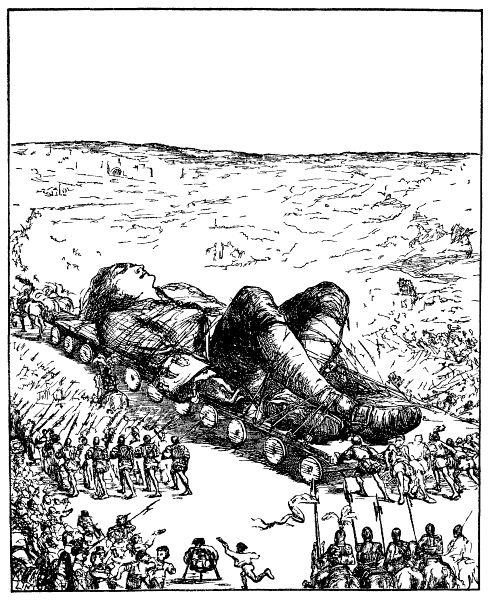
This is no easy task. As J Moorthy puts it, “small and simple molecules – especially ones that participate in hydrogen bonding, typically have large and complex crystal structures”. He illustrated crystal packing interactions through a picture from Gulliver’s Travels: “weak yet powerful”.

Talking about properties, a pretty sought after one is the presence of cavities for further host-guest chemistry. Tony Coleman shared with us his definition of porosity – very similar to Len Barbour‘s – “things go in, things go out”, of non-porosity “nothing comes in, nothing comes out”, and of multi-porosity “things go in, things come out a different way”. We also heard a lot about co-crystals, and how they’re very useful in pharmaceuticals – for example crystallising a drug with another molecule can improve its stability and solubility – but are proving trickier than they seemed. In a nutshell, their properties are unpredictable.

In any case, we’re seeing a lot of pretty, and colourful, X-ray structures. This isn’t surprising in a conference on this topic – but did you know that X-ray crystallography came out first of CNN’s ‘top 10 modern discoveries’? We heard this from Mike Zaworotko.

Unfortunately I don’t have time to tell you more about the sessions – although I wouldn’t risk writing too many details about the session on charge densities, a great way to investigate a structure in its finest details but that involves a lot equations – I’m on my way to another day looking just as busy and interesting.

Anne

Anne Pichon (Associate Editor, Nature Chemistry)

Nature Chemistry Impact Factor

For those of you who care about such things, Nature Chemistry now has an Impact Factor (IF). It is 17.9 (or, if you really want us to quote it to three decimal places, it’s 17.927). We realise that the IF is far from a perfect metric; really, we do. And we also appreciate that there are a range of opinions out there amongst our audience on the matter — some of you love the IF, some of you hate it. For those of you who aren’t about to click away in a rage or aren’t sick of IFs, I’m going to drill a little more deeply into our number and what it might mean, if anything.

The 2010 IFs (the ones just released in 2011) are calculated for any given journal by looking at the number of citations it received in 2010 to the articles it published in 2008 and 2009. This total number of citations is then divided by the total number of ‘citable items’ published in 2008 and 2009, and the number you get is the IF. So, it really boils down to the average number of times papers published in 2008 and 2009 get cited in 2010 – if that has any meaning! If a journal has a 2010 IF of 7.5, it means that — on average — each paper from 2008 and 2009 was cited 7.5 times in 2010.

Averaging brings with it some problems. Each paper might have been cited 7.5 times on average, but in reality, some papers will have been cited lots more than that and others might not have been cited at all. One (or a few) very highly cited papers can have a huge effect on the IF of a journal (see the wonderful example of Acta Cryst. A from last year!).

Another bone of contention for some is the use of ‘citable items’. Not everything that a journal publishes counts as a ‘citable item’ — typically only research articles and reviews do. For example, in Nature Chemistry, ‘front-half’ material such as Editorials, Book Reviews, Commentaries and News & Views articles are not counted as citable items and so do not add to the denominator in the IF calculation. Any citations that they do receive, however, are counted in the numerator. Note that this is not a special exception made for Nature Chemistry or Nature journals in general, this type of citable-item categorization is made for all journals.

Also, the sources of the exact numbers used to calculate the IFs are not easy to find. Sure, you can get a total of citations from Web of Science for an individual item or for a given year’s worth of content in a journal, but that does not usually include all of the citations used in the IF calculation. See this post at The Scholarly Kitchen for more details on how impact factors are calculated. Bearing this in mind, however, let’s take a closer look at Nature Chemistry content from 2009.

Nature Chemistry published 82 citable items in 2009; that was 17 review-type articles (Reviews & Perspectives) and 65 primary research papers. Of course we also published many other pieces of content that are not counted as citable items (as described above). Based on our rough calculations, it appears that just under 10% of our total citations in 2010 to these 2009 pieces of content were to these non-counted items, just over 27% of the citations were to the review-type articles and just over 63% were to the research articles.

And if you’re interested, the top five 2009 papers based on 2010 citations are (subscription required to access all of the articles apart from the third on the list, which was in our first ever issue that is currently available for free):

REVIEW: Nanostructured functional materials prepared by atom transfer radical polymerization (77 citations in 2010)

New insights into the structure and reduction of graphite oxide (60)

REVIEW: Towards the computational design of solid catalysts (52)

Bimetallic Pd(III) complexes in palladium-catalysed carbon–heteroatom bond formation (51)

Amyloid-β protein oligomerization and the importance of tetramers and dodecamers in the aetiology of Alzheimer’s disease (37)

There don’t appear to be any obvious trends in terms of articles in one particular subject area (physical, organic, inorganic, bio, analytical) consistently receiving more citations than any other. And there seems to be no correlation between how much an article is cited and how many page views it has received. We do note that what could be considered to be more traditional ‘organic’ papers typically get more page views than other sub-disciplines, but this is not reflected by an increased citation rate.

A few quick numbers for you about the citations our 2009 content received in 2010: of the 82 citable items, the most cited paper received 77 citations and the least cited paper received 1 citation. The other 80 articles fell somewhere in the middle. The top 40 of these had a citation count of 11 or more and the lower 40 each had somewhere from 2 to 10 citations — hence the median number of cites was 10.5. The mean, on the other hand, is 14.5 if you’re interested. And now compare those numbers to the actual IF, which is 17.9.

So, what does this tell us? I’m not really sure. Other than perhaps IF calculations are a strange and mysterious thing.

Stuart

Stuart Cantrill (Chief Editor, Nature Chemistry)

Speaking Frankly: Encounters of the scientific kind

Frank Leibfarth is a graduate student trying to make his way through the academic maze. Find him contributing to the Sceptical Chymist or continue the conversation on Twitter @Frank_Leibfarth.


I am finishing the third year of graduate school and finally starting to feel like a real scientist. The feeling of inferiority that comes with being a young researcher is still hiding just under the façade I’ve fashioned to hide it, but I’m slowly learning that I cannot and should not know everything, that no one does, and that maybe that’s OK. So now I’m blogging, hoping that my musings on the philosophy of science, how we conduct it, communicate it, and interface it with society will entertain, enrage, or otherwise interest you. Either way, I hope the topics I bring up here will only be the start of vibrant discussions, which I encourage us to continue through the comment thread or other social-media outlets.

With that, I wanted to discuss the role of creativity in science and how our current education system helps/hinders it. Inspired by a recent conference I attended, where revolutionary ideas and those pursuing them shone brightly, I pose the question: Can you learn (or teach) creativity? I feel both humility and excitement to know that my generation will soon be expected to carry the torch of scientific innovation… but what will we create and how do we go about doing it? ‘Creative’ is a verb usually reserved for artists and musicians, but was Linus Pauling creative in the same way as Bob Dylan?

To push the frontiers of knowledge, one must first understand their boundaries. Graduate education seems adept at this: an immersive education style after which you surface with a lot of knowledge but not much direction in terms of applying it. There is a fundamental disconnect, however, with the consumption and creation of knowledge, and I contend that our education system provides no mechanism to teach us how to make that leap. The best advisors foster creativity in their students, but should we rely solely on their abilities (after all, there is also no mechanism to ‘teach’ one how to be an academic, but let’s save that for another post). Creating new products, ideas, and understanding is the pinnacle of scientific achievement, and one of the strongest reason governments have for funding academic research.

Like many things, I suppose there is no ‘correct’ answer. Personally, I am trying to make this transition, trying to emulate the creativity of my scientific elders, and it is not easy. At the same time, I do not think anyone can magically teach me to create. I’ve always found that if I keep banging my head against a wall, eventually the bricks will start to crack. Let’s hope for the best. In the mean time, does anyone have any suggestions on fostering this elusive creativity from their own experience?

Notes from Kyle: The awards business

Editor’s note: We have a new guest blogger who might chip in with the occasional post here at the Sceptical Chymist, some of you might have come across Kyle Finchsigmate in the past… here’s his first post for us

Maturation, in the academic sense, is not necessarily a process that runs in parallel with maturation in the social sense. Most academics stop the social maturation process a bit sooner than your average worker and thus many academic activities are intellectually borrowed from things largely found in middle school. Consider, if you will, the humble award process…

Academia is a bizarre place where people run around giving each other awards openly but then are occasionally found gossiping maliciously behind each other’s backs. IN FACT, we have become so accustomed to being awarded titles and medals that we have created a commercial enterprise out of the whole business. That commercial enterprise is called ‘the conference circuit’ and the material reason they exist is to hand out ‘conference awards’.

Believe it or not, I was the lucky recipient of one of these awards. Just shy of entering the academic track, I was invited to give a talk and be presented with, not just my handsome honorarium, but also an unusually unnamed (i.e., it does not have a name, which is going to be hard to put on the CV) award… and $500. Believe me when I say I was honored, because in real life I’m as obnoxious as I am in the blogosphere. But with great (unnamed) reward also comes great responsibility. As the person to kick off the session, I delivered something of an overview of the field followed by a long discussion on how I’ve made it much, much better. Afterwards, there was much back patting and handshakes and I went on my way to do what other invited award winning speakers do at conferences — go back to my hotel room to sleep.

Before I could get out of the conference area, however, I was accosted (ACCOSTED I SAY) by a disgruntled academic who grabbed me by the arm and tried to tell me about how I totally failed to give him credit in my broad overview. He was an elderly chap, so I’m guessing he was used to getting lots of awards and recognition. In fact, I’d bet, in his home country, they’ve named some kind of mineral after him. Sadly, in America, I didn’t have the foggiest who he was and he was quite put off that I assigned credit, you know, to famous people in my talk for work he felt that he did first, better and more originally. He then quipped “You should get a better grasp of the literature, young man!” and started to walk off. (OH NO HE DIDN’T).

That’s not how you talk to an award-winning conference attendee. I thus gently took him by the arm and pulled him over to a private corner and told him that I was deeply sorry (I wasn’t) that I failed to mention his work and hoped that he could understand that I only had 45 minutes to give a talk and a lot of stuff had to be cut (it didn’t) and it wasn’t my intention to slight him (it actually wasn’t, because I didn’t know he even existed before my talk, but after the fact I wasn’t particularly upset that he felt slighted). We left on good terms. Hopefully one day we can nominate each other for an award.

Anyway, I sort of wanted to make this post about the difference between being an invited speaker at a conference and a registered speaker, but I found there to be almost no difference, aside from the honorarium, which was sweet. I did get a pretty nice hotel room, but I think that was actually an accident. Pretty much the biggest deal was that I got an award and how special it made me feel. I now have the unnamed award on my desk and I like to look at it as it reminds me that I’m awesome. It also reminds the other people that see it that they’re less awesome. That’s also important in academia.

Essay competition update

Since we announced our essay competition last month, we’ve had a few questions regarding eligibility and one or two other queries. We’ve replied individually to each query, but just in case there is any confusion out there, this is what we had to say:

1. Are high-school students eligible?

Yes.

If you are currently a student (at high school, or at university studying for an undergraduate or graduate degree, or at an equivalent institution studying for an equivalent qualification) you are eligible.

2. I’ve finished my undergraduate degree but haven’t started a PhD yet — am I eligible?

Yes, as long as it is no more than five years since you completed your undergraduate degree as of 1st August 2011.

You are also eligible if you are no longer a PhD student or a postdoc — as long as it is no more than five years (on 1st August 2011) since you finished your PhD/postdoc.

3. I’m studying something other than science/chemistry, can I enter?

Yes. You don’t have to be a chemistry/science student to enter, and anyone who is no more than 5 years (on 1st August 2011) from their last formal stint of education — from high-school right up through to postdoc — is eligible to enter.

4. I’ve written something that has been published in a magazine/journal already — can I still enter?

Yes. As long as you fulfill the criteria, you can still enter. What we don’t want are essays from professional science writers who make their main living from science writing. If you’re just starting out on that path (and you still fall under the five-year-rule), then you are more than welcome to submit.

5. Are we allowed to include pictures with our submission?

You can if you wish, it would certainly do no harm to include images.

Try not to make your essay reliant on the picture, however, because should your essay be selected as one of the winning ones, we would then need to make sure the figure would be suitable for publication — and that might lead to complications if we can’t use your suggested image and your essay refers to it a lot.

Getting permissions to use images isn’t always quick and/or easy — and that is why for the In Your Element pieces we have published so far, we have typically used generic royalty-free stock images.

We also recommend that you avoid using technical figures or schematics — these are meant to be easy-read type articles.

With all that said, yes, you are free to include pictures, but you may wish to bear in mind the points made above and be aware that we might not be able to use your suggested image.


And don’t forget that, as well as current affairs in industrial or academic research, we are looking for some anecdotes or interesting stories – perhaps about the element’s history, or its reactivity, or an unusual application. There are some examples of In Your Element articles that we have already published that you can use for guidance (see this post), and we’ve announced who our external judges are.

Good luck!

Anne

Anne Pichon (Associate Editor, Nature Chemistry)

Elemental examples

You might have heard by now that we are running an essay competition (I promise we won’t keep banging on about it quite so much for a little while) – unless you happen to be at the upcoming ACS meeting in Anaheim… if you swing by booth 1020 at the expo, you might hear a little more about it!

Anyway – we’ve already told you that the In Your Element article by Ken Wade (Bonding with boron) in our very first issue is freely available as an example. To offer you a little more guidance, we have made two other In Your Element articles free to those of you who register (or who are already registered) on nature.com. Tellurium in a twist by Jim Ibers and The two faces of phosphorus by Jonathan Nitschke will be available for the duration of the competition.

So, get reading, and then get writing. Good luck!

Stuart

Stuart Cantrill (Chief Editor, Nature Chemistry)