2011 Fall MRS: Stiff storage

Posted on behalf of Rosamund Daw (Senior Editor, Nature)


What technological innovations will form the car of the future? Carbon fibre composites are increasingly a viable option for the structural components of next-generation cars for improved energy efficiency, particularly as their use in the aerospace industry will undoubtedly bring manufacturing costs down. Energy storage devices such as capacitors and batteries will also be the order of the day.

Milo Shaffer and colleagues at Imperial College have recognised this as an opportunity for further energy savings. Both structural re-inforcement composites and electrochemical devices rely on the use of layered architectures. So why not combine the two and incorporate energy storage into the composites which provide strength and stiffness in the body of the car? This imaginative concept, potentially offering huge weight saving was presented in the ‘Applications of Hierarchical Materials’ session at the MRS [Hierarchical composite materials for structural energy; Shaffer, M., Qian, H., Houlle, M., Amadou, J., Bismarck, A., Greenhalgh, E.; Symposium G; 2011 Fall MRS]. I think it offers a refreshingly different angle on the vast research activity going on in energy storage.

Shaffer chose supercapacitor devices which cannot store as much energy as batteries but can quickly discharge; he envisages initial applications in load levelling, rather than providing a comprehensive mobile energy supply. His group approached the problem by modifying the traditional components of composites: carbon fibre laminates act as the electrodes and the epoxy matrix of the material forms the electrolyte. Glass fibre mats acted as insulator layers. The carbon fibre laminates were activated (made porous) to maximise surface area and an ionic liquid was incorporated into the epoxy to improve ionic conductivity. Carbon nanotubes deposited on the carbon fibres simultaneously increased the surface area for further charge storage capability and interlocked with the matrix to constrain buckling — frequently a problem with composites.

Early experiments have confirmed proof of principle. In fact the stiffness of the material is impressive despite the modifications: ‘as good as it gets’ says Shaffer. But there is still some way to go to improve mechanical strength and charge storage capability. Shaffer has partnered with Volvo in an FP7 programme entitled ‘StorAGE’ in which his team has been set the task of achieving 15% of a car’s weight reduction using these multifunctional composites. The first car component to be generated will be the wheel well.

These materials could presumably be more broadly used in smaller scale mobile applications such as laptops where weight and volume are at a premium.

2011 Fall MRS: A plug for stem cells

Posted on behalf of Rosamund Daw (Senior Editor, Nature)


In the field of materials science as applied to regenerative medicine, a common theme is the design of novel scaffold materials as supports for stem cell growth and differentiation. However not all stem cell therapies use scaffolds. In some biomedical research efforts, cells are injected directly into the site of need. Such a strategy has been applied to a variety of different injuries and diseases, for example Parkinson’s disease, stroke, heart attack and spinal-cord injuries. Though the approach has had some successes, a major stumbling block has been simply the ability to deliver a payload of viable cells to the site. Sarah Heilshorn at Stanford University has been investigating how materials science can help and presented her group’s findings in the ‘Biomaterials for Tissue Regeneration’ Symposium at the Fall MRS [The design of hydrogel cell carriers to improve stem cell viability during transplantation by direct injection; Brian Aguado, Sarah Heilshorn; Symposium KK; 2011 MRS Fall Meeting].

Early in vitro model experiments surprisingly revealed that the cell injection procedure itself led to severe membrane damage and around 40% cell death. Heilshorn suggested that this cell death was the result of elongational flow at the entrance of the syringe needle, disrupting cell membranes. Her research group has been investigating how hydrogels can mechanically protect cells from damage during injection. In particular they have focused on physically-crosslinked protein hydrogels. The physical crosslinks are easily broken on the application of shear, and it is this which Heilshorn believes helps protect the cells. The hydrogel shear thins at the walls of the syringe during injection providing lubrication to allow the rest of the gel to flow as a plug through the needle rather than with the differential flows across the bore experienced by a fluid which causes the extensive cell death.

Ingeniously, the material is comprised of two components and gelation occurs on mixing. This obviates the need for one of the usual gelation ‘triggers’ such as a temperature or pH, required in a single component gel, which can also damage the cells.

Heilshorn’s group have demonstrated that human adipocyte-derived stem cells and mouse adipocyte-derived stem cells can happily proliferate and differentiate inside the hydrogels. Furthermore the hydrogels improve the retention of cells injected into a mouse model, compared to delivery in alginate, saline or collagen. Adipocyte- or fat-derived stem cells are easily harvested from patients and are likely to be one of the first stem cell types to be used routinely in the clinic.

I shall look forward to the next chapter in the story, to find out if the hydrogels offer enhanced therapeutic capability.

Fall MRS Meeting 2011: Bioinspired energy efficiency

Posted on behalf of Rosamund Daw (Senior Editor, Nature)


At the Fall MRS meeting this year we are enjoying unusually mild weather. I can remember Christmassy snow at MRS’s past where woolly hats were a must. This year, many of the attendees are wandering around without coats and I have even spotted one or two brave individuals wearing T-shirts.

Two major themes at this year’s meeting are energy and the interface of materials with biology and medicine. An intriguing presentation from Philseok Kim on Monday combined these themes in a talk describing a bio-inspired approach to improve the energy efficiency of buildings. [Adaptive and dynamic optical materials for improving energy efficiency of buildings; Kim, P., Kolle, M., Khan, M., Zarzar, L.D., Aizenberg, J.; Symposium V (Multifunctional Polymer-based Materials); 2011 MRS Fall Meeting].

Kim reflected on the concerted motion of cilia in lungs, and other hairy or high-aspect-ratio biological structures which respond and adapt to different environments. He has designed a biomimetic system in which polymeric ‘hairs’ are embedded in a hydrogel. The hydrogels can elicit a tunable response to a variety of stimuli, for example temperature, causing the hairs to stand on end or lie flat against their substrate.

Kim proposed that these structures could be used to improve the energy efficiency of buildings. Extended transparent arrays of hairs could be arranged in panels across windows. Once the temperature outside dropped to a certain level, changes in the molecular conformation of the hydrogels would stimulate the hairs to stand on end simultaneously mobilising an array of deformable micromirrors attached to their ends into a single flat panel to control light transmission, reflection and thermal gain.

I like the work because it applies biomimetics in a rather unexpected way. The final goal offers engineering challenges because effects on the molecular scale are used to elicit functionality on the metre scale. Still, if achieved, such ‘smart curtains’ could reduce need for energy-intensive heating and cooling of buildings.

Speaking Frankly: Steve Jobs and innovation

Frank Leibfarth is a graduate student trying to make his way through the academic maze. Find him contributing to the Sceptical Chymist or continue the conversation on Twitter @Frank_Leibfarth.


The premature passing of Steve Jobs has shaken the international community. Known as perhaps the greatest innovator of his generation, Jobs took Apple from bankruptcy to make it the largest company in the world, surpassing (briefly) even natural-resource giants like Exxon Mobil. The media coverage of Jobs’ death has been intense, culminating in the publication of the much-anticipated biography by Walter Isaacson. Through these numerous homages, we have gotten a sense of not only Jobs’ fierce competitiveness and intense leadership style, but also the motivations and inspirations which influenced him.

For all of Jobs’ extraordinary vision, however, almost every remembrance reiterates the fact that Jobs did not ‘invent’ anything. There were MP3 players before the iPod, smartphones before the iPhone (sorry Blackberry), tablets before the iPad, laptops before the MacBook Air; Jobs even took the idea for the graphical interface from Intel. These biographers and journalists, even those in Science, are missing the point. Jobs was revolutionary, he recognized opportunity where others failed, thought about how people will use the products not just what products they use and, in perhaps his biggest coup d’état (as I sit watching my mom shuffle between her iPhone and iPad), he made technology products so intuitive that they are even accessible to the baby boomers.

Jobs was our generation’s disruptive innovator, so why the criticism about his lack of ‘inventions’? In the technology field, perhaps more than anywhere else, the scientific process is on display for the world to see. Hypotheses are made, products developed, revaluated, and improved. Steve Jobs, like great scientists, had the vision to leapfrog the competition, pulling his field forward with each project he completed. Similar to science, Jobs’ brand of innovation did not happen in a vacuum. Popular culture makes lists of the ‘The Top 10 Inventors’, heralding the individual contributions of scientists and engineers, but it neglects the massive amount of time, talent, and manpower that went into disruptive innovations. Instead of talking about the iPod’s precursors as the true ‘invention,’ we should be focusing on the unparalleled superiority of the first iPod in comparison, where Steve Jobs introduced so many innovations that other manufacturers still haven’t caught up.

We as scientists understand the process of innovation. We have built an entire international discipline where the sharing of information in publications is prized and innovation credits both the innovator and those who inspired her/him. Listen to the science Nobel Prize speeches and hear the dozens of people each laureate mentions who were the inspiration for the work or collaborated to do much of it.

Understanding that innovation is the product of talented people working collectively should be self-evident. This is why countries fund basic research, because the innovations that eventually generate economic and social value are not the product of one ‘genius’. The perception that great discoveries and/or products are the product of mythical savant-like individuals flies against the foundations of the scientific process. Further, a general belief that we are waiting for those Jobs-like individuals gives governments an excuse to cut funding for basic research. We, as aspiring innovators, need to celebrate Steve Jobs for his unparalleled accomplishments and use his example as a reason to celebrate the scientific process.

From crazy chemists to engaged learners through education

Editor’s note: We published a series of ‘beyond the bench’ Commentary articles in our September 2011 issue to celebrate the International Year of Chemistry. These are free just for the rest of September, so get them while you can! We recently received some correspondence from John Spevacek on the chemistry education article written by David Smith from York – and so we are publishing it here, with a reply from Smith. We encourage you to add your own thoughts in the comments section here on the blog.


To the Editors:

Professor Smith argues in his September commentary (“From Crazy Chemist to Engaged Learners through Education”, Nature Chem. 3, 681–684, (2011)) that the retention of facts as a core part of chemical education needs to be questioned since so much information is readily available via electronic means.

I would emphatically argue against this on three points.

First, while an ever increasing amount information is available on the internet, access to much of that information, particularly chemical information, is difficult to access as it is behind pay-per-view or subscription firewalls. I have found that this issue is poorly appreciated by those in academia who have good access to the literature via their institutions. Chemists working in industrial settings, and particularly those employed at medium or small-sized companies do not have such broad access. Scanning the abstract of an article of interest more often than not does not provide appropriate assurance that paying $35 for access to the article will actually provide the needed information. The risk to potentially access the information is often not taken since this game may need to be played multiple times, and so the facts are not found. More free access and lower access costs are certainly foreseeable in the future, but free access to all information is not.

Second, information needs context, a point that ironically was argued by Prof. Smith himself. However, the context I speak of is based on knowledge of the fundamentals, not the social situation in which a concept can be used (such as in the examples of curries provided by the author). Without that knowledge, all inputs must be considered as truthful and consistent with existing knowledge and no judgment can be made regarding the validity of any new inputs. Contrast this with someone who has retained a base foundation of facts. Such a person, in reading an article on Wikipedia or a research article claiming the development of a new breakthrough, is capable of judgments as to whether or not the claims are true and consistent with other findings, and is further capable of generating additional ideas to further test the claims.

Third, knowledge of information is needed to be conversant in chemistry, whether one is in a classroom, meeting with their superiors or outside clients. To be able to say “I can look that up” is to state “I am no better than anyone else”. As an extreme example, I could state that I am fluent in reading Swahili because I can look every word up in an English-Swahili dictionary. (I feel free to make that claim as Professor Smith does nothing to delineate how many fewer facts we should impose on students, only that it should be less.)

In all seriousness, I realize that the scale of “what to look up” versus “what to know” is a slippery slope even today (just poll your colleagues as to how much of the periodic table they have memorized), and that every older generation is appalled by the lack of (basic!) facts taught to the newer generation, but this has occurred in the past as a result of the ever expanding base of knowledge, not because of technological improvements in the access to information. To argue that technology should be used to accelerate that trend clearly takes us into new territory that has not be explored before. While the idea of trying the experiment is worthwhile in principle, keep in mind that we have only one chance to educate students – if the experiment fails, we cannot go back to correct the error.

In summary, the ability to quickly obtain chemical information will increase in the future, but a solid base of facts needs to be known by the individuals accessing it in order to be able to be comfortable with it, to make proper use of the data and to be conversant with it, and if we error, it should be on the side of requiring students to learn too many facts, not too few.

John Spevacek, Ph. D.

Aspen Research Corporation

https://www.rheothing.com/


David Smith replies:

I thank John Spevacek for his comments on my article – only by robustly debating the merits of different approaches can we reinviogorate the way our students are taught. I would, however, like to point out that although my article argues for a change of emphasis in chemical education, it certainly does not, as John suggests, propose the complete removal of facts from the curriculum. Indeed, I would like to quote just one of my key sentences for clarity: ‘Of course a foundation of sound knowledge is crucial, but the bigger challenges facing the modern chemist are to appreciate the true value of the available information, develop the skils to interpret it sensibly and the capabaility to make creative connections…’ [emphasis added].

Students certainly do, as stated above, require a sound foundation of knowledge in order to progress. My article really challenges whether students really need to memorise/know the same amount of detail that they once did. For example, is it necessary for undergraduates to commit to memory each and every variant of a carbonyl condensation reaction, along with the name of its discoverer, as I once did – or is it more important that they have an understanding of the general mechanism of this class of reaction, the capacity to work out the details from its fundamental first principles, and an ability to recognise this type of reaction and its significance, when shown it in a new real-world context? I would still argue that we are wasting our students’ cognitive capacity if we make them memorise too much, and that combining core knowledge with contextual problem solving skills is the only way for them to develop the ability to interpret the vast range of chemistry with which they can be faced.

The point about the accessibility of information is certainly well made. I would hold that for many school and many undergraduate classes, the information available online is rich and diverse in nature, and much of it is high quality. However, certainly at research level, much information is protected by publishers and inaccessible to non-subscribers. Of course this is an issue, not only in an industrial setting, but in the developing world and educational settings outside universities. This is a problem which many initiatives in open access publishing hope to address. In an ideal world, there would be equality of access to all information – there is no doubt that this would facilitate education, and the ability of all to gain access to the cutting-edge of scientific progress.

Finally, in order to emphasise the importance of learning in context – I would like to take John’s example of learning Swahili. It would be possible to learn all the grammar, all the vocabulary, and have a full understanding of the rules of the language, all on paper. However, the best way to learn a language is to pick up some basics (not try to learn the whole language) and then immerse yourself in the country – go out there, make mistakes, and learn from them. Only by living in a country do you become a true expert – you need to hear the language spoken in context, read it from a real newspaper, have a slang conversation with a local friend, or see how the language connects with the local food, culture and history. Chemical knowledge is just like learning a language – only by using your fundamental knowledge to solve problems in a relevant context, immersing yourself in the chemistry of the real world, can you truly learn the skills required to become an ‘expert’. In my opinion, it is these subject-specific skills in applying knowledge which are the most valuable aspects of a modern education and will create the next generation of chemical experts.

Prof. David Smith

The University of York

https://www.york.ac.uk/chemistry/staff/academic/o-s/dsmith/

Speaking Frankly: Changing childbirth policies

Frank Leibfarth is a graduate student trying to make his way through the academic maze. Find him contributing to the Sceptical Chymist or continue the conversation on Twitter @Frank_Leibfarth.


Today’s post enables me to expand upon a recent letter I co-authored (sub req’d) in Science entitled ‘Hope for graduate school childbirth policies.’ We are incredibly grateful for the journal’s support in highlighting this important topic. Below you can find some of my uncensored and expanded opinions on the subject. I would encourage those from other places in the world to comment on this issue. What are the policies like in Europe? In Asia? Are they better or worse?

We, as chemists, strive to recruit the best and brightest students to our discipline. Half of those students are women (or more, since more women than men earn bachelors degrees [pdf] in chemistry), yet the number of women who reach the upper echelon of chemical science is widely disproportionate. Articles about the subject usually cite the standard reasons: women are discriminated against in hiring (sub req’d), grant funding, and publishing [pdf]. These somewhat qualitative explanations, however, do not tell the whole story. Professor Carol Robinson gives a first-hand account of the cultural barriers in her recent article (sub req’d), but there remain concrete, institutional boundaries for women to thrive in science that are routinely ignored. Following the lead of Professor Richard Zare, myself and a group of graduate students set out to change our university’s childbirth policy and eliminate at least one of the institutional barriers toward gaining a fair representation of women in chemistry.

Graduate students in the U.S. who have or desire a child must not only combat the pervading perception that one cannot be both a mother and an academic, but must also navigate university childbirth policy that is often discouraging and/or nonexistent. Even if faculty and administration are supportive of graduate students who want to have children, this support is often unstated, incoherent across disciplines, or informal in nature. Traditionally, the policy for pregnancy in graduate school is to take a formal leave of absence (LOA), which amounts to withdrawing from graduate school for up to four months. Tangibly, a LOA means that, in a vulnerable time, a woman must give up her university health insurance (or pay for it herself) and her teaching assistant income or graduate stipend. Almost worse than these tangible effects is the fact that the students are stigmatized; they are seen as ‘walking away‘ from their responsibilities rather than exercising their minimum rights as an expecting mother.

Graduate students who had children often found they had to make up the rules as they went; they faced insecurities regarding their academic standing in addition to anxieties about their relationship and obligations to their advisor. Consequently, we sought a change in policy not only to give students guaranteed health insurance, housing, and some paid leave, but also to begin to change the institutional culture regarding having a child during graduate school. As mentioned in our letter to Science, the key barrier was establishing a university recognized committee to give our effort a voice within the bureaucracy. After accomplishing this through our Graduate Student Association, providing quantitative evidence about the need for change, soliciting letters from students and faculty, putting together a formal proposal was simple. Furthermore, our collaboration with the Graduate Dean was invaluable in our efforts, as she was able to advocate on our behalf on committees in which we had no voice. This point highlights another surprising finding, almost everyone at the university was supportive of our proposal; policy change is many times a problem of initiative.

We hope that our experience can serve as a blueprint for other graduate students, faculty, and administrators looking to overcome the perceived conflict between family and graduate studies [pdf]. Our policy, which provides an extension of academic requirements without taking a leave of absence and up to six weeks paid leave, endows students with a sense of support and an institutional recognition that they are valuable resources who deserve to be treated as such. Additionally, as evidenced by faculty surveyed, there are uncertainties that face faculty members in these situations that could be removed with clear university-wide policy.

The idea that women should be (effectively) forced to wait until obtaining a Ph.D. to have a child is disgraceful. If we want to see more women in science in the future, we need to rid our universities of institutional sexism. In addressing the need for a formal and coherent childbirth accommodation policy at the University of California, Santa Barbara, we found that tangible policy changes and the accompanying permeative process catalyzed institutional discussions regarding the value of diversity in the academic pipeline. Our experience illustrated the shared goals of faculty, students, and administrators in recruiting, retaining, and supporting the best and brightest graduate students.

Winter School anyone?

The European Winter School on Physical Organic Chemistry will take place in Bressanone early next year, straddling the end of January and the beginning of February. Why am I telling you this? Well, although the main focus of the winter school is going to be catalysis, the organizers have kindly invited me to give a talk about scientific publishing.

There are 14 speakers in total, so in addition to yours truly, there will be lectures from: Martin Albrecht (UCD), Isabel Arends (TUDelft), Matthias Beller (LIKAT), Carsten Bolm (Aachen), Olga Bortolini (Ferrara), Miquel Costas Salgueiro (Girona), Livius Cotarca (Zach), Fahmi Himo (Stockholm), Alceo Macchioni (UNIPG), Feliu Maseras (ICIQ), Per-Ola Norrby (Göteborg), Sason Shaik (HUJI), and Dieter Vogt (TUE).

The school is aimed primarily at PhD students, postdocs and junior researchers in academia and industry, but established researchers can apply to go as well. There are some fellowships available to cover the cost of registration and so if you are interested, you should contact the organizers – see the website for more details. The deadline for applications is November 1st, so get in there quick.

You may notice that the winter-school website has a bit of a skiing theme – so if you like skiing (like my colleague Neil), perhaps there is some extra incentive to apply. I’m about as indifferent to skiing as one can get (I imagine), so Neil is somewhat miffed that I’ve managed to get an invite to a conference in a ski resort in January. I’ve been told to make it clear that if you know of any chemistry conferences next year where skiing is a possibility, you should let Neil know forthwith – perhaps in the comments below!

Hope to see you in Bressanone in Jan/Feb next year!

Stuart

Stuart Cantrill (Chief Editor, Nature Chemistry)

Reactions – Chemjobber

Chemjobber works in industry and blogs about the chemistry job market.

1. What made you want to be a chemist?

I wanted to be a medical doctor and enjoyed biology, but I found organic chemistry to be such a fascinating world that I could never quite leave it. The first reaction I did as an undergraduate researcher was gorgeous and I think I’ve been trying to reproduce that high ever since.

2. If you weren’t a chemist and could do any other job, what would it be – and why?

Other than being a medical doctor? I think medicine is fascinating and I envy the ability to affect people’s lives for the better immediately. I think I’d enjoy being a warehouse manager for FedEx. There’s something deeply interesting about the logistics of efficiently getting things where they need to be in a timely fashion. I’d also enjoy being a restaurant owner, but (in the immortal words of Anthony Bourdain) it would just be the fantasy of ’swanning about the dining room signing dinner checks like Rick in Casablanca."

3. What are you working on now, and where do you hope it will lead?

I work in industry, and my employer probably isn’t very interested in me divulging what I work on. Suffice it to say that I’m a process chemist; I hope to synthesize compounds in sufficient yield and purity on budget and on deadline. I sincerely hope to affect my company’s bottom line in a positive manner by creating or improving processes. (It sounds so corporate, but it’s really true!) It’s a fun challenge and I love the different disciplines that I get to work with as a process chemist.

4. Which historical figure would you most like to have dinner with – and why?

I would choose J. Robert Oppenheimer. I was deeply struck with him when I read Richard Rhodes’ book “The Making of the Atomic Bomb.” Oppenheimer’s ability to manage both the science and the scientists/engineers of the Manhattan Project was quite remarkable, and I’ve love to try to get some of the inside story of all the egos that must have clashed in Los Alamos.

5. When was the last time you did an experiment in the lab – and what was it?

Today — I set an azeotropic distillation. I’m proud to work in the lab daily; there’s nothing quite like it.

6. If exiled on a desert island, what one book and one music album would you take with you?

Vogel’s Textbook of Practical Organic Chemistry — I’ve still never quite made it through the whole thing.

Frank Sinatra’s “Only The Lonely” — if you’re going to be lonely, why not?

7. Which chemist would you like to see interviewed on Reactions – and why?

I could name a couple, so I will. I’d like to hear from Neal Anderson, who’s a fairly prominent author in pharmaceutical process chemistry. I really like his book and I’d like to hear more from him and his thoughts on where the industry is going. I’d also choose Duane Burnett of Merck, who helped develop the cardiovascular drug ezetimibe (Zetia). It’s a beautiful molecule and a great story of drug discovery.

Speakly Frankly: Commentary comments

Frank Leibfarth is a graduate student trying to make his way through the academic maze. Find him contributing to the Sceptical Chymist or continue the conversation on Twitter @Frank_Leibfarth.


The International Year of Chemistry is upon us and, as these Commentaries in Nature Chemistry illustrate, our year of celebration is doubling as a year for re-evaluation. The past two decades have brought rapid changes that have and will continue to profoundly affect how we conduct science.

Unrelenting globalization,’ as Keith J. Watson puts it, has made the world flat, giving us access to almost infinite amounts of information. Business — and thus social, political, resource, and economic instability — is magnified on an international scale, yet we are having trouble effectively training the next generation of chemists to deal with the necessary multifaceted, cognitive challenges to keep pace. These more recent issues just pile on top of the long-standing problems of our discipline including gender inequality, a finite supply of resources, and our inability to communicate with the public. Such fundamental subjects are all addressed in the Commentaries, but I assert that a common thread for beginning to solve many of these problems starts with scientists taking matters into their own hands.

The internet, globalization, and social media have made the world ‘pluralistic, participatory, and social,’ as Matthew R. Hartings and Declan Fahy astutely observe, but has chemistry kept up? This seems to be a central theme in many of these Commentaries. Industry is trying to — Connelly, Vuong, and Murcko tell us how, and Watson gives sound advice for chemists looking to keep up. Our educational system has not, but David K. Smith provides a path to rethink our pedagogy. Scientific communication is getting there, looking to modernize so it can inspire and educate a complex and diverse audience. Chemistry in the developing world is in a precarious position, with C. N. R. Rao wondering ‘whether there will ever be reasonable contributions to chemical research from poor underdeveloped countries…’

So where does this all leave us? I must agree with Smith, in that the defining feature of this new age is our incredible access to information. We have quickly shifted from an age where a select few had access to some information to one in which everyone has access to almost all information, but we have not figured out how to use this for the greater good of chemistry. If social media can catalyse revolution in the Middle East and riots in the UK, why are we not using it to share ideas among scientists about the best way to harness the sun’s energy or make a more effective chemotherapy agent?

Science is missing out on one of the fundamental attributes of the information era — its immediacy. We write grants to make better water purification membranes, but we are working in the developed world, where we find out if a grant is funded in 6-8 months and may publish a paper years later. Why are we not in a constant conversation with scientists from the developing world, asking them exactly what they need, sifting through the massive amount of available information collaboratively, and using our combined cognitive skills to find the needle we are looking for in the haystack? Furthermore, when we do discover something, shouldn’t we make sure to communicate it back through those same inclusive outlets, explaining it in an accessible manner for anyone who may be interested? This is not difficult in 2011.

I am not suggesting we do away with the peer-review process or journal publishing. These serve our community well. In the name of embracing our ‘pluralistic, participatory, and social’ future, however, non-traditional media outlets will only enhance our vision of collaborative, inclusive, and highly progressive science. Alternate communication methods, such as web-based content, blogs, podcasts, and YouTube, let people know not only what you are thinking, but how you are thinking about it and why it is important. As Hartings alluded to, journalists and members of the media are no longer the gatekeepers to our interfacing with members of our own discipline and the public. Just as Kevin Smith skipped the Hollywood studio system to release his award winning film or Marc Maron gave up on comedy clubs in favour of podcasts, so too can scientists make our case to the public without waiting for traditional news outlets to do it for us.

As a young scientist, I think I speak for my generation when I say that I am intimidated by the diversity and magnitude of the challenges contained in these Commentaries, but I am constantly hopeful when I see people from other disciplines and walks of life succeeding outside of the traditional avenues. We can do it too, but we do not and should not wait for the traditional gatekeepers to do it for us. Globalization and the information age have put the power in our hands, now we just need to figure out how to use it.

Marie mosaic

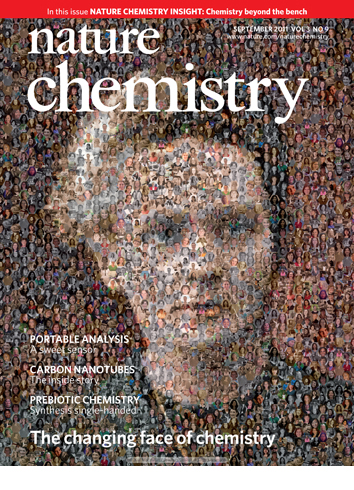
nchemcover.jpg If you haven’t noticed yet, our September issue is a little bit different to all the other issues we’ve published so far. It contains what we call an ‘Insight’, which in this case is a collection of Commentary articles that look at broader issues in chemistry beyond the science itself. We’re doing this to mark the International Year of Chemistry – which happens to coincide with the 100th anniversary of Marie Curie being awarded the second of her Nobel Prizes (the chemistry one).

One of the Commentary articles was written by Michelle Francl – who is moonlighting from her usual job of writing Thesis articles for us. We asked Michelle to write about Marie Curie and how the representation of women in science has changed in the last 100 years. Even before the first draft of Michelle’s article landed in my inbox, she’d come up with a great idea for how to illustrate her article: a picture of Curie as a mosaic made up of photos of female scientists.

This was a fantastic idea, but getting permissions to use a large number of images filled me with dread. Nevertheless, Michelle sent along a mock up of the sort of picture she was suggesting by using images from Google — and it proved just what a great idea it was. Obviously we can’t just scrape the internet for images and then publish them; that would get us into a lot of trouble. We needed to get photos from scientists who wanted to be part of the mosaic and who would be willing to sign a form saying that we could use their photo.

Michelle was so enthusiastic about the mosaic from day one, that we decided we’d give it a go (and the mock up did look quite stunning). Putting down her pen and picking up her camera, Michelle turned photographer instead of writer and started snapping pictures (and made sure those forms were filled in). As the project gained momentum, members of the editorial team e-mailed some of their contacts to see if others wanted to take part. And we also decided that as well as using the image to illustrate Michelle’s article, it should feature on the cover of the journal.

Not only did we get lots of photos from people we contacted, but we got even more photos from others who had had the original e-mail forwarded on to them. I’m not exactly sure of the final count of different people we received photos from, mostly because some people sent more than one photo and some photos contained more than one person. What I can tell you is that we ended up with 270 photos. And then it was time to create the mosaic…

Michelle suggested we used MacOSaiX — and once I discovered you can have hexagonal tiles, I was sold. (There are plenty of other mosaic apps out there, including ones that are not just for Macs). So that we’d have more than just 270 photos and a better colour range, I created black and white versions of each photo and also sepia versions. For a bit of extra variation, I also cropped each original image more tightly to generate another set of photos. All told, that meant 1080 photos.

The mosaic template I chose was 45 × 50 tiles, so 2250 tiles in total. There is a higher-resolution version of the cover available here, and if you look closely, you will definitely see that some photos were used much more than others (I had no control over this…). And I also had no control over where photos were placed, so apologies go to anyone who might have ended up behind the Nature Chemistry logo or the red banner at the top of the cover.

Anyway, thanks to everyone who took part and agreed to be on the cover. I think it’s our best cover yet and will take some beating! If you contributed to the mosaic, we encourage you to leave your name and a comment below!

Stuart

Stuart Cantrill (Chief Editor, Nature Chemistry)