
Post by Giulia Pacchioni
LabEscape is an escape room based on physics – I got the opportunity to explore it during the APS March meeting in Boston, where it was set up for one week away from its usual site in Urbana, Illinois.
Prof. Schrödenberg went missing, and an important grant needs to be submitted. As her new interns we need to log into the computer and hit the submit button. Easy… well, we need to figure out the password, but luckily the professor left hints around the lab in case she forgot it!
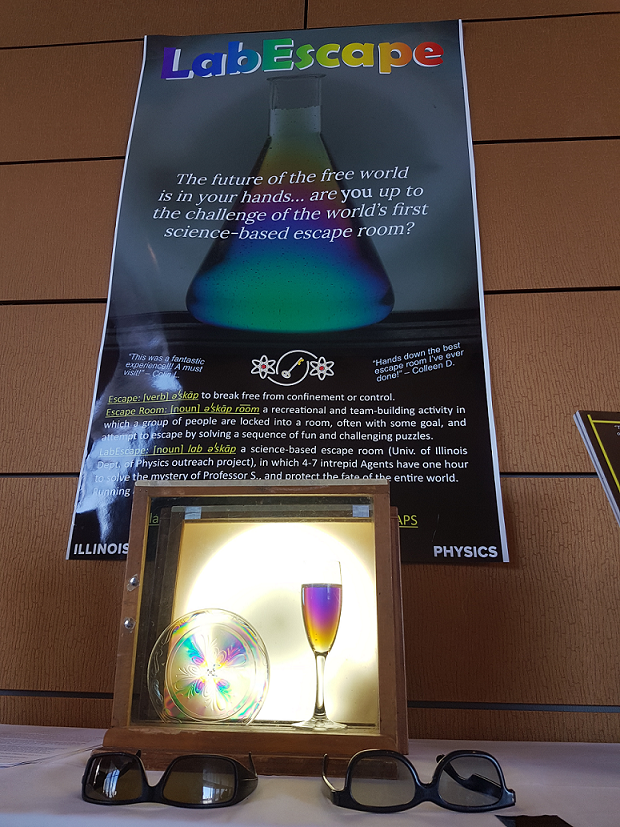 Together with a team of five other physicists (the other interns in the lab), before entering the room I was handled information sheets covering some essential physics concepts laid out in a very digestible way. Indeed, the room, which is the brainchild of Paul Kwiat, a physics professor at the University of Illinois, is by all means not designed for physicists (even though it’s an absolute delight for them). It was created to provide an experience that demonstrates to the general public that physics is useful, permeates everyday objects and is, yes, fun.
Peter recommended we read the material carefully no matter how well we thought we knew it already, as knowing which concepts are illustrated in the room can help understanding how to crack the puzzles inside. Apparently, a group of physicists who refused to go through the material couldn’t escape in the set time, whereas a family with no scientific background who did their reading (as any good intern should do!) aced the challenge.
The main suggestion from Paul was to work as a team, with two or three people looking at each hint or object to combine different points of view, and to share all information with the others. He had to help us a bit, reminding us to work together each time we went our separate ways exploring the fascinating bits and pieces scattered around the lab.
The room contains a clever mix of challenges ranging from the usual looking around for hints and tools to actual small experiments using lab equipment that needs to be manipulated and sometimes completed with missing pieces. As in any good lab, instructions on how to use the instruments are provided, accompanied by extra explanations about how each experience works for the curious explorer. I don’t want to give too much away, but we got to play with an oscilloscope and a laser, polarizing glasses and, of course, a dead/alive cat in a box!
The riddles are generally simple, but require some lateral thinking and careful observation, which makes the experience fun and varied without it ever getting boring or frustrating. The experiments use scientific instruments in very creative ways, the type that stimulates a wow reaction both in science novices who think ‘how is this even possible!’ and physicists who think ‘I never thought of using it like THIS!’ Marveling at the various tricks was so fun that escaping the room became a bit of a secondary focus. Even after we did work out the password and could have escaped, my fellow interns had plenty of questions for Paul about how everything worked and how they could use some of the ideas in their own outreach activities.
For me, the take home message is that that working on a problem together and listening to each team member’s ideas is essential for overcoming challenges in the lab. Also in real life.


