The multitasking mind

Cross-posted with permission of OUPblog.

dario.jpg

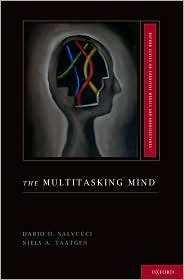
This week’s guest blogger is Dario Salvucci, a professor of computer science and psychology at Drexel University, and author with Niels Taatgen of The Multitasking Mind. Dr. Salvucci has written extensively in the areas of cognitive science, human factors, and human-computer interaction, and has received several honors including a National Science Foundation CAREER Award.

If the mind is a society, as philosopher-scientist Marvin Minsky has argued, then multitasking has become its persona non grata.

In polite company, mere mention of “multitasking” can evoke a disparaging frown and a wagging finger. We shouldn’t multitask, they say – our brains can’t handle multiple tasks, and multitasking drains us of cognitive resources and makes us unable to focus on the critical tasks around us. Multitasking makes us, in a word, stupid.

Unfortunately, this view of multitasking is misguided and undermines a deeper understanding of multitasking’s role in our daily lives and the challenges that it presents.

The latest scientific work suggests that our brains are indeed built to efficiently process multiple tasks. According to our own theory of multitasking called threaded cognition, our brains rapidly interleave small cognitive steps for different tasks – so rapidly (up to 20 times per second) that, for many everyday situations, the resulting task behaviors look simultaneous. (Computers similarly interleave small steps of processing to achieve multitasking between applications, like displaying a new web page while a video plays in the background.) In fact, under certain conditions, people can even exhibit almost perfect time-sharing – doing two tasks concurrently with little to no performance degradation for either task.
mind.jpg

The brain’s ability to multitask is readily apparent when watching a short-order cook, a symphony conductor, or a stay-at-home mom in action. But our brains also multitask in much subtler ways: listening to others while forming our own thoughts, walking around town while avoiding obstacles and window-shopping, thinking about the day while washing dishes, singing while showering, and so on.

Multitasking is not only pervasive in our daily activities, it actually enables activities that would otherwise be impossible with a monotasking brain. For example, a driver must steer the vehicle, keep track of nearby vehicles, make decisions about when to turn or change lanes, and plan the best route given current traffic patterns. Driving is only possible because our brains can efficiently interleave these tasks. (Imagine the futility of only being able to steer, or plan a route.)

So how has multitasking earned such a negative reputation? In large part, this reputation stems from unrealistic expectations. The brain’s multitasking abilities – like all our abilities – come with limitations: when performing one task, the addition of another task generally interferes with the first task. For many everyday tasks, the interference is negligible or unimportant: your singing may affect your showering, or thinking about your day may affect your dish-washing, but likely not so much that you notice or care.

Other tasks, though, require every ounce of attention and can push past the limits of our multitasking abilities. In driving, the essential subtasks are demanding enough; additional subtasks – texting, dialing, even talking on a phone – increase these demands, and when controlling a 3000-pound vehicle at 65 miles per hour, even these minimal additional demands may lead to unacceptable risks.

Still other tasks do not have safety implications per se, yet most would consider them important enough that multitasking in those contexts is undesirable. A student in class is already multitasking in listening to the teacher, processing ideas, and taking notes. If this student is checking Facebook at the same time, this extra subtask drains mental effort away from the more critical subtasks and dilutes the learning experience.

The problem with multitasking thus lies not in our brain’s inability to multitask efficiently, but in our own priorities and decision-making. When we choose to multitask, we are deciding – consciously or not – to accept degraded performance on one or more of tasks involved. And when we still choose to multitask when it is undesirable (as in the classroom) or unacceptable (as in driving), we should hold ourselves accountable for these decisions. So if you walk into a pole or wreck your car while texting, don’t blame your brain; blame yourself.

How does learning to read affect our brains?

untitled.bmp

Sophie Scott is the group leader of the Speech Communication Group at the Institute of Cognitive Neuroscience at University College London (UCL) (UK). She was awarded a Ph.D. at UCL in the acoustic basis of rhythm in speech and then spent several years as a postdoctoral researcher at the Medical Research Council Cognition and Brain Sciences Unit in Cambridge (UK). She currently holds a Wellcome Trust Senior Fellowship and has been funded by the Wellcome Trust since 2001.

Her research uses functional imaging to investigate the cortical basis of human speech perception and production, applying models from primate auditory processing to the neural basis of human perception. She is particularly interested in the different kinds of information conveyed when we speak and how the acoustic information in our voices can be processed in different ways in the brain.

We learn to read in a very different way from learning to speak. Speech is embedded in our social interactions from the minute we are born and even before birth we can hear our mother’s voice in utero_. These prelingual twins=JmA2ClUvUY show how you can understand verbal interactions, before you even have words at your disposal.

Learning to read, in contrast, is something that we largely learn to do when we are at school, where we are specifically instructed how to do it. There are different writing systems:

• Logographic (like Chinese) where a written word or a meaningful part of a word is represented by a single written element (though that symbol may contain phonetic and semantic information).

• Syllabaries: (e.g. Cherokee) where a written element conveys a whole syllable.

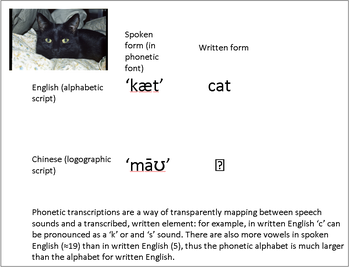
• Alphabetic: (e.g. English) where a single written element roughly represents a single speech sound.

Each of these systems has their own unique advantages and disadvantages. Notably, alphabetic writing systems can differ widely in how easy they are to acquire. Children learning to read English, which is highly irregular in both spelling and pronunciation, do less well at reading non-words after a year of reading, in comparison to children learning to read Spanish or Finnish (Aro and Wimmer 2003) English-reading children only catch up on their Finnish peers in grade 4.

In addition to the undoubted many values of literacy, we can see the impact of learning to read in a variety of ways. For example, it is harder to name the colour of the

ink in the word green than in the word grown. This Stroop effect is commonly used to demonstrate how meaning can interfere with cognitive processes – if you are naming ink colours as fast as possible, competing colour names will slow you down. Importantly, this can only occur because once you are a skilled reader, you can’t ‘switch off’ your reading when trying to name the ink colours, which is how the competing semantic information can get into the system. As skilled readers, it is nearly impossible for us not to read words.

The skill of learning to read also forces us to engage with sounds in ways that differ from what we have to do to understand spoken language. Some abilities in the manipulation of speech sounds are present before we learn to read (e.g. being able to tell that two words rhyme), while others emerge as a consequence of our learning to read. Thus, segmental skills – being able to break a word down into separate chunks corresponding to individual speech sounds – are something that we acquire when we learn to read. People who have never read find it hard to split ‘cat’ into ‘c’ ‘a’ and ‘t’ (though not completely impossible).

cat.PNG

Maybe because of the skills we acquire when we learn to read, psychologists and cognitive neuroscientists often use these segmental skills as an index of speech perception ability, despite the fact that people who haven’t learnt to read and who therefore find such tasks hard, can understand speech perfectly well. Because we can break spoken words down into smaller chunks, it is often assumed that this must be a central aspect of speech perception.

This bias towards segments in speech may have had other, more central effects on how we construe the problems of speech perception. It has been suggested, for example, that reading with an alphabetic system has biased us into the belief that the smallest units of speech, phonemes, are perceptual realities in terms of how we process speech from sound to meaning (Boucher VJ 1994 Alphabet-Related Biases in Psycholinguistic Inquiries – Considerations for Direct Theories of Speech Production and Perception, Journal of Phonetics, 22.1: 1 -18). The argument goes that because we can segment speech into phonetic elements (a skill we acquire when we learn to read) and because we are immersed in a reading system which represents spoken words as sequences of alphabetic symbols, that we implicitly assume speech to have these characteristics.

This assumption has had scientific consequences. For a long time, theories and models of spoken word comprehension incorporated a phonetic level of representation (e.g. the TRACE model.) The problem with phonemes is that any one speech sound will be greatly altered by where it is in a word and the sounds around it – in English the sound ‘l’ is very different at the start of the word ‘leaf’ than at the end of the word ‘bell’. There are also co-articulation effects, which refer the ways that the same speech sound is affected by its neighbours: the ‘l’ at the start of ‘let’ differs acoustically from the ‘l’ at the start of ‘led’ because of differences between final ‘t’ or ‘d’ phonemes. This covariance is highly useful to the listener and it makes sense that the perceptual system would preserve this detail. If you are building a computer system to understand speech, for example, you don’t build one to identify particular phonemes, you build it to look across sequences of sound, either groups of phonemes or whole words. Indeed, more recent psychological models of human speech perception explicitly do not make the assumption that phonemes need to be identified prior to comprehension (e.g. Shortlist B, Norris and McQueen 2008.)

At a brain level, can we see any sensitivity in speech perception areas to phonemes, as opposed to sequences of speech sounds? We recently investigated the neural activity seen when people silently rehearse pseudo-words. We varied how long the pseudo-words were in syllables (e.g. sapeth vs sapethetis) and how phonetically complex they were (e.g. sapeth vs stapreth.) This enabled us to separately identify brain areas which are more activated when people try to maintain longer or shorter pseudo-words, from those that are more activated when there are phonetically complex sequences in the material we are rehearsing. Silent rehearsal recruits both auditory and motor brain systems, both of these systems were sensitive to the length of the pseudo-words. In contrast, only the motor output systems were sensitive to the phonetic complexity of the pseudo-words, being more active when phonetically more complex sequences were rehearsed. This finding suggests that auditory areas are less sensitive to specific phonetic details, unlike motor systems. In turn, this may mean that if phonemes are ‘real’ phenomena in the language system, they are implemented in the motor systems, not in perception systems. In other words, we may not need to extract phonemes to understated speech, but they may be important elements in speech production.

My son is currently learning to read and write and watching his delight at solving the ‘problem’ of the sounds in words and what rhymes with what, is a joy and a privilege to see. Overhearing his dad explaining why ‘bird’ contains an ‘r’ letter (short answer, he had a heroic go at pronouncing it as ‘biRRRd’ as if he was from the Scottish highlands) showed me both the problems that written English presents to someone learning it, as well as the dominance reading can cast over what sounds we think there are in words.

A Happy Revolution

nick.bmp

Dr Nattavudh (Nick) Powdthavee is a behavioural economist in the Department of Economic at Nanyang Technological University, Singapore, and is the author of The Happiness Equation: The Surprising Economics of Our Most Valuable Asset. He obtained his PhD the economics of happiness from the University of Warwick. Discussions of his work have appeared in over 50 major international newspapers in the past five years, including the New York Times and the Guardian, as well as in the Freakonomics and Undercover Economist blogs.

It’s not often in our lifetime that we could almost hear the intellectual tide turning. The year was 1993. The main perpetrators were Andrew Oswald and Andrew Clark; two British economists who, in October that year, organised the world’s first ever economics of happiness conference at London School of Economics and Political Sciences. Posters advertising the event were put up weeks in advance. A hundred chairs were put out in the famous Lionel Robbins building, waiting to be filled by many of the world’s greatest minds. The meeting, the organisers thought, was going to be revolutionary to economics science. Perhaps it was even going to be historical, not so dissimilar to the one which was held a few months earlier in Cambridge where British mathematician Andrew Wiles presented the proof of Fermat’s Last Theorem to a few hundred academics before him.

Imagine their disappointment when only eight people turned up on the day*. It was official; the world’s first ever economics of happiness conference was no less of a complete and utter failure.

Fast forward eighteen years to 2011. Happiness is currently one of the hottest topics in world’s politics and economic research. The British Prime Minister David Cameron has set out a plan to measure and improve people’s happiness – or in his compound term “general well-being”. The French president Nicholas Sarkozy has already launched an inquiry into happiness, commissioning Nobel Prize winners Joseph Stiglitz and Amartya Sen to look at how policies on Gross Domestic Products (GDP) sometimes trampled over the government’s other goals, such as sustainability and work-life balance. There are now over two hundred thousand economic papers on the World Wide Web written exclusively on “happiness”, “life satisfaction”, or “subjective well-being”.

How did we get here so fast in just less than two decades?

Of course, one of the early issues that people have with the economics of happiness (and you’d be forgiven if you yourself did laugh at the idea) is that happiness is hardly a measurable concept. This is a big deal for economists who like to call themselves quasi-scientists (in that they mainly deal with objectively measurable data such as income and inflation rates). If what people say about the way they are feeling is subjective by definition, how can it be analysed and quantified?

This issue, I feel, has now been resolved almost entirely. Working alongside scientists, psychologists have been able to provide objective confirmations that what people say about their own happiness does indeed provide useful information about their true inner well-being. For instance, self-rated happiness has been shown to correlate significantly with the duration of “Duchenne” or genuine smiles a person give during a day, as well as the quality of memory, blood pressure, brain activities, and even heart beats per second. More remarkably, scientists have been able to show that how happy we feel about our lives today have important predictive power of whether or not we will still be alive, forty or fifty years from now. Put it simply, we really do mean what we say.

The last two decades had also seen a substantial rise in the number of newly available data sets which are impossibly large by previous standards. And by applying appropriate statistical tools on these randomly drawn samples, researchers are able to explore whether or not the determinants of individual’s happiness (which is normally captured by asking individuals to rate their happiness from “1.not too happy”, “2.pretty happy”, or “3.very happy”) are the same in America as they are in Great Britain, South Africa, and China (which they are, thus lending further credence to the idea that such answers should be taken seriously).

So, what are the interesting results happiness economists have discovered so far? Well, for a start, happiness is U-shaped in age. On average, we are likely to be happier with our life at the younger and older age points in our life-cycle, with the minimum point occurring somewhere around mid-40s. Money buys little happiness, whilst other people’s money tends to make us feel unhappy with ours. The big negatives in our life include, for example, unemployment and ill health. Yet these negative experiences hurt us less subjectively if we happened to know a lot of other unemployed people (or in the case of ill health, other people with the same illness as ours). Marriage and friendships are extremely valuable, although there is little statistical evidence to suggest that children make parents any happier than their non-parents counterpart. And more recently, happiness economists have been able to put dollar, pound, or euro values on happiness (or unhappiness) from seemingly priceless experiences or life events that come with no obvious market values such as time spent with friends, getting married, losing one’s job, and even different types of bereavement.

It’s difficult to try and forecast how important this kind of work will be in the political arena in the forthcoming century. It’s possible that future governmental policies may shift entirely from the pursuit of wealth towards more non-materialistic goals as a result of these findings. We may even witness a replacement of GDP for a more general well-being index such as the GNH (or Gross National Happiness) altogether, although this is probably unlikely to happen. However, one thing’s for sure; economics as a dismal science will never be the same again.

*Of those eight, five were speakers especially invited to speak at the conference by the organisers.

What The Computer Says About Who We Are

steve.bmp

Steve Fuller is Auguste Comte Professor of Social Epistemology in the Department of Sociology, University of Warwick. His next book, Humanity 2.0: What It Means to Be Human Past Present and Future is out with Palgrave Macmillan in September 2011.

You can tell a lot about the sort of creature we think we are, by the value we place on the things we make. In October 2010, the Economist staged an on-line debate on the most important technological innovation of the 20th century. The challengers: the digital computer and the artificial fertiliser. Perhaps unsurprisingly, the computer won by a margin of 3-to-1. Why was this result not surprising? After all, the artificial fertiliser is arguably the invention most responsible for a fourfold growth in the world’s population over the past century, as well as cutting the proportion of suffering from malnutrition by at least two-thirds. It would be difficult to think of another product of human ingenuity that has had such deep and lasting benefits for so many people. Even if it is true, that in absolute terms there are more people living in poverty now than the entire population of the earth in 1900, the success of artificial fertilisers has kept alive the dream that all poverty is ultimately eradicable.

Yet, the computer won – even though its development has tracked and in some cases amplified, global class divisions. Indeed, it is becoming increasingly common to speak of ‘knows’ and ‘know-nots,’ in the way one spoke of ‘haves’ and ‘have-nots’ fifty years ago. Nevertheless, over the ten days of debate it became clear that the computer was bound to win because, for better or worse, we identify more strongly with the extension than the conservation of human potential. Underlying this distinction is a fundamental ambivalence that human beings have always had towards the bodies of their birth. The fact that, when compared with other animals, we take such a long time to reach adulthood has led philosophers through the ages to muse that we are by nature premature beings who need to go beyond ourselves to complete our existence.

Whether we call this prosthetic extension ‘culture’, ‘technology’ or, in Richard Dawkins’ case, the ‘extended phenotype’, it suggests that we are not fully human until, or unless our biological bodies are somehow enhanced. The computer captures that desire in a twofold sense: it both provides a model for how to think of ourselves in such an enhanced state and the environment in which to realize it. A new book by the media theorist David Berry, The Philosophy of Software, explores the implications of this development in terms of such computer-based technologies as iPhones and iPads that increasingly constitute the human life-world. Bluntly put, the more time people spend interacting with high-tech gadgets, the more grounds there are for claiming that what the previous generation called ‘virtual reality’ is becoming the actual reality in which people define themselves.

Seen in this light, it is not surprising that an invention that ‘merely’ keeps alive our normal biological bodies – such as the artificial fertiliser – should be ranked decidedly lower than the computer in terms of importance. Back in the 1960s, the economist Thomas Schelling argued that you can tell the value that people place on their own lives by the amount they are willing to pay for securing it. Whether the relevant sense of ‘security’ is defined in terms of healthcare, life insurance, development aid or military budgets, one would be left with an open verdict on just how much people value the indefinite maintenance of the bodies of their birth. If we identify people’s preferences with what they do rather than what they say, it would seem that beyond a certain point, people would prefer to forgo security in favour of the freedom (and risk) to explore alternative possible modes of existence – for which the computer, again for better or worse, provides the technological exemplar.

Risk perception

untitled.bmp

David Ropeik is an international consultant in risk perception and risk communication, and an Instructor in the Environmental Management Program at the Harvard University Extension School. He is the author of How Risky Is It, Really? Why Our Fears Don’t Always Match the Facts, principal co-author of RISK A Practical Guide for Deciding What’s Really Safe and What’s Really Dangerous in the World Around You, and blogs for Huffington Post, Psychology Today, and has written guest blogs for Scientific American, Climate Central, and Big Think. He founded the programImproving Media Coverage of Risk,” was an award-winning journalist in Boston for 22 years and a Knight Science Journalism Fellow at MIT.

You are reading a piece in Nature, so you are probably fairly well-educated, and there is a better than even chance that you fancy yourself a fact-based thinker and reasonably rational. Meaning no disrespect, but that assumption is fanciful, at least when it comes to the perception of risk. Ambrose Bierce was right when he defined the brain as “the organ with which we think we think.” Research from diverse fields, and countless examples from the real world, have convincingly established that our perceptions of risk are an inextricable blend of fact and feeling, reason and gut reaction, cognition and intuition. No matter what the hard risk sciences may tell us the facts are about a risk, the social sciences tell us that our interpretation of those facts is ultimately subjective.

While this system has done a good job getting us this far along evolution’s winding road, it also gets us into trouble because sometimes, no matter how right our perceptions feel, we get risk wrong. We worry about some things more than the evidence warrants (vaccines, nuclear radiation, genetically modified food), and less about some threats than the evidence warns (climate change, obesity, using our mobiles when we drive). That produces what I have labeled The Perception Gap, the gap between our fears and the facts, which is a huge risk in and of itself.

The Perception Gap produces dangerous personal choices that hurt us and those around us (declining vaccination rates are fueling the resurgence of nearly eradicated diseases). It causes the profound health harms of chronic stress (for those who worry more than necessary). And it produces social policies that protect us more from what we’re afraid of than from what in fact threatens us the most (we spend more to protect ourselves from terrorism than heart disease)…which in effect raises our overall risk.

We do have to fear fear itself…too much or too little. So we need to understand how our subjective system of risk perception works, in order to recognize and avoid its pitfalls. Surprisingly, few people are aware of how much we know about this system. (I’ve tried to summarize that knowledge in my book, How Risky Is It, Really? Why Our Fears Don’t Always Match the Facts). Here’s a mad dash through the literature on risk perception;

• Neuroscience by Joseph LeDoux et.al. has discovered neural pathways that insure that we respond initially to risky stimuli subconsciously/instinctively, before cognition kicks in. And in the ongoing risk response that follows, the wiring and chemistry of the brain also insure that instinct and affect (feelings) play a significant role, sometimes the primary role, in how we perceive and respond to danger. Simplistically, the brain is designed to subconsciously feel first and consciously think second, and to feel more and think less.

• The research of Daniel Kahneman et.al. has discovered a mental toolbox (as Gird Gigerenzer puts it) of heuristics and biases we use to quickly make sense of partial information and turn a few facts into the full picture of our judgment. These mental shortcuts occur subconsciously, outside (and often before) conscious reasoning. This research further confirms that we are far more Homo Naturalis than Homo Rationalis.

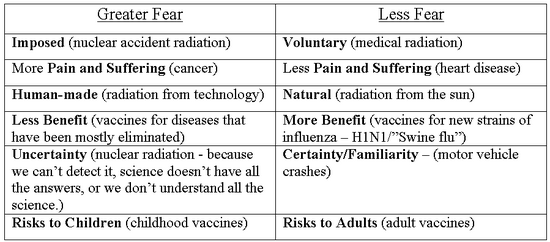
• The Psychometric Paradigm research of Paul Slovic et.al. has revealed a suite of psychological characteristics that make risks feel “more” frightening, or less, the facts notwithstanding. These ‘risk perception factors’ include:

untitled.bmp

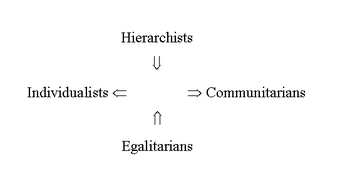
• Recent research on the theory of Cultural Cognition by Dan Kahan et.al has found that our views on risks are shaped to agree with those we most strongly identify with, based on our group’s underlying feelings about how society should operate. We fall into four general groups about the sort of social organization we prefer, defined along two continua, represented as a grid. We all fall somewhere along these two continua, depending on the issue.

untitled1.bmp

Individualists prefer a society that maximizes the individual’s control over his or her life. Communitarians prefer a society in which the collective group is mire actively engaged in making the rules and solving society’s problems (Individualists deny environmental problems like climate change because such problems require a ’we’re all in this together’ communal response. Communitarians see climate change as a huge threat in part because it requires a social response). Along the other continuum, Hierarchists prefer a society with rigid structure and class and a stable predictable status quo, while Egalitarians prefer a society that is more flexible, that allows more social and economic mobility, and is less constrained by ‘the way it’s always been’. (Hierarchists deny climate change because they fear the response means shaking up the free market-fossil fuel status quo. Shaking up the status quo is music to the ears of Egalitarians, who are therefore more likely to believe in climate change.)

That risk is inescapably subjective is disconcerting for those who place their faith in the ultimate power of Pure Cartesian “I think, therefore I am” Reason. But the robust evidence summarized above makes clear that;

1. Risk perception is inescapably subjective

2. No matter how well educated or informed we may be, we will sometimes get risk wrong, producing a host of profound harms.

3. In the interest of public and environmental health, we need a more holistic, and more realistic, approach to what risk means. Societal risk management has to recognize the risk of risk misperception, the risk that arises when our fears don’t match the evidence, the risks of The Perception Gap.

Letting go of our naïve fealty to perfect reason will allow us to recognize and understand these hidden dangers. Once brought to light, the harms to society from declining vaccination rates, the lost benefits of genetically modified food, the morbidity and mortality and societal costs of obesity – these risks and many more can be studied and quantified and managed with the same tools we already use to manage the risks from pollution or crime or disease. The challenge is not how to manage the risks of the Perception Gap. The challenge is to rationally let go of our irrational belief in the mythical God of Perfect Reason, and use what we know about the psychology of risk perception to more rationally manage the risks that arise when our subjective risk perception system gets things dangerously wrong.

Further Reading:

The neuroscience of risk perception – LeDoux J, The Emotional Brain, Simon and Schuster, 1996

Heuristics and Biases – Kahneman, D., Slovic, P. & Tversky, A. Judgment Under Uncertainty: Heuristics and Biases, Cambridge University Press, 1982)

The Psychometric Paradigm ‘risk perception factors’ – Slovic P, The Perception of Risk, Earthscan 2000

Cultural Cognition.

Risk Intelligence

dylan2.jpg

This week’s guest blogger is Dylan Evans, an author and academic at University College Cork, Ireland. He lectures in behavioural science and is the author of numerous books including Emotion and Placebo.

President Obama recently criticized American spy agencies for failing to predict the spreading unrest in the Middle East. Now a new study is attempting to discover what makes a good forecaster.

Volunteers are being recruited for a multi-year, web-based study of people’s ability to predict world events. The study is sponsored by the Intelligence Advanced Research Projects Activity (IARPA). One aim of the study is to discover whether some kinds of personality are better than others at making accurate predictions. The researchers hope to recruit a diverse panel of participants who are interested in offering predictions about events and trends in international relations, social and cultural change, business and economics, public health, and science and technology.

The Forecasting World Events Project is part of a multi-year research program investigating the accuracy of individual and group predictions about global events and trends, with the aim of advancing the science of forecasting. Last year I carried out some similar research. In December 2009 I set up a prediction game in which we asked people to estimate the chances of various developments in politics and business around the world in the coming year.

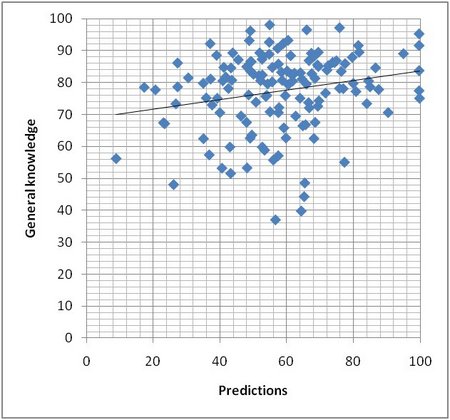
During the first few months of 2010, over 200 people who had already taken our basic risk intelligence test (which asked people to estimate the likelihood of statements about general knowledge) estimated the probability of each prediction. Over the rest of year, whenever any of the predictions came true or false, my colleague Benjamin Jakobus entered the details in the system accordingly. At the end of the year, we had enough data to calculate their risk intelligence.

The big question was whether these scores would correlate with those derived from the general-knowledge version of the test. If they did, that would suggest that the cognitive tasks involved in estimating the likelihood of general knowledge statements are basically the same as the skills required to estimate the probability of future events. In other words, if people tended to get similar scores on both types of test, it would support the view that risk intelligence is a single general-purpose ability to deal with uncertainty that can applied equally to reasoning about the past, present and future. If, on the other hand, people tended to get very different scores on in the two tests, this might suggest that risk intelligence is more domain-specific, so a person could be risk smart in one area and risk stupid in another.

predictions.jpg

As you can see from the graph, the results were not impressive; the correlation between the scores on the two tests was only .21. This means there is questionable value in administering a general knowledge version of the risk intelligence test to someone in an attempt to discover his or her skill at forecasting. It may be a useful approach when selecting the best hundred forecasters from a pool of a thousand applicants, since even low correlations can be useful when dealing with large groups. For individuals, however, it would appear that the only way to measure forecasting ability is to collect probability estimates about actual future events; the general knowledge type of risk intelligence test will not serve as a proxy.

It just doesn’t feel right

simon.bmpThis week’s guest blogger is Simon Laham, PhD, a social psychologist and a Research Fellow and Lecturer in Psychological Sciences at the University of Melbourne, Australia. His work focuses on the psychology of morality.
Matthew is playing with his new kitten late one night. He is wearing only his boxer shorts, and the kitten sometimes walks over his genitals. Eventually, this arouses him and he begins to rub his bare genitals along the kitten’s body. The kitten purrs and seems to enjoy the contact.

What do you think about this? Morally right or wrong? Well, if you’re like most, you think that Matthew’s behavior is not only pretty disgusting, but morally condemnable.

But now ask yourself why you think it’s wrong? No one is harmed here, after all; Matthew is having fun and it seems that the kitten isn’t too bothered. What about germs? Well, let’s say that the kitten has just been bathed and there is no chance of Matthew catching something. Still wrong?

When psychologist Jonathan Haidt presented participants in one of his studies with scenarios just like this (depicting harmless, but norm-violating behaviors, such as masturbating with frozen chickens and eating road kill), he found that many people relentlessly insisted that such behaviours were “just wrong,” even though they couldn’t muster any convincing justifications. These participants sat, “morally dumbfounded,” as Haidt put it, asserting simply that “it just feels wrong.”

When prodded, people’s moral foundations tend to wobble a little bit. Although many of us like to think that our moralities are firmly grounded in principles – thou shalt not kill, love thy neighbour as thyself – and that moral judgments spring from the logical application of such principles, it just so happens that many of our moral judgments aren’t driven by the rational, deliberative contemplation of moral rules at all. Rather they are driven by intuitions. We witness an action, experience an intuitive flash of disgust, or anger, for example, and, as a result, deem the action morally wrong. Matthew isn’t violating any lofty moral law with his kitten rubbing, he’s just doing something disgusting, and, thus, wrong.

Just where do these intuitions come from? It’s quite likely that they have an evolutionary basis. Put simply, we feel disgusted or angry about behaviors that somehow compromised the reproductive success of our evolutionary ancestors.

Take incest as an example. Those ancestors of ours who happened to have felt disgust at incest would have been less likely to commit it, and thus more likely to have produced viable offspring, passing on their incest-condemning genes to future generations. Certain moral intuitions conferred reproductive advantages in the past; those are the moral intuitions we feel today.

It’s quite sobering to realise that your moral outlook is shaped not by appeal to higher reason, but by the contingencies of your evolutionary history. Still more sobering, however, are results from other research which suggests that opinions about important moral questions are influenced by a raft of other, thoroughly irrelevant factors.

Consider this: if I had happened to write the Matthew scenario above in chiller font or blackadder ITC font or some other difficult to read font, chances are you would have found it even more morally wrong than you did originally. Some work from my own lab shows that when people have a difficult time processing a stimulus (because, for example, it’s hard to read), they are more likely to think it’s morally wrong than if they have an easy time processing it. The idea here is that “disfluent” processing feels negative, and this negativity seeps into our moral judgments, making us harsher moral critics.

Or consider this question: What entities in the world deserve our moral consideration? Apes? Dogs? Fetuses? This is not a trivial question. Your answers will form the basis of your attitudes towards vegetarianism, abortion, or animal experimentation, among other pressing moral issues. Yet even here we see the subtle influence of moral irrelevancies. When people are asked to generate a list of such morally worthy entities by selecting candidates from a longer list, they end up with fewer candidates than people asked to cross unworthy entities off a longer list. The size of your moral community, in other words, depends on how you happen to be asked to populate it.

The list of subtle shapers of moral judgment goes on: show people a clip from Saturday Night Live and they are more likely to make utilitarian judgments; have them make judgments in a dirty room, littered with used tissues and pizza boxes, and they become harsher moral judges; expose people to “fart spray” and they less likely to endorse marriage between first cousins…

It should give you pause to realize that your judgments of right and wrong – be they about euthanasia, incest, abortion, or kitten masturbation – are subject to a range on non-rational, gut feelings or intuitions rather than under the control deliberative, rational, reasoning processes. The belief that our moral compasses are guided by a set of well thought-out principles that we consciously and painstakingly apply to each new situation is simply inconsistent with the empirical evidence. This belief fails to capture the complexity of moral judgment and it ignores the now well-documented fact that our judgments of right and wrong are driven largely by intuitive and often irrelevant factors that reside largely outside of our awareness.

A pack of cards and a little calculated hocus-pocus

PETER 2.bmp

This weeks guest blogger, Peter McOwan, is currently a Professor of Computer Science and Dean for Taught Programmes in Science and Engineering at Queen Mary, University of London. His research interests are in visual perception, mathematical models for visual processing, in particular motion, cognitive science and biologically inspired hardware and software. He is also active in science outreach through various projects such as cs4fn and Sodarace. Peter was awarded a National Teaching Fellow in 2008 by the Higher Aducation Academy.

Since I was a kid I’ve been fascinated by magic, the way that you can use science and maths to make it look as if you’re breaking the rules of the natural world. Way back I remember being amazed with diagrams in old magic books from my local library showing how the Victorians created ghosts on stage using sheets of glass, or how you could pour a colourless liquid into a glass and it would turn to ‘wine’ or ‘milk’, (all done not with mirrors, but with physics and chemistry). My favourite tricks were the ones where the ‘secret’ was in the hidden maths. With a pack of cards I could entertain my friends and family, being able to perform seemingly impossible feats of mind reading or memory; as a kid that was cool!

Fast forward to the present day; my interest in science and maths led me through various earlier incarnations to being a professor of computer science, researching into biologically inspired artificial intelligence (I also loved Dr Who and Sci Fi on TV, but that’s another story…). Computer science, the study of information and how we process it is, I believe, at the core of understanding the modern world round us. In the past we needed physics chemistry and biology; now we also need computer science. If you look at it, computer science underpins much of the progress in diverse scientific endeavors, for example bioinformatics or climate change, it is also fundamental to our economic prosperity, banking and businesses. It’s computer science that today lets us work, rest and play. But computer science also has a significant ‘image’ problem. The fundamentals are often hidden in our everyday devices, it’s considered to be filled with socially inept ‘geeks’ , it’s seen as too hard or dull, with a low uptake of students at all levels and an almost invisible profile with the public. Why were people not getting it?! It perhaps needed a bit of magic.

With my colleagues Paul Curzon and Jonathan Black I set about applying my knowledge of magic techniques to create a series of entertaining tricks the hidden secrets for which were some fundamental computer science principles. In the same way as those Music Hall illusions from the past had inspired me to study science, we would create tricks to inspire people to explore computing. It wasn’t that hard, in the back of my mind during my scientific career I’d come across techniques that I realised were used in the mathematical based tricks I loved, I just never thought those links would be useful.

One of the first moments of magical ‘fusion’ was with computer assisted tomography, the Radon transform technique which is used to back project and reconstruct 2D images from an angular sequence of 1D scans clicked, it was exactly the same idea that was used to construct forcing matrixes as used by mentalists. The more I looked the more I realised that a whole load of magic tricks involved computer sciency things like binary searches, Markov sequences and so on. These ideas had been developed by magicians, and by scientist separately but they used the same principles. I was intrigued and started to do more research. To my surprise I discovered that there were a number of famous magical effects that had been developed by computer scientists.

Alex Elmsley, who created the wonderful slight of hand move called the Elmsley Count (perfecting which had taken many days of my youth) was actually a Cambridge computer scientist – his famous 16th card trick was a binary search algorithm!

Then I discovered Dr Brent Morris, who has probably the only doctorate in the world in card shuffling with the snappy title of “Permutations by Cutting and Shuffling: A Generalization to Q Dimensions.” Brent was an amateur magician who had practiced long and hard to perfect the Faro (or so called perfect shuffle), where a pack is split in two and weaved together so that the cards interlock alternatively one by one with each other. It’s inspiring to see (I’m still practicing!). The Faro shuffle was known by magicians of old as being a way to shift a card from one position in the pack to another while looking like you’re shuffling the deck. Brent spotted that if you understood the maths of how to move things around you could equally apply the method to efficiently moving data in a computer memory instead of sneakily shifting cards. It got him his computer science doctorate and also two U.S. patents on computers designed with shuffles. I was impressed!

So with all of these fascinating stories of amazing people and equally amazing secrets, we set about writing our first Magic of Computer Science book, hoping that it would catch the imagination, and it did. We traveled the UK doing magic shows, entertaining and educating. The books was translated into Welsh, Italian and German, so we wrote another.

This time we used it to make the point that good software needs both a good mathematical algorithm but also an understanding of how human brains work. This is the all important software usability agenda and it linked with some lovely magic. Magicians for centuries have known how to confuse their audience – its called misdirection – they point left and do something sneaky on the right. Magicians deliberately get you to make mistakes. Understanding how that happens means that you can reverse the procedure and build better software for use in safety critical situations like hospitals, so that the users are directed to pay attention to what’s important.

You would expect that strange out-of-this-world type things happen in magic, and they do! We ended up helping private space explorer and computer games designer Richard Garriott design science based magic tricks to perform on his 2008 visit to the International Space Station (yet another scientist who loves magic). The magic is working.

Finally a blog on magic wouldn’t be complete without a trick…

Shuffling cards.bmpShuffle a deck of cards. Spread the cards on the table face down. Now think of the colour RED and select any 8 cards, then think of the colour BLACK and select another 7 cards at random. Now think of RED again, select another 6 random cards, then finally BLACK again and select 5 cards. Shuffle the cards you chose, and then turn the pile face-up. Take the remaining cards, shuffle them and spread them face-down. Now the magic starts. Concentrate. You are going to separate the cards you selected (and that are now in your face-up pile) into two piles, a RED pile and a BLACK pile.
Go through your face-up cards one at a time. If the card is RED put it in the RED pile. For each RED card you put in your RED pile think RED and select a random card from the face-down cards on the table. Put this card face-down in front of your RED pile. Similarly if the next card is a BLACK card put it face up on your BLACK pile, think BLACK and select a random face down cardand put this face-down card in front of your BLACK pile. Go at it until you run out of face-up cards.

You now have a RED pile and in front of that a pile containing the face-down cards you selected while thinking RED. You also have a BLACK pile in front of which is a pile of cards you selected while thinking BLACK.

Interestingly your thoughts have influenced you choice of random cards! Don’t believe me? Look at the pile of cards you chose and put in front of your RED pile. Count the number of RED cards in this pile. Now look at the cards in front of your BLACK pile, and count the number of BLACK cards you selected. They are the same! You selected the same number of RED and BLACK cards totally at random! Amazing.

And for our next trick, wait and see…

The magic books mentioned can de downloaded for free here, we also wish to thank EPSRC, Google and Microsoft for their support of our work, they are all magic!

Common sense?

John Farndon

This week’s guest blogger – John Farndon studied earth sciences at Cambridge University and has written more than 300 books on science and nature including How the Earth Works, The Wildlife Atlas, The Practical Encyclopedia of Rocks and Minerals, and the forthcoming The Atlas of Oceans. He also writes extensively on the history of ideas and contemporary and environmental issues, penning such books as China Rises, India Booms, Bird Flu and 101 Facts You Should Know about Food. He was the author of the best-sellers Do Not Open, Do You Think You’re Clever? and The World’s Greatest Idea and his books have been translated into most major languages. He has been shortlisted four times for the Royal Society Prize for Science Books, and for the Society of Authors Education Award. He lives in London.

In a fortnight’s time, I’m giving a talk at the Brighton Science Festival about a recent book of mine entitled ‘The World’s Greatest Idea”, which is an exploration of 50 of the great ideas that have shaped the world.

One of the ideas that features is the welfare state, and in researching the topic I was reminded how groundless assumptions can assume the mantle of ‘common sense’ if repeated enough times.

cutting costs.bmpCurrently, many governments around the world are wondering how to cut welfare budgets. Generous spending on welfare is not only unaffordable in these hard economic times, it is argued; it is a drag on economies, discouraging people from seeking work. And most people assume this is so.

And yet this ‘common sense’ argument has no actual foundation in reality. Welfare systems have rarely acted as a brake on a country’s economy. In nearly all cases, countries that have introduced a welfare system have experienced dramatic economic growth.

After Germany introduced its welfare system in the 1880s, its economy grew rapidly – so rapidly that Britain was shocked to find it had an economic rival for the first time, and right on its doorstep. And in the post-war years, Western Europe has experienced a time of unparalleled prosperity. Moreover, the most prosperous countries, such as Sweden and Germany, are those with some of the most generous welfare provision.

Similar myths have been perpetuated in the field of science. Do you, for instance, assume that it is scientifically proven that intelligence declines slowly with age? If so, you’re not alone. For a long while, IQ tests did appear to show that younger people did better than old people, and were taken as gospel proof that intelligence declines with age. Yet a re-examination of the evidence shows that this isn’t so for two reasons.

iq tests.bmp

The first was that the IQ tests which showed young people did better were simply a matter of training. Younger people had had more practice of doing the kind of mental tasks tried in IQ tests than older people. As soon as older people were trained in this kind of thinking, their performance levels shot up.

The second reason is that IQ tests were done against the clock. If the time pressure is removed, older people do just as well as their young counterparts – and it is quite reasonably argued that older people are slower simply because their experience means they have to sift through more possibilities to reach the answer.

In fact, these assumptions about IQ and age went further. Psychologists have been telling us for decades that the one thing that your IQ is fixed and unchangeable through life. If you’re intelligent, we were told, you remain intelligent until age begins to sap it. If you were not, you were not, and that was that. Yet there is little scientific evidence that any of this is so. It is just another ‘common sense’ assumption. And recent scientific research has begun to throw doubt on this.

brain power.bmpIt is now becoming clear, for instance, that IQ is closely connected to your working memory, the amount of current data you can store in your head at any one time. Recent research by Torkel Klingberg in Sweden showed that the neural systems used in working memory may actually grow in response to training. What’s more children who completed a training course not only did better in the tests given to them by Klingberg but actually found their scores in IQ tests leap by 8 per cent.

Of course, Thomas Kuhn argued that scientists can never divorce their own personal take on their subject, and that science is inevitably bound within the prevailing outlook. So there is always likely to be a time when any assumption is finally shown to be false. But in the meanwhile it definitely pays to be wary of those who would dismiss your questions on the basis of common sense.

As Einstein observed, “Common sense is the collection of prejudices acquired by the age of 18.”

Does genius follow the ten-year rule?

andrew final.JPG

Our guest blogger this week is Andrew Robinson, the author of over twenty books on both the arts and sciences. They include biographies of Albert Einstein, A Hundred Years of Relativity, and of the polymath Thomas Young, The Last Man Who Knew Everything. He recently published a biographical study, Sudden Genius? The Gradual Path to Creative Breakthroughs.

Gradual preparation with sudden illumination, dogged work with a “eureka” experience, perspiration with inspiration—whichever pair of contrasts one prefers—are defining features of creative breakthroughs in any domain of science or art. In Thomas Edison’s much-quoted remark, from around 1903, “Genius is one per cent inspiration, ninety-nine per cent perspiration.”

I first became interested in genius while writing a biography of the great Indian film director Satyajit Ray in the 1980s. I followed this book with four more biographies in the arts and sciences, including studies of Albert Einstein and the polymath Thomas Young. Eventually, in 2007, I decided to look generally at the relationship between genius and creative breakthroughs, to see if it follows any rule.

albert.bmpThere can be no doubt that geniuses have worked habitually and continually. Long years of relevant labour have often preceded a scientific breakthrough. In medicine, Alexander Fleming had been working in the bacteriology department of a hospital for some two decades when he discovered penicillin by accident in 1928. Alec Jeffreys’s discovery of genetic fingerprinting in 1984 was similar. Having left an experiment running over the weekend, he returned to his laboratory to find a peculiar array of blobs and lines on his developed film. His first reaction was: “God, what a mess.” But when he stared at the data a bit longer, “The penny dropped.” Yet, the penny would not have dropped without his more than a decade of prior research in genetics.
Both discoveries are fine examples of Louis Pasteur’s 1854 dictum: “Where observation is concerned, chance favours only the prepared mind.” Can we today be more specific than Pasteur? Perhaps. Although genius does not follow laws, it seems to follow the so-called 10-year rule. First identified by the psychologist John Hayes in 1989 and soon endorsed by other psychologists, the rule states that a person must persevere with learning and practising a craft or discipline for about 10 years before he or she can make a breakthrough. Remarkably few breakthroughs have been achieved in less than this time.

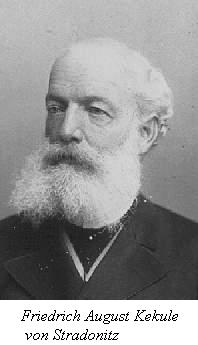
Frkekulé-thumb-198x345-1941In the sciences, Einstein is a good example. His first insight into special relativity occurred around 1895, 10 years before the creation and publication of the theory in 1905. August Kekulé’s theory of the benzene ring was published in 1865, 10 years after his first day-dream
of his structural theory on a London omnibus. Tim Berners-Lee invented the World Wide Web in 1990, 10 years after his first web- like computer program, known as Enquire. It is not difficult to multiply examples.

The arts frequently show the rule in operation, too—if “breakthrough” is defined as the production of an artist’s first generally accepted masterwork. In literature, Percy Bysshe Shelley’s creative explosion of 1819-20 occurred 10 years after he wrote and published his first poetry and fiction in 1809-10. In painting, Pablo Picasso’s Les Demoiselles d’Avignon was created in 1907, a decade after he began training as an artist in Barcelona in 1896. In music, Igor Stravinsky’s The Rite of Spring was composed in 1912, a decade after he began his apprenticeship to Nikolai Rimsky-Korsakov in 1902. In cinema, Satyajit Ray created his first film, Pather Panchali in 1955, a decade after drawing illustrations for the novel on which the film was based.

In my view, the 10-year rule is best considered in three versions: weak, medium, and strong. The weak version is that a breakthrough requires a minimum of 10 years’ hard work and practice in a relevant domain—and it may take much longer. The medium version is more restrictive: a breakthrough requires a minimum of 10 years’ hard work and practice focused on the particular problem solved by the breakthrough. The strong version is more restrictive still: a breakthrough requires about 10 years—no less and no more—of hard work and practice focused on the particular problem solved by the breakthrough. Of course, there are many exceptions to the strong version, such as Fleming and penicillin. However, exceptions to the weak version of the rule are rare. Not even Wolfgang Amadeus Mozart fits this last bill, since his first masterwork, his piano concerto No. 9 (K271), was written in 1777, which is 12 years after his first published composition.

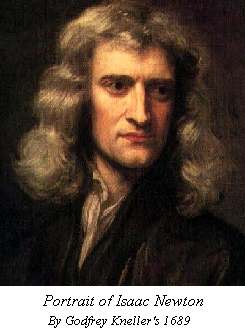
issac newton.bmpHayes discovered only three exceptions among classical composers: Erik Satie composed a masterwork in year 8 of his career, while Niccolò Paganini and Dmitry Shostakovich composed one masterwork each in year 9 of their careers. In the sciences, exceptions are extremely rare. Werner Heisenberg created matrix mechanics in 1925, aged 24 years, only about 5 years after beginning his university study of physics. On the other hand, Heisenberg had two leading physicists, Max Born and Niels Bohr, as close mentors during this period. Paul Dirac may provide a further exception: in 1928, he formulated the relativistic theory of the electron from which he predicted the existence of the positron, aged 25 years, about 6 years after beginning his university training in applied mathematics. However, Dirac had previously taken a 3-year degree in electrical engineering. Perhaps only Isaac Newton fairly and squarely beats the 10-year rule in science: his annus mirabilis, 1665-66, occurred after less than 5 years of solitary study at Cambridge, at the age of only 22 years.

The predominance of theoretical physics among the handful of exceptions may be a small clue to the explanation of the 10-year rule in exceptional creativity. In theoretical physics, years of laboratory grind are not required, nor is any of the corpus of facts about nature that has to be memorised and assimilated in other sciences, such as medicine and biology. So perhaps the theoretical physicist needs to expend less time in perspiration than other scientists before he or she can reach the frontier of the subject and make a breakthrough. Indeed, the 10-year rule seems to me to be an empirical truth about perspiration and inspiration equivalent to that of Edison’s personal guess—not only in its underlying rationale but also approximately in its ratio. Instead of Edison’s 99% versus 1% estimate, for every 10 years (120 months) of hard work, an individual may be granted, so to speak, a month or two’s worth (1%) of “sudden inspiration”. Discouraging as this may be in one sense, it also means that hardly any genius in history—not even Leonardo da Vinci —seems to have short-cut the long and gradual path to creative breakthroughs.