
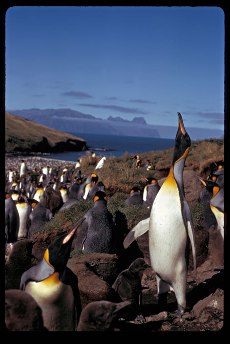
 Last December the Great Beyond featured a warning from the WWF that global warming threatens penguins. At the time we said there was no new science but it was a good time to visit the issue as it coincided with the Bali climate change meeting. Well now there is some new science.
In a new paper in PNAS Yvon Le Maho and colleagues report the results of their nine year study into King penguins on Possession Island in the southern Indian Ocean. They found that high sea surface temperatures from El Nino events reduced the availability of small fish and squid on which the penguins rely. Survival of adult penguins also dropped off.
“Our findings suggest that king penguin populations are at heavy extinction risk under the current global warming predictions,” states the paper.
It predicts a 9% reduction in the adult population for every 0.26 degree Celsius rise in sea surface temperature. Current predictions are for a 0.4 degree rise over the next 20 years, meaning the King penguin is going to be in for a rough ride.
 The Australian says the findings tie in with predictions from ecologist Eric Woehler, of the University of Tasmania. Last year, at the International Penguin Conference, Woehler and others warned the birds face serious population declines.
“Penguins are the bellwether of climate change,” Woehler says in the paper’s coverage of the new findings. “As birds, they’re pretty much at the top of the food chain and act as two-footed bio-indicators of the health of the environment, marine and terrestrial.”
National Geographic quotes William Fraser, ecologist at the Polar Oceans Research Group in Sheridan, Montana: “Here’s another species, [such as] the polar bear in the Arctic and the Adélie penguin in the Antarctic, that we would have thought to be undisturbed. Because these animals live so far removed from people, it often passes us by that they too are vulnerable to human impacts like climate change.”
The LA Times spoke to Christophe Barbraud, who works at the same place as Le Maho but was not involved in the study. Barbraud thinks the time period of the study is too short to be certain about the link between temperature and survival.
Image top: courtesy of Dr Yvon Le Maho
Image bottom: courtesy of David Beaune