
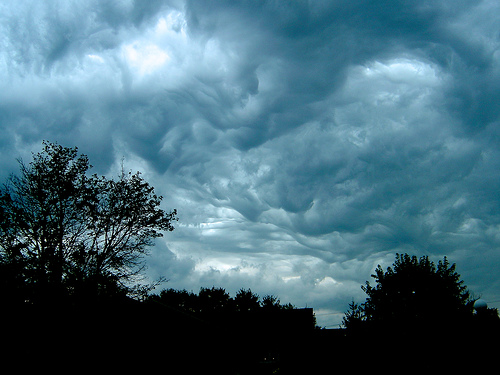
 Despite decades of research, relationships between clouds, aerosols and precipitation are poorly understood, concludes a review article in Nature today.
Before a cloud can produce rain or snow, rain drops or ice particles must form. Atmospheric aerosols, tiny particles of mineral or organic origin, serve as the nuclei for condensation.
But the precise effects of aerosols on cloud formation and radiative forcing remain controversial. In their review article, Bjorn Stevens and Graham Feingold propose that the uncertainties reflect a failure to take into account processes that act to buffer the response of clouds and precipitation to aerosol changes. Worse, existing tools and methodologies for untangling these processes are inadequate, they say.
“If we wish to make significant strides in understanding the interplay among the aerosol, clouds and precipitation, we consider it imperative to launch significant new international initiatives, with comprehensive, coordinated and enduring measurements, targeting specific regimes and coupled to state-of-the-art modelling,” the duo concludes.
Among other things, they say, what’s lacking is an array of ground-based remote sensors capable of vertically and temporally resolving the aerosols, clouds, precipitation and the meteorological state.
Quirin Schiermeier
Image: Flickr user laffy4k, Creative Common license