
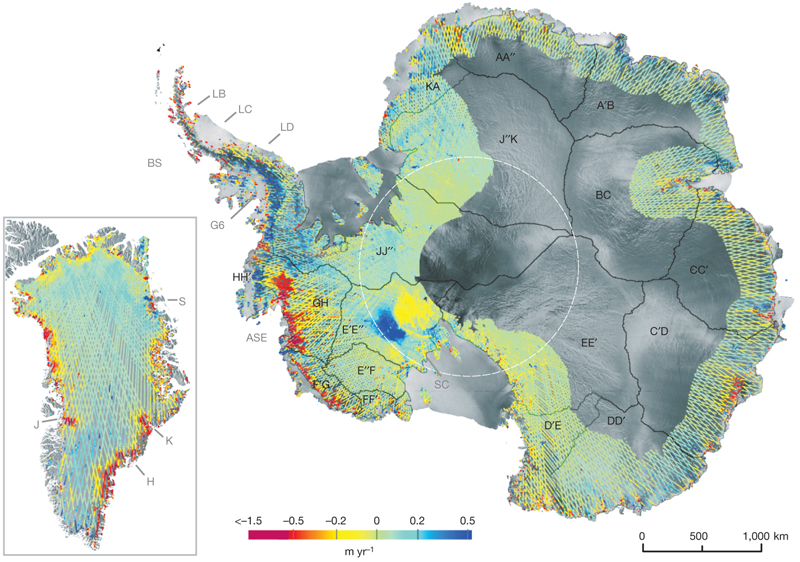
 Many glaciers in Greenland and Antarctica are speeding up their slide into the sea. But this type of ice loss – known as dynamic thinning – is so ill-understood and difficult to predict that the IPCC, in their 2007 assessment report, threw up their hands and refused to guess how much it would contribute to future sea level rise.
Meanwhile, however, scientists have been working with a new tool for studying glacier flow: NASA’s ICESat spacecraft. This satellite uses a laser to measure the changing height of the glaciers with spatial resolution an order of magnitude better than its predecessors.
The results from 2002-2007 are just in, published as a Nature paper (subscription) online this week:
Dynamic thinning of Greenland and Antarctic ice-sheet ocean margins is more sensitive, pervasive, enduring and important than previously realized.
On both the Greenland and Antarctic ice sheets, ICESat can see glaciers all around the coast, many of which were too steeply sloping to monitor with earlier technology. Hamish Pritchard of the British Antarctic Survey and his colleagues report that rapid dynamic thinning (colored red in the map above) is widespread around much the margin of Greenland, and has intensified on key Antarctic coastlines. At the extreme, certain Antarctic glaciers flowing into the Admunsen Sea embayment are losing more than 9 metres of thickness per year.
Such thinning can extend far inland, they report – hundreds of kilometres, in some cases. The dramatic collapse of floating ice shelves that push back on glaciers is one cause of speed-up, and the group found that this effect can continue for decades after a collapse. But they also suggest that gradual melting and thinning of the ice shelves by a warming ocean is causing many glaciers to accelerate.
Pritchard gave AP this bottom line: “To some extent it’s a runaway effect. The question is how far will it run?”
Anna Barnett
Image: reprinted from Nature advance online publication, doi:10.1038/nature08471 (2009).