
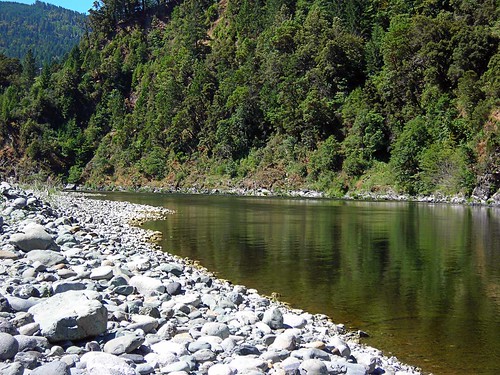
The Klamath River runs through Oregon and northern California. {credit}Pam Rentz on Flickr under Creative Commons{/credit}
In the first of its reports on alleged scientific misconduct to be released since the 2011 introduction of a new scientific integrity policy, the US Department of the Interior (DOI) has rejected allegations brought by Paul Houser, a scientific-integrity official and hydrologist who claimed in 2012 that he was fired for trying to do his job calling out bad science.
After his dismissal, Houser, now at George Mason University in Fairfax, Virginia, reached a settlement with the DOI in December 2012. But the DOI and Houser continue to disagree on whether the work he questioned during his time there contained examples of scientific misconduct.
Now the report, which was released by the DOI as part of a new scientific-integrity website launched on 15 March, agrees with Houser that a press release and scientific summary document prepared by DOI staff in 2011 downplayed the level of uncertainty around scientific studies suggesting that the proposed removal of four dams on the Klamath River in Northern California would be good for the environment. But it finds that the misrepresentations were not deliberate and did not rise to the level of scientific misconduct. “The issues he raises do not appear to constitute intentional distortion or omission of scientific facts, falsification of science, or compromise of scientific integrity,” the report states. Still, its executive summary warns the department that “false precision” is not desirable, and notes that panel members struggled with a lack of clarity over how the newly introduced integrity policy should be interpreted.
The Klamath River basin is one of the most politically polarized areas in the United States, with some libertarians and Tea Party groups opposing dam removal, and some native American tribes and environmentalists strongly supporting it. “It’s like national politics on steroids,” says Craig Tucker, a biochemist working with the Karuk tribe, which supports dam removal and has been following Houser’s case. Tucker says that the tribe would be concerned if science had been manipulated to justify dam removal, but he believes that the report puts those concerns to rest by making clear that the problems involved only press releases and not the underlying science.
Houser says that he has concerns about the way the investigation was conducted, specifically that panel members did not seem to have interviewed anyone involved and simply relied on a documentary record provided by the DOI. “It’s hard to tell if misconduct is intentional just by looking at the scientific record,” he says.
Panel members acknowledged that they failed to get to the bottom of at least one issue: the source of quoted figures of 81.4% and 83% that are given in different versions of the summary document as the amount by which populations of Chinook salmon would increase following dam removal. Nature‘s reporting has suggested that the numbers come from an unpublished computer-modelling study located on a US government website. The study’s author, Noble Hendrix, an ecologist at R2 Resource Consultants in Redmond, Washington, told Nature in an interview last March that the goal of his analysis was actually to highlight the large uncertainty in forecasts of fish populations carried out by computer modelling. The 81.4% figure was the median observation of 1,000 runs, whereas 83% was the mean, and the full uncertainty range was as large as −59.9 to 881.4% (information not included in the department’s public summary).