
In June 2016, 21 young Indian scientists made a trip to the beautiful island of Lindau, in south west Germany, to attend the 66th Lindau Nobel Laureates Meeting, dedicated this year to physics. In this sunny side of Germany, 29 Nobel Laureates met with 400 young scientists from 80 countries in an informal setting, which has come to be celebrated as the hallmark of these meetings.
On a boat trip from Lindau to Mainau island, Nature India caught up with the Indian delegation consisting of master’s students, PhDs and Post-docs, freshly chosen every year since 2001 by India’s Department of Science and Technology (DST) in collaboration with the German Research Foundation (DFG) to be part of this science extravaganza. In this blog series ‘Lindau lessons‘, Nature India will bring to you the unique experience of some of the young scientists from India who basked in the Lindau sun this year. Join their online conversation using the #lindaulessons hashtag.
First up this week, we have Biplab Pal from the Department of Physics, University of Kalyani, West Bengal recounting his dream experience of meeting the 2011 Chemistry Nobel Laureate Daniel Shechtman, discoverer of the quasi-periodic crystals. He tells us why it was so special and other things he learnt from Lindau.
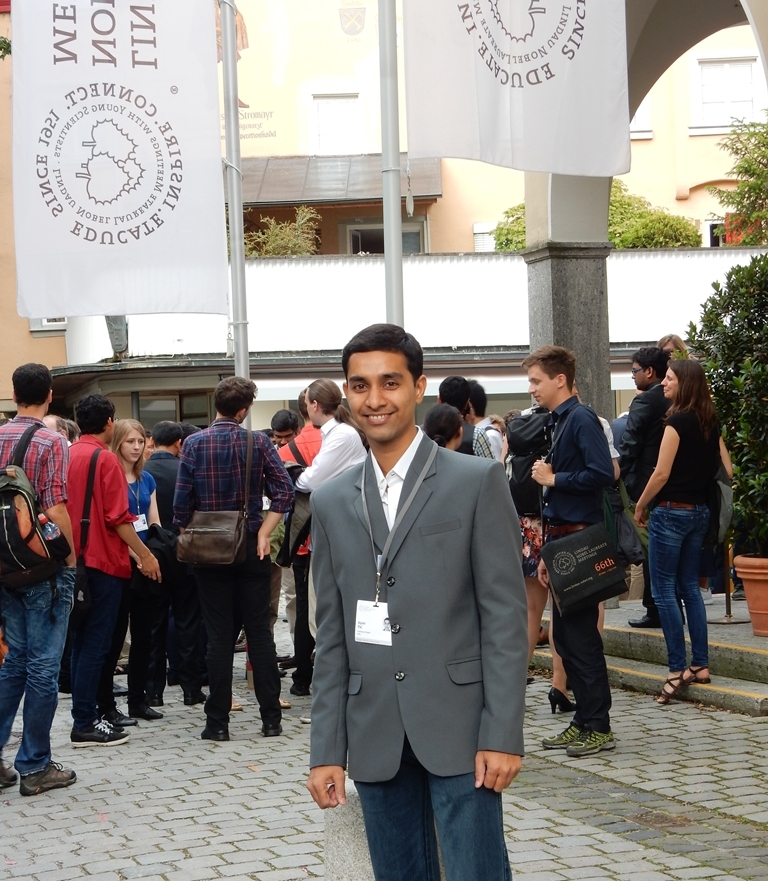
Biplab Pal at the 66th Lindau Nobel Laureates Meet
We were the 16th batch from India to go to the Lindau Nobel Laureates meeting, and it was an absolute pleasure for me to be at the dream destination for budding young researchers from all over the world, where they get the golden opportunity to meet the Nobel Laureates, listen to them and interact with them.
This was a life-time opportunity for a young scientist like me to witness and listen to the some of the legends from the field of science, and interact with them during the scientific discussion session.
One of the important aspects of this meeting, which makes it very special as compared to the other international conferences or meetings is that, you get a chance to listen to so many Nobel Laureates at one time, and to have a one-to-one interaction with them.
The other special thing is that only a very special group of selected people get a chance to participate in this meeting coming through a very tough selection process of their respective country. So I got a chance to interact with some of the best young researchers from very diverse fields of physics starting from high energy physics, astrophysics, cosmology, condensed matter physics and optics to biophysics, just to name a few.
In terms of personal scientific interaction, this meeting was very rich and fruitful for me. I interacted with some of the participants about my research, shared my thoughts, and they also told me about their research work and gave me feedback about my ideas which enhanced my vision of scientific research. This can be very useful for my future research work.
With Nobel Laureate Dan Shechtman
It was a great pleasure to listen to the inspiring talks of all the Nobel Laureates, but to be able to listen to Prof. Daniel Shechtman and talk with him was a very special feeling. He is the discoverer of the quasi-periodic crystals, and a major part of my doctoral research was based on quasi-periodic systems. So it was always a dream for me to talk with him and take his valuable advice — and finally my long-standing dream was fulfilled!
I got lot of boost for my future research direction. And now I am also an alumni of the Lindau Nobel Laureates Meetings holding the legacy of very talented and distinguished group of people to do so, and I feel very proud to say that I am the first one from my University to get there.
I hope in “Educate, Inspire, Connect” spirit of Lindau, I will be able to share my knowledge with other young researchers from India, and inspire and motivate them towards pursuing good science in their life.
More in the series:
- Lindau lessons: It wasn’t about science, it was about life
- Lindau lessons: Collaborations are the future
- Lindau lessons: Science is a journey, not destination
- Lindau lessons: Self-motivation is the key to long research careers
- Lindau lessons: Science is like a philharmonic orchestra
- Lindau lessons: Secret behind work-life balance
- Lindau lessons: Where have all the women gone?
- Lindau Lessons: It’s OK to be ignorant
- Lindau lessons: Equality for genders, nations
- Lindau lessons: Nobel Laureates are humans
