
In June 2016, 21 young Indian scientists made a trip to the beautiful island of Lindau, in south west Germany, to attend the 66th Lindau Nobel Laureates Meeting, dedicated this year to physics. In this sunny side of Germany, 29 Nobel Laureates met with 400 young scientists from 80 countries in an informal setting, which has come to be celebrated as the hallmark of these meetings.
On a boat trip from Lindau to Mainau island, Nature India caught up with the Indian delegation consisting of master’s students, PhDs and Post-docs, freshly chosen every year since 2001 by India’s Department of Science and Technology (DST) in collaboration with the German Research Foundation (DFG) to be part of this science extravaganza. In this blog series ‘Lindau lessons‘, Nature India will bring to you the unique experience of some of the young scientists from India who basked in the Lindau sun this year. Join their online conversation using the #lindaulessons hashtag.
Today we feature Nishchhal Verma from the Department of Physical Sciences, Indian Institute of Science Education and Research, Kolkata. Nishchhal’s reflections from the meeting border on the philosophical — on patience being the key to learning, on the realisation that Nobel Laureates are flesh-and-blood people who come fitted with extra perseverance, and on a ‘bold statement’ of his hero William D. Philips, the 1997 physics Nobel Laureate.
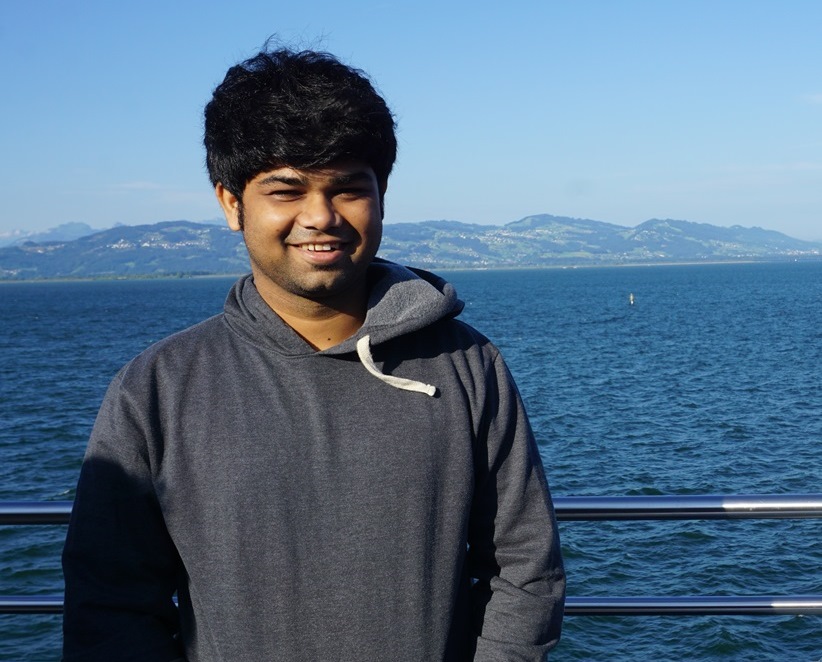
Nishchhal Verma
It wouldn’t be hyperbole if I say that the Lindau Nobel Laureate meeting has completely changed my attitude towards science. Without going into the geeky details, I will now explain how the tagline of the meeting — educate, inspire and connect — came to life for me.
Modern science is more interdisciplinary than we have ever thought. As a scientist one shouldn’t be constrained to a particular field. This immediately sparks a question – all fields of science can’t be mastered in a human lifespan, then how do we justify our existence as young scientists with that limited knowledge? There’s so much to learn in theory, so much to think about in experiments, so many tricks to master in mathematics – how can we do this in one lifetime? The answer to this question lies in one word: Patience. Nowadays even WhatsApp messages can tell you that much, but it takes something special to make you believe in it.
In a brief encounter with Prof. Hiroshi Amano, the 2014 physics Nobel Laureate, the answers to these deep questions seemed much more plausible than textual. His life story is an inspiration in itself. Blue LEDs were not made overnight, it took almost a decade. Starting from the third year of undergraduate to doctorate, Prof Amano faced a lot of funding issues and spent years without publication. But he kept going. And as he said in his presentation: “At that point in my life I had two options: Path 1: many researchers, many publications, promising academic position; Path 2: few researchers, few publications and no guarantee of an academic position.” It takes courage for any mortal to choose the latter.
Another important thing is to realise that Nobel laureates are humans, very persistent and diligent ones. Their hard work propels them to a peak from where the connections between different theories, different disciplines, and different techniques are clearly visible. Unfortunately, the climb is painfully slow and perhaps that’s why we have a few of them in our world. Excellence is not everything, and like the famous hare-tortoise story, persistence is the key.
Bill Phillips at the panel discussion where he made the ‘loud statement’.{credit}Nischhal Verma{/credit}
Prof. Bill Phillips was the hero in my frame in this meeting. Apart from his eagerness to interact with students, his presence of mind made discussions very enjoyable. To elaborate, in the middle of a panel discussion on the future of quantum devices, the 1999 Nobel Laureate Prof. Gerdaus ‘t Hooft demonstrated, by periodically taking the microphone away from his mouth, how quantum devices may be possible to make but impossible to use. The microphone was useless if held away – like quantum devices which are super-difficult to make and even more difficult to exploit.
Prof. Phillips reacted to the demonstration by first stating that quantum devices were indeed very difficult to exploit. He then kept his microphone away and shouted with all the power his old body had: “But there’s always another way”. This was audible to the last bench of the auditorium, and probably even woke some sleeping souls. It was a very loud statement, quite literally, that dominated the rest of the discussion. Apart from many crazy gedanken experiments, Prof. Phillips told us many real-life stories, including the one with C.V. Raman and his discovery of Raman effect. It was great — no book can do that job better than him.
The selection process for the meeting perhaps has extremely high bars. The presentations, the posters and the master classes were top class. Almost each poster was backed up by a publication in Nature or Physical Review. Add to that the direct interaction sessions, cruise rides, international get-together – LiNo16 organisers tried their level best to mix us all up as much as possible.
It was great meeting some young minds from different countries – an Australian who gave free chocolate biscuits to everyone visiting his poster, a Filipino who moved from quantum chromodynamics to condensed matter physics, a Kenyan with interest in mathematical foundations of quantum mechanics, a Burmese nuclear physicist, a British with interests in solving puzzles of non equilibrium systems – the list will probably never end, so won’t this article if there weren’t any word limits!
To sum it up, this has been one of the best experiences of my life.
More in the series:
- Lindau lessons: It wasn’t about science, it was about life
- Lindau lessons: Collaborations are the future
- Lindau lessons: Science is a journey, not destination
- Lindau lessons: Self-motivation is the key to long research careers
- Lindau lessons: Science is like a philharmonic orchestra
- Lindau lessons: Secret behind work-life balance
- Lindau lessons: Where have all the women gone?
- Lindau Lessons: It’s OK to be ignorant
- Lindau lessons: Equality for genders, nations
- Lindau lessons: Drenched in quasiperiodic systems
