
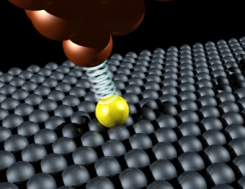
 Scientists have for the first time measured the force needed to move one individual atom.
In the latest issue of Science, researchers from IBM and the University of Regensburg in Germany detail how they used an atomic force microscope to measure the vertical and lateral forces exerted on individual atoms by the probe tip of the microscope probe (research paper, related perspective paper, IBM press release, Regensburg press release).
It seems to move a cobalt atom over a smooth platinum surface requires a force of 210 piconewtons. Moving a cobalt atom over a copper surface takes only 17 piconewtons. By contrast, IBM’s press release points out lifting a penny requires nearly 30 billion piconewtons.
These forces should have been fairly easy to predict: chemists have known for years the various bond strengths involved between adsorbed atoms and surfaces. However this new research “helps us to understand what is possible and what is not possible,” Andreas Heinrich, one of the new paper’s authors says (NY Times). “It’s a stepping stone for us, but it’s by no means the end goal.”
While moving the atom was easy, measuring the force was hard. The researchers swept a tiny piece of quartz at the end of their microscope across the surface on which they placed their atom to be moved. Eventually this quartz tip flipped the atom from one indentation in the surface to the next.
The quartz tip vibrates like a tuning fork until it comes into contact with the atom, when the frequency of the vibration changes. This change can be analysed to give the forced used to move the atom.
“From the surface science point of view you cannot measure much more than the force needed to move an atom,” Werner Hofer, a surface scientist at the University of Liverpool told Chemistry World. “We can now think about full control of chemical reactions, watching what happens when two molecules are pushed together to react to make another molecule.”
Video from IBM
Image: illustration of an Atomic Force Microscope (AFM) tip measuring the force it takes to move a cobalt atom on a crystalline surface / Jenny Hunter, IBM