
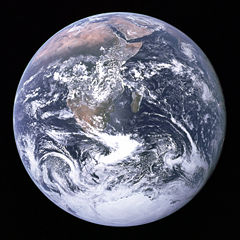
 The next US president should merge two huge government research agencies to bring forth a new independent and comprehensive Earth science body – that’s the idea put forth in a commentary by former agency heads in Science yesterday (subscription required). They call for NOAA and the USGS become a single Earth Systems Science Agency, ESSA.
That merger would ring a few nostalgic bells, since NOAA was once also called ESSA (for Environmental Science Services Administration). And it would bureaucratically marry the atmospheric and ocean research at NOAA to the terrestrial, freshwater and biological studies at the USGS. To face the daunting agenda of “climate change, sea-level rise, altered weather patterns, declines in freshwater availability and quality, and loss of biodiversity,” the authors say, the US needs massive scientific support from an integrated, streamlined institution – one as seamless as the Earth system itself.
But would ESSA really produce better science? The proposal’s authors have tempting suggestions for changes under a new agency, not least upping the amount of money that would leave the building: grants to outside researchers total a few percent of current NOAA and USGS budgets, they told me, but they want the sum to be at least 25% at ESSA. They also call for Big Science modelling and monitoring programs, and even for research into breakthrough green tech, a la DARPA.
Such plans would have to be hashed out over and above the decision to put ESSA together, however. Meanwhile, trying to mesh the USGS and NOAA missions could have interesting effects. What would happen, for example, to NOAA’s marine fisheries programs? NOAA is housed in the Department of Commerce, where commercial fishing interests are sometimes seen to clash with conservation. Mark Schaefer, former USGS director and the ESSA proposal’s lead author, said creating the hoped-for independent, nonregulatory agency might mean moving fisheries regulation to the Fish and Wildlife Service in the Department of the Interior, where protecting natural resources is key.
I talked to quite a few Earth and climate researchers about the ESSA idea – next week in Nature Reports Climate Change I’ll have a news story looking into it – and heard a range of reactions. Many were excited about the visionary qualities of the plan. Separating NOAA from the USGS “is not how you’d set it up if you were starting fresh,” says Richard Anthes, president of the University Corporation of Atmospheric Research and the American Meteorological Association. “We should be looking to future and designing our scientific institutions around the challenges we face.”
Some sensed that a major, visible change in the government’s approach to climate and Earth science was the right response to a surge of public concern over planetary emergencies – much as environmental fervor in the 1970s birthed the EPA. Wrote Tom Delworth of NOAA’s Geophysical Fluid Dynamics Laboratory:
Within NOAA there is much discussion of the development of a National Climate Service. That is one possible response to part of this growing demand. What the authors propose is much bolder, and an independent agency may well be a better way to organize these activities.
Others thought ESSA would be a big step – but probably in the wrong direction. Some say leaders should more directly and immediately address the disgraceful neglect of Earth observation programs bemoaned by the commentary’s authors, as well as poor collaboration on Earth studies between NASA, NOAA and USGS, which a major report flagged up last year.
“Collaboration is something that needs to be done in any large-scale program,” said Bryan Pijanowski of Purdue University, “so having one agency with one capability and another agency with another capability isn’t necessarily a problem. It’s how those agencies work together.” Pijanowski models land-use patterns and says that for his work to continue, a looming loss of satellites focused on land has to be dealt with now – not wait for a new government body to be patched together.
Gavin Schmidt, a NASA climate modeller who blogs at RealClimate, wrote in an email:
The main issue is not bureaucratic organisation, but the lack of interest at any level in funding interagency or interdisciplinary programs (even within an agency). This idea might help if a) long term climate measurements and their stability became more of a priority, b) if they would allocate significant funds for cross-cutting work, and c) if it didn’t just mean changing the names on the buildings.
But it’s all too easy to say that the agencies should simply start working together better, according to Schaefer. For one thing, he says, it forgoes the opportunity for an independent Earth science bureau to become an informational and financial focal point. He adds that when closely aligned research groups working under different directors, missions and budgets have to bridge those divides to get the complete picture of our planet, it’s “a prescription for future problems.”
Any more thoughts out there?
Anna Barnett

Photo: NASA