
Sitting on the London Underground the other day I saw people flinch when one of the passengers sneezed – looking at the front page of a copy of The London Paper lying on a seat it’s not hard to see why. The media’s rather sensationalist reporting that swine flu could cause up to 94,000 deaths in London alone, is enough to make even the toughest of Londoners that little bit more cautionary on the tube.
However, London has previously faced seemingly disastrous epidemics and natural killers and still come out fighting. So to provide a backdrop to the media sensationalism of “farmageddon” here is a look back at some of London’s previous killers:
Killer Fog
Over 50 years ago London experienced its deadliest environmental episode when the killer fog of 1952 descended on London. Estimates suggest that over 12,000 people were killed in just four days.
A mass of stagnant air enclosed London, trapping the coal smoke from millions of residential fires. When this smoke combined with the natural fog, the air turned colder causing more coal fires to be burnt leading to an ever increasing production of smog.
On 9th December the wind arrived unexpectedly and swept away the killer fog as quickly as it had arrived.
Cholera Epidemic
Occurred during the summer of 1854 in the Soho district of London resulting in more than 600 deaths.
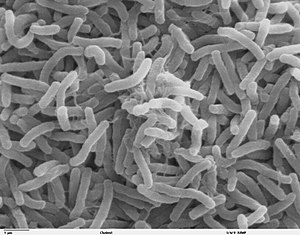
Scanning Electron Microscope image of Vibrio cholerae, courtesy of Wikipedia
The outbreak was initially hard to explain. Dr John Snow was sceptical of the dominant miasma theory, which implicated a noxious form of ‘bad air’. He eventually identified the Broad Street water pump as the source of the outbreak.

The Broad Street water pump, courtesy of the Londonist
Later it was discovered that the public well was situated only 3 feet from an old cesspit that had begun to leak faecal bacteria. It had been contaminated with another source of cholera contracted by an ill baby, whose diapers had been subsequently washed into this cesspit.
Snow’s observational study is often hailed as starting the science of epidemiology.
The Great Plague of London
Still one of the largest ever London killers, the Great Plague, in 1665-1666, killed an estimated 100,000 people – equivalent to 20% of the population. However, this epidemic was still on a smaller scale that the earlier “Black Death” pandemic which is estimated to have caused between 75 million deaths worldwide in the 14th Century.
The infections were caused by the bacterium Yersinia pestis which was transmitted through a flea vector.
Other Notable Epidemics
1485 & 1528: Sweating sickness epidemic
1647 – 1893: Smallpox epidemics. During the years 1837 – 1840, 6400 deaths were recorded in London
1647 – 1837: Measles epidemics in London
Throughout history, there have also been several whooping cough and influenza epidemic in London and the rest of the UK.
Perhaps the media should put the current swine flu pandemic in context by considering that their estimates are only equivalent to about 1% of the current population and London has survived far worse epidemics in the past.