
A look back at some of the significant, intriguing, and slightly strange Boston research of 2006
Mason Inman and Pat McCaffrey
RNA interference picks up Nobel and speeds into clinic
RNA interference (RNAi) was all the rage this year. The discovery eight years ago by University of Massachusetts investigator Craig Mello and Stanford’s Andrew Fire that small RNA molecules regulate gene activity earned them this year’s Nobel Prize in Physiology or Medicine.
The prize brought attention to just how fast RNAi has become a routine research tool for studying gene and protein function, and also how fast it’s moving into the clinic as the basis for a new class of drugs.
The Cambridge, MA, biotech company, Alnylam Pharmaceuticals, had a March paper in Nature describing the first tests of the RNA drugs in nonhuman primates. The company also presented data from early trials in humans.
In their paper, the Alnylam researchers showed that an injectable, synthetic small interfering RNA could reduce levels of a cholesterol-carrying protein in monkeys. The result was lower blood cholesterol, a goal for the prevention of heart disease.
In April at a national conference, the company presented the results of an early stage safety trial of an anti-viral RNA molecule to treat a common childhood respiratory illness. That therapy will be tested in infected patients next year. P.M.
Remote control sharks
The popular image of sharks—bloodthirsty beasts ripping the legs off hapless surfers—could get a makeover if Boston University’s Jelle Atema succeeds in his research. The U.S. Department of Defense (DARPA) funded Atema to figure out a way to remotely control sharks. The goal: to turn sharks into swimming sentinels, outfitted with detectors and sent out to look for signs of explosives or oncoming submarines.
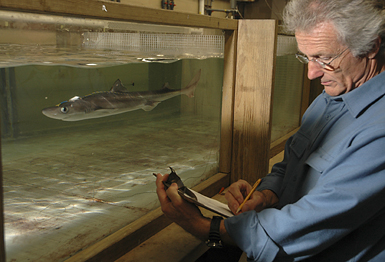
Steerable shark
Credit: Cory Hatch, Boston University Science and Medical Journalism Program
At a meeting of the American Geophysical Union in February, Atema described a couple of methods he’d found successful for steering sharks. One was to insert tubes into the shark’s nostrils to release spurts of chemicals that mimic food scents. Another method was to implant electrodes into the shark’s brain to stimulate the neural pathways directly. Either way, the researchers were able make the shark swim in a certain direction, fooling it into thinking it was following a scent trail in the water.
Now Atema’s DARPA funding is up, and he’s exploring nonmilitary applications for his remote-control sharks, such as tracking pollution or monitoring ocean temperatures. M.I.
Brain implant translates thought into action for paralyzed man
On the cover of the July 13 issue of Nature was Matt Nagle, a subject of an experiment in which he played computer games and scrolled through e-mail. That’s unusual because he has been paralyzed for more than three years, ever since a spinal cord injury rendered him quadriplegic.

Nagle owes these abilities to John Donoghue of Brown University and his Foxborough, MA-based company, Cyberkinetics, for developing a brain implant. The small array of electrodes, surgically placed in Nagle’s brain, picked up the brain’s electrical signals. A computer connected to the implant translated the signals into the movement of a computer cursor or a prosthetic arm. Nagle was able to command a robot to give a piece of candy to a researcher and to change the channels on a TV. P.M.
Just how different is my genome from yours?
The year 2006 opened and closed with local genome researchers revealing new types and higher levels of variability in the genetic makeup of individual people. This year’s work helps to redefine genetic diversity, showing that our differences go beyond the well-studied single nucleotide changes and include deletions or additions of much longer stretches of DNA.
In January, David Altshuler and colleagues at the Broad Institute mapped the occurrence of small deletions across the genome. Their work, published in Nature Genetics, found 1,000 new locations where DNA was missing. Deletions, it seems, are far more common than previously thought.
Then, in November, Charles Lee and his team from the Brigham and Women’s Hospital were part of an international consortium that published another genomic map in Nature. This one includes deletions, but also shows places where pieces of DNA were added as well. By comparing the genomes of 270 people from around the world, they showed that these additions and subtractions are very common, spanning 1,400 regions and covering a whopping 12 percent of the genome.
All this diversity raises the question of just what a “normal” genome looks like. And because some of these DNA changes are likely linked to disease, the new findings have researchers reevaluating their disease gene-hunting techniques. P.M.
Dueling placebos
The placebo effect in clinical trials is well known, but is one placebo better than another? Ted Kaptchuk at Harvard Medical School decided to find out, by pitting two placebos against each other. In one corner was a sham acupuncture technique, and in the other, cornstarch pills. The sham acupuncture used a trick needle: when the doctors poked a subject with the needle, it retracted rather than piercing the patient’s skin.
The 270 people in the British Medical Journal study published in February all had repetitive stress problems in their hands, wrists, or elbows that had lasted at least three months despite treatment. With a few weeks of fake treatment, both techniques made people’s pain subside. The sham acupuncture group reported more pain relief, while the placebo pill group regained more function in their arm.
Treatment involving devices like needles has been thought to have a greater placebo effect than sham pills and this was the first rigorous evidence for the idea. Also, the side effects that people suffered from each placebo mirrored the side effects the doctors told people they might have—again showing the power of the mind over body. M.I.
Black holes that belch eat matter faster
Black holes are famous for engulfing everything nearby. But actually, the magnetic fields that surround black holes force matter to spew out of them as well.
This “belching” helps the black hole gobble up its surroundings more quickly, according to a paper in a June issue of Nature. John Raymond and Danny Steeghs at the Harvard-Smithsonian Center for Astrophysics and Jeroen Homan at MIT’s Kavli Institute for Astrophysics and Space Research studied one particular black hole that’s siphoning off material from a star orbiting nearby.
Matter flowing straight into a black hole would get “jammed up,” just as flour poured straight down a funnel can become clogged. In their paper, the researchers said that something must be churning up the area around the black holes, helping matter to slide down the black hole’s gullet as fast as observations suggest. The study says that this churning effect may be a result of magnetic fields that drive “winds” of charged particles, which belch forth from the black hole. M.I.
Wringing water out of air
Inspired by an African beetle that harvests dew from the air, MIT researchers have devised a simple way of making artificial materials that can do the same.
The back of the Namib Desert Beetle consists of a series of tiny bumps, surrounded by waxy areas. Water condenses on the bumps. When the droplets get large enough, they trickle down to the beetle’s mouth.

Namib Desert Beetle
Credit: Andrew Parker, MIT
Now a team led by Michael Rubner and Robert Cohen has come up with a trick for creating similar surfaces: a water-repellent landscape with water-attracting spots. These spots act like tiny sponges: wrinkled, bumpy surfaces full of crevasses and holes where water can collect. They hope that the technique could be useful for harvesting water but also for making new kinds of lab-on-a-chip microfluidic devices. M.I.
When pigs swim? Making pork as heart-healthy as fish
Good fats made the news this year, with more studies driving home the health benefits of eating fish containing omega-3 fats. But for people who prefer meat, a high-tech pig might be the answer.
Mammals, like humans, pigs and cows, do not make omega-3 fats and depend on dietary sources for this nutrient.
Rather than trying to feed livestock with fish meal, Jing Kang from Massachusetts General Hospital had another idea for getting omega-3 fats into meats. He and collaborators at the University of Missouri genetically engineered a pig to produce omega-3 fats. The transgenic pigs carry a worm gene, which codes for an enzyme that converts abundant omega-6 fats to omega-3s.
As shown in the April issue of Nature Biotechnology, the modified hogs had four times more omega-3 fats in their meat than normal pigs. Don’t go looking for healthy bacon just yet, though—genetically modified meats will have to gain regulatory approval and then win over potentially skittish consumers. P.M.
Squirt-on Band-Aids
Protein scaffolds have long been used in tissue engineering as a physical support for growing cells. But such proteins can also help repair damaged nerves and even stop bleeding, according to a study by MIT neuroscientist Rutledge Ellis-Behnke and colleagues.
In their March paper in the Proceedings of the National Academy of Science, they described how their protein could assemble itself into a scaffold within seconds and aid in the repair of severed optic nerves in hamsters. In that study, they found by accident that the scaffolding also stopped bleeding.
The protein could be stored as a powder and then dissolved in water. When that solution came into contact with an ionic fluid like blood or spinal fluid, the protein formed a gel-like nanoscale net that held tissue together while it repaired itself. It had no apparent side effects in the animals and dissolved over time. Since about half of all surgery time is spent controlling bleeding, the researchers argue that such nanoscaffolding could be a new surgical tool. M.I.
Precision in particle physics just got even more precise
Harvard physicists this year made one of the most precise measurements ever made in physics.
Gerald Gabrielse and his students have, over the last two decades, created a system for trapping a lone electron using electric and magnetic fields. Though this electron isn’t circling a nucleus, it acts like an artificial atom, reacting the same way to external forces and showing distinct quantum-energy levels. Gabrielse’s team used it to pin down a subtle feature of the electron, called its magnetic moment.
The magnetic moment is a key property for understanding electrons’ quantum mechanical quirks. It determines how the electron interacts with electromagnetic fields and with a vacuum.
This summer, his team announced the first improvement in 20 years in the measurement of the electron’s magnetic moment, extending it by another decimal place to better than one part per trillion.
Pushing the precision of these measurements to their limits allows physicists to push the limits of physical theories, to see whether they still hold up. M.I.