
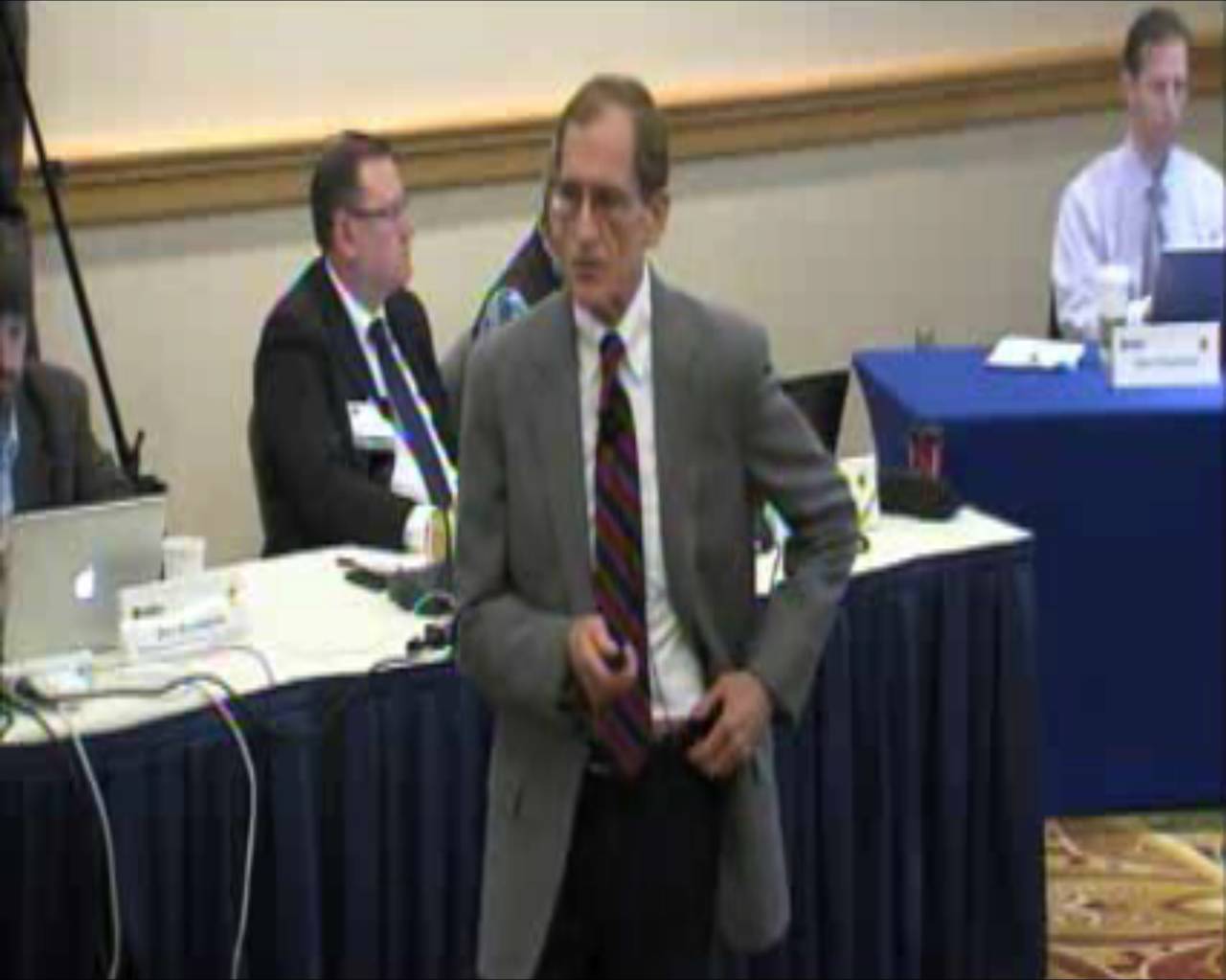
 Nuclear physicist Robert Tribble (right) looked markedly depressed as he presented his panel’s conclusions ranking three US nuclear science facilities against each other at a meeting in North Bethesda, Maryland, yesterday and today. The loser, as projected by Nature last August, is RHIC, the Relativistic Heavy Ion Collider at Brookhaven National Laboratory (BNL) in Upton, New York, where experiments creating trillion-degree subatomic soups of quarks and gluons may have to be shut down under the worst budget scenario.
“I am very concerned that if we have to close a major facility our field is going to continue a spiral down,” says Tribble, of Texas A&M University in College Station. “It’s a very, very difficult situation.”
For the past 8 months, the US nuclear science advisory committee (NSAC) has been tasked with choosing between three leading US facilities under two flat-funding scenarios (one rising with inflation, the other flat in real terms but effectively falling). Both are well below the levels assumed by a plan mapped out by another panel chaired by Tribble in 2007, recommending all three facilities be supported (see chart, below, after the jump). The latest panel struggled with the projected loss of nuclear science jobs and discoveries that losing any of the three facilities would bring. Its report, which is expected to be released at the end of this week, stops short of recommending RHIC’s early closure, Tribble says. Still, that is the report’s effective message as it ranks the ion collider below a planned upgrade of the Continuous Electron Beam Accelerator Facility (CEBAF) at Jefferson National Laboratory in Newport News, Virginia, and the construction of the Michigan State University’s Facility for Rare Isotope Beams (FRIB), in East Lansing, both of which are already well under way. Tribble says that RHIC is the most complex and expensive of the three facilities to operate. Continue reading