
 Carbon dioxide emitted today – and the warming it causes – could stick around for centuries or millennia, reported Mason Inman over on Nature Reports Climate Change not long ago. New research (subscription) published online in Nature Geoscience this week looks at the impacts of CO2 emissions on the global ocean over a timescale even longer and less imaginable.
Because warm water holds less oxygen than cold water, oceans are expected to lose some of the dissolved gas as a consequence of climate change. This is already happening in certain tropical regions. Using a low-complexity model of the Earth system, Gary Shaffer of the University of Copenhagen and colleagues now find that the full effects of ocean warming and deoxygenation could lag thousands of years behind changes in the atmosphere – and that oxygen levels may not fully recover for the next 100,000 years.
Their projections are based on two IPCC emissions scenarios: A2, a high-emissions world, where carbon dioxide emissions climb through this century, and B1, a more moderate scenario, where emissions peak by around 2050. In both cases, Shaffer et al. assume emissions rapidly fall to zero after 2100. The researchers also try two levels of ‘climate sensitivity’ – the amount of global warming expected for a doubling of CO2 concentration.
Have a look at their figure to see just how long CO2 and its effects are found to linger under various combinations of these variables. The worst-case result is that mean ocean oxygen concentration falls to a low of about 68% of pre-industrial levels in the next few millennia, while low-oxygen ‘dead zones’ – which don’t support fish or many other marine animals such as crabs and clams – spread nearly six-fold to cover 12.8% of the sea surface area. Their best case is a low that represents 89% of pre-industrial oxygen levels, with dead zones covering 5.2% of the sea surface.
“Such expansion would lead to increased frequency and severity of fish and shellfish mortality events, for example off the west coasts of the continents like off Oregon and Chile”, says Shaffer. “The future of the ocean as a large food reserve would be more uncertain.”
The number of these underwater deserts has reportedly been doubling each decade since the 1960s, fueled not just by warming but by agricultural runoff – which is expected to increase with flooding in some regions (see this 2008 review in Science; subscription). Other studies have suggested that rapid dead zone expansion this century will be driven by high levels of marine carbon. As Shaffer et al’s models don’t seem to include these effects, their estimates could run low.
What they do try to factor in is overturning. Mixing of the surface and deep layers of the ocean has a big influence on oxygen levels in deeper waters, and coupled climate models show that mixing will likely weaken in the future. Without taking this into account, the growing low-oxygen zones are projected to comprise just a few percent of the ocean’s volume. With overturning taken into account, more than two fifths of the ocean volume becomes a dead zone. The conclusion:
Substantial reductions in fossil-fuel use over the next few generations are needed if extensive ocean oxygen depletion for thousands of years is to be avoided.
Anna Barnett
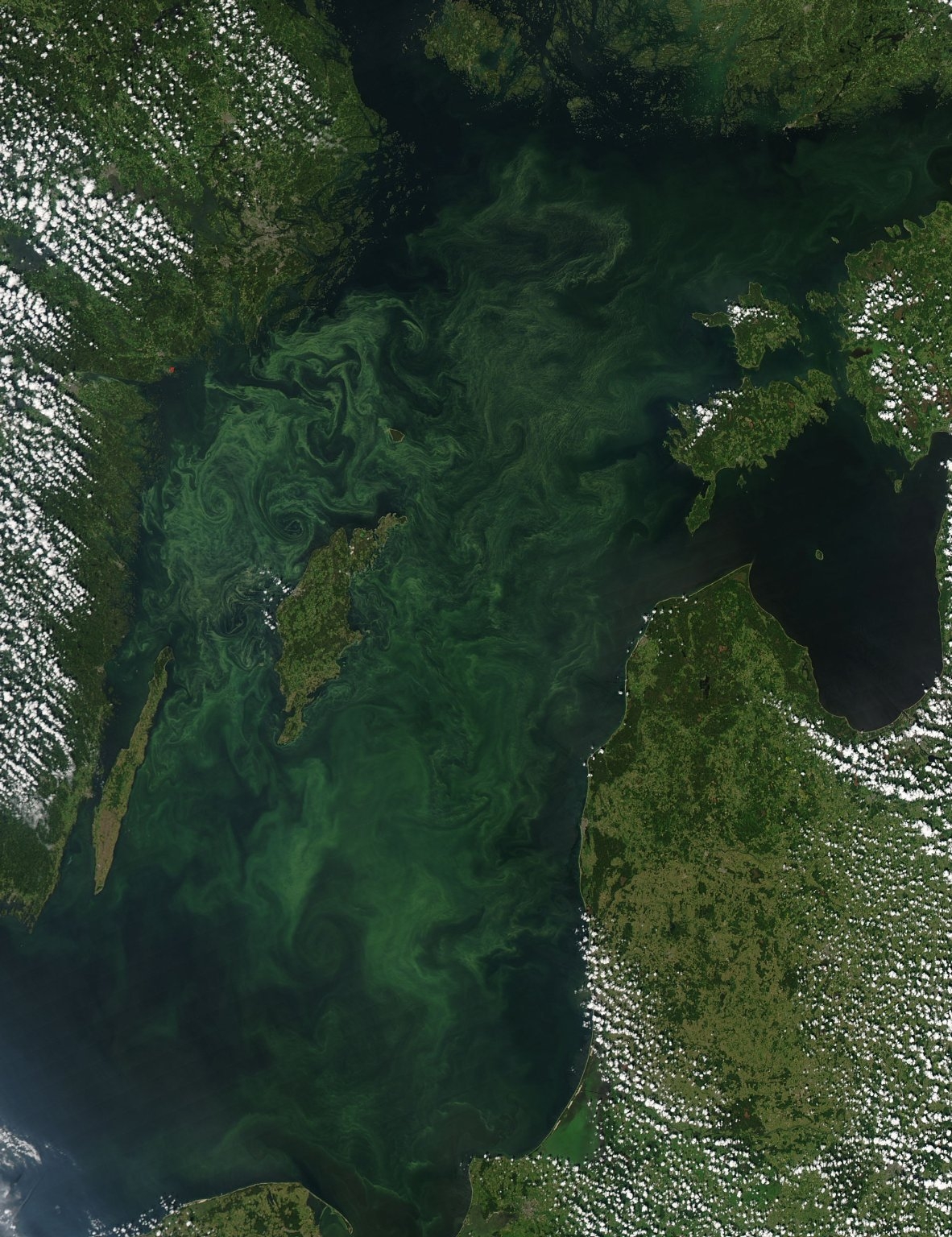
Image: Summer plankton bloom sucking up oxygen in the Baltic sea / NASA