
A tale from Boston’s history: the contentious discovery of anesthesia.
Caitlin Stier
Overshadowed by more prominent statues in Boston’s Public Garden is a monument strikingly different from the usual figures of statesmen that populate the green: one that commemorates the first demonstration of an anesthetic, ether, during surgery at Massachusetts General Hospital in 1846.
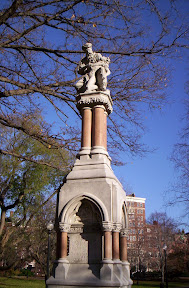 Ether monument, Boston Public Garden (Credit: Caitlin Stier)
It’s an accomplishment worthy of a statue; before the advent of anesthesia, operating rooms were virtual torture chambers; patients felt and saw everything. Up until then, most doctors didn’t think it was possible to numb sensation.
Like many scientific firsts, the true discoverer of anesthesia is contestable, so much so that the ether monument deliberately avoids giving credit to any individual. Indeed, the fight for recognition for this medical breakthrough was so contentious that it contributed to the ruin of the three men responsible for the discovery.
In the early 1800s, long before its use as an anesthetic, ether was commonly used as a recreational drug. Ether came into more practical use in dentistry. A Boston dentist named William Morton first heard about ether from his assistant, who had experienced its effects during his student days.
At that time, Morton knew that his former business partner, a Hartford, CT, dentist named Horace Wells, was experimenting with another anesthetic, nitrous oxide, in his practice. In fact, a year before, Morton had arranged for Wells to demonstrate the use of nitrous oxide at MGH. But the demonstration failed when the patient cried out during the dental procedure. Wells was declared a “humbug” even after the patient reported feeling little pain.
So after hearing about ether from his assistant, Morton decided to experiment with it like Wells did with nitrous oxide.
He sought the advice of his mentor, the revered Boston physician Charles Jackson, on how to administer ether as a vaporized liquid. With his help, Morton was able to painlessly extract teeth from his patients. This sparked the interest of a local surgeon, who secured Morton a demonstration at MGH. On October 16, 1846, Morton administered ether to a patient undergoing neck surgery in front of a small audience in MGH’s surgical amphitheater.
After his successful demonstration, Morton received a patent for the use of ether at a time when the commercialization of medical procedures was unthinkable. Many physicians and dentists used ether, openly violating Morton’s patent.
With his patent under attack, Morton became increasingly concerned about getting recognition for the discovery. He wasn’t alone. As ether became more commonly used, Jackson, who didn’t seem interested in ether before, now claimed that he had realized the anesthetic properties of ether four years before Morton. Wells also sought recognition because of his earlier work with nitrous oxide. And an Athens, GA, physician named Crawford Long said he had evidence that he used nitrous oxide in his practice years before Morton’s demonstration. A long and bitter legal dispute ensued.
The dispute was never fully resolved. Wells became addicted to chloroform and committed suicide in a New York jail after being arrested for spraying prostitutes with acid while under its influence. Jackson lost credibility among his medical colleagues after changing his story about his role in discovering anesthesia. He later had a stroke and was institutionalized. Morton in turn squandered his fortune defending his patent and died from heat stroke in New York.
Sources:
Fenster, Julie M. Ether Day: The Strange Tale of America’s Greatest Medical Discovery and the Haunted Men Who Made It. New York: HarperCollins Publishers, 2001.
Morgenroth, Lynda. “Ether, 1846.” Boston Firsts: 40 Feats of Innovation and Invention that Happened First in Boston and Helped Make America Great. Boston: Beacon Press, 2006.
See this recent NNB story for a more modern look at anesthesia.