
Cross posted from Spoonful of Medicine
The US Patent and Trademark Office granted its first license related to induced pluripotent stem (iPS) cells to a California biotech, Fate Therapeutics, the company announced today. The decision comes hot on the heels of the UK Intellectual Property Office awarding a similar patent in Britain to a rival California firm, iPierian.
The new, US patent credits the Whitehead Institute’s Rudolf Jaenisch, a scientific founder with Fate Therapeutics who licensed the technology to the company, and his former postdoc Konrad Hochedlinger, now at the Massachusetts General Hospital, with inventing a method for reprogramming cells in 2003 — three years before Kyoto University ’s Shinya Yamanaka reported the first bona fide iPS cells, in mice.
The patent, however, is fairly limited in scope. It only covers methods that involve introducing one or more reprogramming genes into an adult cell that has been genetically engineered to carry another pluripotency gene in its genome. Although Yamanaka did genetically modify the mouse skin cells used to create the first iPS cells, this technique has since become obsolete*.
The technology covered by the patent “is pretty cumbersome,” David Resnick, a patent attorney with Nixon Peabody in Boston, told Nature Medicine. “Yes, it’s an induced pluripotent cell but in my experience I don’t think anybody is making them this way.” As such, the patent is unlikely to affect any other researchers or companies in the field, he says.
Still, Fate Therapeutics is touting its patent as “formidable.” In a statement, Paul Grayson, president and CEO of Fate Therapeutics, said: “Dr. Jaenisch’s prescient vision in 2003 for creating human iPS [cells], and how reprogrammed cells could be used to revolutionize drug discovery and enable cell-based therapies, is truly unparalleled.”
* Correction: An earlier version of this story incorrectly stated that Yamanaka did not genetically manipulate the skin cells used to make iPS cells in 2006. He and most other researchers no longer use this technique, but Yamanaka did genetically tweak the cells to visibly see when they had reverted to an embryonic-like state.
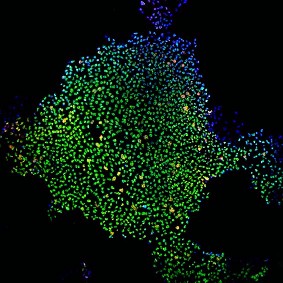
Image: James Thomson, University of Wisconsin-Madison