Today, I have mostly left a trail of used paper (neatly slotted into the recycling bin), a plastic cup and a cardboard container that was earlier filled with brown gloop that had somehow convinced me it was lunch. Surrounding me are a computer, sundry dictionaries and reference books, a collection of pens (various colours), a phone, some plastic bags and a metal box containing the periodic table with the individual elements in fridge-magnet form.
Should all of this be frozen in time to be rummaged through by future scholars, the best they might make of me is an untidy creature governed by rules for rituals, with multiple limbs for writing, suspicious taste in food and the most bizarre hand in Scrabble ever (though if you do find a way to play unununium (Uuu) on a triple you can score 333 without breaking a sweat). It is unlikely that the detritus from my life would significantly shift scholarly thinking on how to describe the world. But as a member of the Homo sapiens club, it seems I am making a minor contribution to something that could change geological time.
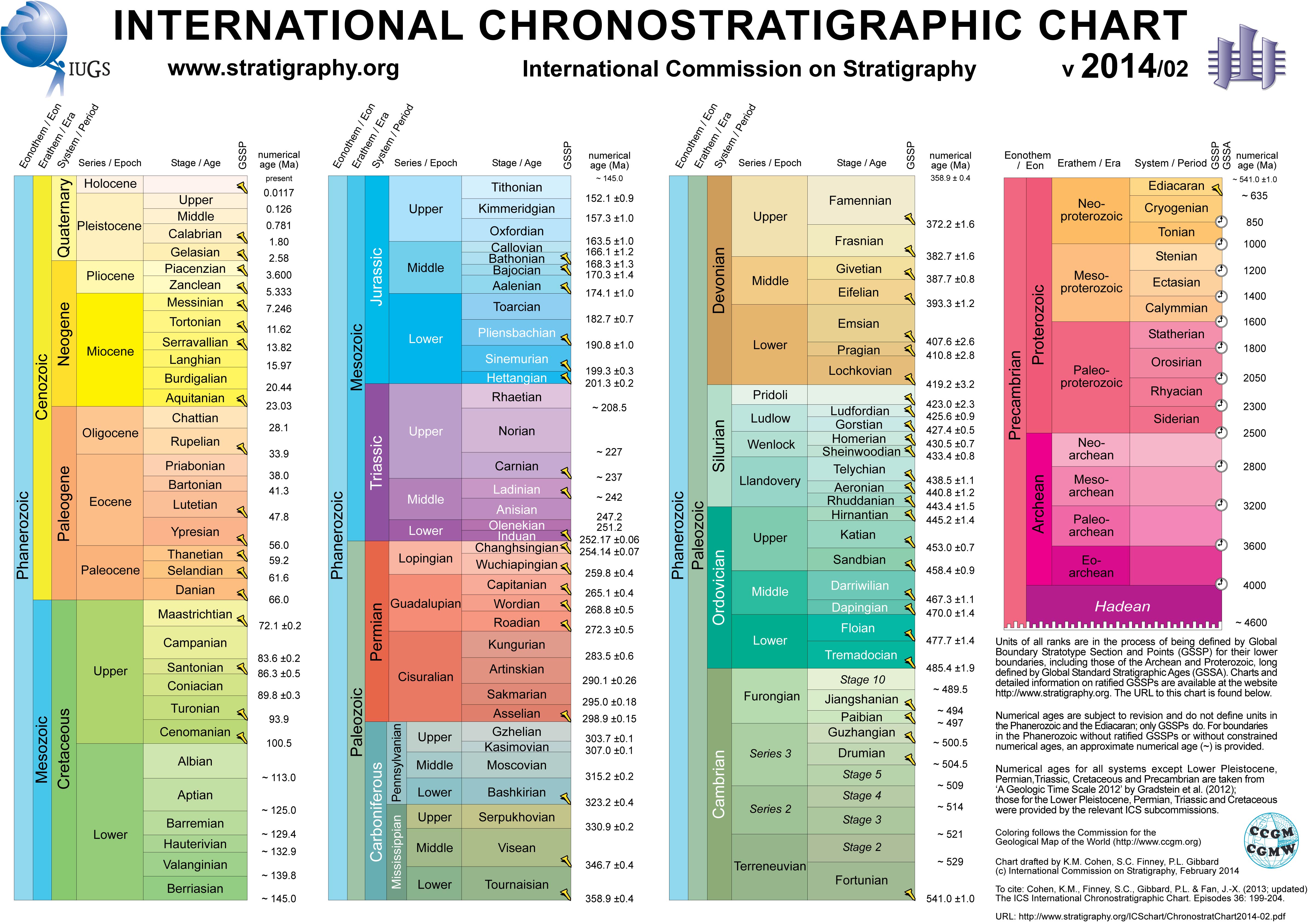
The assignation of geological time is a somewhat esoteric art that tends impinge on the general consciousness only because it encapsulates a time long ago when dinosaurs roamed the Earth and ice ages swept the face of the globe. The names given to the various divisions within the time scale are in equal measure enticing and confusing. There are A-list celebrities, of course — step forward the Jurrasic — and there are those that might struggle to get an invite to the party (the Kimmeridgian anyone?). And there are those whose fame rests, in part, on a misunderstanding: the creatures in Doctor Who called Silurians get their name from the Silurian Period of some 416–440 million years ago, although there are strong arguments that in fact they would have lived during the Eocene Epoch a mere 35–56 million years ago and so should be called Eocenes ( I defy anyone to face Madame Vastra and actually make that argument…).
The reason geological time is exercising my brain — and those of many others this week — is a meeting that kicks off in Berlin today. It is the gathering of the Anthropocene Working Group, a team of scientists and humanists who are trying to determine whether the world has crossed (or is about to cross) the boundary into a new epoch.
Currently, we reside in the Holocene, which began about 11,700 years ago. (Those of you who are keeping tabs on the whole structure might like to know that the Holocene Epoch is part of the Quaternary Period, which is part of the Cenozoic Era, which is part of the Phanerozoic Eon — there will be questions later.) But the meeting is debating whether the Holocene is over and the Anthropocene has begun.
At stake is the question of definition. The geological time scale gets its name because it is, well, defined by geology. Each subdivision relates to observable stratigraphy — and those wondrous names are derived from the geological locations that play host to the defining geology (the Jurassic gets its name not from a spurious theme park but the Jura mountains in the Alps). And that’s one of the things that makes the idea of the Anthropocene so intriguing: the hubris of naming an epoch after ourselves and the suggestion that the actions of the human race have wrought definable changes that merit a new division in geological time.
That has led people to start asking about the markers we will leave behind. What would aliens of the future landing on Earth be able to discover about us? Formally, it will probably be a rise in pollutants captured in layers of rock, but the idea of an alien gazing across Earth’s surface millions of years from now begs the question of what other clues we might leave. What equivalents of cave paintings and fossilized bones will signify the rise and fall of the human race?
I suppose that the more of something there was to start off with and the more widely it was used, the more likely some of it will survive to be found later — so for archaeologists, coins are more readily found than crowns and sceptres. Based on that, will the human race leave a legacy of toasters, mobile phones and body piercings?
Perhaps, in between fending off attacks from the giant insects that are now masters of the planet, an itinerant alien will be lucky enough to find preserved some technology that is still functional. Once it gets the mp3 file to play, a look of bemusement will cross its face as it tries to decipher the meaning of Everything I Do I Do It For You by Bryan Adams (mind you, if it just turns the volume up it might resolve the problem with the giant ants).
Some readers who grew up watching 1970s TV in the UK will remember an advert in which robotic aliens laughed incessantly at foolish humans peeling and boiling potatoes in order to make mash, when the advanced aliens could make it instantly from a packet. I can’t help thinking that the stars will echo with similar pan-galactic derision when what is left of our civilization comes to light and it becomes clear that twenty-first-century Earth was one huge religious cult that venerated graven images of cats doing unspeakably cute things.