Guest post by Sylvia Spruck Wrigley: The story behind the story

The Futures story in this month’s Nature Physics is ‘Alienated’ by Sylvia Spruck Wrigley. Sylvia has written for Futures before — ‘A long way from home’ appeared earlier this year, and her story ‘The front line’ features in the Futures 2 e-book anthology. You can find out more about her work at her website. Here she explores the inspiration behind her latest tale:

Writing Alienated

The most watched programme on the BBC, after the news, is probably Doctor Who. What has happened is that science fiction has been subsumed into modern literature. There are grandparents out there who speak Klingon, who are quite capable of holding down a job. No one would think twice now about a parallel universe. — Terry Pratchett

I have been doing my best to write stories for Natures’ Futures series for two years now and I’m thrilled every time I have a story accepted. I have always loved to write about other worlds, ranging from banshees in our sewer system and dragons in our forest to rockets heading for the far reaches of space. My favourite challenge, though, is to write about our future within our own world. When I first started thinking about ‘Alienated’, I was thinking about space colonization. I grew up in the American West and so the idea of the frontier and encountering the residents (and painfully misunderstanding them) is very familiar to me.  A lot of science fiction is about space teams and government organizations and organized events and military. Whereas when I look at exploration on Earth, it’s been about solving a problem: a need for land, a way to distract problem people, a place to ship undesirables. I imagine after the initial age of discovery, the key to exploration will be commercial systems looking to solve immediate problems and make a profit.

The question for me then becomes: who are these people who will travel great distances for a harsh life on a world upon which they know nothing, when they can almost certainly never return. I’ve come up with a couple of answers to this question, none of them pretty.

So that’s how I started thinking about a penal colony set up in the clouds on Venus meant to keep a group of undesirables out of the way. That swiftly got complicated and I realized that I was too close to home — any change on Venus would draw a lot of scientific attention. In order to save the story, I pushed it farther away, both in terms of timescale and distance. I imagined the space age of discovery had finished and a more practical view of far-off worlds had reached us. The people funding the travel, those with commercial interests, would be focused on setting up the colony as cheaply and efficiently as possible. The only people with time to spare, to watch the environment and see what changes, would be those dragged out against their will.

Combine that with an unstable prison population and I had a story.

Adding detail is always a dangerous thing; I planted this firmly into our world with the Barbie doll because I can’t quite imagine a future without them. Purple fingerling potatoes are just such an incongruously weird thing to be planting as a starting point on a world far away from ours, it captured my imagination immediately. The schnapps, well, there’s a lot of alcohol in my stories; my characters have a tendency to drink to forget. I think, that’s an aspect of being in the middle of a fast-moving emotional world of a story, the narrator can be forgiven for wanting to escape.

And then there’s the xenobiology, or lack thereof.  I’ll hold my hands up there: it’s difficult to imagine how intelligent life could manifest on a faraway planet. A science-fiction writer can no longer rely on heavily made-up Star Trek aliens who were always recognizably human. Today’s story telling takes into account the diversity and breadth of possibilities that we have learned while we still only peek at outer space. That’s not to say that I think bright green gaseous life forms exist, let alone that they would likely populate future penal colonies without anyone noticing. But it was fun to imagine how these could exist so completely separately to us, with no means of communication.

My story relies more on imagination and every-day people than predictions of the future but then, so does Doctor Who, so at least I’m in good company.

Guest post by Alvaro Zinos-Amaro: The story behind the story

This week’s Futures story is ‘Dumpster diving’ by Alvaro Zinos-Amaro. Alvaro is co-author with Robert Silverberg of When the Blue Shift Comes, and first appeared in Futures with ‘Coffee in end times’, which he co-wrote with Alex Shvartsman. His Futures story ‘Waste knot, want knot’ appeared earlier this year in Nature Physics. You can read more about Alvaro’s work at his website. Here he kindly takes us behind the scenes of this week’s Futures story:

 The story behind the story

Dumpster diving’ is my attempt to come up with a new twist on an old theme, that of the Sleeper Awakes (the SF Encyclopedia says interesting things about it). Part of the fun for the reader with these stories, I think, is to realize that what may initially seem a utopia is quite the contrary, and this was a reversal I wanted to incorporate. I also remembered the clever and disturbing conceit of Will McIntosh’s Hugo-winning story ‘Bridesicle’ (2009), and thought it might be fun to push my protagonist’s fate into even darker territory. I’d been reading some short shorts (flash stories, in today’s lingo) by Fredric Brown, a master of the form, and that reading inspired the shape of my story. I have the feeling that if Brown were alive today he’d be featured regularly in the pages of Nature, and I’m pleased to work in a tradition he helped to define and perfect some 70 years ago.

Remains of the day

Today, I have mostly left a trail of used paper (neatly slotted into the recycling bin), a plastic cup and a cardboard container that was earlier filled with brown gloop that had somehow convinced me it was lunch. Surrounding me are a computer, sundry dictionaries and reference books, a collection of pens (various colours), a phone, some plastic bags and a metal box containing the periodic table with the individual elements in fridge-magnet form.IMG_0880

Should all of this be frozen in time to be rummaged through by future scholars, the best they might make of me is an untidy creature governed by rules for rituals, with multiple limbs for writing, suspicious taste in food and the most bizarre hand in Scrabble ever (though if you do find a way to play unununium (Uuu) on a triple you can score 333 without breaking a sweat). It is unlikely that the detritus from my life would significantly shift scholarly thinking on how to describe the world. But as a member of the Homo sapiens club, it seems I am making a minor contribution to something that could change geological time.

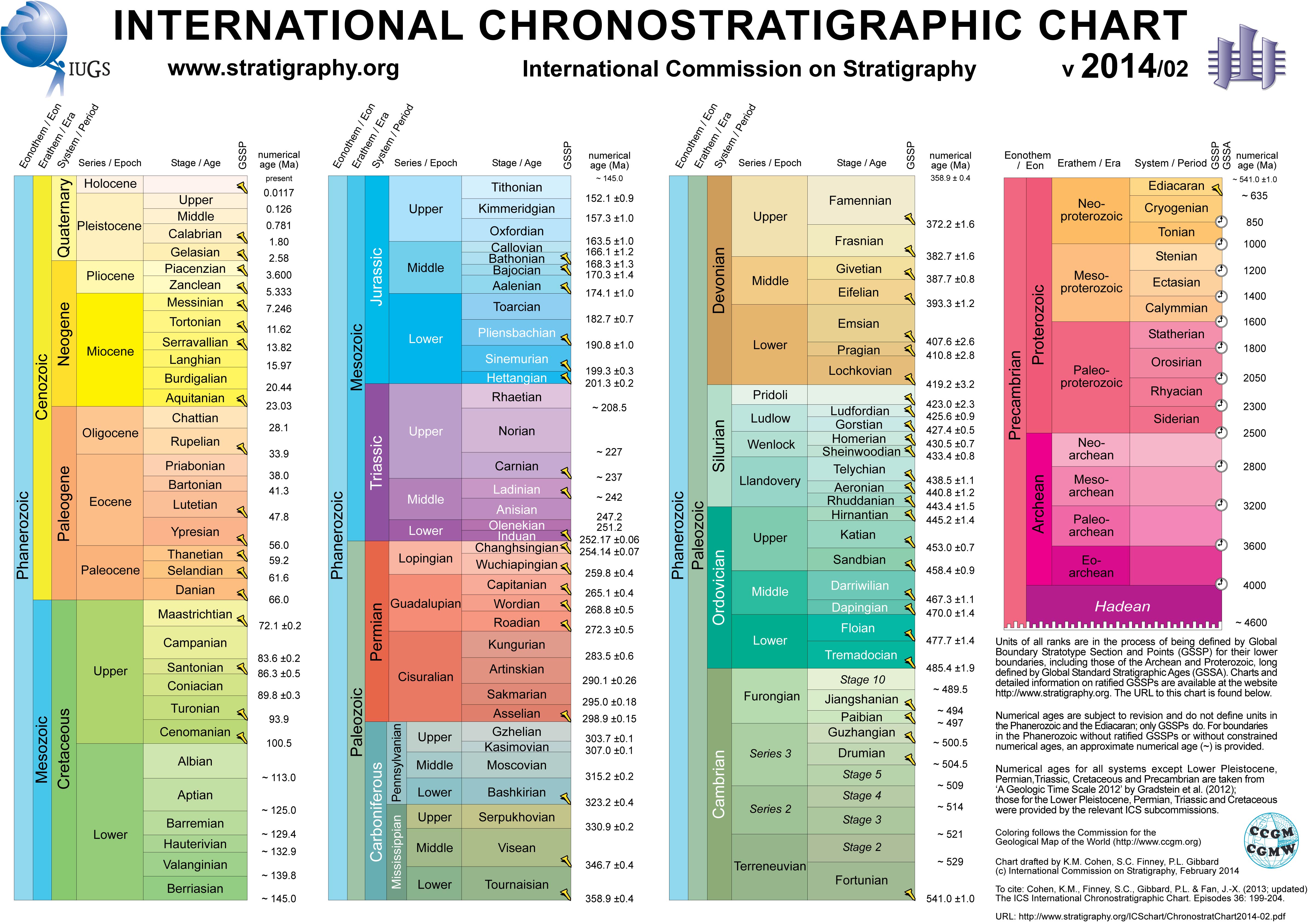
The assignation of geological time is a somewhat esoteric art that tends impinge on the general consciousness only because it encapsulates a time long ago when dinosaurs roamed the Earth and ice ages swept the face of the globe. The names given to the various divisions within the time scale are in equal measure enticing and confusing. There are A-list celebrities, of course — step forward the Jurrasic — and there are those that might struggle to get an invite to the party (the Kimmeridgian anyone?). And there are those whose fame rests, in part, on a misunderstanding: the creatures in Doctor Who called Silurians get their name from the Silurian Period of some 416–440 million years ago, although there are strong arguments that in fact they would have lived during the Eocene Epoch a mere 35–56 million years ago and so should be called Eocenes ( I defy anyone to face Madame Vastra and actually make that argument…).

The reason geological time is exercising my brain — and those of many others this week — is a meeting that kicks off in Berlin today. It is the gathering of the Anthropocene Working Group, a team of scientists and humanists who are trying to determine whether the world has crossed (or is about to cross) the boundary into a new epoch.

Currently, we reside in the Holocene, which began about 11,700 years ago. (Those of you who are keeping tabs on the whole structure might like to know that the Holocene Epoch is part of the Quaternary Period, which is part of the Cenozoic Era, which is part of the Phanerozoic Eon — there will be questions later.) But the meeting is debating whether the Holocene is over and the Anthropocene has begun.

At stake is the question of definition. The geological time scale gets its name because it is, well, defined by geology. Each subdivision relates to observable stratigraphy — and those wondrous names are derived from the geological locations that play host to the defining geology (the Jurassic gets its name not from a spurious theme park but the Jura mountains in the Alps). And that’s one of the things that makes the idea of the Anthropocene so intriguing: the hubris of naming an epoch after ourselves and the suggestion that the actions of the human race have wrought definable changes that merit a new division in geological time.

That has led people to start asking about the markers we will leave behind. What would aliens of the future landing on Earth be able to discover about us? Formally, it will probably be a rise in pollutants captured in layers of rock, but the idea of an alien gazing across Earth’s surface millions of years from now begs the question of what other clues we might leave. What equivalents of cave paintings and fossilized bones will signify the rise and fall of the human race?

I suppose that the more of something there was to start off with and the more widely it was used, the more likely some of it will survive to be found later — so for archaeologists, coins are more readily found than crowns and sceptres. Based on that, will the human race leave a legacy of toasters, mobile phones and body piercings?

Perhaps, in between fending off attacks from the giant insects that are now masters of the planet, an itinerant alien will be lucky enough to find preserved some technology that is still functional. Once it gets the mp3 file to play, a look of bemusement will cross its face as it tries to decipher the meaning of Everything I Do I Do It For You by Bryan Adams (mind you, if it just turns the volume up it might resolve the problem with the giant ants).

Some readers who grew up watching 1970s TV in the UK will remember an advert in which robotic aliens laughed incessantly at foolish humans peeling and boiling potatoes in order to make mash, when the advanced aliens could make it instantly from a packet. I can’t help thinking that the stars will echo with similar pan-galactic derision when what is left of our civilization comes to light and it becomes clear that twenty-first-century Earth was one huge religious cult that venerated graven images of cats doing unspeakably cute things.

Is this an android I see before me?

Beating classic opening lines such as “It was the best of times, it was the worst of times …” and “It is a truth universally acknowledged …” is, at least in my household, “As Gregor Samsa awoke one morning from uneasy dreams he found himself transformed in his bed into a gigantic insect.” (I was a strange child.)

But that delightful image from Franz Kafka’s Metamorphosis — cunningly adapted by Futures author Anatoly Belilovsky in his story Gifts of the Magi — has just had a rewrite. And the change is recasting the story — quite literally.

At a point where science fiction transforms into science fact, playwright and director Oriza Hirata has reworked Metamorphosis for the stage and cast a robot as the central character. This is not the first time I’ve heard of a robot taking up acting: Kamelion (voiced by Gerald Flood) was notorious for its role in two Doctor Who stories during Peter Davison’s era, although it was probably more notorious for, um, not working very well. But things have moved on somewhat since the early 1980s, and although we are still some way from an android King Lear, the video footage of Repliee S1 suggests that Hirata has gone some way to achieving his goal of creating “a situation in which a robot could move an audience”.

Hirata has actually been working with robotic actors (no jokes about soap operas, please) for the past five years in the guise of the Robot Theater Project at Osaka University. Collaborating with roboticist Hiroshi Ishiguro, who is also behind Repliee S1, Hirata has staged several short plays in Japanese. This latest production goes one step further, pitching the robot as the lead and the performance in French with Japanese subtitles.

Acting alongside Repliee S1 in La Métamorphose Version Androïde is award-winning actress Irène Jacob. The play opens in Japan before transferring to Hungary and then heads for the Autumn Festival in Normandy on 12 November.

This android vision of the future hints finally at robots edging their way into the creative arts — an idea captured neatly by Greg Bear in his Futures story RAM shift phase 2. Whether it will mean that we can look forward to a reworking of Hamlet for daleks (“Now, Hamlet, where’s Polonius?” “He has been exterminated”) or La Traviata performed by a slew of R2D2 clones (“Bleeping marvellous” — The RoboTimes) remains to be seen. Mind you, I’m not sure I’d want to audition a room full of robots for Waiting For Godot. But one thing we can be certain of, Repliee S1 is unlikely to forget its lines, miss its cues or corpse. For all you thespians out there, the future may very well be digital, in more ways than one …

This is what the Future looks like

As you may have heard on the grapevine (for which read me standing on a soapbox yelling), Futures has a new anthology out. And if you haven’t heard that and bought your copy, where have you been??

Anyway, the medium of Twitter would have stopped this post in its tracks long ago for want of character space, which makes it, along with its sibling social media outlets, good for headlines but less good for detail.

As a result I thought it would be worth kicking back a little and talking specifics.

Futures 2 (and the number is a clue, there is a Futures 1 as well) collects together 100 stories from the Futures archive and presents them in a handy eBook format (together with an intro hastily scribbled on the back of a beer mat by yours truly). The stories represent the fairly eclectic style of Futures veering from dark comedy to android despair and taking in xenotransplantation, cerebral modification and artificial intelligence along the way.

The selection was agonized over by myself and co-editor, former Futures editor Henry Gee. Long into the night, we pored over the past few years’ output and were pleased to discover just how hard it was to draw up a short-list of 100 (which bodes well for a Futures 3 …). The cover art (reproduced here again, cos I can’t get enough of it, was done by long-term Futures artist Jacey.

The eBook (did I mention that it’s on sale now, RRP $3.99?) features a wide range of authors from the well known, to the just starting out — which pretty much sums up the philosophy at Futures of publishing stories from all walks of life (more in a forthcoming post if you want to write for Futures, though an e-mail to futures AT nature.com is always a good start).

Anyway, for those of you who would like to know exactly who these 100 authors are, here’s the full list (deep breath):

S. R. Algernon | Madeline Ashby | Neal Asher | Tony Ballantyne | Barrington J. Bayley | Elizabeth Bear | Jacey Bedford | Anatoly Belilovsky | Gregory Benford | David Berreby | Ananyo Bhattacharya | David G. Blake | Polenth Blake | Keith Brooke | Eric Brown | Tobias Buckell | Steve Carper | Sarah K. Castle | Priya Chand | Brenda Cooper | Robert Nathan Correll | Elizabeth Counihan | Kathryn Cramer | T. F. Davenport | Sean Davidson | Robert Dawson | Paul Di Filippo | Joe Dunckley | Peter J. Enyeart | Dan Erlanson | Ronald D. Ferguson | Simon Quellen Field | John Frizell | John Gilbey | David W. Goldman | Dan Gollub | John Grant | Richard P Grant | Preston Grassmann | Lee Hallison | Nye Joell Hardy | Merrie Haskell | Martin Hayes | Jeff Hecht | Tania Hershman | Ken Hinckley | Joses Ho | Taik Hobson | Kerstin Hoppenhaus | Gareth D Jones | Rahul Kanakia | James Patrick Kelly | Swapna Kishore | David Langford | Susan Lanigan | Tanith Lee | Shelly Li | Jessica May Lin | Marissa Lingen | Ken Liu | Clayton Locke | Steve Longworth | Michael W. Lucht | Nick Mamatas | David Marusek | William Meikle | Mark W. Moffett | John Moran | Neale Morison | Anand Odhav Naranbhai | Gareth Owens | Conor Powers-Smith | João Ramalho-Santos | Mike Resnick | Jennifer Rohn | H. E. Roulo | Alex Shvartsman | Amber D. Sistla | Mohamad Atif Slim | Matthew Sanborn Smith | Norman Spinrad | Vaughan Stanger | Philip T. Starks | Ian Stewart | Eric James Stone | Ian Randal Strock | Rachel Swirsky | Grace Tang | Julian Tang | Adrian Tchaikovsky | Igor Teper | Joost Uitdehaag | William T. Vandemark | Scott Virtes | Deborah Walker | Ian Watson | Ian Whates | Sylvia Spruck Wrigley | George Zebrowski | Stephanie Zvan

And we’re live in 3 … 2 … 1 …

Hello? Testing, testing. Is thing on? Ah, there you are. Welcome to Future Conditional, the shiny new blog from Nature Futures.

Hopefully, you might already have noticed a few minor changes here at Nature Futures. First and foremost, we now have a lovely new homepage, where we can showcase our stories a little more attractively than before. Second, and almost as important, the new Futures anthology, Futures 2, has finally been released as an eBook, so you settle back with your favourite e-device and read 100 stunning stories from the Futures archive.

For those of you who are new around here, you may well be asking, this is all well and good, but who is this Nature Futures?

So, a quick potted history. Futures began as a flash of inspiration in the mind of Henry Gee, who by day sifts submissions in palaeontology and archaeology for the science journal Nature. (By night, when not avoiding the dog park, he has a tendency to amass book shelves and make sinister noises with his keyboard.) The idea was that with the end of the millennium fast approaching, it was a good time to take stock of the world and to find out what science-fiction aficionados thought the future might hold. Opening with a fanfare — and a story by Arthur C Clarke — Futures began its first series in the magazine on 4 November 1999.

Its original run was for just over a year, ably fulfilling its remit of seeing the millennium in in style. But something had happened … along the way Futures had begun to amass a group of devoted followers and it wasn’t too long before it was back in the magazine’s pages for a second series, running for two years to 2006. (If you happened to be out when all this was happening, fear not, as you can get 97 of the gems published back then collected together in the Futures 1 eBook.)

Briefly, Futures moved to its sister publication, the monthly journal Nature Physics, but by mid-2007, it was clear that the back page slot in Nature could only sensibly be filled by science-fiction stories and Futures was back, back, back — and we’ve not looked back since (partly because we’re slightly worried that we might be being followed …).

In among all of these events, Futures picked up the Best Science Fiction Publisher award from the European Science Fiction Society in 2005. Then, in 2011, Henry decided to step back from the front line on Futures, and I quickly cast myself as his natural successor, having spent years plotting and brooding (colleagues were often moved to ask why I insisted on having a cat on my lap when in the office, and I’ve lost count of the times I’ve been reprimanded for peals of demonic laughter and muttering in a sinister way). In truth, my subtle ploy of lulling everyone into a false sense of security by doing the production duties on almost every Futures page since 2005 had paid off.

Here in 2014, Future finds itself in an exciting place, with a fun bid to run microFutures, some of the shortest SF stories ever written under our belts, we have also made a welcome return to the pages of Nature Physics, giving us an extra outlet for our submissions. And we have also expanded into the world of social media, so you can keep up to date with all things Future on Facebook and Twitter.

So here we are, the smell of new paint just starting to subside from the new homepage, and a brand new blog from which to explore the world of science fiction. Here I hope not only to expose the convoluted machinations of my inner thoughts (be afraid — they keep me up at night), but also to delve into the various facets of things SF with guest posts from our authors and friends.

The future, as they say, starts here …