
A new report and a book this week presented two sides of the climate change coin.
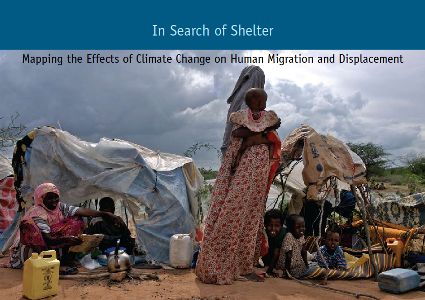
While the report unveiled at the Bonn UN climate change meeting sounded alarm bells for many Asian countries, including India, predicting large scale migrations due to glacial thaw, the book was a guide for erring cities across Asia, Africa and Latin America – cajoling them into becoming ‘good boys’.
Reports of the report flooded the Indian media since a lot is at stake for the country. The climate gurus have warned that the ongoing melting of alpine glaciers in the Himalayas will devastate the heavily irrigated farmlands of Asia by increasing floods and decreasing long-term water supplies. The glacier-fed basins of the Ganges, Brahmaputra, Irawaddy, Salween, Mekong, Yangtze and Yellow rivers support over 1.4 billion people.
The report ‘In search of Shelter: Mapping the Effects of Climate Change on Human Migration’ also predicted breakdown of ecosystem-based economies including subsistence herding, farming and fishing.
And while we were still coming to terms with the crisis looking us in the face, the International Institute of Environment and Development (IIED) sent us word that they have quite a few pointers for the Indian city of Mumbai along with its Asian metro counterparts in their new book ‘Adapting Cities to Climate Change: understanding and addressing the development challenges’.

The book, they say, should be of interest to policy makers, practitioners and academics, who face the challenge of addressing climate change vulnerability and adaptation in urban centres throughout the ‘global South’. It describes how the first priority for adapting cities to climate change is to remedy deficits in infrastructure and services. For most urban centres in these regions at least half of the population lacks piped water, sewers, drains, health care or emergency services. Also included are chapters discussing where adaptation can overlap with reducing greenhouse gas emissions (for Indian cities) and a critique of the very limited international funding available to support adaptation.
The UN-Columbia University-CARE International report also makes a few policy recommendations that include prioritising the world’s most vulnerable populations and including migration in adaptation strategies.
Takes me back to the gloom I experienced while doing an investigation some time back in the Sunderban islands of the Bay of Bengal. The story of the vanishing islands has been quoted widely (and even got a BBC award). But the migrants from these sinking islands have not yet been recognised as vulnerable , neither has there been any serious rehabilitation effort to save these environment refugees. Just the other day, a young environmentalist who had revisited the Sunderban delta, reported at a seminar on climate change that she hadn’t seen any perceptible change in the plight of the people despite the international press writing about them.
Makes one cynically wonder, what do reports, books and investigations finally boil down to? I would love to be shaken out of this cynicism: do tell me of the last book, report or press coverage that helped significantly alter the lives of such vulnerable populations in India.
I share your despair and sorrow about this. Our science and attention to reports is dependent on how much “certification” we have from people outside our system. So either we pay attention to reports by Ph.D. students or post-docs who continue to be Ph.D. students or post-docs of some (famous) people (mostly westerners) while pretending to be “independent” intellecutals in India or we pay “negative” attention to reports from outsiders with the view that they’re really not in the system to realise the “real” situation.
But lets take heart. We do have one report/book/investigation that has helped significantly in transforming a society of slaves for the Sahibs into a beautiful democracy that has very recently shown its wonderful dance to the world. It is called the “Constitution of India”. I wonder when the Indian “intellectuals”, especially in sciences, will come out of the slavery in their minds. Anyway, to end on a positive note, you asked for a proof, I’ve provided one!
Aditya,
In a timely reply to my cries, here’s something my friend Mike Shanahan from the International Institute for Environment and Development in London has to say about coverage of climate change in the Indian media: (I quote from a chapter he wrote in a new book ‘Climate Change and the Media’ Edited by Tammy Boyce & Justin Lewis.)
“Billett (in review) analysed the content of India’s English-language daily newspapers — The Times of India, The Hindu, Hindustan Times, and the Indian Express — from 1 January 2002 to 1 June 2007, and interviewed 15 of the country’s leading environment journalists in 2007. In contrast to trends in the United States and United Kingdom during these years (Boykoff, 2007a), the Indian press gave no space to contrarian viewpoints, and presented climate change as a scientific reality (100 percent) caused by human activity (98 percent).
There was a heavy focus on threats such as glacial melting and disrupted monsoons, with many articles pointing to evidence of impacts (Billett, in review). Overall the dominant narrative was one of India being at risk because of historic and ongoing emissions from industrialised nations that bear the biggest responsibility for addressing the problem.
Coverage was generally negative towards the Kyoto Protocol and said that efforts to include emissions cuts for nations such as India would be a bad idea, with some going as far as to say the Kyoto Protocol was intended to block India’s development. Although the United States also opposes mandatory emissions cuts — and the Kyoto Protocol — the Indian press coverage of climate change was highly negative towards that country (while being somewhat positive overall towards UK, EU, Japan, China, and Brazil).
Billett (in review) points out that the English-language papers he studied are the only ones with a national circulation, and that the narrative they construct is presented as national yet masks subnational divides within India. He concludes that this “silences the question of domestic emissions” and so excludes debate about responsibilities of the elite classes that make up the majority of the readership of these newspapers
(Billet, in review).
Meanwhile, the popular Hindi-language TV channel — Aaj Tak — made no mention on its main evening news programme of the reports the IPCC published in April and May 2007 on climate change impacts, mitigation, and adaptation (Painter, 2007)."
Excellent and pertinent post, would like to see more information on ‘renewable energy sources for rural India’ with minimal carbon footprint. Can you link further information about actions and plans in India on this subject?
Thanks and best regards
Archana Sharma