A huge haul of exoplanetary treasure has just been revealed. To those of you who’ve read more stories about exoplanets than you’ve had hot dinners, this news is unlikely to send you into throes of excitement. Neverthless, the haul of 32 new exoplanets announced by the HARPS (High Accuracy Radial Velocity Planet Searcher) team is significant (press release).
The planets may not be the biggest, fattest, smallest or Earthiest, but they show that the chances of us finding Earth-like planets are pretty high. Stéphane Udry from the Geneva Observatory, who announced tha findings during a conference in Porto, Portugal, says that the HARPS results show that astronomers are going about this in the right way so far: “We know that close to 40% of solar-type start have low mass planets. Low mass planets are everywhere, basically,” he says.
The search, done by the HARPS team on the European Southern Observatory’s 3.6 metre telescope at La Silla, in Chile’s Atacama desert, turned up two candidate planets that are six times the mass of Earth, and two planet candidates that are five times the mass of the Earth. The smallest exoplanet found so far was also by the HARPS team, and was about two Earth masses (see “Exoplanets lighten up“).
Xavier Bonfils from the Université Joseph Fourier – Grenoble 1 and CNRS, Laboratoire d’Astrophysique de Grenoble (LAOG), France, explained that some of the lightest planets in this set were found around M dwarf, or red dwarf stars, which are faint, cool and small. This is evidence that super-Earths are common in our galaxy. The existence of the largest planet in this group, a 4-jupiter mass planet was also around an M dwarf. This, says Bonfil, means that we’ve some way to go to understand how these giant planets form; because such a cool star wouldn’t be expected to have enough stuff to build a planet from.
The observations have taken five years, although not all the planets required such a long time to be spotted. That said, some of the biggest planets only orbit their stars once every 5000 days.
The technique being used to spot al these plants is radial velocity – where the speed of the parent star is tracked as planets orbit it. Any wobble caused by the gravitational pull of the planet can be deciphered to give a lower limit on the planet’s mass.
The 32 new planets will help bolster with the statistics for exoplanet finders and gee-up those who want to one day spy another Earth from home territory. Greg Laughlin, an astronomer from the University of California Santa Cruz and author of the blog systemic told me that these results from HARPS are a “significant step toward determining the statistical outlines of the galactic planetary census. It’s especially exciting to see that ground-based detection continues to be incredibly productive even as Space-based missions such as Kepler and CoRoT are contributing to the pace of discovery.”
And there’s yet more to come. Udry says there’s the same again, if not more, waiting to be announced over the next year. For now he’s happy that, apart from the giant around an M dwarf, the models that exoplanetary scientists are working to seem to be right. “I’m pretty confident that there are Earth like planets everywhere,” he says.
It’s the continued pursuit of these planets, and the continued successes, that leads people, like me, to maybe become a little jaded. Sometimes I find that I am so eager to report the finding of a planet the same as Earth, that I dismiss anything that isn’t the grand prize. What I forget is that this continued plugging away, testing the models, finding other planets, is crucial if astronomers are to be certain when they find the other Earths that they really found them. Keep up the good work!
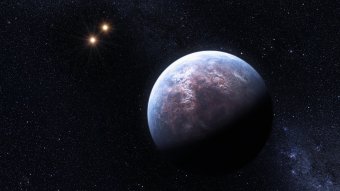
Image: The Gliese 667 system, ESO/L. Calçada
Fourier analysis can break down any periodicity in multiple ways. Hence the so-called evidence for terrestrial exoplanets is weak indeed, mathematically speaking. Could we detect earth from how far away? Would this be a control to compare to alleged terrestrial exoplanets?