The Florence Museum's meteorite fragment, which holds a grain of quasicrystal.{credit}PAUL J STEINHARDT{/credit}
In January this year, theoretical physicist Paul Steinhardt reported how he had traced the Florence rock back to its source – the Listvenitovyi stream in the Koryak mountains in Chukotka, a remote gold-mining region in north-eastern Russia. It turned out that a man named Valery Kryachko had dug up the stuff in 1979 while searching for platinum, and it was eventually smuggled to Florence.Together with nine other scientists from the US, Russia and Italy (and two drivers and a cook), Steinhardt embarked on an expedition across the tundra last July to look for more samples, as I wrote about at the beginning of the year. In a review paper published today in the journal Reports on Progress in Physics, Steinhardt (of Princeton University in New Jersey) and Luca Bindi (a mineralogist at the Florence museum) say their expedition did find new rock fragments containing grains of quasicrystals: solids with a mosaic-like atomic structure that appears to show long-range order but never quite repeats its arrangement. And the evidence further backs up their January report that these quasicrystals appear to come from a meteorite some 4.5 billion years old. Rocks found around the site suggest the meteorite, a carbonaceous chondrite, landed on Earth before or during the last ice age, 15,000 years ago.

Find out more about these quasicrystals in Richard’s post.
Laboratory dye repurposed against protein clumps found in Huntington’s disease
Kathleen Raven announces in the Spoonful of Medicine blog, a compound already sitting on the shelves of biomedical laboratories seems to interrupt the formation of neurodegenerative protein clumps found in Huntington’s disease, according to a preliminary animal study published this week in the Journal of Neuroscience:
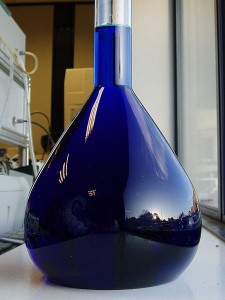 This versatile agent, called methylene blue, gets a mention in medical literature as early as 1897 and was used to treat, at one time or another, ailments ranging from malaria to cyanidepoisoning. The US Food and Drug Administration has never formally approved it as a therapy for any illnesses. But that fact hasn’t stopped biomedical researchers from tinkering with the agent’s apparent ability to improve cognitive function. And although the new paper out today relies on a Huntington’s disease model in flies and mice, scientists are hopeful. “Because of existing knowledge of methylene blue and the fact that it’s not harmful to humans, I would hope that progress toward clinical trials could go relatively quickly,” says Leslie Thompson, a neurobiologist at University of California–Irvine and lead author on the new study.
Continue to Kathleen’s post to learn more about Huntington’s disease.
{credit}CDC{/credit}

CDC officials previously reported 16 total cases on 3 August. In all cases, patients interacted with pigs either in their occupation or at local agricultural fairs, suggesting that the virus has not yet evolved the ability to efficiently transmit between humans. CDC first reported the variant in a 12 case outbreak from July to December 2011, with two instances of suspected weak human to human transmission. This week’s surge may be partially due to a change in protocol: states can now confirm positive test results prior to additional CDC testing. But, CDC Influenza Division chief, Joseph Bresee warned in a press teleconference today, “We’re seeing a big increase, and we think it’s a real increase.”
Helen explains that the outbreak covers four states: one case in Hawaii, one in Illinois, 30 in Ohio, and 113 in Indiana. Continue to her summary to find out more.
Save endangered butterfly
Freelance science writer, Ed Yong, reports in the News Blog that inmates at the Mission Creek Corrections Center for Women in Belfair, Washington, are helping to save the endangered Taylor’s checkerspot butterfly (Euphydryas editha taylori):
Prisoners are helping in efforts to conserve the Taylor's checkerspot butterfly.{credit}U.S. FISH AND WILDLIFE SERVICE, AARON BARNA{/credit}
Under the supervision of guards and graduate students, a small group of prisoners is breeding the beautiful orange-and-white insects in a greenhouse outside the prison. They have even carried out research to show what plants the butterfly prefers to lay its eggs on — information that will be crucial for boosting its dwindling numbers.
These efforts are part of the Sustainability in Prisons Project (SPP), the brainchild of Nalini Nadkarni of the University of Utah in Salt Lake City. “A lot of her work is about coming down from the ivory tower and involving under-served audiences in science,” says Dennis Aubrey, a student who works in the checkerspot initiative. He spoke about the project at the 2012 Ecological Society of America Annual Meeting in Portland, Oregon.

Learn more about the SPP initative in Ed’s post.
Why Cartoons, sex and music are necessary in science communication
This week’s Sopabox Science guest post is by Emily Coren, a science illustrator from California. Her post continues on from the #reachingoutsci discussion, the focus of June’s Soapbox Science series, where we heard from a range of scientists discussing ways they can reach out of the ivory tower to communicate science to the public:
Science literacy would be improved by teams of people working with scientists creating content which is accessible to the public. I agree with Shaaron Leverment when she said, “Reaching out to people where they are is a very important part of what we do” and with Jeanne Garbarino when she said, “I hope that we can figure out a way to expand science communication efforts from research institutions by having a dedicated team of people who work side by side with scientists.” We need to integrate science into popular media.
I don’t expect scientists to be able to or have the time to do this, so hire science communicators! Many of us come from science backgrounds and really want to help you get your work understood by the public so that you continue to have public support and funding. As Kalliopi Monoyios so perfectly put it, “Dun-duh-nuh-NUH!!!!!! ENTER: The science communicators! (“We are here! We are here!”)”
Do you agree with Emily’s thoughts? Feel free to join in the conversation.
Olympic Diving Physics
 In honor of the Olympics, Paige Brown’s latest post is about the Physics of Diving:
When a diver flips forward off of the diving board, he or she may begin by throwing into a pike position to gain angular speed in a flipping direction while his or her feet remain on the board as long as possible. Almost all of a diver’s “work” is done on the diving board – by putting energy into the board, a diver harness the “equal and opposite” Newton’s Third Law of Motion, with that energy eventually being transferred back into projecting the diver up and forward away from the diving board.
Follow through to Paige’s post to learn more about diving.
Conference Cast Reloaded
Scitable’s Conference Cast blog relaunched this week and will now be managed by PhD student Jonathan Lawson:
Conferences are the places that new ideas are born. Only here do you discuss with other specialists from around the world about the fine details of your scientific interests and only here can you draw upon such an extensive pool of knowledge for input on your work and how it should progress. Sharing the experience of conferences is what Conference Cast is all about, it’s about putting you in the audience, it’s about meeting new people and sharing ideas. It is your place in the crowd.
I hope that the relaunched Conference Cast will provide a window into the conference-going experience with first-hand reports from delegates at conferences all over the world in the full range of scientific fields. Much more than that, I aim to develop Conference Cast into an all-round conference resource offering advice on how you can make the most of going to a conference, how to meet new people, present your data and get the best feedback possible from other attendees.

If you plan to go to a conference, have recently attended one or just have heard about a conference you think the blog should cover, get in touch with Jonathan.
Mars Curiosity Rover
Eric Hand asks in the News Blog, “What’s next for the Mars Curiosity Rover?”
As I describe in the magazine this week, Curiosity’s ultimate destination is Aeolis Mons, (informally dubbed Mount Sharp), to the southeast — but that is many months, if not a year, away. It might be tempting to go look at the wreckage of the sky crane, which is directly behind the rover. Some have even speculated that the very first image returned, from the rear hazard cameras, caught a puff of dust caused by the sky crane crashing. It would be an amazing coincidence of time and orientation. “I don’t think we can rule it out,” said mission manager Mike Watkins. But the rover team is unlikely to drive to that wreckage, partly because scientists with finicky geochemical instruments want to keep their distance from the confounding effects of 140 leftover kilograms of hydrazine propellant that may have polluted that terrain. So where will the rover drive?

Stay tuned for more Curiosity updates.
Curiosity’s photos
Curiosity safely landed on Mars. Let’s see the amazing pictures from an alien world:

You can not over-emphasize how great accomplishment is this, since any tiny mistake can ruin the whole multi-billion-dollar project.