Guest post by Iulia Georgescu, Senior Editor, Nature Physics
The next couple of experiments with light listed in our ‘beautiful experiments’ poll come from, well, the age of enlightenment.
First up is Christian Huygens. Although Galileo first used a telescope to make detailed observations of celestial objects, it was Huygens who by 1655 had crafted a telescope with a refracting lens powerful enough to resolve the ring structure of Saturn.
A decade later, in 1665, Isaac Newton discovered that a beam of white light is decomposed by a prism into its component colours, which another prism would combine back into white. At the time, the origin of colours was still debated and Newton’s experiment confirmed that it is light that gives colour to the world. His work influenced art and Newton also came up with the colour circle he described in his book Optiks.
Around the same time the Dutch merchant Antonie van Leeuwenhoek was indulging into lens-making. He crafted powerful lenses and was the first to create a microscope with sufficient magnification to see single-celled organisms. He later dedicated himself to the characterization of tissues and micro-organisms, becoming the father of microbiology.
In 1679 Ole Rømer, working at the Royal Observatory in Paris, determined the speed of light by cataloguing the eclipses of Jupiter’s moon Io. Rømer was in fact trying to calculate the orbital period of the moon, but noticed time differences depending on the relative positions of Earth and Jupiter and realized that these could only be explained by the finite speed of light. He estimated that light would take 22 minutes to cross the diameter of the Earth’s orbit – not a bad estimate given his rough data.
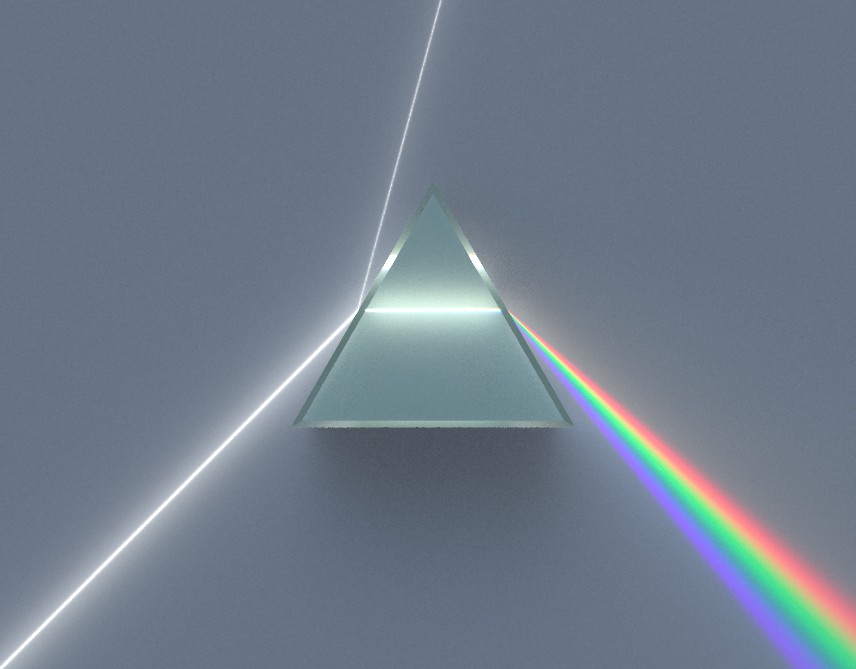
Dispersive Prism (Wikimedia)
Jump to the industrial revolution: England, 1801. Thomas Young presented to the Royal Society his paper “On the Theory of Light and Colours” and his double-slit experiment: the interference pattern produced by light passing through two holes cut into a plate. This demonstration went against Newton’s particle theory of light and Young’s work met great opposition at first. It was late 19th century before the wave nature of light, mathematically captured by the electromagnetic wave equations from James Maxwell, was fully confirmed.
Interestingly, the double-slit experiment with electrons, confirming they can behave just like light, was voted most beautiful experiment by PhysicsWorld readers in 2002.
Experiments covered this week:
1655 Huygens’ observation of Saturn’s rings by telescope
1665 Newton’s prism, splitting the rainbow
1670 Van Leeuwenhoek’s microscope, making micro-organisms visible
1676 Roemer’s measurement of speed of light by observing lunar eclipses at Jupiter
1801 Young’s double slit experiment with light
See last week’s introductory blog from Liesbeth Venema here. Next week Nicky Dean will write about Hertz’s discovery of the photoelectric effect and Becquerel’s creation of the photovoltaic cell, among others.