
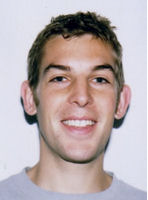
Dr Pete Culmer is a Senior Translational Research Fellow in the School of Mechanical Engineering, University of Leeds (UK). He has a background in medical engineering, with a PhD and subsequent post-doc work developing technology for rehabilitation assessments and interventions. He was awarded his current position, funded by the Biomedical Health Research Centre (BHRC), in 2010 and works with a growing team of researchers including engineers, surgeons and psychologists, conducting research in Surgical Technologies._
I’m at a large white console that wouldn’t be out of place in a games arcade, staring into a 3D display and carefully manoeuvring two hand-held controllers. Across the room, the other half of the surgical robot looms over the operating table, its arms mirroring my movements. It gives me a helping hand, ironing out the slight shake in my hands and scaling things so the small instruments it holds move more delicately than I could ever manage on my own. I’m trying to tie off a knot, yet despite all this technological help I mess up, miss the loop of thread and instead plunge the needle into the soft mass beneath. Oops…
It sounds like science fiction, but this robot system, the da Vinci, is widely used for minimally invasive surgery in healthcare systems around the world. This one is in the heart of Leeds General Infirmary where I’m sitting with colleagues, currently laughing at my lack of surgical prowess. Luckily this is just a practice using silicon models rather than people and I’m an engineer, not a surgeon.
It might seem unusual for an engineer, but this is part of my job in the Surgical Technologies research group at the University of Leeds. The group, led by Anne Neville (Prof. of Engineering and next up at the da Vinci’s controls) and David Jayne (Prof. of Surgery, watching on amused), focuses on developing new technology to improve modern surgery, with a particular emphasis on laparoscopy (minimally invasive surgery (MIS) on organs such as the bowel within the abdomen). For engineers it’s a challenging and fascinating task, but with systems like the da Vinci already in use, is new technology still necessary and beneficial? Understanding this question takes clinical expertise and experience and this is why our group comprises both surgeons and engineers working closely together. The answer, by the way, is a definite ‘yes’; laparoscopic surgery is sometimes described as being like trying to tie your shoelaces using a pair of long chopsticks….we need to give surgeons all the help we can to improve this situation.
As a researcher I’m fortunate in having a 5 year fellowship position which has been incredibly valuable in helping me establish a career in academia. It provides me with the opportunities, resources and crucially the time to develop my own research. My interests focus on developing ‘smart’ surgical tools that integrate sensors, data analysis and feedback systems to improve the surgeon’s operating experience. But there’s way too much work for one person alone so a key part of my job involves developing our research group by working with colleagues to obtain funding for new PhD students and post-docs. This gives us more hands on deck but also a wider set of skills to better tackle the multidisciplinary work, from robotics specialists to trainee surgeons with clinical expertise.
One interesting area we’re looking at is how human tissue can be damaged by surgical tools – and how we can help prevent it. In laparoscopy, organs and tissues are manipulated by grasping them with plier-like tools. However, the tools are on long levers (the chopsticks) which pass through the abdominal wall and their mechanisms are affected by friction – factors which make it extremely difficult for the surgeon to ‘feel’ and regulate the forces that they apply to the tissue. This can result in tissue damage through excessive force, like getting a bruise but with potentially far more serious consequences for the patient. So we need to understand how the damage is caused; how much force is too much and how long a ‘grasp’ is too long? Our approach highlights the multidisciplinary nature of this work; using computer controlled lab equipment we grasp tissue specimens with precisely controlled forces. Then we relate this to clinical measures of tissue damage through histological analysis – looking at small sections of the tissue under a microscope and assessing how structures and cells have been deformed or destroyed. Using this information we’re working to develop improved tools that minimise tissue damage. The solutions have come from a range of different engineering fields; tribology: new bio-inspired materials with surfaces that reversibly adhere to tissue (think bio-velcro), mechanics: computational models of how tissues react to forces; robotics: tools that can actively and automatically regulate the forces they apply to prevent damage.

The other side of my work here involves teaching, something I’ve gradually moved into and really enjoy. We have an emphasis on linking our research with teaching here at Leeds. I think (hope!) this keeps things interesting and relevant for the students, it definitely does for me. I teach a 1st year computing course and the material could be quite abstract so it’s important to ground it with real-world examples – from controlling equipment at CERN to autonomously recording high scores on Guitar Hero, both important in their own way! One part I particularly enjoy is running projects for 3rd and 4th year students; it gives them a bite-sized taste of research and the opportunity to apply the engineering skills they’ve learnt without the normal constraints of lab-classes etc. This year I ran a project with my colleague Rob Hewson. Hatched over a strong coffee or two, we thought it might have been a touch ambitious…the idea was to investigate how palpation could be applied to laparoscopic surgery. It’s commonly used by clinicians (e.g. in breast examinations) to detect and assess lumps, which could potentially be cancerous, by feeling the tissue and its mechanical properties (tumours are typically much stiffer than healthy tissue). However, in laparoscopic surgery the surgeon cannot directly touch the tissue so an alternative approach is needed. The student team surpassed all our expectations, developing a proof-of-concept system that uses a computer model to simulate liver tissue (including a tumour) and then allows you to feel, and virtually palpate the tissue using a ‘haptic’ interface. They worked hard to achieve a lot in a short space of time and it was great to see this recognised when they were runners up in the Global NI student design competition, receiving some attention in the press which they took in their stride! We’ve now submitted the work for publication – certainly a tough act for this year’s students to follow!

It’s the end of a long week; over the last few days we’ve run a conference on Oncological Engineering which has had some fascinating talks, I’ve started teaching our new intake of first year students and there’s been lots going on in our research projects. It’s a mix that constantly keeps me on my toes and reflects the challenge of working in modern day academia with its often competing demands. I’m not looking for sympathy though, it’s stimulating, rewarding and involves working with a great bunch of people, I wouldn’t have it any other way -already looking forward to next week!