
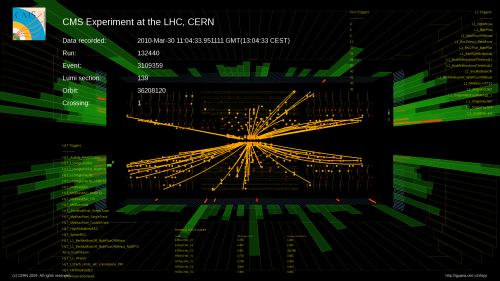
 Today, after over fifteen years of planning, construction, delays and drama, the Large Hadron Collider began doing what it was built to do: colliding particles.
Just before 13:00 Geneva time, physicists guided two beams of protons moving at 3.5 TeV into collision points around the machine’s 27 km ring. Moments later, cheers erupted from the control rooms of the machine’s four main experiments, as shrapnel from the collisions flooded into the detectors.
The collisions end a long data drought for particle physicists, who haven’t had a new accelerator since the completion of the Tevatron’s main injector in 1999 at Fermilab in Batavia, Illinois. In the US, particle physicists had hoped to replace the Tevatron with a new Superconducting Supercollider, but that projected was cancelled by Congress in 1993, in the face of enormous cost overruns.
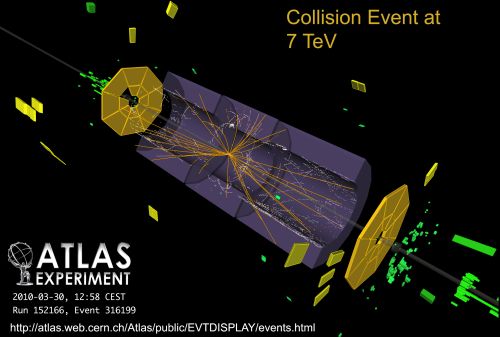 The LHC is less powerful than the SSC would have been, but it’s still far more powerful than the Tevatron. Initially the machine will collide particles at 7 TeV, over three times the energy of the Tevatron. After a year of running at that energy, the LHC will shut down for about a year to perform a series of upgrades. It will then (hopefully) reopen at 14 TeV, its original design energy.
I can’t think of another case where the future of an entire field hinges on the success of a single experiment. If the LHC works, it could verify current theories of particle physics, most notably the Higgs mechanism, which endows all matter with mass. It could also discover new physics beyond the current “standard model”, and explain some current mysteries in physics like “dark matter”, a mysterious form of matter that makes up around 85% of all matter in the universe. If it doesn’t see anything new, thousands of high-energy physicists will have to find a new line of work.
That may be a bit of an exaggeration, but only just, and the relief was clearly visible on the faces of happy physicists at CERN today. Now that the LHC is finally working, physicists will once again press forward in their search for new particles and new physics beyond anything that’s seen today.