
 |
 |
A new analysis posted to the popular physics preprint server ArXiv.org suggests that the damaged reactors at Fukushima Daiichi have not restarted their nuclear processes since 11 March. The work is not peer-reviewed, and like all speculation about Fukushima, it is based on sketchy and sometimes incorrect readings from the plant. Nevertheless, it’s notable for its apparently thorough synthesis of a lot of information.
Since the mid-March partial meltdown at the Fukushima Daiichi nuclear power plant, scientists have been speculating about what may have actually happened inside the reactors. We’ve reported some of their ideas before, though many other experts doubt the value of these earlier analyses, which are based on second-hand measurements that can be unreliable.
The latest work is from Tetsuo Matsui, a physicist at the University of Tokyo who seems to specialize in high-energy physics and nuclear theory. Matsui has looked at two much-discussed (and much recorded) isotopes from the accident: Iodine-131 and Caesium-137.
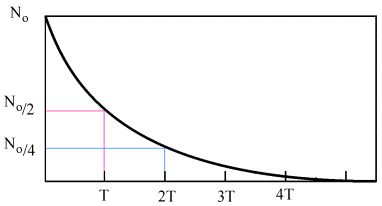
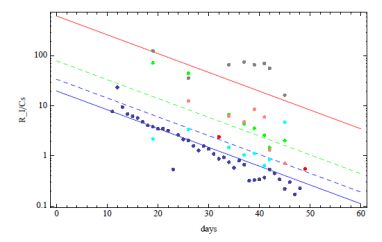
Rather than just plotting the radiation levels, Matsui takes the ratio of I-131 to Cs-137. Because I-131’s half-life is so much shorter than Cs-137, the ratio should look like a typical half-life graph: an asymptotic slope on a normal graph (top) or a straight line on a log plot (bottom). The advantage of doing a ratio is that any errors (and there have been many) in either measurement will be effectively cancelled out, assuming they were made with the same piece of equipment. Based on what we’ve seen, that is likely in most cases.
Matsui also does some theoretical calculations about what the relative abundances of the isotopes would have been when the reactors first shut down.
The result: water from the southern most monitoring post (dark blue) seems to follow the model (blue line) pretty well. But water from the unit 4 reactor (pink), where fuel was being stored in a temproary storage pool, does not, nor does data from the sub-drains of the individual reactors (unit 1=green, unit 2=gray, and unit 3=cyan).
Matsui concludes that the reactors likely shut down successfully and did not restart. But he suspects something may have happened at the fuel pool at unit 4—perhaps contamination or a brief burn of some of the fuel in the pool.
It’s an interesting idea, but plenty of questions remain. The entire analysis rests in large part on the complex art of reactor fuel modelling, something Matsui, so far as I know, has little experience with. The data is still sketchy at best, and the latest video of the unit 4 spent fuel pool (below) doesn’t seem to show extensive damage.
Above all, it’s good to see an attempt at thorough analysis of what’s happened inside the reactors.
You are currently viewing a placeholder content from YouTube. To access the actual content, click the button below. Please note that doing so will share data with third-party providers.
For full coverage of the Fukushima disaster, go to Nature’s news special.
For a selection of our coverage in Japanese, see Nature Asia Pacific.
Top: SLAC
Bottom: T. Matsui, arXiv:1105.0242v1
Video: TEPCO