Lunar dust mission still chasing mystery of ‘horizon glow’

LADEE at moon credit NASA

{credit}NASA{/credit}

Posted on behalf of Alexandra Witze.

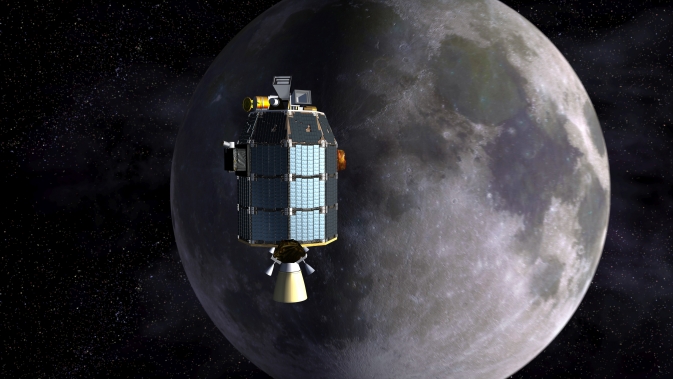
NASA is preparing one last blast for its expired Lunar Atmosphere and Dust Environment Explorer (LADEE) spacecraft — a controlled crash into the Moon’s surface, probably on 21 April. But before it goes, LADEE will take a final shot at unravelling one of the main mysteries it went to the Moon to uncover.

A major goal of the mission was to understand a bizarre glow on the Moon’s horizon, spotted by Apollo astronauts just before sunrise. “So far we haven’t come up with an explanation for that,” project scientist Rick Elphic, of NASA’s Ames Research Center in Moffett Field, California, said at a media briefing on 3 April. One leading idea is that the Sun’s ultraviolet rays cause lunar dust particles to become electrically charged. That dust then lofts upwards, forming a cloud that caught the light and the astronauts’ eyes.

LADEE carries an instrument that measures the impact of individual dust particles, as well as the collective signal from smaller particles. Lunar scientists had expected a certain amount of tiny dust to explain what the Apollo astronauts saw. But LADEE didn’t find it. “We did measure a signal that indicates that the amount of lofted dust has to be at least two orders of magnitude below the expectations that were based on the Apollo reports,” says Mihály Horányi, the instrument’s principal investigator, who is at the University of Colorado. Perhaps the dust lofting happens only occasionally, he suggests, and the astronauts were in just the right place at the right time to see it.

LADEE will try one more time to unravel the horizon-glow mystery. As it gets closer and closer to the lunar surface, it will point its star tracker towards the Moon’s horizon to try to replicate the angle and conditions under which the astronauts saw the glow. The star tracker is not designed for high-resolution imaging, but Elphic says that it’s worth looking.

This weekend, mission managers will guide LADEE on a trajectory just 3 kilometres above the Apennine mountains on the Moon’s near side. The goal is to see what sort of dust LADEE can spot so close to the surface. Then it will move slightly higher for its remaining few weeks before plunging to its doom. It is destined to follow the natural decay of its orbit and vaporize itself on the lunar far side.

LADEE scientists have plenty of science to distract them from mourning. The spacecraft made the best measurements ever of the Moon’s dusty envelope, generated as tiny meteorites bombard its surface. The mission also discovered exotic atoms such as neon, magnesium and aluminium in the Moon’s outer atmosphere.
NASA’s Deep Impact spacecraft is spinning out of control

deepimpact

{credit}Ball Aerospace & Technologies Corp.{/credit}

Posted on behalf of Ron Cowen.

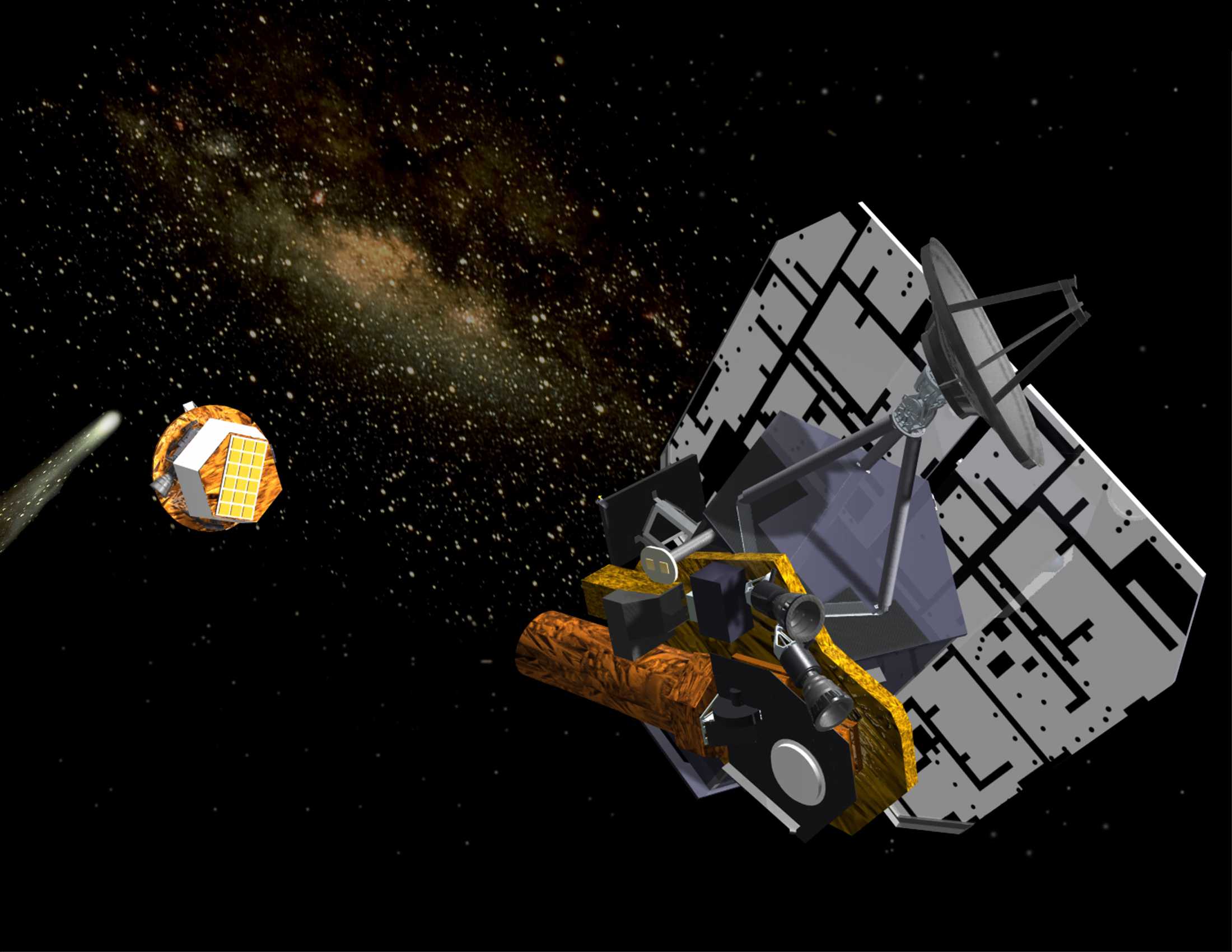
NASA’s Deep Impact spacecraft is in deep trouble. The craft, famous for blasting a projectile into the Comet Tempel 1 in 2005, lost contact with Earth sometime between 11 August and 14 August. Recent commands to put the craft in hibernation, or safe mode, were unsuccessful, and Deep Impact is now spinning out of control, says principal investigator Michael A’Hearn of the University of Maryland in College Park. The mission was renamed Epoxi when it was extended to observe comets and stars with transiting exoplanets.

Engineers have traced the problem to a software-communications glitch that reset the craft’s computer. They are now working on commands that could bring Deep Impact back into operation. They may try to communicate with the spacecraft this weekend, but the team first has to figure out its most likely orientation and whether to broadcast signals to the vehicle’s high-gain or low-gain antenna.

Mission scientists are racing against the clock because the craft’s batteries rely on power provided by Deep Impact’s solar panels. If the panels on the wayward craft happen to be pointing in a direction where they receive partial sunlight, the batteries could last for a few months. But if the panels are pointed away from the Sun, the batteries would die in just a few days. Once the batteries are gone, Deep Impact can no longer be revived, A’Hearn says.

One casualty of the mishap is that scientists have not received any of the expected images the craft was scheduled to take in August of Comet ISON, the icy space rock that could make a spectacle in the inner Solar System this fall before diving into the Sun, A’Hearn says.

Europe launches massive laser communications satellite

Alphasat_Launch_node_full_image

{credit}Arianespace{/credit}

On Thursday Europe launched into orbit the most massive telecommunications satellite ever built on the continent. Managed by the European Space Agency and commercial operator Inmarsat, the 6.6-tonne Alphasat will relay data between different spots on the globe — using radio waves in the already crowded L-band frequency range. But it will also test out a laser communication device that could give a boost to space communications.

One piece of experimental equipment will broadcast at the higher and underused frequencies in the Q/V band. Higher frequencies encode more information, increasing the bandwidth available for transmissions. Sending such signals to the ground has been technically challenging because they are more easily disturbed by the atmosphere.

A second device will shoot and detect beams of laser light that have even higher frequencies and can carry even more information. Other satellites equipped with such terminals will be able to send information from low-Earth orbit up to Alphasat, which will relay the data to the ground from its high geosynchronous orbit. This will be the first step towards a network of laser-relay satellites intended to handle data from a planned fleet of European Earth-observing satellites.

An advanced star tracker particularly resistant to radiation will help these communications systems to aim their messages. Like a mariner out on the sea, it observes the stars to help the craft orient itself properly.

The Ariane 5 rocket that carried Alphasat also put into orbit INSAT-3D. This satellite will provide weather forecasting services to India.

Europe picks a neutrino machine

Posted on behalf of Devin Powell.

According to a new prioritization, the Neutrino Factory, a proposed multibillion-euro facility, is the best long-term European option for testing whether neutrinos and antineutrinos behave differently, a step towards understanding why the Universe contains primarily matter instead of antimatter.

The recommendation comes from a report, four years in the making, that looks ahead to Europe’s future in high-intensity neutrino research. Paid for by the European Commission’s Seventh Framework Programme and presented on 10 June at CERN, Europe’s largest particle physics laboratory, in Switzerland, the EUROnu project weighed the pros and cons of three candidate neutrino machines.

Costing between €4.6 billion (US$6.1 billion) and €6.5 billion, the Neutrino Factory would generate an especially intense beam of neutrinos and send them on an underground journey of about 2,000 kilometres. At the source end, probably at CERN, the neutrino beam would be created by smashing protons into a solid target, producing muons that in turn break down into neutrinos. At the receiving end, perhaps in Finland’s Pyhäsalmi mine, a 100-kilotonne detector made of iron could spot the arrival of neutrinos and detect whether the particles had ‘oscillated’ during flight, transforming from one of the three types of neutrinos to another.

This setup could measure how often neutrinos and antineutrinos change form with less error than the other two options considered by the report: Beta Beam, powered by the breakdown of ions, and Fréjus Super Beam, which would employ a water-based detector. The Neutrino Factory would be significantly more expensive, though, so its architects are exploring ways to scale it down or implement it in stages.

Whether the facility will ever be funded and built, in its entirety or in stages, remains an open question, especially in light of the CERN Council’s recent update to the European strategy for particle physics. It indicates a willingness to back large projects abroad, such as the Long-Baseline Neutrino Experiment (LBNE), which intends to send neutrinos on a 1,300-kilometre trip from Fermilab in Batavia, Illinois, to a mine in South Dakota.


Refurbished Alvin submersible returns to sea

alvin

Alvin will soon be back in business after a two-year hiatus.
{credit}Brian Owens{/credit}

Posted on behalf of Brian Owens.

After a two-year, US$41-million upgrade, the venerable Alvin submersible is about to return to sea.

On 25 May, the research ship Atlantis will leave the Woods Hole Oceanographic Institution (WHOI) in Massachusetts with Alvin on board, bound for Astoria, Oregon. After a series of US Navy certification cruises in September and a scientific-verification cruise in November, Alvin will return to full service in December studying the deep ocean off the US Pacific Northwest.

The main improvement in this first phase of the Alvin upgrade is the new titanium sphere where the sub’s three-person crew sits (see Nature’s feature story ‘Deep-sea research: Dive master‘). It is 18% bigger than the previous sphere and has two extra windows and high-definition cameras, giving the scientists a better view of the deep ocean. It also has more comfortable seats. In addition, the manipulator arms have longer reach, and the sample-collection basket can carry twice as much weight — up to 181 kilograms.

Even though the new sphere was designed to travel to depths of 6,500 metres, Alvin will still be limited to its old depth of 4,500 metres after the first phase of the upgrade. Holding it back from greater depths are battery limitations, says Susan Humphries, who is in charge of the upgrade programme at WHOI. Alvin uses lead–acid batteries, which do not provide enough power for longer, deeper dives. Lithium-ion batteries would be better, but are considered to have too great a risk of fire for now. “In a few years, once the battery technology has matured, we’ll complete phase two,” says Humphries. She hopes that within five years, when Alvin is scheduled for regular maintenance, the problem will be solved.

In the meantime, ocean scientists are eager to get back below the waves. Over its five-decade career, Alvin has been responsible for revealing some of the deep ocean’s biggest surprises, including the famous ecosystems powered by hydrothermal vents rather than sunlight. Julie Huber, a microbiologist at the Marine Biological Laboratory, also in Woods Hole, has been on three Alvin dives in the past. She is looking forward to the new exploration opportunities, but sounds a note of caution: “I want to wait for them to have 50 safe dives under their belt before I go back.”

Disclosure: Brian Owens is in Woods Hole as part of the Logan Science Journalism Fellowship at the Marine Biological Laboratory.

Obama administration announces manufacturing institutes

Posted on behalf of Chris Palmer

The administration of US President Barack Obama announced this week that it is committing US$200 million to create three advanced-manufacturing innovation institutes, focusing on digital manufacturing, lightweight composites and next-generation power sources.

The new institutes are another step in Obama’s plan to reboot America’s manufacturing sector with a National Network for Manufacturing Innovation. Obama’s fiscal 2014 budget requested a one-time $1-billion investment to fund the network, which would consist of 15 more institutes around the country.

The institutes will mesh industry, universities and community colleges with federal agencies to design and implement innovations in manufacturing. Funding will come from the defence, energy and commerce departments, as well as NASA and the National Science Foundation. Industry partners and local governments will provide matching funds.

A pilot programme for the initiative launched last year in Youngstown, Ohio, focusing on additive manufacturing, often referred to as 3D printing. “This is a great next step,” says David Dornfeld, a mechanical engineer at the University of California, Berkeley. “A lot of enthusiasm has already been generated for these institutes.”

The digital manufacturing institute will develop software to help push manufacturing from design and prototyping to production and testing stages. The institute for lightweight metals manufacturing will attempt to spur reductions in manufacturing and energy costs for products such as medical devices and vehicles. The next-generation power-sources institute will employ semiconductor technology to develop compact, high-efficiency power sources. “The bandgap semiconductor institute is fairly specific to the Department of Energy, but the other two are right on target for where we advised the president to go,” says Dornfeld, referring to a report submitted to the president last year by the Advanced Manufacturing Partnership steering committee and endorsed by the President’s Council of Advisors on Science and Technology.

Whereas industry observers are mostly positive about the manufacturing initiative as a whole, some are concerned that the initiative may not be robust enough. Philip Shapira, a public-policy analyst at the Georgia Institute of Technology in Atlanta, says that it would begin to support the US manufacturing landscape in a way comparable to systems in Germany, the United Kingdom, Japan and Taiwan. “However, 15 centres is probably the absolute minimum,” Shapira adds. Germany, by comparison, has 60 Fraunhofer institutes focusing on innovation in technology and manufacturing.

Also, experts agree that even if Obama receives $1 billion from Congress, the institutes will not become self-sustaining without additional long-term public financing.

Obama calls for peer-review autonomy

Posted on behalf of Beth Mole

In a brief 15-minute speech today, US President Barack Obama championed independence for the peer-review process, in front of an audience of elite researchers at the 150th annual meeting of the National Academy of Sciences in Washington DC.

“In order for us to maintain our edge, we’ve got to protect our rigorous peer review system,” Obama said.

His support comes on the heels of draft legislation, dated 18 April, that ScienceInsider reports is being discussed by the chairman of the US House of Representatives Science Committee, Lamar Smith (Republican, Texas). That legislation would overhaul peer review of grants submitted to the National Science Foundation (NSF) and require the NSF director to certify each funded project as benefitting the economic or public health of the United States.

The effort by Smith follows a stream of recent attacks on science funding and the peer-review system, including legislation in the 2013 spending bill from Oklahoma Senator Tom Coburn, a Republican, that requires the NSF director to certify that all funded political-science research is crucial to national security or the US economy.

Without directly referencing the new legislation, President Obama spoke of maintaining the NSF’s control over social-science grants. “One of the things that I’ve tried to do over these last four years, and will continue to do over the next four years, is to make sure that we are promoting the integrity of our scientific process,” he said. “Not just in the physical and life sciences, but in psychology and anthropology and economics and political science, all of which are sciences,” he said.

Allowing politicians to be involved in scientific decisions is a “disastrous” idea, says Bruce Alberts, former president of the National Academy of Sciences. He adds that it’s ironic that proponents of the changes want the government involved in picking winners and losers in science when they don’t want it involved in the economy.

Akkihebbal Ravishankara, a climate scientist at the University of Colorado in Boulder, agrees that the grant process ought to remain independent. “The thing that would be really nice is if we could make science apolitical,” he says.

Third time is a charm for Orbital’s cargo rocket

antares1

{credit}via NASA TV{/credit}

Posted on behalf of Devin Powell.

On Sunday, the Antares rocket successfully completed its maiden test flight. Launched from a new pad at NASA’s Wallops Flight Facility in Virginia, the rocket is the largest vehicle to ever take off from the spaceport.

“It looks like it performed flawlessly throughout the day,” said NASA launch commentator Kyle Herring.

The flight puts NASA one step closer to having two US cargo carriers capable of resupplying the International Space Station. Funded in part by NASA subsidies and made from components built around the world, Antares was assembled by Orbital Sciences of Dulles, Virginia. The Frankensteinian vehicle put into orbit a 3,800-kilogram mock-up of Orbital’s Cygnus spacecraft that will, during a future mission later this year, transport supplies to the space station.

The spacecraft simulator separated and went into orbit about 10 minutes after launch. It will take measurements using on-board instruments and deploy four small satellites. Three inexpensive PhoneSats built by NASA’s Ames lab in Moffett Field, California — named Alexander, Graham and Bell — will be controlled by the same computer chips used in smartphones. The fourth satellite, Dove-1, will snap photos of the planet from low-Earth orbit.

Today’s launch comes four days after the first attempt, scrubbed when a data cable disconnected prematurely from the fuelled rocket. Strong winds delayed a second countdown on Saturday.

Veteran space player Orbital may be finally catching up to its rival, SpaceX, founded by PayPal magnate Elon Musk. SpaceX is already well underway on its US$1.6-billion resupply contract, with three visits to the space station by its Dragon spacecraft to date. Plagued by delays — from setbacks in the construction of its launch pad to problems with Antares’ engines and valves — Orbital has yet to get started on its own $1.9-billion contract.

Russia announces space-spending plan

Posted on behalf of Chris Palmer.

Russia will give its Roscosmos space programme a whopping US$52-billion boost between now and 2020 in an effort to maintain its position as a leading space power.

The announcement came from Russian President Vladimir Putin as he told cosmonauts aboard the International Space Station on Friday that Russia will send up the first mission from its new Vostochny launch pad by 2015. Russia has been developing the Vostochny cosmodrome in the Russian Far East as a way to reduce dependency on the Baikonur cosmodrome in Kazakhstan. Putin added that the first manned missions would launch in 2018, with “super-heavy” rockets capable of missions to the Moon ready by 2020.

Experts think that Putin’s timeline is optimistic, but mostly achievable. “The fact that they’re putting money into it is good,” says Louis Friedman, former director of the Planetary Society in Pasadena, California. But money alone will not guarantee success, he adds. “They need to eliminate a lot of the waste and corruption that’s been endemic in their industry.”

George Abbey, senior fellow for space policy at the Baker Institute at Rice University in Houston, Texas, agrees that Russia has a long way to go to return to its former glory, given recent missteps such as the failure of its Phobos-Grunt Mars probe in 2011. However, he sees Friday’s announcement as a positive step. “Russia’s number one today,” says Abbey.

Although Abbey thinks that manned launches from Vostochny by 2018 are well within reach, he is less confident about Russia’s lunar goals. “I don’t know if they’re going to get to the Moon on that $50 billion,” he says.

John Logsdon, professor emeritus of space policy at George Washington University in Washington DC, is also sceptical of the lunar timeline, and says that building a new heavy-lift rocket in seven years is ambitious. “However, they are throwing a hell of a lot of money at it,” he says. Logsdon adds that space accomplishments are part of Russia’s national pride and the new plan is a “signal to the world that they are still an advanced country”.

Dragon soars then stumbles

spacex5Posted on behalf of Devin Powell.

UPDATE #2 (4 p.m. Eastern Standard Time): SpaceX says that a second set of thrusters is up and running. Dragon needs two to fly towards the station but won’t be able to dock without at least three. SpaceX engineers are working to bring the other two sets of thrusters online, but Saturday’s scheduled docking with station has been postponed.

UPDATE #1 (3 p.m. Eastern Standard Time): Owing to a problem with a propellant valve, only one of Dragon’s four thrusters fired. SpaceX deployed the spacecraft’s solar panels  and is working to get at least two thrusters  running before beginning maneuvers. Whether Dragon could hobble to the station on a single thruster remains unknown.

On Friday at 10:10 a.m. Eastern Standard Time, a Falcon 9 rocket blasted off from Cape Canaveral in Florida, the fifth successful launch of this model by SpaceX. Riding the rocket was an unmanned Dragon capsule that detached about ten minutes after lift-off and entered orbit, heading towards the International Space Station (ISS).

But just before the spacecraft’s solar panels were set to deploy, SpaceX engineers reported a problem. What the problem was, and how it will impact Dragon’s visit to the ISS, scheduled for 2 March, remains unknown.

The ISS visit would be the space freighter’s third to date and the second of 12 resupply missions paid for by SpaceX’s US$1.6-billion NASA contract. Dragon’s pressurized pod contains 677 kilograms of packaged cargo. That includes food, clothing, equipment, a rock song called “Up in the Air,” and research experiments studying how plant cells, soot, and mixtures of liquid and solid behave in reduced gravity. For the first time, the spacecraft will also carry cargo in its unpressurized external trunk, bars that will be attached to the outside of the ISS.

During its previous resupply mission in October, Dragon successfully delivered its cargo. But a satellite carried by that Falcon 9 failed to reach its proper orbit after an engine failed in mid-flight. All nine engines appeared to function properly during Friday’s launch, giving a boost to SpaceX’s track record of reliability.

On 25 March, if all goes well, Dragon will detach from the space station and come back down, ultimately splashing into the Pacific Ocean. Retrofitted to prevent water leakage, which shorted out a freezer on board last time, the capsule will bring back 1,370 kilograms of cargo and samples from experiments including NASA’s human research program. By 2015 SpaceX hopes to be returning humans themselves in its first crewed Dragon.

Image: via Livestream