Private rocket explodes on launch to space station

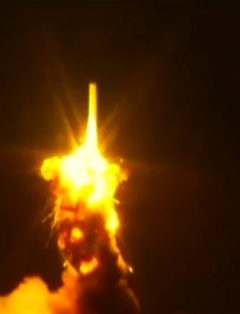
Flames engulfed the rocket seconds after lift-off.

Flames engulfed the rocket moments after lift-off.{credit}NASA-TV{/credit}

An Orbital Sciences Antares rocket exploded seconds after its 6:22 p.m. lift-off from Wallops Island, Virginia, Tuesday on a mission to resupply the International Space Station. No one was hurt, but the rocket was apparently destroyed and there was “significant property damage”, according to mission control commentators on NASA television.

“We have lost the vehicle,” said controllers from the Johnson Space Center in Houston. “The [space station] crew has been informed of the accident.”

Orbital moved almost immediately into contingency mode, asking its engineers to retain all notes and photographs related to the launch. Fires could be seen burning across the launch pad. “Obviously we will need to instigate an accident investigation team,” the launch director said.

Orbital, of Dulles, Virginia, is one of two private companies flying cargo to the space station for NASA. Its competitor, SpaceX of Hawthorne, California, is aiming to eventually carry astronauts as well.

It was the third of eight scheduled missions for Orbital. Among the 2,300 kilograms of cargo on board were a spectrometer to measure meteors entering the atmosphere and a neck collar for astronauts to measure blood flow from the brain. The payload also included test hardware for a future private asteroid prospecting mission, as well as unspecified classified cryptography equipment.

Launch of a Russian Progress vehicle, scheduled for the morning of 29 October with more crew supplies, was not expected to be affected.


UK launches space weather forecast centre

The UK officially opened its first space weather forecasting centre this week.

Funding for the Met Office Space Weather Operations Centre, based at the organisation’s headquarters in Exeter, was announced by the government late last year.

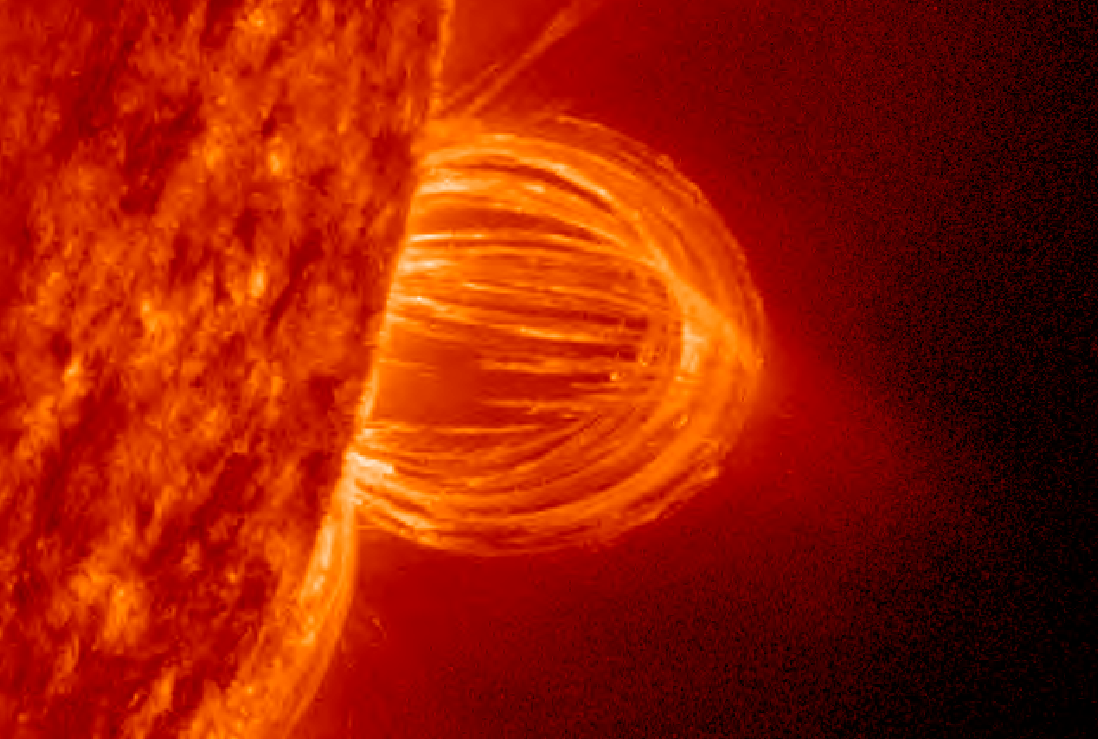
Solar flare July 2012

{credit}NASA/Royal Observatory Belgium/SIDC{/credit}

Since May the centre has been operating 24/7, ahead of its public launch on 8 October. As well as giving early warning of space weather threats to critical infrastructure, such as the National Grid, the Met Office now also provides publicly-available forecasts, published on its website.

‘Space weather’ is a term which covers how radiation and high-energy particles, ejected from magnetic storms in the Sun, interact with Earth’s magnetic field and impact terrestrial technology. Severe space weather can knock out satellite communications and disrupt global positioning systems (GPS) and power grids.

The centre came about following three years of discussion between the Met Office and its US counterpart, the National Oceanic and Atmospheric Administration’s National Weather Service, based in Boulder, Colorado, which was keen to establish a backup for their Space Weather Prediction Center (SWPC).

To determine how soon a solar event will be felt on Earth, forecasters at the SWPC and Met Office will use the same models, based on data from the same spacecraft. But by running the models at slightly different times, forecasters will be able to compare the results and generate a more accurate picture, says Catherine Burnett, space weather programme manager at the Met Office.  The UK’s centre will also use different ground-based data to hone its forecasts for the UK, she adds.

Speaking ahead of the official launch, Laura Furgione, deputy director at NOAA’s National Weather Service, said that accurately predicting and preparing for the impacts from space weather required “a commitment similar to terrestrial weather forecasting and preparedness”.

Possible space weather role in downing of US copter

Posted on behalf of Mark Zastrow.

In the predawn hours of 4 March 2002, as the United States and its allies battled Al Qaeda in the mountains of Afghanistan, a US army helicopter was sent to drop reinforcements on Takur Ghar, a mountain peak blanketed by snow — and enemy fire. Attempts to warn the chopper off by satellite radio failed. At the landing zone, it was hit by a rocket-propelled grenade and crash-landed, stranding its force in a fierce firefight that killed four US soldiers.

 US_10th_Mountain_Division_soldiers_in_Afghanistan

{credit}SSG Kyle Davis{/credit}

Now, research suggests that space weather — in the form of enormous bubbles of plasma high above Earth’s atmosphere — disrupted the chopper’s satellite communications.

Plasma populates the upper layers of Earth’s ionosphere during the day, when sunlight breaks atmospheric particles into their charged constituents. At sunset, turbulence can develop as the plasma recombines, forming buoyant regions of lower density than their surroundings. These bubbles typically form near the magnetic equator, which snakes around the planet at low latitudes. During the night, they can grow to be tens of kilometres wide and extend towards the poles for thousands of kilometres. Smaller-scale turbulence inside these writhing tubes distorts radio waves that pass through it the way heat roiling above hot tarmac sets distant images dancing.

Typically, this distortion — called scintillation — is forecast by measuring the loss of signal along the line of sight from ground stations to communications satellites, or directly by satellites that fly through the bubbles. But in work published online this month in Space Weather, scientists analysed ultraviolet images from NASA’s TIMED satellite, which passed over the Afghanistan theatre at the time of the battle.

Their work indicates that a plasma bubble lay roughly 500 kilometres over the battlefield, directly between a pair of communications satellites overhead. The bubble’s clearly defined perimeter suggested the presence of radio-disruptive turbulence within.

The team notes that the initial disruption from space bubbles was probably small, but interference from radio echoes off the surrounding peaks could have greatly amplified the signal breakup. Lead author Michael Kelly, of the Johns Hopkins Applied Physics Laboratory in Laurel, Maryland, also notes that the battle occurred in the absence of a solar storm; such storms carry the potential for even greater impacts on military or emergency response communications. “It’s kind of this esoteric topic and yet it can affect society in very compelling ways,” he says.

Keith Groves of Boston College in Massachusetts says that it would be unusual for plasma bubbles to form at the latitude of Afghanistan, but not implausible. Groves led development of the ground-based system the US Air Force currently uses to measure radio wave scintillation. He’s sceptical that ultraviolet images alone can indicate the small-scale turbulence that is the culprit, but thinks they could be a powerful tool when used in tandem with current techniques.

Correction: This post has been changed to indicate that the ground-based system for measuring radio wave scintillation developed by Keith Groves is deployed by the US Air Force.

Curiosity rover comes in last in NASA ranking

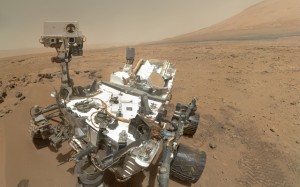
curiosity pic

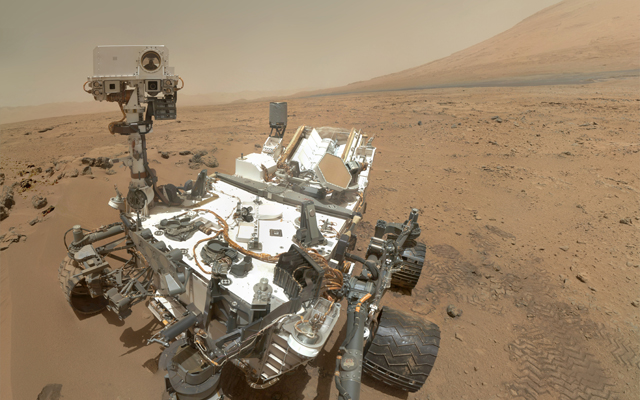
The Mars Curiosity rover. Credit: NASA/JPL-Caltech/Malin Space Science Systems.

The US$2.5-billion, two-year-old Mars Curiosity rover has come in last in a scientific review of NASA’s planetary missions, trumped by even the 10-year-old Opportunity rover.

The review evaluated seven working missions that are seeking funds for another two or more years of operations. The review panel, chaired by lunar scientist Clive Neal of the University of Notre Dame in Indiana, said that all seven proposals have high science value — ranked from ‘excellent’ to ‘very good’ — and that “all have important strengths.”

All were approved to continue after 1 October, although actual funding levels will depend on appropriations from Congress. But Curiosity came in for some of the report’s most scathing criticism. Among other things, the proposal for Curiosity’s next two years of operations “lacked specific scientific questions and testable hypotheses,” according to a summary of panel findings presented at a planetary science meeting today by NASA official William Knopf.

The panel also noted that project scientist John Grotzinger was present only by phone for the first round of discussions and not available for a follow-up round. “This left the panel with the impression that they were too big to fail,” the reviewers wrote. (Grotzinger says he had a pre-existing outreach commitment involving students and shares all mission responsibility with his deputy project scientists, one of whom attended in his stead.)

Curiosity has already rolled more than 9 kilometres across the surface of Mars, exploring an ancient lakebed within Gale Crater. In its next two years, mission planners had proposed sending it another 8 kilometres to visit four areas representing different stages of Mars’s climate history. According to Knopf’s overview, the instrument-laden Curiosity had planned to drill just eight samples during those two years, “which the panel considered a poor science return for such a large investment.” Instead, panel members recommended cutting back on the distance traveled and focusing on just two or three geologic areas.

NASA has asked the Curiosity team to revise its two-year plan, focusing on characterizing a particular geologic unit before going on to new ones or deciding whether to drill a sample. The agency has also asked for a stronger justification for how Curiosity supports NASA’s broader exploration goals, including its connections with orbiting spacecraft.

“The important thing to us as a mission is that they recommended the guideline budget we were asking for, so that we can continue to do operations,” says Grotzinger. He says the team constantly assesses the value of doing science in-place as opposed to driving to a new location, and that Curiosity’s sampling instruments are sophisticated enough that they often need relatively few drillholes to achieve science goals such as chemically analyzing rocks and soil.

Curiosity received a ‘very good/good’ rating from the panel. But the much older Opportunity got a higher rating of ‘excellent/very good’ for its extended mission plans. They include exploring ancient clay deposits near Endeavour crater, which may or may not be similar to other environments Opportunity has already encountered.

Of the other Mars missions reviewed, the Mars Reconnaissance Orbiter was extended with a particular nod to the number of scientific publications coming from researchers who are not part of the science team. The Mars Odyssey orbiter, soon to enter its sixth extended mission, was tapped for its instruments that probe the radiation environment and atmosphere of Mars, and their relevance to future human exploration. (Odyssey may, however, “be coming to the end of its productive science life as highlighted by declining rate of publications,” the panel reported.) And NASA contributions to the European Space Agency’s Mars Express mission will drop funding for its high-resolution camera but continue atmospheric measurements to support the Mars Atmosphere and Volatile Evolution (MAVEN) orbiter, which will arrive at the red planet later this month.

At the Moon, NASA will continue the Lunar Reconnaissance Orbiter but, on the panel’s recommendation, will terminate a radar instrument. Two other instruments suggested for cutting will be retained given that they measure lunar water and radiation, both of interest to NASA’s exploration goals.

And at Saturn, the highest panel ranking of all — ‘excellent’ — went to the Cassini orbiter. NASA has extended Cassini until 2017, when the spacecraft will plunge into the planet in a mission-ending finale.

NASA extends Mars rover and Moon orbiter missions

A false-colour image of the Mars Opportunity rover, taken in March 2014.

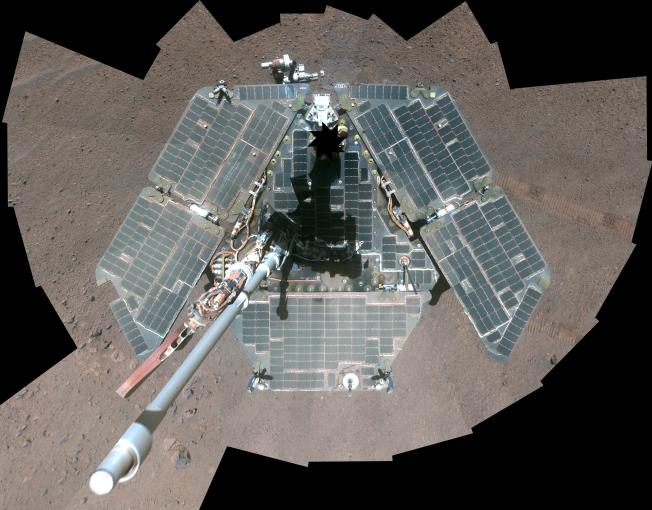
A false-colour image of the Mars Opportunity rover, taken in March 2014.{credit}NASA/JPL-Caltech/Cornell Univ./Arizona State Univ.{/credit}

NASA is on the verge of releasing its long-awaited prioritization of planetary missions, meant to guide the agency if tight budgets force it to switch off an operating spacecraft. But two missions that had been considered to be on the verge of closure — the Mars Opportunity rover and the Lunar Reconnaissance Orbiter (LRO) — have each received a reprieve of another two years of operations, scientists close to the projects have confirmed.

Although NASA officials had insisted otherwise, Opportunity and the LRO were considered particularly vulnerable because funding for them was included in a supplement to the White House’s annual budget request to Congress, rather than as part of the main planetary-sciences division budget.

In a decade of operation, Opportunity has rolled more than 40.6 kilometres across Mars, exploring areas including the most ancient habitable environment known on the planet. The rover has several mechanical issues as well as problems with its flash memory that have triggered computer resets in recent weeks. Opportunity, which costs on the order of US$13 million annually, is heading for a region called Marathon Valley, where scientists think clay minerals formed in a watery environment.

The LRO finished its main task in 2010: mapping possible locations for astronauts to return to the Moon. More recently it has focused on studying changes on the lunar surface, such as those from fresh meteorite impacts.

The complete ‘senior review’, encompassing five other planetary missions, will be released at a planetary sciences advisory group meeting in Washington DC on 3 September.

Of the five other missions, two are big-ticket items — on the order of $60 million annually — that are considered shoo-ins for approval. The Curiosity rover landed on Mars two years ago and is still heading for its ultimate goal, Mount Sharp. (The harsh rocks of Mars have taken a toll on Curiosity, however, and the rover recently had to backtrack out of a sandy valley so as not to get stuck, as well as give up on drilling what would have been its fourth hole on Mars.)

The Cassini mission has been orbiting Saturn since 2004, but as seasons change it has been observing new phenomena on the planet. “In many ways it’s a brand-new mission,” project scientist Linda Spilker, of NASA’s Jet Propulsion Laboratory in Pasadena, California, said earlier this month. Cassini engineers are planning for a ‘grand finale’ in 2017, when the probe will dive repeatedly between the gaseous planet and its ring system to make unprecedented close-up measurements. “It will be 7 seconds of terror every 22 days,” Spilker said.

The three remaining missions under scrutiny are the Mars Reconnaissance Orbiter, which costs around $30 million annually and has a crucial communications-relay role at Mars; the 13-year-old Mars Odyssey orbiter, at $12 million annually; and a $3-million contribution for an instrument aboard the European Space Agency’s Mars Express spacecraft, launched in 2003.

Jim Green, head of NASA’s planetary-sciences division, has said repeatedly that the agency will work within its budgetary constraints to try to fulfill the recommendations of the senior review panel. The big unknown is how much the agency will have to spend for each of the extended missions. NASA typically allocates around $1.3 billion annually to planetary sciences, but Congress has yet to decide the numbers for the 2015 fiscal year, which begins on 1 October.

Space agencies battle to keep Mars mission on track

Delays and funding problems are threatening to push back the planned launch of ExoMars, a European and Russian rover designed to search for life on the red planet.

ESA Exomars robot

{credit}ESA{/credit}

They had originally planned to launch the mission in 2018, but the European Space Agency (ESA) and Roscosmos, the Russian space agency, may now have to wait until 2020.

ESA has confirmed that problems with the design of the lander’s descent module — a component for which Roscosmos takes the lead — has delayed a key milestone: a health check of the entire mission called the System Preliminary Design Review. Technical problems with the module include the need to increase the clearance between its landing platform and the ground, to allow for a landing on large rocks.

Originally planned for early July, the review has been delayed until mid-September, says Jorge Vago, ESA’s ExoMars project scientist.  When the review board concludes in early November, it hopes to confirm ExoMars’ design and procurement plans, and also address whether the schedule remains feasible, he adds.

A further problem is funding. After NASA dropped out of the €1.2 billion (US$1.6 billion) mission in 2011 and Roscosmos took its place, ESA was forced to increase its contribution. Vago says that ExoMars is still short of “a couple of hundred million” euros. He hopes that, once the review is complete, the cash will be confirmed during a meeting of ESA’s governing body, the council of ministers, planned for early December.

If ExoMars misses its 2018 launch, the mission would have to be delayed until 2020 because Earth and Mars are only suitably aligned every 26 months.

How likely this is to happen depends on whom you ask. Thomas Passvogel, head of the projects department in ESA’s directorate of science and robotic exploration, predicts that the project will be able to absorb the delay and still launch on time. Other ExoMars scientists who did not want to be named told Nature‘s news team that planning for a potential launch in 2020 had been going on for some time, although this did not mean a delay was inevitable. Meanwhile, a report last week by Russian journalist Anatoly Zak claimed that many on the inside view the delay as “inevitable”. ESA described the article as “speculative”.

Vago says that if faced with further problems, the agencies would do everything they can to stick to a 2018 launch — including reshuffling the schedule and working double shifts, not least because a shift to a later date would mean finding even more funding to cover two more years’ costs. “We would not consider a launch delay lightly,” he adds.

If ExoMars 2018 becomes ExoMars 2020, an intriguing twist in the plot is that the delay would see the European mission competing with NASA’s next Martian venture — the Mars 2020 Rover, which last week announced the instruments it will take to the planet.

The US-led mission will look at how habitable Mars may have once been, with a focus on selecting samples that could eventually be brought back to Earth. Meanwhile ExoMars, armed with a drill and wide-ranging analytical laboratory, will concentrate on looking for signs of Martian life in situ, which could be preserved up to 2 metres under the surface.

Jack Mustard, a Mars scientist at Brown University in Providence, Rhode Island, says that the two projects have sufficiently different goals and landing sites to ensure they remain distinct even if they operate at the same time.

More detrimental for ExoMars, of course, would be having to share the limelight.

NASA announces instruments for 2020 Mars rover

NASA's 2020 Mars rover will carry seven instruments.

NASA’s 2020 Mars rover will collect samples for future return to Earth.{credit}NASA{/credit}

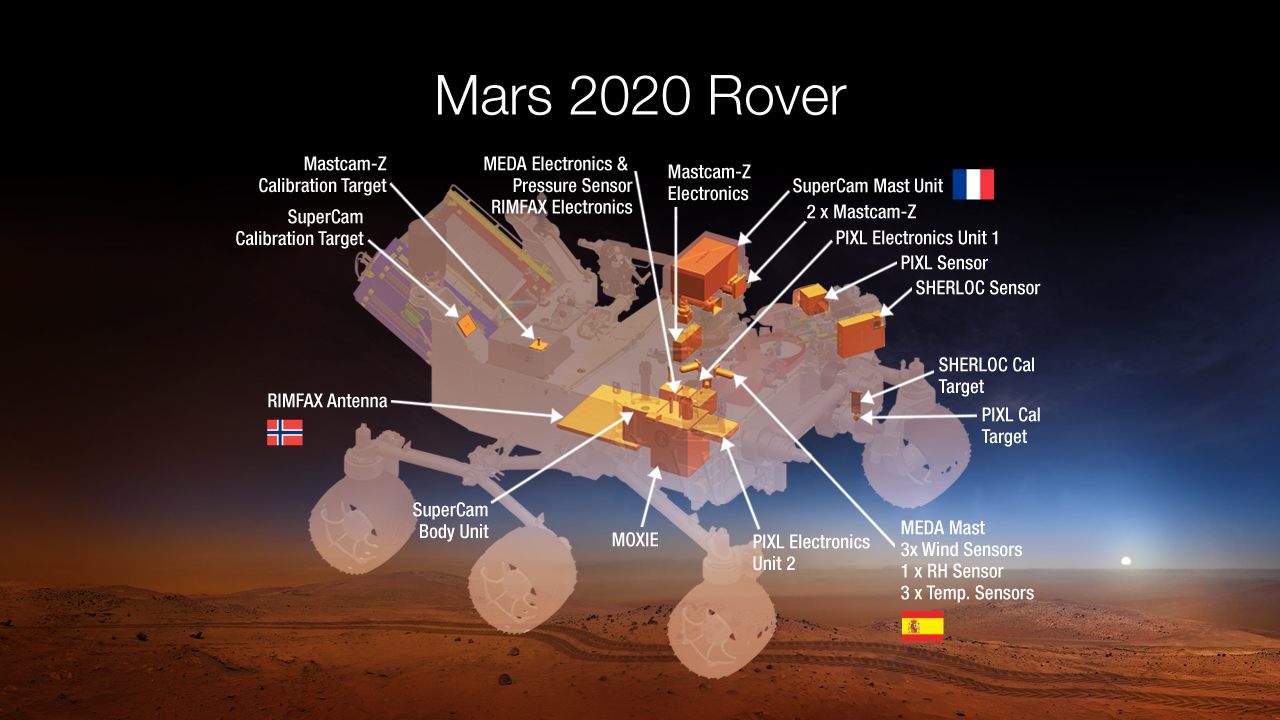
The rover that NASA is sending to Mars in 2020 will carry seven instruments geared to choosing just the right rocks to collect and store for future return to Earth. They include several firsts for Mars, including a zoomable camera, a machine to generate oxygen from carbon dioxide, and radar to explore geology up to half a kilometre deep.

The instruments, announced 31 July from a pool of 58 competitors, are in some ways a very different collection than what the Curiosity rover is currently trundling around Mars with. Curiosity does most of its chemistry on its back, by scooping up samples of soil or rock and dumping them into various instruments to analyze. The 2020 rover, which is otherwise modeled heavily on Curiosity, drops many of those analytical abilities and instead focuses on selecting samples that might be studied one day back on Earth. At 40 kilograms, the weight of its science payload will be actually less than that of Curiosity.

John Grunsfeld, NASA’s associate administrator for science, confirmed that the 2020 rover would carry a small ‘caching’ system for future sample return. Details have yet to be worked out, but it will likely collect slender, pencil-sized cylinders of rock and tuck them into a canister for future missions to retrieve. “I wouldn’t rule out the possibility that it’s a future astronaut that picks up the sample and returns it to Earth,” said Grunsfeld, in optimistic speculation given current funding for NASA. “But the most important step is to find samples that are so compelling that we need to get them back.”

NASA has yet to determine exactly where the US$1.9 billion rover will land. But it is likely to aim for a spot with a wide variety of geological features nearby. Curiosity has been plagued by landing more than 10 kilometres from its ultimate goal, a mountain named Mount Sharp, and having to drive all that way to get to it. (The rover still has several kilometres to go.) The long drive and sharper-than-expected rocks have pummeled the thin aluminum sheeting on Curiosity’s wheels, tearing huge holes; engineers are testing new designs and new materials in hopes of keeping the 2020 rover from suffering the same problem.

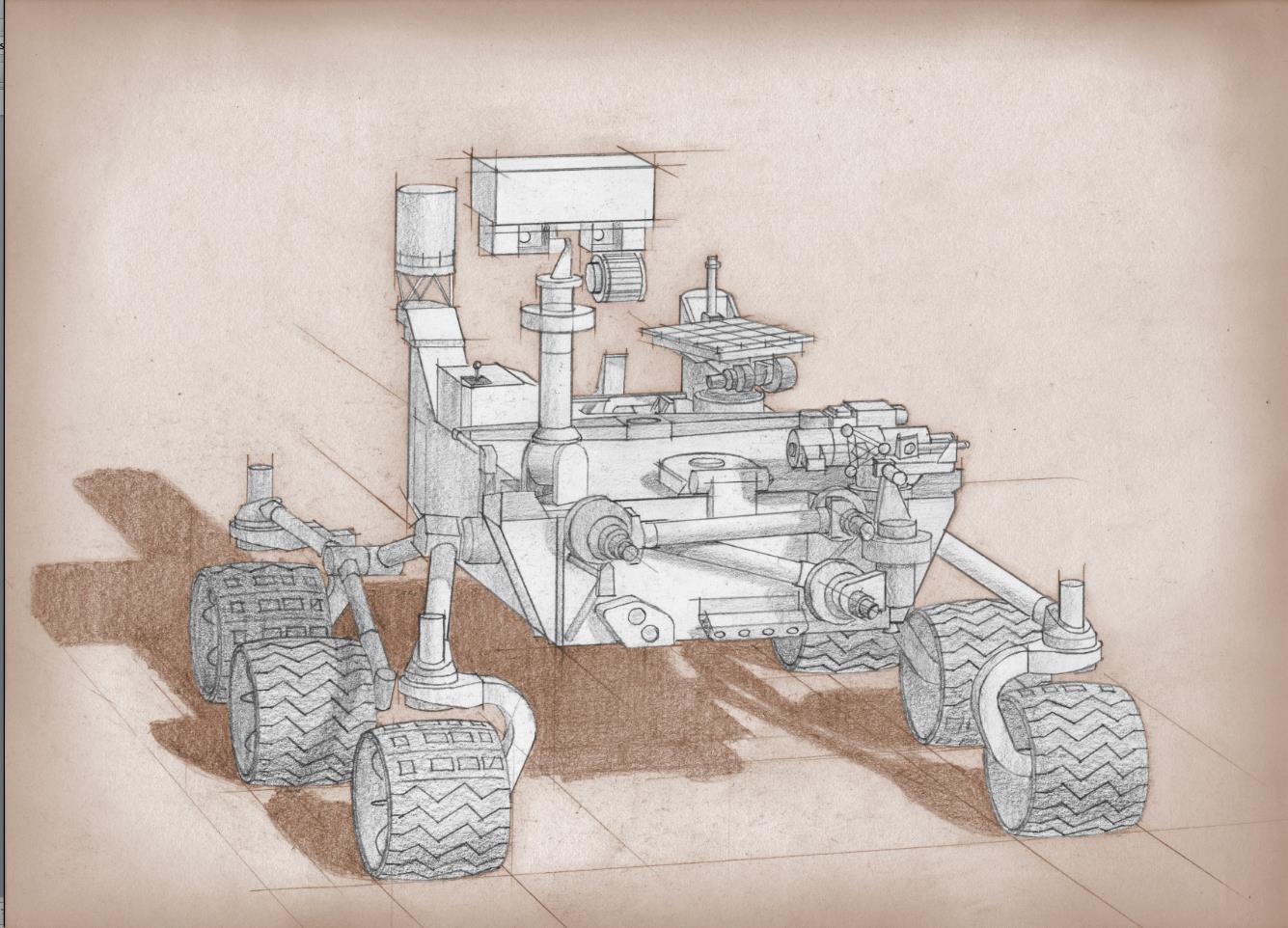
2020RoverSketch_Color-full

NASA’s 2020 Mars rover is modelled on Curiosity, which is now exploring the red planet. {credit}NASA{/credit}

The 2020 rover will need to trade off the time spent driving to find samples and the time spent drilling and collecting them, says Kenneth Farley, a geologist at the California Institute of Technology in Pasadena and the mission’s project scientist.

Curiosity was originally supposed to carry a three-dimensional zoom camera on its mast, developed with filmmaker James Cameron, but NASA pulled it from the manifest. The 2020 rover tries to compensate with a zoom camera developed by planetary scientist James Bell of Arizona State University. The ability to zoom should allow the rover to move more quickly along the surface, because it can more easily scrutinize distant rocks and better calculate potential hazards before it starts moving in a particular direction, said Michael Meyer, NASA’s lead scientist for the Mars exploration programme.

The oxygen-making machine comes from NASA’s human exploration side, and is a step towards demonstrating whether astronauts could generate resources they need on the Martian surface, said William Gerstenmaier, head of the agency’s human exploration programme. Going by the peppy acronym MOXIE, it will aim to measure the efficiency of producing oxygen from carbon dioxide in the Martian atmosphere.

Other instruments include an X-spectrometer and an ultraviolet laser, both targeted to studying the mineralogy of rocks in high resolution, and a camera that can probe for organic compounds. “Every single instrument is either improved [from past missions] or we haven’t sent it to Mars before,” said Meyer.

Two instruments will be operated by non-US scientists. The ground-penetrating radar will be led by radar expert Svein-Erik Hamran, of the Forsvarets Forskning Institute in Norway. The meteorological package on the rover’s mast will be run by robotics engineer José Rodríguez-Manfredi of the Center for Astrobiology in Madrid, the same group that provided the weather instruments for Curiosity.

Mars rover facing harshest journey yet

After travelling 8.5 kilometres on Mars, NASA’s Curiosity rover is now facing some of the most dangerous terrain it has ever encountered.

The car-sized rover is currently crossing a stretch of hard, rocky ground of the sort that previously dented and punctured its aluminium wheels. Winds at Gale Crater, Curiosity’s landing site, have whittled and sharpened rocks into piercing points unlike that seen by NASA’s three earlier Mars rovers. Curiosity needs to travel about 200 metres of this sharp ‘caprock’ before it can descend into a sandy, more wheel-friendly depression dubbed Hidden Valley.

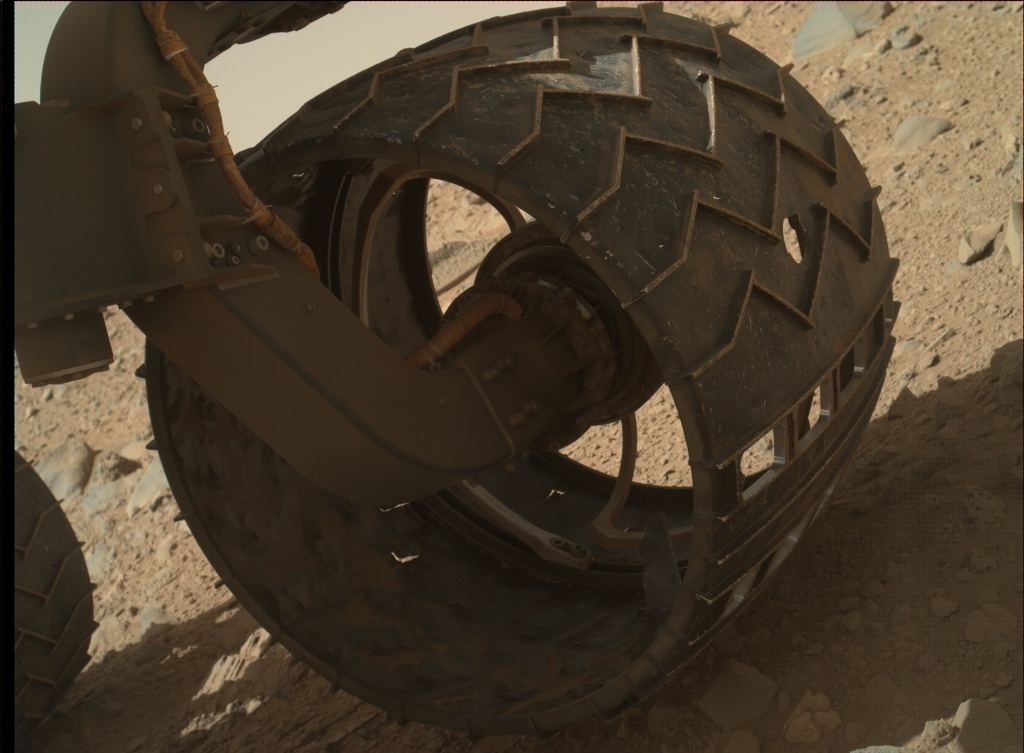
A puncture (centre right) in one of Curiosity's wheels. The sequence of cutouts in the lower right are deliberate and imprint 'JPL' in Morse code as the wheels roll across the Martian surface.

A puncture (centre right) in one of Curiosity’s wheels. (The sequence of cutouts at lower right are deliberate and imprint ‘JPL’ in Morse code as the wheels roll across the Martian surface.) {credit}NASA/JPL-Caltech/MSSS{/credit}

“This is awful stuff,” says John Grotzinger, the mission’s chief scientist and a geologist at the California Institute of Technology (Caltech) in Pasadena. He spoke on 16 July in a public lecture associated with a week-long Mars conference on the Caltech campus.

Grotzinger and his team of scientists and engineers have spent much of the past few months figuring out a way to get Curiosity closer to its ultimate target — a 5-kilometre-high mountain known as Mount Sharp — without destroying its wheels along the way. The problem became apparent last December, when Curiosity sent back close-up images of its wheels that revealed more wear and tear than engineers were expecting. Over the next few months, the wheels rapidly deteriorated. One ripped across nearly half of its width in a giant gash. “When you have a metal wheel and you can see the planet through it, that’s not a good thing,” says Grotzinger.

Each of the rover’s six wheels is machined from a single piece of aluminium, measures 40 centimetres across and weighs just 3 kilograms. That size saved weight at launch, but means that the aluminium skin — just three-quarters of a millimetre thick — is prone to tearing, says rover driver Chris Roumeliotis, of NASA’s Jet Propulsion Laboratory (JPL) in Pasadena.

The damage was particularly bad on the rover’s pairs of front and middle wheels. To figure out why, mission engineers hauled out a mockup of Curiosity and rolled it over piles of sharp rocks in the ‘Mars yard’ test site at the JPL.

In one particularly gruesome test, the wheels went over a sharp metal point nicknamed the Impaler. “Hearing the aluminium crack and puncture like that just gives me chills,” says Roumeliotis.

Soon the team figured out that Curiosity could minimize damage by driving backwards over sharp rocks, which lessened the load on the wheels just as pivoting from pushing to pulling luggage changes the stress. The rover has been scuttling along mostly in reverse ever since.

But the team cannot avoid the fact that sharp rocks must be crossed. Using images from orbiting spacecraft, Grotzinger and his colleagues have mapped out ten types of terrain, colour-coded from green (kind to wheels) to an extreme red (full of pointy rocks). At times, they have opted to take the long way between two locations to cross over the least-damaging terrain possible.

But there was no avoiding the fact that Curiosity had to cross a swath of red at a place called  Zabriskie Plateau. Next week, rover planners will send it slowly rolling over the last stretch of dangerous caprock and descending into Hidden Valley below. “We will go in and out of the valleys, trying to work at the interface between the wheel-damaging caprock and where we would like to be,” says Grotzinger.

That could take a while. Curiosity still has 3.5 kilometres to travel just to make it to the base of Mount Sharp.


Mars probe to get rare view of comet

Astronomers will have a virtual front-row seat to study a pristine comet in October, when it squeaks past Mars and a flotilla of spacecraft orbiting the red planet. NASA scientists are finalizing their plans to observe the rare event.

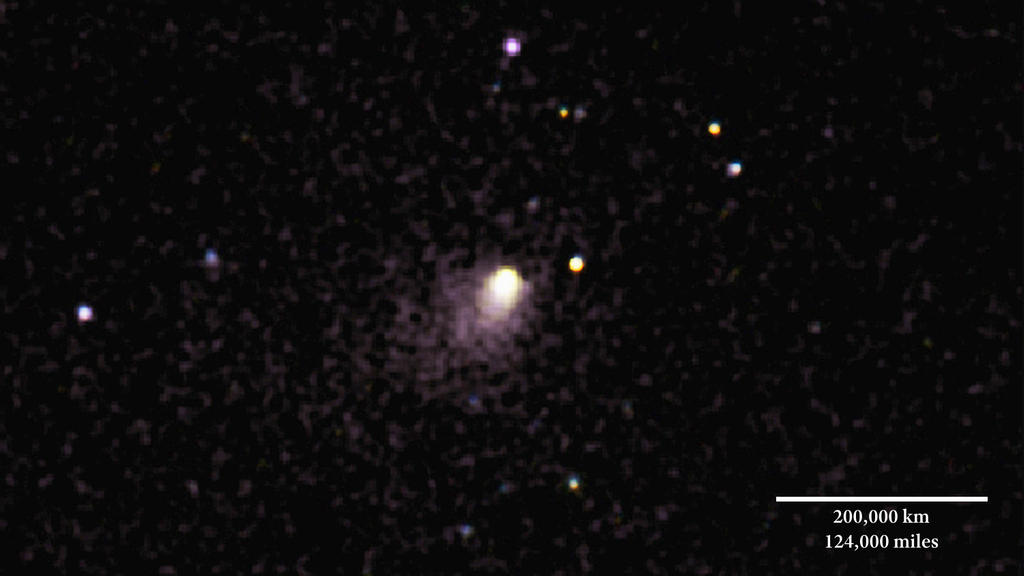
Comet Siding Spring is on its first trip to the inner Solar System. {credit}NASA/Swift/D. Bodewits (UMD), DSS {/credit}

On 19 October, Comet Siding Spring will swoop just 135,000 kilometres above the Martian surface. That’s less than half the distance between Earth and the Moon. And because the comet is on its first trip to the inner Solar System, the gas and dust that have been frozen to its surface for billions of years are finally warming up and spraying off.

“This is our first chance to see the nucleus of a long-period comet up close,” says Richard Zurek, chief scientist for the Mars programme office at the Jet Propulsion Laboratory in Pasadena, California. “Mars will be right at the edge of the debris cloud.”

Zurek leads a team that has been analysing whether dust particles flying off the comet could damage spacecraft around Mars. Three probes currently orbit the red planet (NASA’s Mars Odyssey and Mars Reconnaissance Orbiter, and the European Space Agency’s Mars Express), and two more are slated to arrive in September (NASA’s Mars Atmosphere and Volatile Evolution (MAVEN) mission and India’s Mars Orbiter Mission). Cometary dust is zipping towards Mars at a relative speed of 56 kilometres per second — fast enough to ding protective shielding.

But observations this spring from the Hubble Space Telescope, the asteroid-hunting Near-Earth Object Wide-field Infrared Survey Explorer spacecraft, and other telescopes show that the comet is not spewing out quite as much debris as astronomers had feared, says Zurek. New modelling studies suggest that the most dangerous period will come about 1.5 hours after the comet’s closest approach to Mars, when the planet whizzes within just 27,600 kilometres of the comet’s path. During the most crucial half-hour when the comet dust comes fast and furious, all the orbiters will hunker down on the other side of Mars.

MAVEN, which was built to study the Martian atmosphere, is planning to take science data two days before and two days after the comet’s closest approach. Its ultraviolet spectrometer will take images and spectra of the comet, and other instruments will monitor any changes in the upper atmosphere before and after the comet hits. It’s possible that the comet may dump enough hydrogen into the atmosphere to be seen, says mission leader Bruce Jakosky, a planetary scientist at the University of Colorado in Boulder.

“It’s going to be a spectacular data set,” he says. Jakosky spoke to Nature during a Mars conference this week in Pasadena, California.

As seen from the Martian surface, the comet’s dust cloud will cover a huge amount of sky. The Opportunity and Curiosity rovers will attempt to take pictures of it, but it will be daytime from the rover perspective. They may have a shot at seeing meteors the night before or after the comet passes, Zurek says.

Discovered in January 2013 by astronomers in Australia, Comet Siding Spring is on its first trip to the inner Solar System. More than a million years ago, gravitational interactions probably kicked it out of the frigid cometary reservoir at the edge of the Solar System known as the Oort cloud. It has been travelling towards the Sun since; after this pass it won’t return for about 1 million years.


Attempt to retrieve NASA probe runs out of gas

Posted on behalf of Mark Zastrow.

An ambitious citizen-science effort to revive and redirect a decades-old NASA spacecraft has hit a snag. The International Sun-Earth Explorer-3 (ISEE-3) probe, now roughly 5 million kilometres from Earth, appears to be out of the nitrogen gas that it needs to pressurize its propulsion system’s rocket thrusters.

NASA launched the ISEE-3 satellite in 1978. {credit}NASA{/credit}

This means that the volunteer ISEE-3 Reboot Project will not be able to manoeuvre the 35-year-old craft and place it in a holding orbit at the L1 point between the Earth and the Sun, where the two bodies’ gravitational pulls cancel out. Instead, ISEE-3 will fly past the Moon on 10 August and reenter an orbit around the Sun. However, the team is still in communication with the probe and intends to collect scientific and engineering data as long as it holds out — perhaps for years to come.

The group, led by former NASA employee and journalist Keith Cowing and entrepreneur and engineer Dennis Wingo, hoped to use ISEE-3 to monitor space weather or even fly by a comet. A crowdfunding campaign raised nearly US$160,000 for the effort, which allowed the group to purchase control of the satellite from NASA — the first time that the agency has contracted out a defunct spacecraft. The team successfully reestablished contact with ISEE-3 in May and fired its thrusters to adjust its spin rate last week. They were attempting a series of fuel burns to alter its course early Wednesday morning (GMT) when its rockets hiccupped and ran out of nitrogen.

The ISEE-3 Reboot Project has pushed back against notions that the reboot mission is over, saying Thursday on Twitter that “ISEE-3 is going to be useful for YEARS” even in its uncontrolled orbit.

Robert Farquhar, ISEE-3’s NASA flight director when it launched in 1978, was more downbeat on the craft’s scientific prospects. “I don’t believe that,” he says. “It’s going be too far from the earth. It’s not going to be that useful.”

But Cowing says the team is in the process of forming an ad hoc network of radio dishes that can maintain contact with the satellite even in deep space. He also says that the fact that the craft and 9 of its 13 instruments are still working after 35 years in space is valuable engineering data in itself. Michael Combi, a space physicist at the University of Michigan agrees and says that it can stand as a comparison to the Voyager probes, which launched one year before ISEE-3.

In the meantime, the loss of nitrogen in ISEE-3’s thrusters has left the team puzzled. “I’ve never heard of a spacecraft losing all of its pressurant like that,” says Farquhar, who has advised the citizen-science group. One early suspicion is that the nitrogen may have dissolved into the hydrazine fuel it was intended to pressurize. Farquhar, who put the ISEE-3 reboot’s odds of success at 50-50 back in March, still says Cowing and Wingo’s team has done “a tremendous job.”

The citizen-science mission was intended to be a homecoming of sorts for ISEE-3. Originally launched to study the magnetic interactions between the Earth and the Sun, the probe was diverted through the tail of Comet Giacobini-Zinner in 1985, making ISEE-3 the first spacecraft to explore a comet. NASA intentionally put it on a meandering course to fly by Earth this year, nearly 20 years later, allowing for the possibility of retrieval.