Private rocket explodes on launch to space station

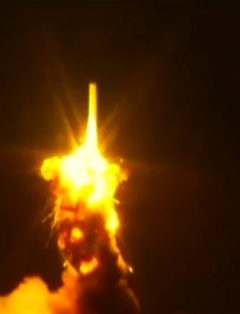
Flames engulfed the rocket seconds after lift-off.

Flames engulfed the rocket moments after lift-off.{credit}NASA-TV{/credit}

An Orbital Sciences Antares rocket exploded seconds after its 6:22 p.m. lift-off from Wallops Island, Virginia, Tuesday on a mission to resupply the International Space Station. No one was hurt, but the rocket was apparently destroyed and there was “significant property damage”, according to mission control commentators on NASA television.

“We have lost the vehicle,” said controllers from the Johnson Space Center in Houston. “The [space station] crew has been informed of the accident.”

Orbital moved almost immediately into contingency mode, asking its engineers to retain all notes and photographs related to the launch. Fires could be seen burning across the launch pad. “Obviously we will need to instigate an accident investigation team,” the launch director said.

Orbital, of Dulles, Virginia, is one of two private companies flying cargo to the space station for NASA. Its competitor, SpaceX of Hawthorne, California, is aiming to eventually carry astronauts as well.

It was the third of eight scheduled missions for Orbital. Among the 2,300 kilograms of cargo on board were a spectrometer to measure meteors entering the atmosphere and a neck collar for astronauts to measure blood flow from the brain. The payload also included test hardware for a future private asteroid prospecting mission, as well as unspecified classified cryptography equipment.

Launch of a Russian Progress vehicle, scheduled for the morning of 29 October with more crew supplies, was not expected to be affected.


Arctic archaeologists find Franklin expedition ship

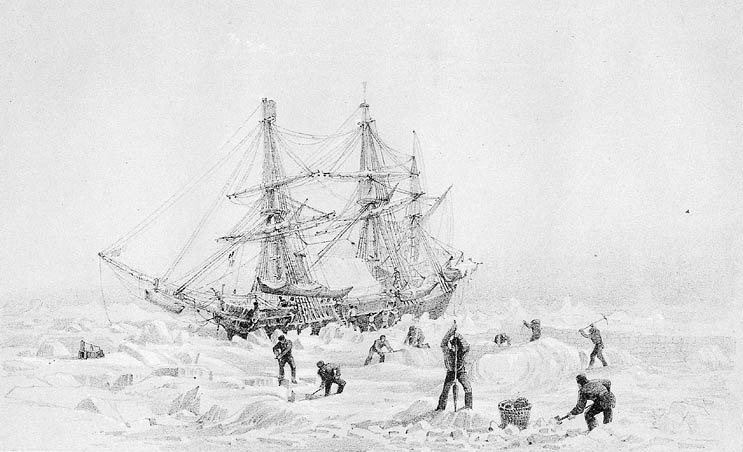
Canadian archaeologists have found one of the Franklin expedition’s ships — lost since the Arctic explorers famously disappeared in 1846 — off of King William Island in the Canadian Arctic. The ship is either the HMS Erebus or the HMS Terror, Prime Minister Stephen Harper announced on 9 September.

The HMS Terror was lost in the Arctic during the Franklin Expedition.

The HMS Terror was lost in the Arctic during the Franklin expedition.{credit}National Archives of Canada{/credit}

The discovery comes in the sixth year of expeditions led by Parks Canada, which has scoured hundreds of square kilometres of ocean bottom in search of the Franklin ships. A remotely operated vehicle (ROV) deployed from Parks Canada’s 10-metre survey vessel Investigator made the discovery on 7 September.

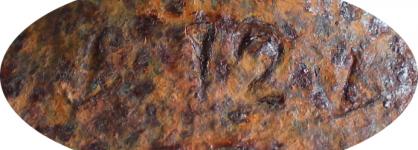
Days earlier, archaeologists working on land reported finding an iron fitting from a Royal Navy ship. It was a major clue that the search team was in the right area, farther south than some had expected but in line with where Inuit had reported seeing a shipwreck in the nineteenth century.

The team found the ship’s remains using underwater sonar, controlled from on board the Canadian Coast Guard icebreaker Sir Wilfred Laurier. A Toronto Star journalist aboard the vessel reported that when archaeologist Ryan Harris saw the sonar feed, he raised two open hands “like a winning sprinter”.

This iron fitting could be a clue to the location of the lost Franklin Expedition. {credit}Government of Nunavut{/credit}

The ROV, a Saab Seaeye Falcon, carries a high-definition video camera that captured the wreck, resting with its bottom on the sea floor. Parks Canada says it is certain the ship belongs to the Franklin expedition, given its design.

John Franklin left England in May 1845 with 128 other men in the Erebus and Terror, aiming to find and explore a Northwest Passage. Both ships vanished. In 1859, searchers found a message in a cairn on King William Island reporting that Franklin and some of the crew had died while the ships were trapped in ice. The remaining men eventually abandoned ship and began walking south. Studies of bodies of various crew members, found in graves scattered across several islands, suggest that lead poisoning may have contributed to their deaths. Cut marks on some bones suggest cannibalism, again supporting Inuit accounts.

The Canadian government funded the bulk of the search along with several private partners. In recent years, oceanographers from Arctic nations have been mapping assiduously in the far north to help establish sovereignty over possible future oil and gas exploration in the region.

Even today, ships can run into trouble in the area. On 3 September, the Arctic Research Foundation’s  vessel Martin Bergmann, which was taking part in the search, hit a previously unknown shoal and became grounded for about two-and-a-half hours.

Curiosity rover comes in last in NASA ranking

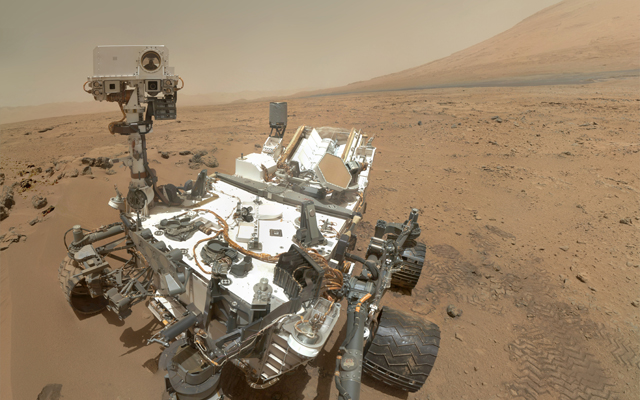
curiosity pic

The Mars Curiosity rover. Credit: NASA/JPL-Caltech/Malin Space Science Systems.

The US$2.5-billion, two-year-old Mars Curiosity rover has come in last in a scientific review of NASA’s planetary missions, trumped by even the 10-year-old Opportunity rover.

The review evaluated seven working missions that are seeking funds for another two or more years of operations. The review panel, chaired by lunar scientist Clive Neal of the University of Notre Dame in Indiana, said that all seven proposals have high science value — ranked from ‘excellent’ to ‘very good’ — and that “all have important strengths.”

All were approved to continue after 1 October, although actual funding levels will depend on appropriations from Congress. But Curiosity came in for some of the report’s most scathing criticism. Among other things, the proposal for Curiosity’s next two years of operations “lacked specific scientific questions and testable hypotheses,” according to a summary of panel findings presented at a planetary science meeting today by NASA official William Knopf.

The panel also noted that project scientist John Grotzinger was present only by phone for the first round of discussions and not available for a follow-up round. “This left the panel with the impression that they were too big to fail,” the reviewers wrote. (Grotzinger says he had a pre-existing outreach commitment involving students and shares all mission responsibility with his deputy project scientists, one of whom attended in his stead.)

Curiosity has already rolled more than 9 kilometres across the surface of Mars, exploring an ancient lakebed within Gale Crater. In its next two years, mission planners had proposed sending it another 8 kilometres to visit four areas representing different stages of Mars’s climate history. According to Knopf’s overview, the instrument-laden Curiosity had planned to drill just eight samples during those two years, “which the panel considered a poor science return for such a large investment.” Instead, panel members recommended cutting back on the distance traveled and focusing on just two or three geologic areas.

NASA has asked the Curiosity team to revise its two-year plan, focusing on characterizing a particular geologic unit before going on to new ones or deciding whether to drill a sample. The agency has also asked for a stronger justification for how Curiosity supports NASA’s broader exploration goals, including its connections with orbiting spacecraft.

“The important thing to us as a mission is that they recommended the guideline budget we were asking for, so that we can continue to do operations,” says Grotzinger. He says the team constantly assesses the value of doing science in-place as opposed to driving to a new location, and that Curiosity’s sampling instruments are sophisticated enough that they often need relatively few drillholes to achieve science goals such as chemically analyzing rocks and soil.

Curiosity received a ‘very good/good’ rating from the panel. But the much older Opportunity got a higher rating of ‘excellent/very good’ for its extended mission plans. They include exploring ancient clay deposits near Endeavour crater, which may or may not be similar to other environments Opportunity has already encountered.

Of the other Mars missions reviewed, the Mars Reconnaissance Orbiter was extended with a particular nod to the number of scientific publications coming from researchers who are not part of the science team. The Mars Odyssey orbiter, soon to enter its sixth extended mission, was tapped for its instruments that probe the radiation environment and atmosphere of Mars, and their relevance to future human exploration. (Odyssey may, however, “be coming to the end of its productive science life as highlighted by declining rate of publications,” the panel reported.) And NASA contributions to the European Space Agency’s Mars Express mission will drop funding for its high-resolution camera but continue atmospheric measurements to support the Mars Atmosphere and Volatile Evolution (MAVEN) orbiter, which will arrive at the red planet later this month.

At the Moon, NASA will continue the Lunar Reconnaissance Orbiter but, on the panel’s recommendation, will terminate a radar instrument. Two other instruments suggested for cutting will be retained given that they measure lunar water and radiation, both of interest to NASA’s exploration goals.

And at Saturn, the highest panel ranking of all — ‘excellent’ — went to the Cassini orbiter. NASA has extended Cassini until 2017, when the spacecraft will plunge into the planet in a mission-ending finale.

NASA extends Mars rover and Moon orbiter missions

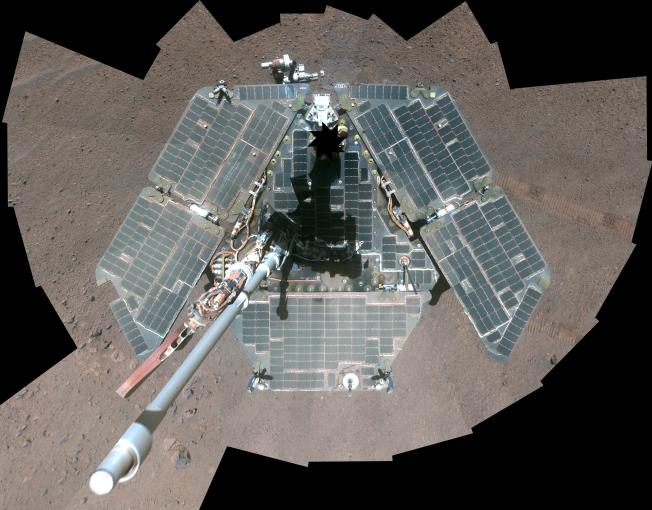
A false-colour image of the Mars Opportunity rover, taken in March 2014.

A false-colour image of the Mars Opportunity rover, taken in March 2014.{credit}NASA/JPL-Caltech/Cornell Univ./Arizona State Univ.{/credit}

NASA is on the verge of releasing its long-awaited prioritization of planetary missions, meant to guide the agency if tight budgets force it to switch off an operating spacecraft. But two missions that had been considered to be on the verge of closure — the Mars Opportunity rover and the Lunar Reconnaissance Orbiter (LRO) — have each received a reprieve of another two years of operations, scientists close to the projects have confirmed.

Although NASA officials had insisted otherwise, Opportunity and the LRO were considered particularly vulnerable because funding for them was included in a supplement to the White House’s annual budget request to Congress, rather than as part of the main planetary-sciences division budget.

In a decade of operation, Opportunity has rolled more than 40.6 kilometres across Mars, exploring areas including the most ancient habitable environment known on the planet. The rover has several mechanical issues as well as problems with its flash memory that have triggered computer resets in recent weeks. Opportunity, which costs on the order of US$13 million annually, is heading for a region called Marathon Valley, where scientists think clay minerals formed in a watery environment.

The LRO finished its main task in 2010: mapping possible locations for astronauts to return to the Moon. More recently it has focused on studying changes on the lunar surface, such as those from fresh meteorite impacts.

The complete ‘senior review’, encompassing five other planetary missions, will be released at a planetary sciences advisory group meeting in Washington DC on 3 September.

Of the five other missions, two are big-ticket items — on the order of $60 million annually — that are considered shoo-ins for approval. The Curiosity rover landed on Mars two years ago and is still heading for its ultimate goal, Mount Sharp. (The harsh rocks of Mars have taken a toll on Curiosity, however, and the rover recently had to backtrack out of a sandy valley so as not to get stuck, as well as give up on drilling what would have been its fourth hole on Mars.)

The Cassini mission has been orbiting Saturn since 2004, but as seasons change it has been observing new phenomena on the planet. “In many ways it’s a brand-new mission,” project scientist Linda Spilker, of NASA’s Jet Propulsion Laboratory in Pasadena, California, said earlier this month. Cassini engineers are planning for a ‘grand finale’ in 2017, when the probe will dive repeatedly between the gaseous planet and its ring system to make unprecedented close-up measurements. “It will be 7 seconds of terror every 22 days,” Spilker said.

The three remaining missions under scrutiny are the Mars Reconnaissance Orbiter, which costs around $30 million annually and has a crucial communications-relay role at Mars; the 13-year-old Mars Odyssey orbiter, at $12 million annually; and a $3-million contribution for an instrument aboard the European Space Agency’s Mars Express spacecraft, launched in 2003.

Jim Green, head of NASA’s planetary-sciences division, has said repeatedly that the agency will work within its budgetary constraints to try to fulfill the recommendations of the senior review panel. The big unknown is how much the agency will have to spend for each of the extended missions. NASA typically allocates around $1.3 billion annually to planetary sciences, but Congress has yet to decide the numbers for the 2015 fiscal year, which begins on 1 October.

Updated: Icelandic volcano erupts

Update, 23 August 23:27 BST: As of this evening, Icelandic experts are reconsidering whether an eruption has begun or not. With no surface changes visible, and no meltwater rushing downriver as of yet, the Icelandic Meteorological Office reports “there are no signs of ongoing volcanic activity”. The aviation alert remains red, “as an imminent eruption cannot be excluded”.

 A volcanic eruption has begun near the caldera of Bárðarbunga, the Icelandic Meteorological Office (IMO) announced on 23 August. Officials have raised the area’s aviation colour code to red, signifying that an “eruption is imminent or in progress”.

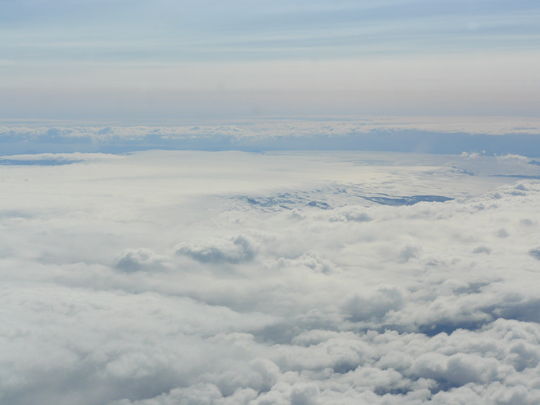
All is quiet on the surface above the Bárðarbunga caldera.

All is quiet on the surface above the Bárðarbunga caldera. {credit}Halldór Björnsson/Icelandic Meteorological Office{/credit}

The eruption is taking place beneath 150–400 metres of ice, north and east of the Bárðarbunga caldera. For the past week magma has been rising from the deep and forming a long underground sheet of freshly cooled rock, known as a dyke. The formation of the dyke has been marked by a series of intense earthquakes stretching from Bárðarbunga towards a glacier called Dyngjujökull (see ‘Icelandic volcano shakes ominously’).

Scientists from the IMO and the University of Iceland flew over the eruption today and reported no visible signs at the surface. The eruption was probably detected by seismic stations monitoring the region, as the shaking produced when water interacts with magma and turns to steam has a distinctive energy signature. Since the earthquake swarm began on 16 August, Icelandic scientists have been peppering the region with extra seismic and global-positioning instruments to capture just such an event.

Officials have also moved mobile radar observation stations into place around Bárðarbunga, to monitor any plumes if the volcano starts to emit ash. All airports in Iceland remain open, although airspace of approximately 140 by 100 nautical miles (260 by 185 kilometres) has been closed over the eruption site. If the eruption begins to produce ash, the volcanic ash advisory centre responsible for the region may issue an alert. Those alerts can be monitored here.

How the eruption proceeds will depend on how much magma is forcing its way upward and at what rate. The last eruption in Iceland happened in 2011 at the Grímsvötn volcano and was the most powerful in nearly a century. Like this new one, it took place under the Vatnajökull ice cap, and it broke through the ice to spew ash 20 kilometres high. So far, there is no indication that the new eruption will do anything like that, although the interaction of magma and ice is notoriously unpredictable.

volcano_status (3)

{credit}Icelandic Meteorological Office{/credit}

NASA announces instruments for 2020 Mars rover

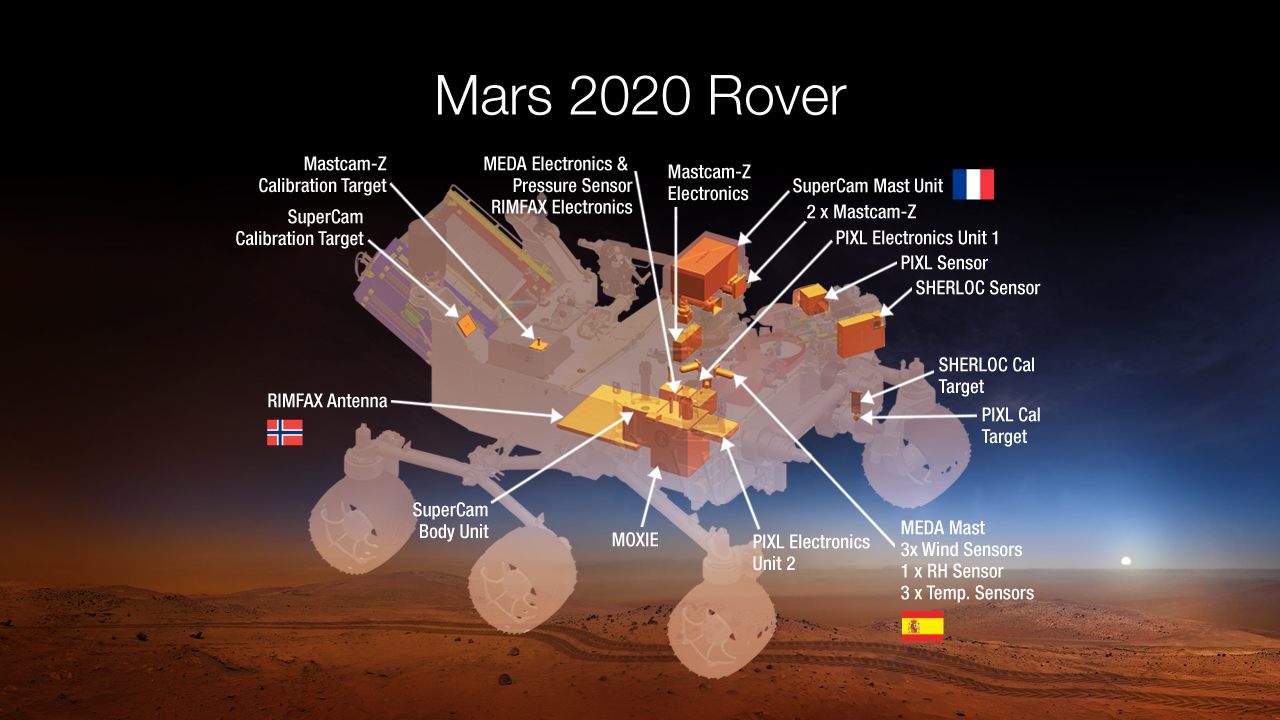
NASA's 2020 Mars rover will carry seven instruments.

NASA’s 2020 Mars rover will collect samples for future return to Earth.{credit}NASA{/credit}

The rover that NASA is sending to Mars in 2020 will carry seven instruments geared to choosing just the right rocks to collect and store for future return to Earth. They include several firsts for Mars, including a zoomable camera, a machine to generate oxygen from carbon dioxide, and radar to explore geology up to half a kilometre deep.

The instruments, announced 31 July from a pool of 58 competitors, are in some ways a very different collection than what the Curiosity rover is currently trundling around Mars with. Curiosity does most of its chemistry on its back, by scooping up samples of soil or rock and dumping them into various instruments to analyze. The 2020 rover, which is otherwise modeled heavily on Curiosity, drops many of those analytical abilities and instead focuses on selecting samples that might be studied one day back on Earth. At 40 kilograms, the weight of its science payload will be actually less than that of Curiosity.

John Grunsfeld, NASA’s associate administrator for science, confirmed that the 2020 rover would carry a small ‘caching’ system for future sample return. Details have yet to be worked out, but it will likely collect slender, pencil-sized cylinders of rock and tuck them into a canister for future missions to retrieve. “I wouldn’t rule out the possibility that it’s a future astronaut that picks up the sample and returns it to Earth,” said Grunsfeld, in optimistic speculation given current funding for NASA. “But the most important step is to find samples that are so compelling that we need to get them back.”

NASA has yet to determine exactly where the US$1.9 billion rover will land. But it is likely to aim for a spot with a wide variety of geological features nearby. Curiosity has been plagued by landing more than 10 kilometres from its ultimate goal, a mountain named Mount Sharp, and having to drive all that way to get to it. (The rover still has several kilometres to go.) The long drive and sharper-than-expected rocks have pummeled the thin aluminum sheeting on Curiosity’s wheels, tearing huge holes; engineers are testing new designs and new materials in hopes of keeping the 2020 rover from suffering the same problem.

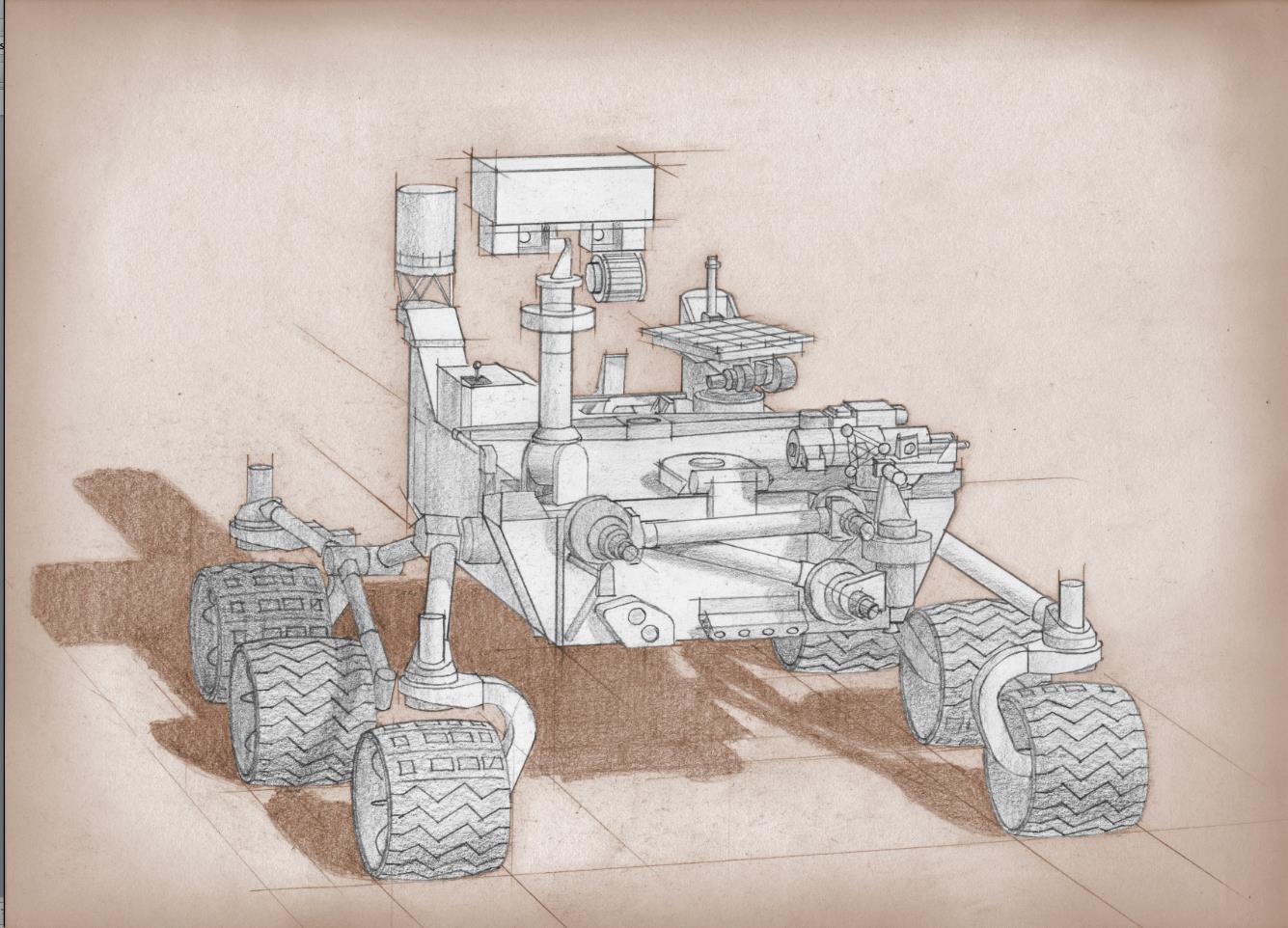
2020RoverSketch_Color-full

NASA’s 2020 Mars rover is modelled on Curiosity, which is now exploring the red planet. {credit}NASA{/credit}

The 2020 rover will need to trade off the time spent driving to find samples and the time spent drilling and collecting them, says Kenneth Farley, a geologist at the California Institute of Technology in Pasadena and the mission’s project scientist.

Curiosity was originally supposed to carry a three-dimensional zoom camera on its mast, developed with filmmaker James Cameron, but NASA pulled it from the manifest. The 2020 rover tries to compensate with a zoom camera developed by planetary scientist James Bell of Arizona State University. The ability to zoom should allow the rover to move more quickly along the surface, because it can more easily scrutinize distant rocks and better calculate potential hazards before it starts moving in a particular direction, said Michael Meyer, NASA’s lead scientist for the Mars exploration programme.

The oxygen-making machine comes from NASA’s human exploration side, and is a step towards demonstrating whether astronauts could generate resources they need on the Martian surface, said William Gerstenmaier, head of the agency’s human exploration programme. Going by the peppy acronym MOXIE, it will aim to measure the efficiency of producing oxygen from carbon dioxide in the Martian atmosphere.

Other instruments include an X-spectrometer and an ultraviolet laser, both targeted to studying the mineralogy of rocks in high resolution, and a camera that can probe for organic compounds. “Every single instrument is either improved [from past missions] or we haven’t sent it to Mars before,” said Meyer.

Two instruments will be operated by non-US scientists. The ground-penetrating radar will be led by radar expert Svein-Erik Hamran, of the Forsvarets Forskning Institute in Norway. The meteorological package on the rover’s mast will be run by robotics engineer José Rodríguez-Manfredi of the Center for Astrobiology in Madrid, the same group that provided the weather instruments for Curiosity.

Mars rover facing harshest journey yet

After travelling 8.5 kilometres on Mars, NASA’s Curiosity rover is now facing some of the most dangerous terrain it has ever encountered.

The car-sized rover is currently crossing a stretch of hard, rocky ground of the sort that previously dented and punctured its aluminium wheels. Winds at Gale Crater, Curiosity’s landing site, have whittled and sharpened rocks into piercing points unlike that seen by NASA’s three earlier Mars rovers. Curiosity needs to travel about 200 metres of this sharp ‘caprock’ before it can descend into a sandy, more wheel-friendly depression dubbed Hidden Valley.

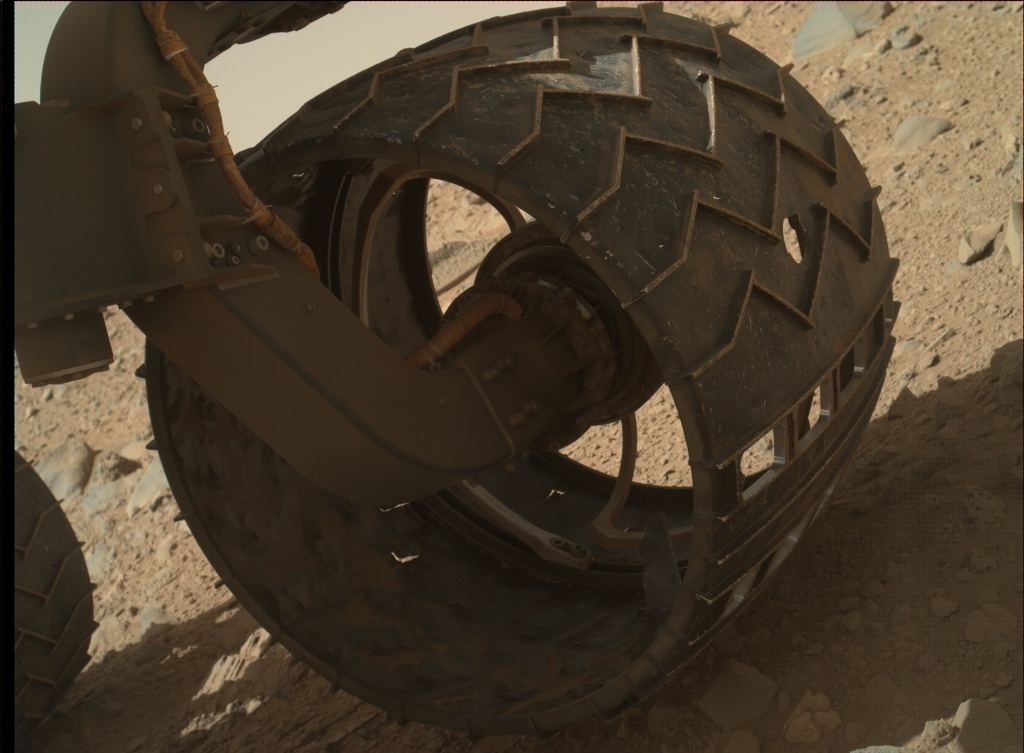
A puncture (centre right) in one of Curiosity's wheels. The sequence of cutouts in the lower right are deliberate and imprint 'JPL' in Morse code as the wheels roll across the Martian surface.

A puncture (centre right) in one of Curiosity’s wheels. (The sequence of cutouts at lower right are deliberate and imprint ‘JPL’ in Morse code as the wheels roll across the Martian surface.) {credit}NASA/JPL-Caltech/MSSS{/credit}

“This is awful stuff,” says John Grotzinger, the mission’s chief scientist and a geologist at the California Institute of Technology (Caltech) in Pasadena. He spoke on 16 July in a public lecture associated with a week-long Mars conference on the Caltech campus.

Grotzinger and his team of scientists and engineers have spent much of the past few months figuring out a way to get Curiosity closer to its ultimate target — a 5-kilometre-high mountain known as Mount Sharp — without destroying its wheels along the way. The problem became apparent last December, when Curiosity sent back close-up images of its wheels that revealed more wear and tear than engineers were expecting. Over the next few months, the wheels rapidly deteriorated. One ripped across nearly half of its width in a giant gash. “When you have a metal wheel and you can see the planet through it, that’s not a good thing,” says Grotzinger.

Each of the rover’s six wheels is machined from a single piece of aluminium, measures 40 centimetres across and weighs just 3 kilograms. That size saved weight at launch, but means that the aluminium skin — just three-quarters of a millimetre thick — is prone to tearing, says rover driver Chris Roumeliotis, of NASA’s Jet Propulsion Laboratory (JPL) in Pasadena.

The damage was particularly bad on the rover’s pairs of front and middle wheels. To figure out why, mission engineers hauled out a mockup of Curiosity and rolled it over piles of sharp rocks in the ‘Mars yard’ test site at the JPL.

In one particularly gruesome test, the wheels went over a sharp metal point nicknamed the Impaler. “Hearing the aluminium crack and puncture like that just gives me chills,” says Roumeliotis.

Soon the team figured out that Curiosity could minimize damage by driving backwards over sharp rocks, which lessened the load on the wheels just as pivoting from pushing to pulling luggage changes the stress. The rover has been scuttling along mostly in reverse ever since.

But the team cannot avoid the fact that sharp rocks must be crossed. Using images from orbiting spacecraft, Grotzinger and his colleagues have mapped out ten types of terrain, colour-coded from green (kind to wheels) to an extreme red (full of pointy rocks). At times, they have opted to take the long way between two locations to cross over the least-damaging terrain possible.

But there was no avoiding the fact that Curiosity had to cross a swath of red at a place called  Zabriskie Plateau. Next week, rover planners will send it slowly rolling over the last stretch of dangerous caprock and descending into Hidden Valley below. “We will go in and out of the valleys, trying to work at the interface between the wheel-damaging caprock and where we would like to be,” says Grotzinger.

That could take a while. Curiosity still has 3.5 kilometres to travel just to make it to the base of Mount Sharp.


Mars probe to get rare view of comet

Astronomers will have a virtual front-row seat to study a pristine comet in October, when it squeaks past Mars and a flotilla of spacecraft orbiting the red planet. NASA scientists are finalizing their plans to observe the rare event.

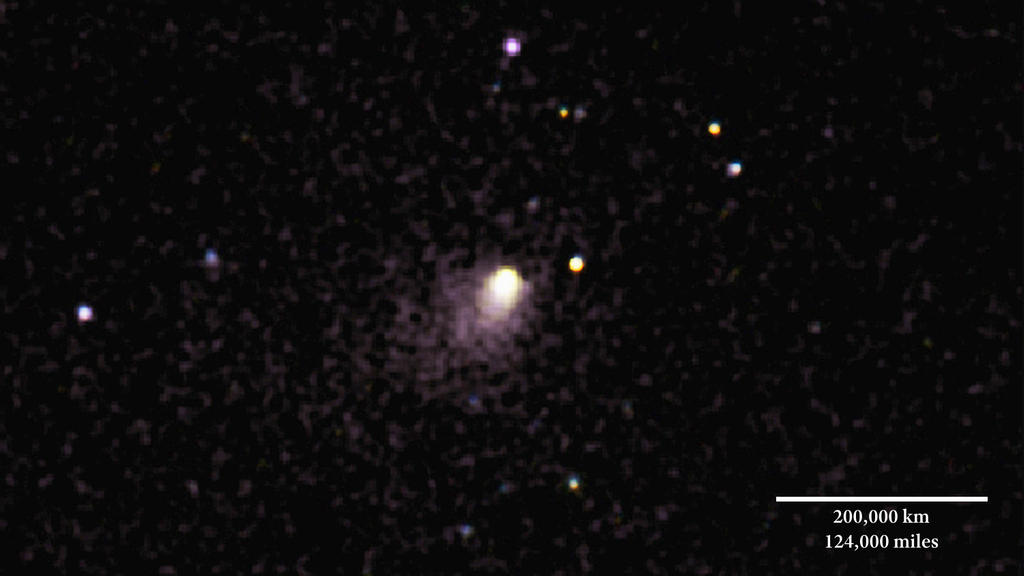
Comet Siding Spring is on its first trip to the inner Solar System. {credit}NASA/Swift/D. Bodewits (UMD), DSS {/credit}

On 19 October, Comet Siding Spring will swoop just 135,000 kilometres above the Martian surface. That’s less than half the distance between Earth and the Moon. And because the comet is on its first trip to the inner Solar System, the gas and dust that have been frozen to its surface for billions of years are finally warming up and spraying off.

“This is our first chance to see the nucleus of a long-period comet up close,” says Richard Zurek, chief scientist for the Mars programme office at the Jet Propulsion Laboratory in Pasadena, California. “Mars will be right at the edge of the debris cloud.”

Zurek leads a team that has been analysing whether dust particles flying off the comet could damage spacecraft around Mars. Three probes currently orbit the red planet (NASA’s Mars Odyssey and Mars Reconnaissance Orbiter, and the European Space Agency’s Mars Express), and two more are slated to arrive in September (NASA’s Mars Atmosphere and Volatile Evolution (MAVEN) mission and India’s Mars Orbiter Mission). Cometary dust is zipping towards Mars at a relative speed of 56 kilometres per second — fast enough to ding protective shielding.

But observations this spring from the Hubble Space Telescope, the asteroid-hunting Near-Earth Object Wide-field Infrared Survey Explorer spacecraft, and other telescopes show that the comet is not spewing out quite as much debris as astronomers had feared, says Zurek. New modelling studies suggest that the most dangerous period will come about 1.5 hours after the comet’s closest approach to Mars, when the planet whizzes within just 27,600 kilometres of the comet’s path. During the most crucial half-hour when the comet dust comes fast and furious, all the orbiters will hunker down on the other side of Mars.

MAVEN, which was built to study the Martian atmosphere, is planning to take science data two days before and two days after the comet’s closest approach. Its ultraviolet spectrometer will take images and spectra of the comet, and other instruments will monitor any changes in the upper atmosphere before and after the comet hits. It’s possible that the comet may dump enough hydrogen into the atmosphere to be seen, says mission leader Bruce Jakosky, a planetary scientist at the University of Colorado in Boulder.

“It’s going to be a spectacular data set,” he says. Jakosky spoke to Nature during a Mars conference this week in Pasadena, California.

As seen from the Martian surface, the comet’s dust cloud will cover a huge amount of sky. The Opportunity and Curiosity rovers will attempt to take pictures of it, but it will be daytime from the rover perspective. They may have a shot at seeing meteors the night before or after the comet passes, Zurek says.

Discovered in January 2013 by astronomers in Australia, Comet Siding Spring is on its first trip to the inner Solar System. More than a million years ago, gravitational interactions probably kicked it out of the frigid cometary reservoir at the edge of the Solar System known as the Oort cloud. It has been travelling towards the Sun since; after this pass it won’t return for about 1 million years.


NASA finds asteroids to visit but may lose an important tool for studying them

NASA’s controversial plan to capture an asteroid and study it is facing a challenge beyond the obvious technical feat: the potential shuttering of the Spitzer Space Telescope, whose observations can help calculate an asteroid’s size.

The Spitzer telescope’s ability to observe in infrared light is potentially crucial. Doing so allows it to measure absolute brightness, which tracks directly with asteroid size. Images taken in visible light can’t reveal the true dimensions of an asteroid, because a highly reflective rock might appear to be larger than it actually is. And NASA needs to accurately know the size of an asteroid before sending a spacecraft there.

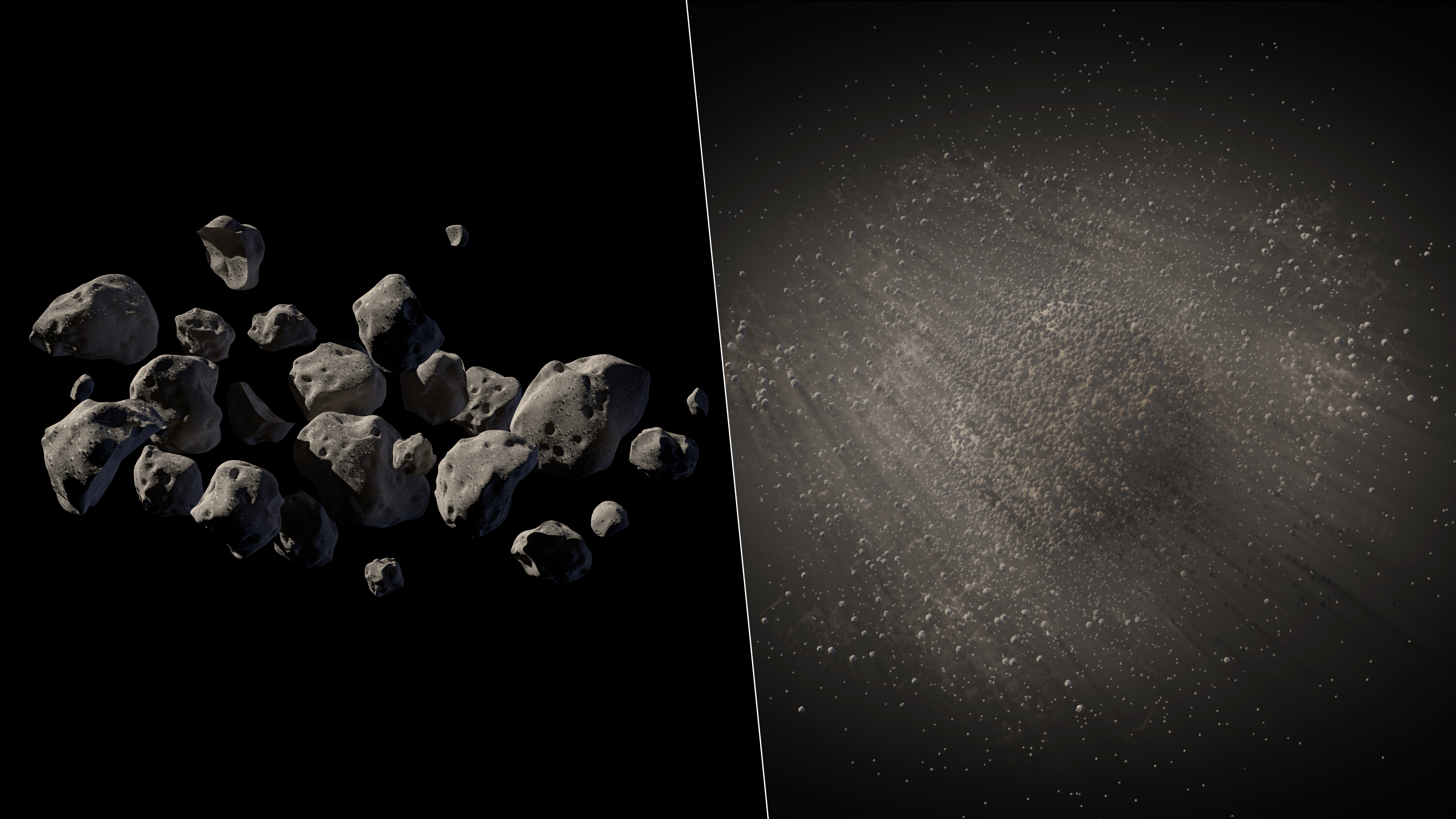
An artist's representation of asteroid 2011 MD suggest that it could be a pile of small rocks (left) or a single rock surrounded by dust particles (right).

An artist’s representation of asteroid 2011 MD suggest that it could be a pile of small rocks (left) or a single rock surrounded by dust particles (right).{credit}NASA{/credit}

But the agency’s astrophysics division, facing tight budgets, has proposed turning off Spitzer next year. It scored lowest in a recent ‘senior review’ of all the astrophysics missions the agency is trying to keep operating.

“We have to look at other ways to fund operations of Spitzer,” said Lindley Johnson, near-Earth object programme manager at the Johnson Space Center in Houston, Texas, during a 19 June update of the asteroid mission. The telescope costs about US$17 million a year to operate. NASA is exploring several possible scenarios, Johnson said, including running Spitzer only part of the time or getting extra money from other institutions or funding sources.

The other big challenge is to find the right space rock to visit. Two possible projects are on the table: grab a single small asteroid, or fly to the surface of a large asteroid and grab a boulder. In both cases, the sample would be dragged near the Moon, where astronauts could visit it for close-up study.

NASA currently has six asteroids on its short list — three of the single small variety, and three that are on the order of 100–500 metres across, large enough to have boulders on their surfaces that could be retrieved.

The small-rock option includes 2011 MD, an asteroid about 6 metres across that zipped past Earth three years ago. Its orbit is very similar to that of Earth, but it travels more slowly. Over time, 2011 MD falls behind and is no longer visible from Earth. In February of this year, it passed close to Spitzer.

Spitzer stared at 2011 MD for 20 hours, said David Trilling, an astronomer at Northern Arizona University in Flagstaff. He and his colleagues, led by Michael Mommert, used those observations to calculate the size and then the density of the rock. It turns out to be very porous (about 65% empty space) and about as dense as water. “This object might swim if you put it in a swimming pool,” said Trilling. The work appeared today in Astrophysical Journal Letters. The best time to grab the asteroid would be in 2024, when Earth will again catch up to it.

Candidates for the boulder retrieval attempt include the asteroid Itokawa, which the Japanese spacecraft Hayabusa visited in 2005; one known as 2008 EV5; and Bennu, which the OSIRIS-REx spacecraft aims to visit.

“We are looking to have a fairly large list of potential candidates,” said Johnson. “It won’t be dozens, but it might be ten or so by the time we need to make the decision.”

NASA plans to choose between the small- and large-rock approaches by December, said Michele Gates, programme director for the asteroid redirect mission. It won’t have to pick an actual target until about a year before launch, currently targeted for 2019.

Hubble telescope to search for spacecraft target beyond Pluto

The Hubble Space Telescope has begun searching for an icy world in the outer Solar System that NASA’s New Horizons probe can visit after it flies past Pluto in July 2015.

The awarding of Hubble observing time, announced today, could greatly increase the chances of the mission’s success. The spacecraft was meant to fly first past Pluto and then past another object in the cluster of icy bodies known as the Kuiper belt. But mission scientists have been unable to identify a suitable Kuiper belt object (KBO) using big telescopes on the ground. They needed the space-based vision of Hubble.

“Hubble is coming to the rescue of New Horizons, and we’re very excited about it,” says Alan Stern, principal investigator for the mission and a planetary scientist at the Southwest Research Institute in Boulder, Colorado.

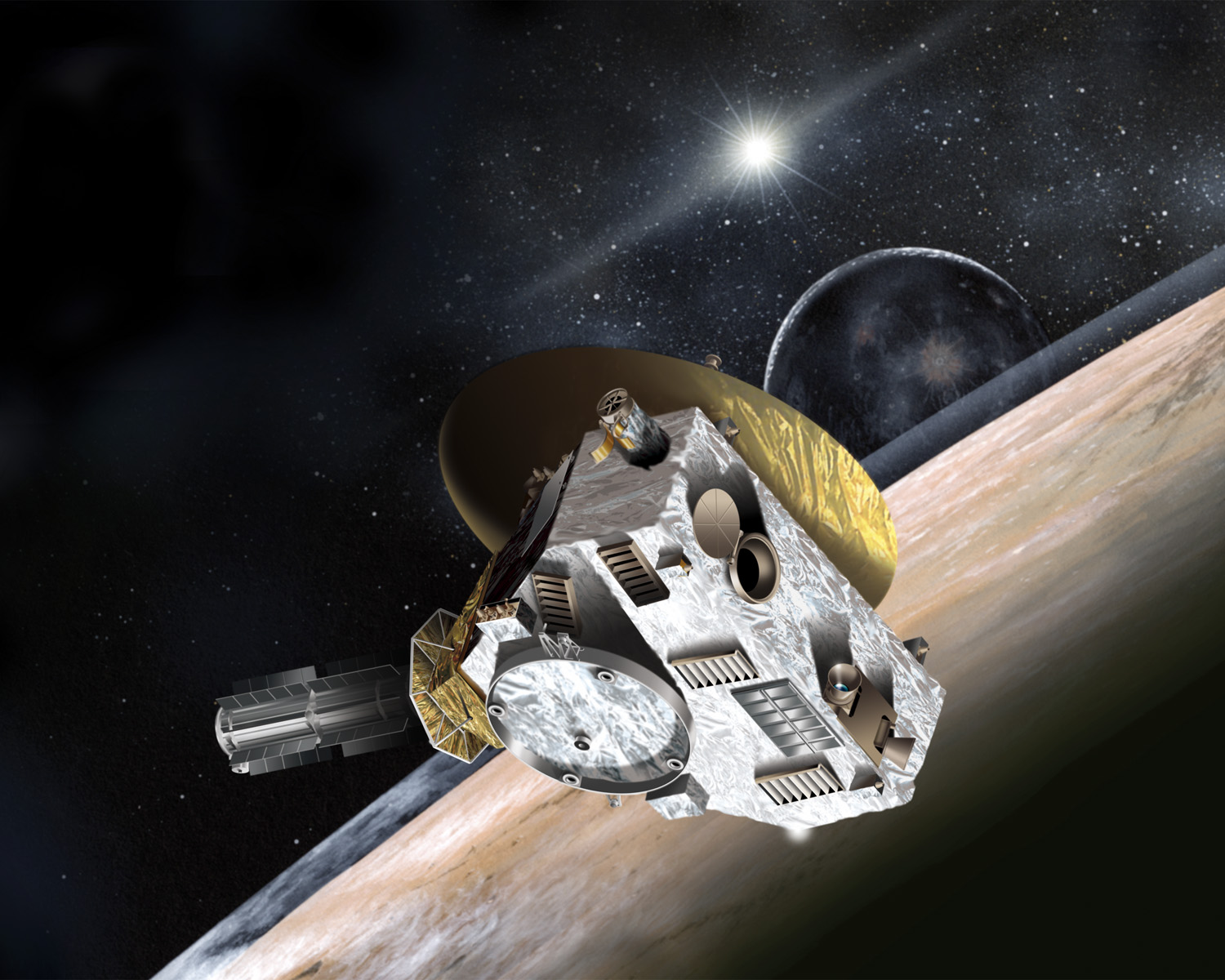
An artist's illustration of the New Horizons spacecraft.

An artist’s illustration of the New Horizons spacecraft.{credit}JHUAPL/SwRI{/credit}

Launched in 2006, New Horizons is currently about nine-tenths of the way to Pluto. Mission planners woke it up yesterday for an extended diagnostic assessment.

NASA has yet to approve funding to fly past a second target after Pluto, but without a candidate KBO the question was moot. The problem has been how to pick out KBOs, which are far away and thus very faint, from the crowded background field of Milky Way stars against which the New Horizons probe is travelling. Mission scientists began their ground-based search in earnest in 2011, but they’ve been stymied by bad weather at observing sites, and the fact, discovered only recently, that that there are actually fewer faint KBOs than one might expect given the number of bright ones. They have discovered more than 50 faint KBOs, but none are in the right region of space for New Horizons to make a close-up visit.

New Horizons has been given an initial allotment of 40 Earth orbits of Hubble observing time, or about 40 hours. If it finds two faint KBOs during that period, then a second observing period of 156 orbits will kick in. The first set of observations is meant to show whether there are enough faint KBOs, statistically speaking, for it to be worth Hubble’s time to continue with the full search. The group that allocates telescope time agreed “that going forward with at least the pilot was a good use of Hubble time,” says Matt Mountain, director of the Space Telescope Science Institute in Baltimore, Maryland.

First observations began over the weekend and the data are already being processed. Time is of the essence because the team must identify at least one KBO target by roughly the end of August to be able to follow its trajectory for at least a year and accurately plan a visit. The probe has limited fuel; mission scientists intend to fire the probe’s thrusters soon after the Pluto flyby next summer in order to accurately set it on a course to visit a KBO.

Ideally, Stern says, the Hubble search will turn up several candidate KBOs that are in the right place for a New Horizons visit. The team will continue to use ground-based telescopes to hunt throughout the year, but they calculate that having Hubble time raises their chances of finding a suitable KBO target from less than 40% to more than 90%.

“This is going to make all the difference,” he says.