A conversation about neuroscience

Nature research journal editors speak with Eric Nestler and Robert Greene about neurobiology and the Society for Neuroscience (SfN) 2017 annual meeting.

A conversation about neuroscience
presented by Nature Methods, Nature Neuroscience & Nature Communications

Sachin Ranade and Jean Zarate

eric_nestler_robert_greene


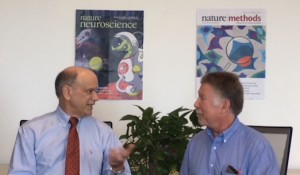
In advance of the 2017 annual meeting of the Society for Neuroscience, Jean Mary Zarate, an editor at Nature Neuroscience and Sachin Ranade , an editor at Nature Communications (photo, upper left) had the opportunity to speak with Eric Nestler, President of the Society for Neuroscience and researcher at the Icahn School of Medicine at Mt. Sinai and Robert Greene, a scientist at the University of Texas Southwestern Medical Center (photo, upper right).

Watch the video here

Machines moved by mind

3Q: José Millán

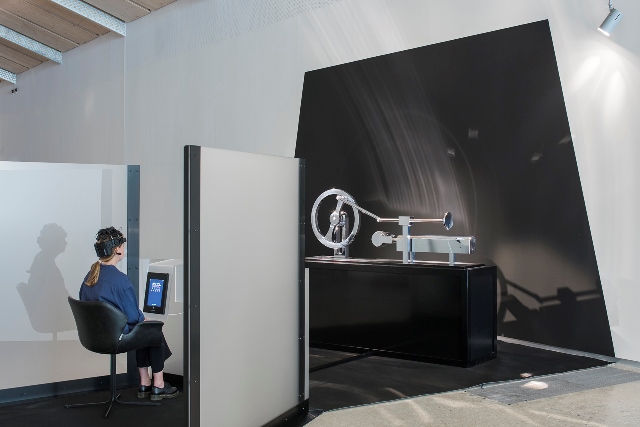
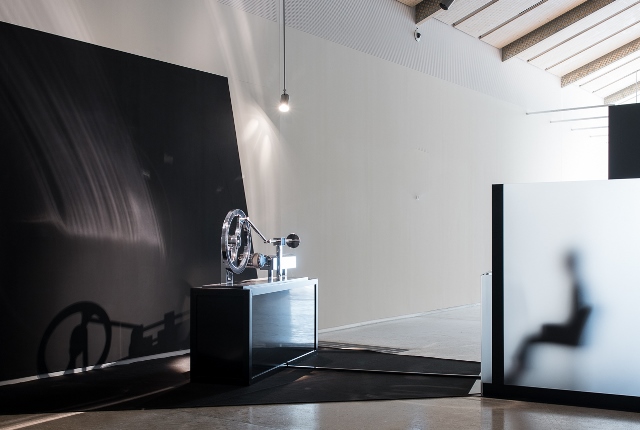
A 'mental worker' (behind screen at right) with Machine 1 at the exhibition Mental Work.

A visitor (behind screen at right) driving Machine 1 using the force of their own thoughts, at the exhibition Mental Work.{credit}© Photography Adrien Baraka / Mental Work{/credit}

At Mental Work, an exhibition at the Swiss Federal Institute of Technology Lausanne ArtLab (EPFL), visitors can drive simple machines using the force of their own thoughts. Probing the rapidly changing relationship between humans and technology, these artworks will also generate vast amounts of data that will be shared with researchers around the world. The show is a collaboration between experimental philosopher Jonathan Keats and EPFL neuroengineer José Millán, who develops brain-machine interfaces (BMIs) to help people with paralysis. Here, Millán talks pistons, probability and the debate over who or what is in control.

What will visitors experience at the show?

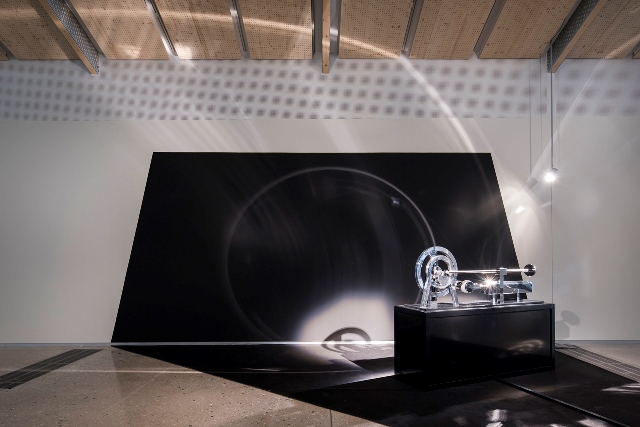
Some will be active participants in three experiments; others will watch them work. The participants, or ‘mental workers’, wear an EEG helmet studded with 19 dry electrodes — which continuously pick up electrical activity in their brains. In the first experiment they sit in front of a 2-metre-long construction (Machine 1) comprising a piston, fly-wheel and horizontal shaft. Using mental imagery, they try to move the piston onto the fly wheel; this starts the wheel turning, driving the shaft through a bolt. The brain-machine interface or BMI that makes this possible is an algorithm that has to be trained to ‘read’ the mind of each driver. The driver instigates the training by making a binary movement of the hand or foot, such as clenching and opening a fist, while simultaneously imagining the piston moving or stopping. The algorithm learns the stop-go instructions from patterns of the data from the electrodes, and converts them into commands for the piston. Because the data are always noisy and variable, the command is based on probability; but we program the piston motor to generate movement only when the probability is high — usually in the 70-90% range.

xxx

Another view of a ‘mental worker’ with Machine 1.{credit}© Photography Adrien Baraka / Mental Work{/credit}

What happens in the other two experiments?

They are more complex, and so are the machines. Participants take the role of either ‘driver’ or ‘supervisor’. Supervisors may change the level of probability through their own mental imagery, so the driver has a harder or easier (but messier) job of getting the machine to work. Or the supervisors may use their mental imagery to instruct the BMI to stop using mental imagery altogether, and switch to a different algorithm that use patterns of alpha waves — the brain-wide oscillations generated when the brain is at rest — to drive movement. In this case, the supervisor also uses mental imagery to instruct the driver to relax and ‘empty’ his or her brain. This is the part I am terrified about! We can get this to work in the lab, but it gets so complicated we don’t know what will happen when it is tested in more open conditions. We’ll also distribute a questionnaire asking participants whether they felt they were controlling the machines or if the machines were controlling them.


xxx

Machine 2, where ‘drivers’ have their threshold adjusted using a brain-machine interface or BMI.{credit}© Photography Adrien Baraka / Mental Work{/credit}

What do you want to emerge from the exhibition?

We are entering a cognitive revolution in which we will increasingly use many different new technologies to tap into or extend the capabilities of our brains. I hope that Mental Work will help generate a societal debate about this. Could brain power be used to carry out real work in the real world? What would that mean for employment? Will machines take control of our minds, or will our minds always have the control of machines? Personally, I am optimistic – I think the future is up to us. But the debate needs to start now. I hope visitors to this show will also enjoy the aesthetics of these artistic machines. Meanwhile, the data will be very valuable scientifically. We will capture and share it with the BMI research community, which is constantly trying to improve interfaces, for example by increasing the probability that brain signals are correctly read. Our experience suggests that many participants improve their performance as they move from one machine to another, and I expect that the research community will also be able to develop better machine-learning techniques for BMI users. At the end of the day what I really want is help BMI users, particularly  people with paralysis, to generate brain signals that are more stable and easier to decode.

Interview by Alison Abbott, senior European correspondent for Nature. She tweets at @alison_c_abbott

 This interview has been edited for length and clarity.

Mental Work runs from 27 October – 31 January 2018. The first two weeks are open for registered participants only, so any visitors wishing to participate as ‘mental workers’ must first sign up on the website mentalwork.net. The show opens to the general public on 13 November. It will subsequently move on to swissnex San Francisco in California. 


For Nature’s full coverage of science in culture, visit www.nature.com/news/booksandarts.

Picturing science: top 5 illustrated books

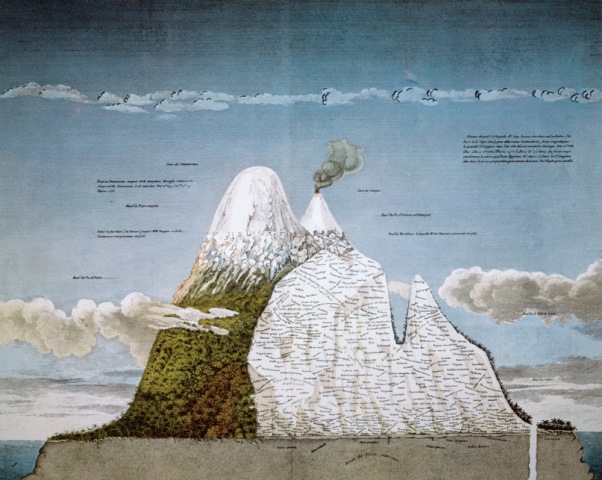
A study from Alexander von Humboldt's detailed expedition notebooks. This cross-sectional study of Chimborazo in Ecuador (1805) shows flora growing at different altitudes.

Alexander von Humboldt kept immensely detailed expedition notebooks. This cross-sectional study of Chimborazo in Ecuador (1805), derived from a sketch, shows flora growing at different altitudes on the volcano.{credit}akg-images. Reproduced in Explorers’ Sketchbooks. {/credit}

We live in illustrated times — a golden age for science graphics, data visualisation and scientific illustration generally. Photography has become positively eye-popping — from the cosmoscapes of Hubble to the Earthly delights of nature photography and photo archives the world over. And luckily for us, this gargantuan trove is being steadily funnelled into science-oriented coffee-table books.

I confess that in early in 2016 I was hanging around waiting for one. Then, like a fleet of barouches, several came along at once. In them I’ve found aesthetic thrills, deep insights and unexpected hilarity. Here are five of the best.

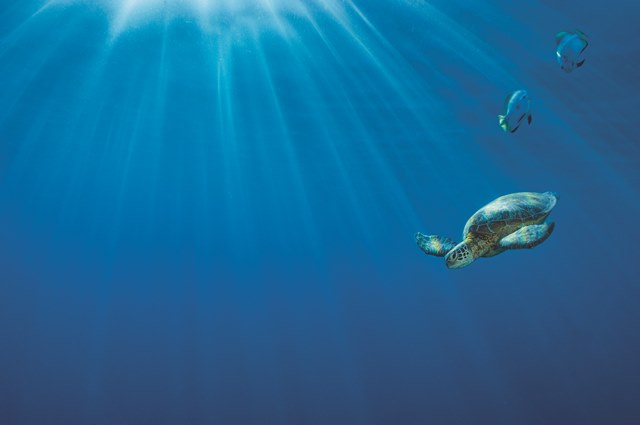
xxx turtle in xxx.

A green turtle (Chelonia mydas).{credit}Alex Mustard, in Secrets of the Sea.{/credit}

Animals proved a draw  — archival menageries and photo-surveys playing on our unquenchable fascination with other species. Secrets of the Seas: A Journey into the Heart of the Oceans (Bloomsbury), with text by marine biologist Callum Roberts and photographs by underwater adept Alex Mustard, explores the wild beneath the waves. It begins in the Coral Triangle, where 4 million square kilometres of tropical ocean support three-quarters of the world’s corals and 2,500 fish species. One denizen, the paddle-flap scorpionfish Rhinopias eschmeyeri of Indonesia, is a cartoon in bubble-gum pink. Beauties throng here too, from the sinuous ballets of California sealions Zalophus californianus to silver blizzards of shoaling fish — mackerel to barracuda.

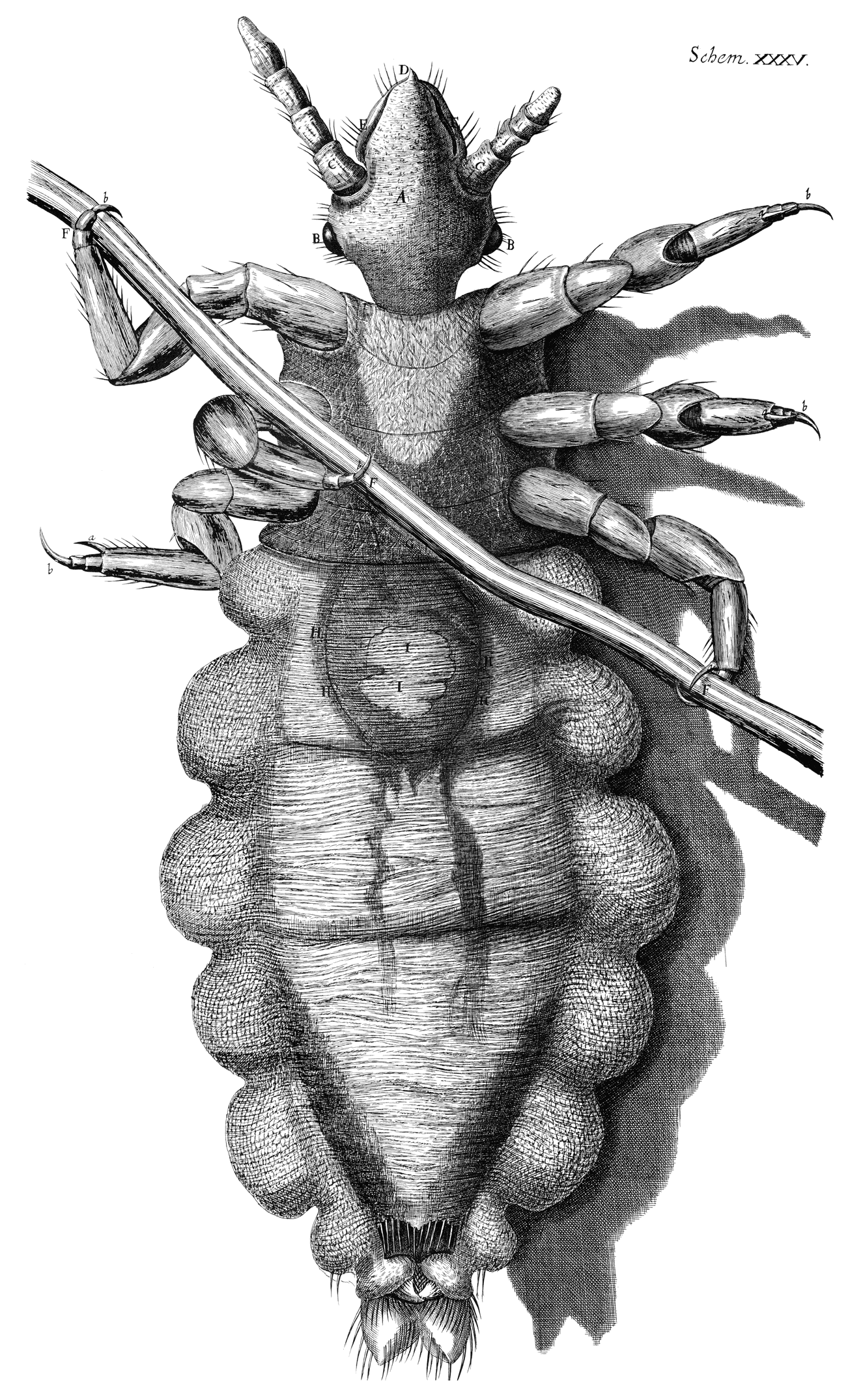
Robert Hooke's 1665 drawing of a louse on a human hair, from Micrographia.

Robert Hooke’s 1665 engraving of a louse on a human hair, from Micrographia.{credit}National Library of Wales. Reproduced in The Paper Zoo.{/credit}

Roberts’s urgent text underlines the state of play for today’s beleaguered marine animals. The Paper Zoo focuses firmly on the planet’s biodiverse past, rummaging through the British Library’s wealth of natural history illustrations spanning 500 years. Science historian Charlotte Sleigh leads us through an ark of beasts from the exotic to the ‘paradoxical’, limned by greats of scientific illustration. Robert Hooke’s eighteenth-century microscopic menagerie of drone flies and lice jostle with natural historian John Ray’s Dürer-like renderings of fish from the 1680s. The nineteenth-century art ranges further South; my favourite is an anonymous double portrait of langurs (one black, one white) staring sagely out in mid-snack.

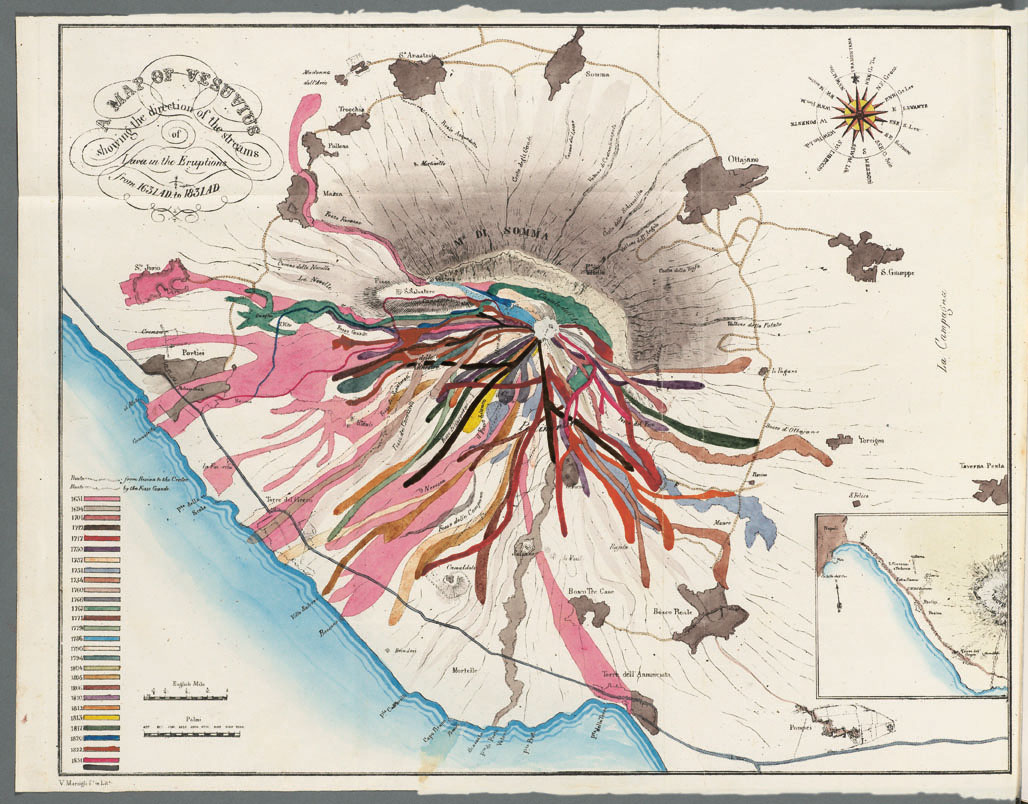
By necessity, many explorers were illustrators manqué — before the advent of reliable cameras, sketches were essential records of the geological, zoological and meteorological wonders they encountered. Explorers’ Sketchbooks: the Art of Discovery and Adventure (Thames & Hudson), by cultural historians Huw Lewis-Jones and Kari Herbert, is a mesmerising multiverse of them. Facsimile pages from the notebooks of 70 ‘terranauts’ give a stunning immediacy to distant time and space. Edward Wilson’s dreamlike evocations of the Antarctic, Maria Sibylla Merian’s caiman chomping on a false coral snake, the lava streams on Vesuvius mapped by John Auldjo, Alexander von Humboldt’s bold cross-section of Chimborazo — every turn of the page is a subtle thrill.

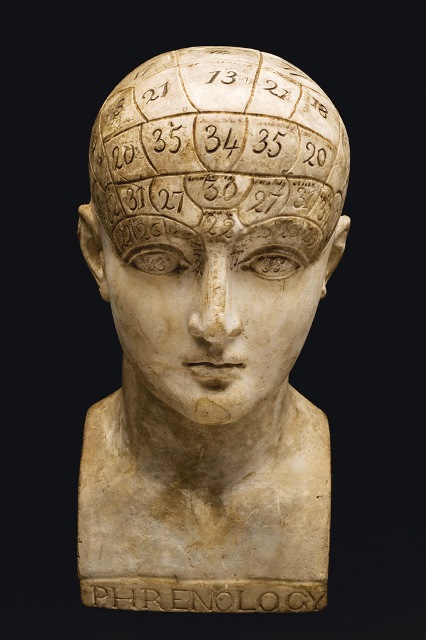
A phrenological bust.

A phrenological bust.{credit}Wellcome Library, London. Pictured in This Way Madness Lies.{/credit}

There are outer, and inner, journeys. Mike Jay’s This Way Madness Lies (Thames & Hudson) peers into the history of mental illness and its treatment as ‘madhouses’ gradually morphed into mental hospitals. (The book accompanies the Wellcome Collection show Bedlam.) Many of the more than 600 images, gleaned from European and US archives, are harrowing portraits of marginalised people further marginalised by experimental treatments ranging from the bizarrely exploitative to the ineffectual. Yet, as Jay notes, there were countercurrents. Franco Basaglia’s 1960s-70s psychiatric revolution in Italy sought to reinstate patient autonomy and social integration. Community refuges from Geel, Belgium, to Gould Farm, Massachusetts, offer treatment based on acceptance and occupation. And the science advances — even as depression and psychoses remain very much with us. A gallery features astounding art by the diagnosed, from proto-surrealist and Victorian parricide Richard Dadd to Adolf Wölfi, a talented abstractionist confined to a Bern asylum for life in 1895.

Finally, there are journeys into myth. The Un-Discovered Islands: An Archipelago of Myths and Mysteries, Phantoms and Fakes (Polygon) by travel writer Malachy Tallack and artist Katie Scott relates the stories of islands that never were. The Terra Novas off East Antarctica spotted by expedition leader Phillip Law in the 1960s were probably icebergs. The Auroras, a trio of islands halfway between the Falklands and South Georgia, were discovered in 1762, actually surveyed in 1796, and finally declared non-existent in the nineteenth century. There are more, from Hy Brasil to Bermeja, and all embellished by Scott’s strange and powerful images of whales, rabbits and jellyfish — species inhabiting what Tallack calls the “geography of the mind”.

John Auldjo's nineteenth-century map of successive lava flows on Vesuvius.

John Auldjo’s nineteenth-century map of successive lava flows on Vesuvius.{credit}Houghton Library, Harvard University, Cambridge, Massachusetts. Reproduced in Explorers’ Sketchbooks. {/credit}


For Nature’s full coverage of science in culture, visit www.nature.com/news/booksandarts.

A requiem for recollection

Posted on behalf of Kerri Smith

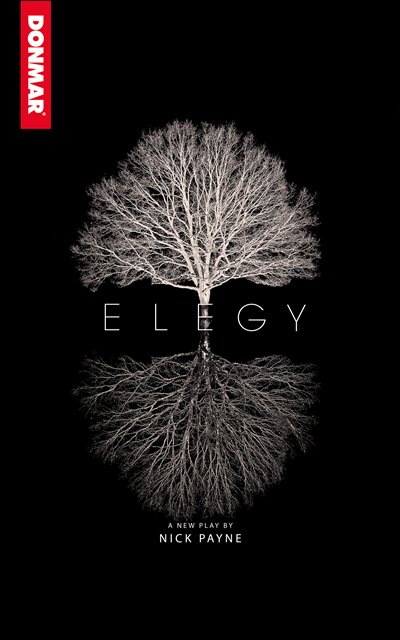
Elegy-logo-and-title-treatment-NEW2The best science fiction can predict the science of tomorrow and colour the preoccupations of today. It’s too early to tell whether Nick Payne’s new play, Elegy, will do the former, but it certainly takes a powerful swing at the latter.

Payne’s short three-hander, currently at the Donmar Warehouse in London, evokes the challenge of coping with a relative with worsening dementia, a dilemma well-known to many families. The sci-fi twist comes in the form of a new therapy that carries a heavy cost.

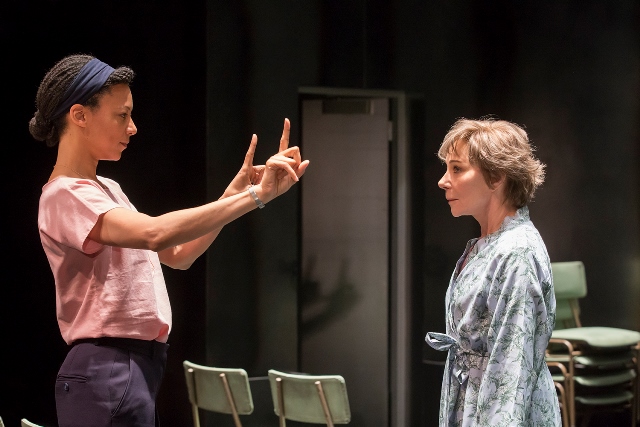
We meet a couple in their sixties. Lorna (Zoë Wanamaker) has an unnamed disease, which has taken its toll on her mood and memory. She and partner Carrie (Barbara Flynn) have to decide whether to embark on a radical new treatment, or let her condition continue its march.

In Payne’s world, doctors can map the brain’s tangle of neurons and have learned how to replace some ailing circuits with prosthetic versions. Normal functions such as walking can be preserved or restored. But, the couple is told, the treatment will not be able to reinstate memories from a large chunk of the patient’s adult life: the period during which the couple met and married. Lorna will have to sacrifice a life’s worth of memories with Carrie for a healthy post-op life.

Some of the science fiction has a basis in today’s fact. Neuroscientists are working on the brain’s ‘connectome’ — a map of all the brain’s neural projections. But they are nowhere close to having a complete atlas, let alone a definitive guide of what functions and memories lie where. It’s also unlikely that Lorna’s  surgery would selectively remove memories depending on their age, although one 2009 study suggested that different brain regions help recall memories of different ages.

Patients today have dire choices similar to this. People with Parkinson’s, for instance, might have to choose between a drug with severe side effects, a major operation or a worsening of the movement disorder. But in Elegy, Payne presents a different type of Hobson’s-choice: would you change your ‘self’ to save your life? As Lorna asks, “What life, if it isn’t this life?”

Nina Sosanya and Zoe Wanamaker in Elegy by Nick Payne.

Nina Sosanya and Zoë Wanamaker in Elegy by Nick Payne.{credit}Johan Persson{/credit}

One speech mars the flow. The doctor, Miriam (Nina Sosanya), gives the couple a primer on axons and glutamate that seems lifted from a neuroscience textbook. There are, rightfully, no more such explications. But there are inconsistencies in how we are told the treatment works and what neuroscientists know about how the brain makes memories and stores motor programmes. A more profound integration of neuroscience into the plot might have helped that.

For instance, the therapy Miriam offers — which excises memories that cannot be replaced — is problematic. Memories do not exist in one neural area; they are stored more widely. Likewise, many motor procedures are essentially glorified memories: riding a bike is a classic example. It’s not clear that these would live somewhere entirely and conveniently different from Lorna’s recollections of events in her life.

But the premise needn’t make neuroscientific sense for the plot to touch us. And it does, in part because the characters are so well-portrayed. Wanamaker shows us Lorna’s deterioration viscerally — walking across the stage and wheeling around angrily when she forgets what she wanted there — as well as her struggle to adjust to healthy life after the procedure. Sosanya brings a humanity to Miriam, despite the scientific soliloquies. She also gets to crack a science joke, raising a laugh from the audience when she tells the couple that the treatment works in mice, rats…and zebrafish.

Zoe Wanamaker in Elegy.

Zoë Wanamaker in Elegy.{credit}Johan Persson{/credit}

The play’s structure and dialogue also reflect the fragmentation of Lorna’s memory and the couple’s life together. We start at the end of the story, when Lorna has already undergone treatment, and look back at the beginning of their relationship, their appointments with the doctor and struggle to cope with Lorna’s dementia. The splicing and disjointedness force you to work to figure out where each scene fits and what has come before, evoking the confusion of the condition.

The dialogue is wonderfully natural, yet also crafted to add to the sense of fragmentation. Barely any character finishes a sentence and many important words are missed out, just as people talking about difficult subjects will tail off and let the listener fill in the blanks. “I worry we’re in danger of reducing an extremely complex…” says Miriam, leaving the thought hanging under a barrage of questions from the couple.

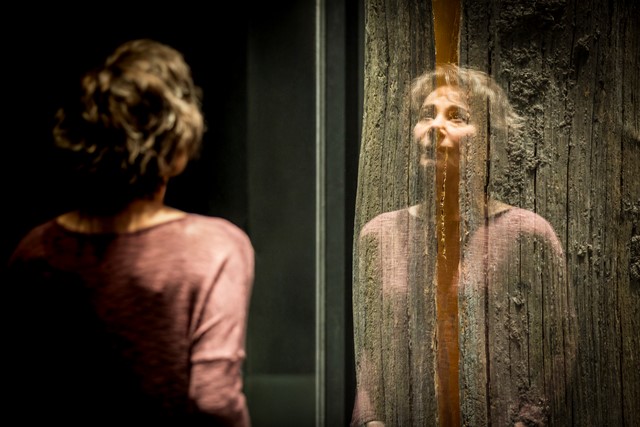
In the middle of the stage, a tall tree trunk with a deep split along its length stands in a glass box. When Lorna’s memory clouds, the box fills with smoke. Like the sparse stage and the half-sentences, it is beautiful, disturbing — and memorable.

Kerri Smith is Nature’s podcast editor. She tweets at @minikerri.

Elegy runs at the Donmar Warehouse, 41 Earlham Street, London, through 18 June.


For Nature’s full coverage of science in culture, visit www.nature.com/news/booksandarts.


Humour on the brain: Robert Newman reviewed

Posted on behalf of Kerri Smith

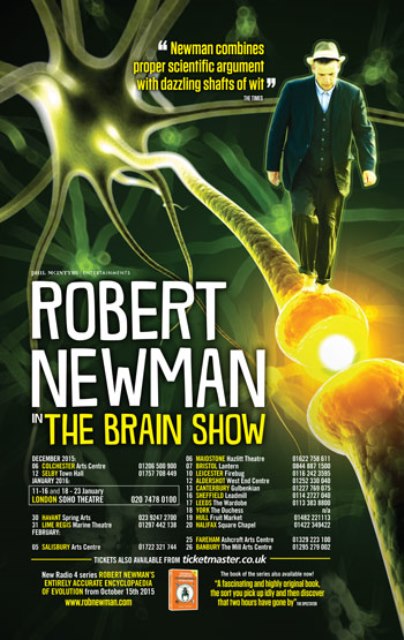
brainshowposterdecember 2British comedian Robert Newman kicks off new act The Brain Show like any self-respecting scientist: with an abstract. He tells the audience about the billions pouring into mapping European and American brains through, respectively, the Human Brain Project and the White House BRAIN (Brain Research through Advancing Innovative Neurotechnologies) Initiative. He lays out the shortcomings of these projects’ best-known predecessor, the Human Genome Project, which, he bemoans, never did find half the genes it promised. There was no “gene for getting into debt”; no “low voter turnout” gene. And he explains what the rest of his argument will be: that humans cannot be thought of as machines, and that scientists devalue us all by conceptualising people in this reductive way.

Critiques of neuroimaging could not often be called comic. Newman, however, manages it.

Newman hinges The Brain Show on a re-imagining of an infamous 2000 neuroimaging experiment by Andreas Bartels and Semir Zeki. This claimed to have found the brain network responsible for romantic love, and Newman purports to have taken part. Many of his gags are only tangentially related to the science, but it’s skilfully done. He is asked to bring four photos to the scanner session: one of someone he is deeply in love with, and three of friends he is fond of. He worries about his selection of the first image. “I’m looking at this photo and thinking: is this the best picture of me I could have brought?”

Once in the scanner, he starts to question how the experiment has been set up. Have the neuroscientists who scanned his brain really found ‘the love spot’? “Maybe what we’ve discovered,” Newman says, “is the bit of the brain that lights up when we spot an elementary conceptual blunder in experimental design.” (You can hear more from the show in this week’s Nature Podcast.)

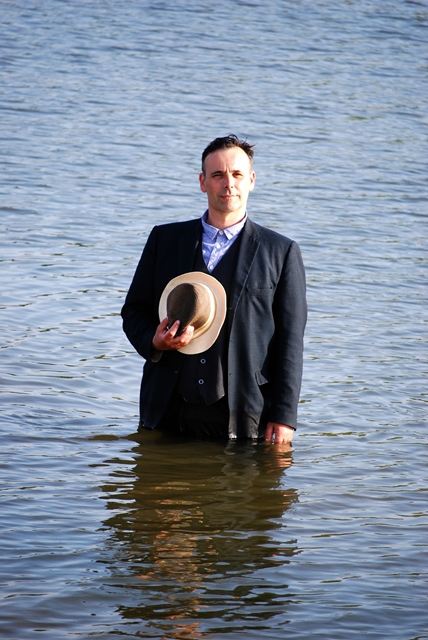
Robert Newman in 2013.

Robert Newman in 2013.

I found him on shakier ground when he chided modern neuroscience for deeming ‘we are our brains’. This encapsulation is simplistic, I’ll grant him, but to believe anything else is to come over a little bit Descartes, in danger of endorsing that mind and body are different things. To many neuroscientists, it isn’t dehumanising to imagine that cognitive powers and personalities are just patterns of neural activity. I think Newman is right to say, though, that “the idea that the brain is a wet computer is a philosophical assumption, not a scientific idea”.

At times, the comedian veers off into evolutionary biology, familiar to anyone who saw his 2013 show, New Theory of Evolution. It is perhaps easier to be hilarious when nature offers up such delights as the lemon ant (Myrmelachista schumanni). The Amazonian insects are actually known for creating so-called ‘devils’ gardens’ in which they kill off certain trees by injecting formic acid into their leaves. Newman, however, simply riffs off their name, telling us that London’s Natural History Museum employs an ant taster responsible for naming the salt-and-vinegar ant and the “I can’t believe it’s not beetle” ant.

During the show Newman wears a large flashing helmet to demonstrate his brain activity during a study of guilt. He also plays the ukulele to two rubber cephalopods, and does a great impression of the physicist and broadcaster Brian Cox standing behind a row of skulls and talking about evolutionary progress. “That’s not evolution Brian, that’s a xylophone!”

Occasionally awkward and delightfully eccentric throughout, Newman also delivers shafts of insight. He doesn’t know which discipline he’ll target next – possibly the history of science – but as his previous shows attest, he’s certainly willing to do his time in the library.

The Brain Show is on tour in the UK until 26 February, and will be reprised at the Edinburgh Fringe festival. Kerri Smith is acting head of Nature’s multimedia team. She tweets at @minikerri.

For Nature’s full coverage of science in culture, visit  www.nature.com/news/booksandarts.

On reflection: the art and neuroscience of mirrors

Posted on behalf of Alison Abbott
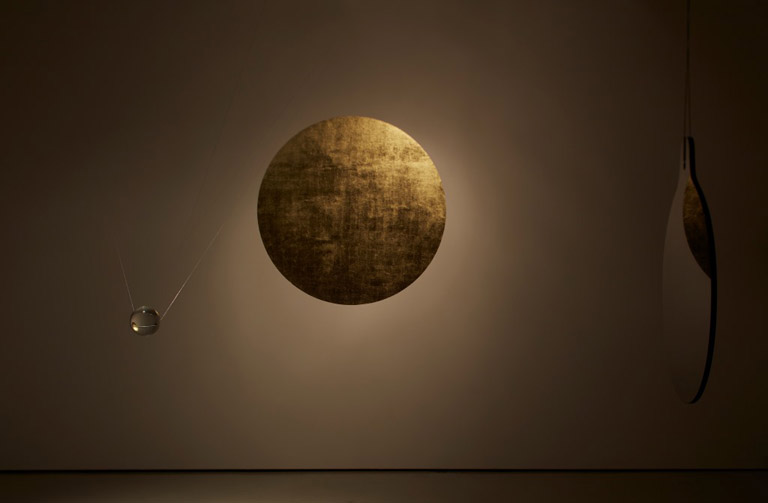
The installation Smoking Mirror by Otavio Schipper and Sergio Krakowski, 2015.

The installation Smoking Mirror by Otavio Schipper and Sergio Krakowski, 2015.{credit}Nick Ash{/credit}

Two linked exhibitions in Berlin – Mirror Images in Art and Medicine and Smoking Mirror – begin where Narcissus left off. The hero of Greek mythology wasted away gazing transfixed at his own beauty reflected on the surface of a dark pool. He left his name both to the narcissus (daffodil) that sprang up on the banks where he died, and to psychology.

The desire to see one’s own reflection more conveniently than kneeling at the waters’ edge on a sunny day  appears universal. Most of the world’s major cultures invented their own types of portable mirror over the millennia. The earliest so far found, in Anatolia, were made from polished obsidian, a naturally occurring volcanic glass, and date back 8,000 years. Later came mirrors made from polished metal, and around the first century AD, metal-coated glass.

Examples of mirror-based objects – like the extraordinary non-reversing mirror invented by US mathematician Andrew Hicks in 2010 – are on display in Mirror Images at the Museum of Medical History at the Charité. But at its most provoking, the exhibition explores the psychological and neuroscientific power of reflections. It departs from the relatively simplistic notion of narcissism – an unhealthy concern with one’s self – to examine deeper and altogether more fascinating concepts of ‘self’.  How do we perceive the boundary between the outer limits of our body and the environment in which our bodies move? Is our perception of our individual ‘self’ constant or manipulable?

These concepts have both medical and philosophical significance. In the past half-century, artists have been doing their own explorations of what self means, exploiting video technology to capture ‘reflections’ more permanently than mirrors can. Mirror Images shows, as few similar ventures have been able to do, how art and science really do sometimes converge on important questions in a meaningful way.
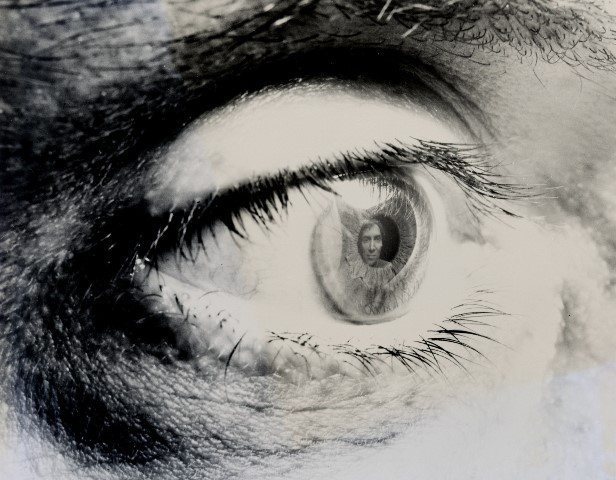
'Maintenance III (Self Portrait)' by William Anastasi (1967).

‘Maintenance III (Self Portrait)’ by William Anastasi (1967). {credit}© William Anastasi{/credit}

The exhibition showcases several mirror-containing instruments that transformed medicine in the nineteenth and early twentieth centuries. Among them is an exquisite 1851 ophthalmoscope in its original wood, velvet and silk case. Invented by pioneering physicist and physiologist Herrmann von Helmholtz, the instrument was the first to allow light to be shone directly into any part of the body that is sealed from the environment by a membrane, and it gave physicians their first view inside a functioning eye. This was long before photography became common, so physicians had to draw what they saw there. A sample watercolour alongside the ophthalmoscope shows how impressive their artistic skills could be.

The exhibition also showcases the healing potential of reflections. A series of photographs on display, taken of herself in different locations during paralysing panic attacks, helped artist Sabina Grasso to cure her psychological disorder. She says the cure resulted from being able to contemplate from a distance the images of her own captured body.

A version of neuroscientist Vilayanur Ramachandran’s famous mirror box is available for visitors to test its illusory powers on their own bodies. Ramachandran  developed the deceptively simple device in the 1990s to help amputees who feel phantom pain from their missing limb. The pain may occur because the brain responds as if the limb were not missing, but in spasm. The patient places his or her remaining limb in front of a vertical mirror so that its reflection appears as if it could be the missing limb. The brain registers the spasm-free movements and, in some cases, stops sending the painful signals.
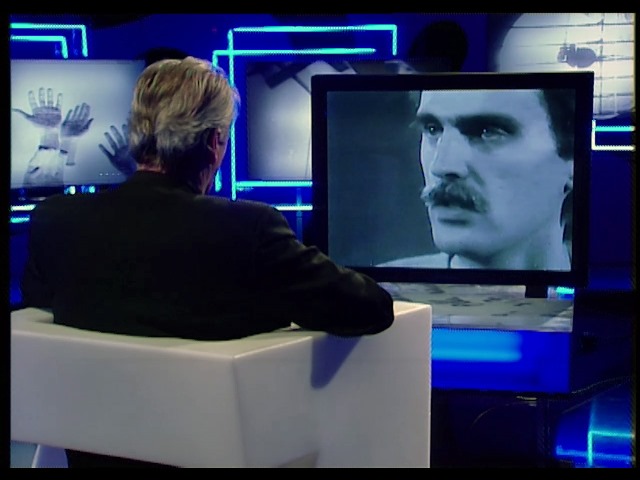
'DM/1978 Talks to DM/2010'. In this media project by Dalibo Martinis, the artist answers questions he posed to himself over 30 years before.

‘DM/1978 Talks to DM/2010’. In this media project by Dalibo Martinis, the artist answers questions he posed to himself over 30 years before. {credit}Dalibo Martinis{/credit}

A different, even more startling, type of body illusion is presented by Croatian artist Dalibor Martinis in a video interview between two of his ‘selves’, separated by more than three decades. In 1978, at 31, he video-recorded a series of questions, in English, addressed to his future self. The mature Martinis responds in 2010 in a Croatian television show. He finds his younger self “a bit puffed up”, and comments “if we are at all the same person, it is neither you nor I”.

Across town, a darkened exhibition room at the Schering Foundation hosts the mesmerizing installation Smoking Mirror. It was created by two Brazilian artists: one, Otavio Schipper, has a degree in physics; the other, jazz musician Sergio Krakowski, a PhD in mathematics.

The artwork comprises three reflecting objects suspended from the ceiling, each inspired by the working tools of the astronomer-astrologer mathematician John Dee, advisor to the Tudor Queen Elizabeth I. One is a large obsidian mirror, another a glass sphere filled with water, and the third, a circular, concave surface coated with gold. (The originals are held in the British Museum.) Sound waves emitted from speakers on opposite walls during a 26-minute sound composition by Krakowski cause the objects to turn slowly, shifting their mutual reflections as ever-changing lighting plays on their surfaces.

And the mesmeric sounds? The brain-wave frequencies recorded during different states of consciousness (awake, sleeping, dreaming); frequencies of resonances in the Earth’s atmosphere; spoken sequences of numbers recorded from the mysterious shortwave numbers radio stations in the airways whose purposes may be espionage. The installation keeps just this side of mysticism, but its draw is like that of Narcissus to his pool. The sensory domination does, as intended, channel the minds of visitors, turning thoughts inwards.

 Alison Abbott is Nature’s senior European correspondent.

Mirror Images runs at the Museum of Medical History at the Charité, Berlin, Germany, until 3 April 2016. Smoking Mirror runs at the Schering Foundation, Berlin, Germany, until 23 January 2016.


For Nature’s full coverage of science in culture, visit www.nature.com/news/booksandarts.

Oliver Sacks: an appreciation

Posted on behalf of Philip Ball

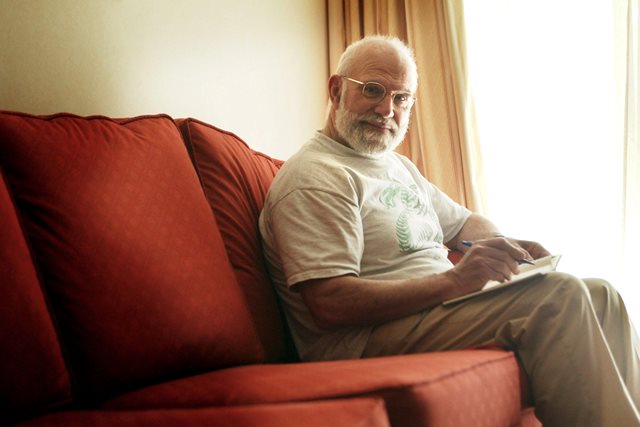
Oliver Sacks in 2002.

Oliver Sacks in 2002.{credit}Rex Shutterstock{/credit}

“Not quite salve et vale yet,” Oliver Sacks signed off a letter to me at the end of June, expressing the hope that he’d visit London again in the time he had left. The treatment he received earlier in the year had, he said, done “a very good job clearing out the majority of the metastasis in my liver”, and I allowed myself to be optimistic about seeing this remarkable, terminally ill man once more.

That’s not how it worked out. With his death at the end of August I – and many others – lost a friend whose generosity and sympathy of spirit were constantly inspiring. That Oliver would find the time to write at all when his remaining days were clearly so few, and when he had “case histories, essays etc, short and long” – and apparently several books too – still to complete will not surprise anyone fortunate enough to have felt his kindness. That his comments would stroll from the virtues of the Japanese “actor-magician” Yoshi Oida to Shakespeare’s belief that the fern can confer invisibility typifies his boundless curiosity. But who else wielded such breadth this lightly? Who, while afforded tremendous acclaim, was ever so devoid of ego?

This was one of the qualities that lifted Oliver’s writing to canonical status, and not just within the confines of “science writing” (he was rightly uncomfortable with being labeled thus). His subject was that of novelists, philosophers, poets, humanists of all descriptions: what is often rather grandly called “the human condition”. But in Oliver’s books and essays, the humanity was immediate and intimate, coming not from sweeping generalizations or lofty pronouncements but from deep within the grain of individual experiences. His concern was not “humanity” as such; it was people.

In all of the extraordinary, sometimes bizarre and baffling case histories that he described, he sought out what they revealed about our own fragile existence and what was unique and valuable in the lives of these people who often faced unimaginable challenges. To do this without mawkishness or sentimentality, yet with enormous empathy and even affection, required not just a rare talent with words but exquisite sensitivity. It is a fittingly Sacksian question to wonder (without expecting answers) how all this came about. Oliver’s account of his early life, in the first volume of his autobiography, Uncle Tungsten (2001), tells of his affluent, intellectual Jewish family in north London, whose scientific inclinations – his father was a general practitioner – might have been expected to launch him on just the kind of path it did: into neurochemistry and then consulting neurology. It offers no real clues about what would turn him into a writer with a unique ability to translate the clinical work of a neurologist into insights both beautifully lucid and movingly profound.

It does, however, hint at the beginnings of the loneliness that seemed to me to linger in the background even while Oliver was among friends and colleagues who shared a great deal of mutual affection. He writes in his second autobiographical volume, On the Move (2015), of “the habits of a lifetime’s solitude, and a sort of implicit selfishness and self-absorption”. Well, maybe; you might guess the former, not the latter. I was delighted, then, that Oliver found love again in 2009 at the age of 77.

It was Oliver’s passion for chemistry, revealed in Uncle Tungsten, that brought us into contact, when I discovered to my surprise and delight that he had read the books I’d written on the subject. His friends, the chemists Roald Hoffmann and Bassam Shakhashiri, rightly file Uncle Tungsten alongside Primo Levi’s The Periodic Table as one of the “great chemistry classics of all time”: two books that put chemistry on the required reading list. These books are not “about science” but simply and undemonstratively let science assume its place in culture. Like Levi, Oliver was a great writer whose subjects often happened to be scientific.

The first time I met him, in the harsh New York winter of 2003, I witnessed the irresistible strength of his chemical enthusiasms, undiminished since the days he tossed lumps of sodium into Highgate Pond in north London with his boyhood friend, the polymath Jonathan Miller. With barely a word of introduction but with eyes sparkling, he beckoned me eagerly into his kitchen, where next to the bowls of nuts he had laid out as much of the periodic table as he possessed (which was most of it), encouraging me to listen to the “cry of tin” and to handle the round ball of mildly toxic cadmium.

I do not envy anyone the necessary task of sorting through Oliver’s unpublished writings – which, he admitted, “spreads onto the backs of envelopes, menus, whatever scraps of paper are at hand”. The correspondence alone will be enormous – he kept it all. It should also be delicious. “I enjoy writing and receiving letters,” he wrote. “It is an intercourse with other people, particular others.” That concern with the particulars of others is what makes all his writings so bountiful; I see now that is why he wrote – and with generous and life-affirming energy – in June.

Several writers have written about coming to terms with terminal illness, and many accomplish it with grace and courage. I’m not sure, though, that any of these accounts has been as uplifting as what indeed proved to be Oliver’s salve et vale in The New York Times in February. “It is up to me now to choose how to live out the months that remain to me”, he wrote. “I have to live in the richest, deepest, most productive way I can… I have been a sentient being, a thinking animal, on this beautiful planet, and that in itself has been an enormous privilege and adventure.” It has been an enormous privilege that he has shared the adventure with us.

Philip Ball is a writer based in London.

See Nature‘s Special on Oliver Sacks here. For Nature’s full coverage of science in culture, visit www.nature.com/news/booksandarts.
A scintillating shortlist for the Royal Society prize

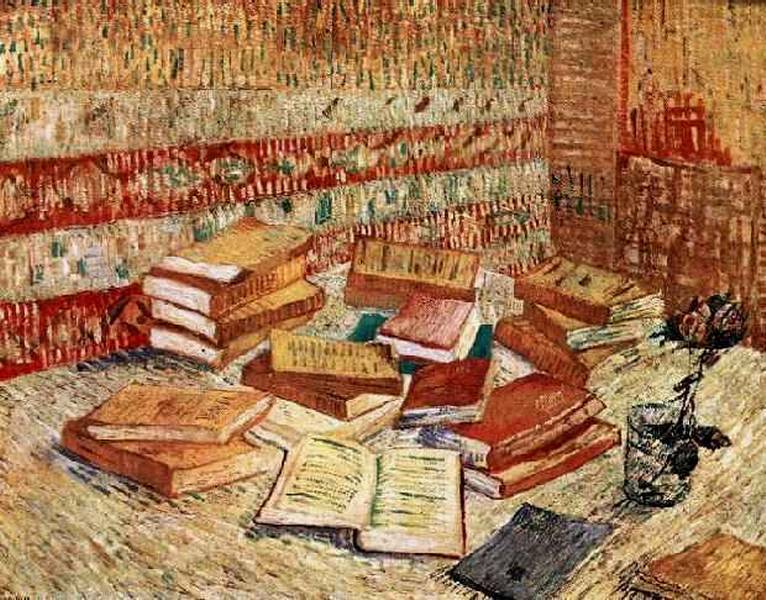
Libri_Vincent_van_Gogh

{credit}Still Life with French Novels and a Rose, Vincent Van Gogh (oil, 1887){/credit}

As the literati strive to predict the future of the book, one thing is clear in the here and now: the best of popular science writing is still all about clarity, rigour and brio. This year’s six-book shortlist for the Royal Society Winton Prize for Science Books bristles with that mix.

The Society’s annual prize, now worth £25,000, is awarded to the year’s “outstanding popular science books from around the world”. This half-dozen certainly delves into many worlds — the universe inside the skull, the cosmos of numbers, the subatomic, the gene, and the dynamic interplay between biology and quantum mechanics, and people and planet.

Meet the contenders (in alphabetical order of authors’ surnames).

The Man Who Couldn’t Stop by David Adam (Picador)

Seasoned science journalist (and Nature colleague) Adam’s searing study-cum-memoir, reviewed here, is a twin journey through his own knotted, traumatic experience of obsessive-compulsive disorder, and the evolving science surrounding it. A reflective eye on what Adam calls “our siege mentality”.

Alex Through the Looking-Glass: How Life Reflects Numbers and Numbers Reflect Life by Alex Bellos (Bloomsbury)

The erudite and engaging Bellos, a writer and speaker on mathematics, follows up his bestselling 2010 Alex’s Adventures in Numberland with this equally adroit interweaving of maths history, the peculiarities of day-to-day maths, and the mindscapes of mathematicians. (Why is 24 is better than 31 in the context of anti-dandruff shampoo? You’ll need to read the book.)

Smashing Physics: Inside the World’s Biggest Experiment by Jon Butterworth (Headline)

Butterworth, a particle physicist and CERN insider, here (writes my colleague Jo Baker) gives “a personal account of three years that shook his research field – from the switching on of the Large Hadron Collider at CERN in 2009 to the discovery of the Higgs boson in 2012. In a lucid treatment —  part memoir, part primer — he relates the ups, downs and minutiae of everyday life at the particle physics coalface and reflects on the public and political perceptions of science.”

Life’s Greatest Secret: The Story of the Race to Crack the Genetic Code by Matthew Cobb (Profile)
Zoologist Cobb masterfully recontextualises the 1953 discovery of the structure of DNA (reviewed here). One for the shelf bearing seminal early studies by James Watson and Horace Judson, Cobb’s treatment beautifully explicates the contributions of physics, biology and chemistry, and scientists from Oswald Avery to Rosalind Franklin.

Life on the Edge: The Coming of Age of Quantum Biology by Johnjoe Mcfadden and Jim Al-Khalili (Bantam Press)
Al-Khalili (a physicist) and McFadden (a molecular biologist) take on the vexed nexus of quantum weirdness and life itself in this exploration of an emergent field of scientific endeavour (reviewed here). From synthbio to quantum tunnelling inside enzymes, a trip into strange, and strangely compelling, realms of research.

Adventures in the Anthropocene: A Journey to the Heart of the Planet we Made by Gaia Vince (Chatto & Windus)
Writer, broadcaster and former Nature news editor Vince covered six continents over two years to craft this compilation (reviewed here). Bucking the trend to view the environmental challenges of the Anthropocene with terrified or jaundiced eye, she discovered innovators and pioneers working towards new models of adaptation and environmental ‘reverse engineering’. A grand survey of development endeavour through a science writer’s lens.

In looking through this list, it occurred to me anew how popular science writing remains one of the great exemplars of multidisciplinarity. It is the context to the findings — the history, the socioeconomic realities, the psychology of the players and their rivals, the leadup to discovery and the societal implications of its deployment — that reveals the real-world significance of the science.

Scientific storytelling is one of the great artforms of our age. Its roots may stretch back to Mary Somerville’s monumental On the Connexion of the Physical Sciences 181 years ago (reviewed here), but its heyday is now.

The judges of this year’s prize include chair Ian Stewart (mathematician and Royal Society Fellow), Guardian books editor Claire Armitstead, Channel 4 lead anchor Krishnan Guru-Murthy, electronics engineer Jo Shien Ng, science broadcaster and author Adam Rutherford, and novelist Sarah Waters. The winner will be announced at a Royal Society public event on 24 September, hosted by Brian Cox, Royal Society Professor for Public Engagement in Science.


For Nature’s full coverage of science in culture, visit www.nature.com/news/booksandarts.
 

Inside Inside Out

Posted on behalf of Kerri Smith

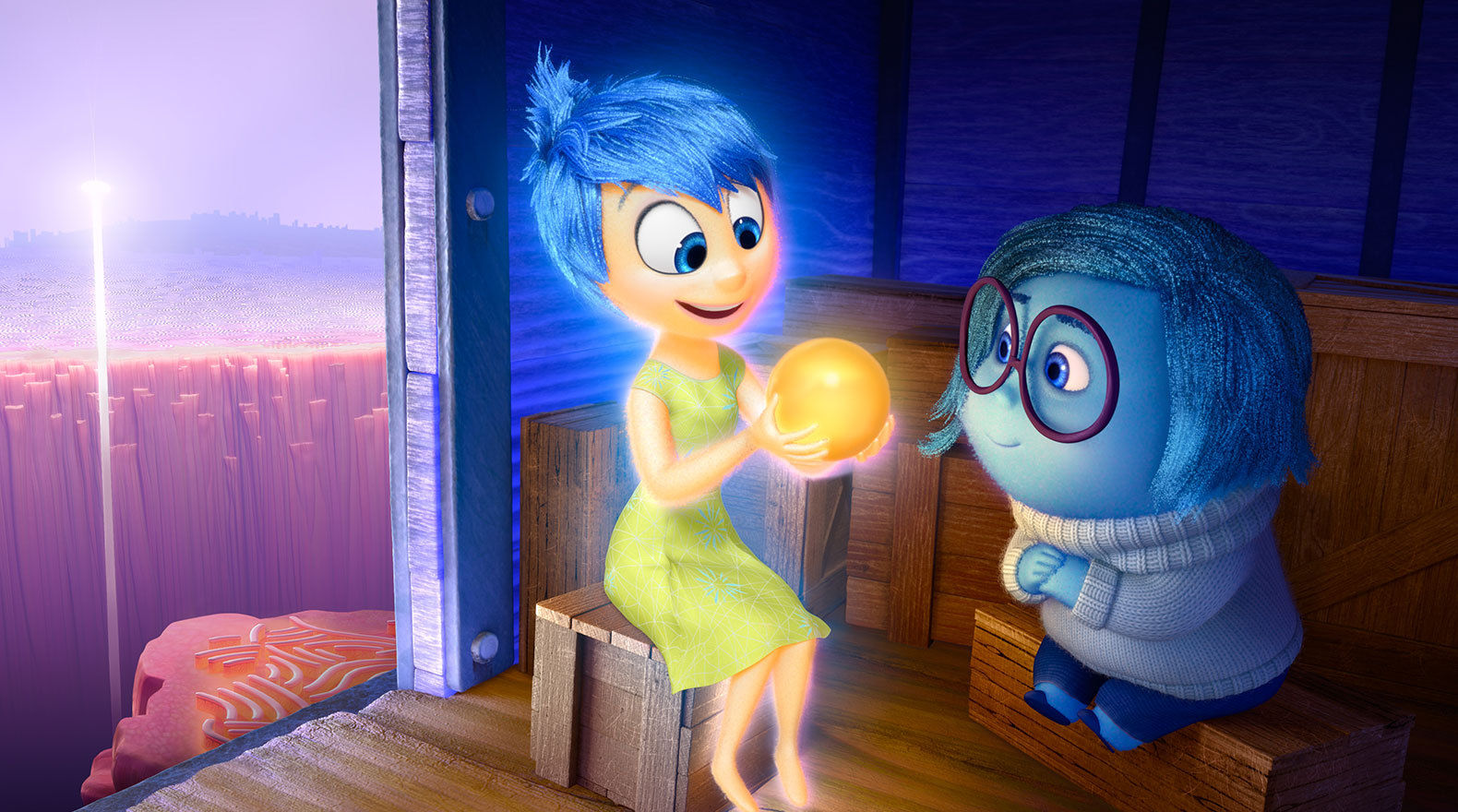
Joy and Sadness, two of the personified emotions in Pixar's Inside Out.

Joy and Sadness, two of the personified emotions in Pixar’s Inside Out.{credit}Disney/Pixar{/credit}

Moving emotional journeys are the stock-in-trade of animation studio Pixar. In their Toy Story trilogy, released in 1995, 1999 and 2010, little Andy’s toys compete for his affections as his family move, threatening to leave them behind. In the 2009 Up, even the opening sequence — a poignant recap of the elderly protagonist’s life story – had audiences blubbing.

In Inside Out, now on general release, it is the emotions – personified – that themselves go on a journey. The feelings of 11-year-old Riley are characters (Joy, Sadness, Anger, Disgust and Fear) lodged in a neuroscientifically improbable ‘Headquarters’ reminiscent of Rene Descartes’ pineal gland — the brain area where he imagined mind governed body. This volatile crew rev into action when Riley’s parents move the family from Minnesota to San Francisco, where she faces the first big challenges of an easy life: finding new friends, getting used to a new home and school.

As Riley navigates these changes, the narrative is driven by the interplay between her emotions – particularly Joy and Sadness — and their adventures in the wild kingdom of Riley’s psyche. Joy had had the upper hand in Riley’s life to date; the central message is of the crucial role of Sadness in forming Riley’s character as she makes the bitter-sweet transition from child to teen and beyond. The adventures of Joy and Sadness form a counterpoint to Riley’s as each navigates a thrilling narrative of lost and found.

The colours of emotions drench this film: golden for Joy and green for Disgust, for instance. They tint Riley’s experiences, which are delivered to HQ like bowling balls, and thence dispatched to be enshrined in memory or forever forgotten. Many travel along tubes to long-term storage, a maze of high shelves resembling the folds of cortex when seen from above. “Let’s get those memories down to long-term!” trumpets Joy, as Riley falls asleep at the end of a happy day. I found this a compelling portrayal of memory processing: neuroscientists know that memories spend a little time in the hippocampus, where they are made, before some are shuttled to the cortex for long-term storage.

Memory in the mind’s eye

Likewise, when Riley recalls one positive memory and it is projected onto a ‘mind’s eye’ screen for her emotions in HQ to see, Sadness reaches up to re-colour it. It is well-established that memories can be rendered malleable by being recalled, and then altered by new experience before being stored again.

A handful of experiences become core memories, each powering a different aspect of Riley’s personality. Others tumble to a dark chasm where they dissolve in wisps of dust. Forgetting isn’t always this passive – remembering competing facts can cause other related information to be forgotten, for instance, and forgetting can be beneficial, freeing up processing power for new memories.

Five emotions are quite enough for Inside Out’s writers to be getting on with, but there is some debate in psychology over how many we really have. American psychologist Paul Ekman, one of the film’s scientific consultants, would have liked to see upwards of 20; others argue that there can be no more than 4. I would have been interested in seeing Surprise and Embarrassment, but perhaps the latter will play a greater part in Inside Out 2: The Teenage Years.

The physical appearance of the emotions was unsurprising: Anger is a bright-red cube, Sadness a blue blob with a frumpy jumper, and Joy an elfin figure who left little particles of yellow glitter floating in her wake. But each had their own emotional range. Joy was sometimes sad, and often worried about Riley. Was this Pixar giving us a lesson on how our own emotions can blend, or could they not make the narrative work with relentlessly one-note characters? 

There are some witty asides aimed at adults. While travelling on the Train of Thought, for instance, Joy knocks over two boxes and spills their contents. “All these Facts and Opinions look the same!” she cries, trying to shovel them back in.

The brain’s fleshy chasms and labyrinthine neuronal libraries are an inspired choice for a filmic landscape. In Pixar’s treatment, brain are transformed into psychedelic fairgrounds (‘Imaginationland’) and dark, terrifying gulfs (the ‘Unconscious’). But even with this stiff competition, our three-pound lumps of squidgy pinkness are still more exotic, surprising and mysterious. As we learn more about how we processes and react to the complexities of our world, there will surely be plenty more to inspire Pixar.  

 Kerri Smith is Nature’s podcast editor. She tweets @minikerri.


For Nature’s full coverage of science in culture, visit www.nature.com/news/booksandarts.
Neuroscience-tinged kids’ app put to the test

Posted on behalf of Hysell Oviedo and Siboney Oviedo-Gray

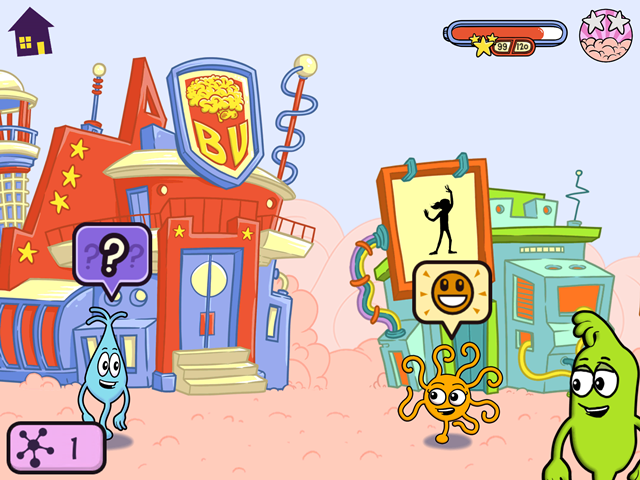
'Brain Street' in Kizoom's gamified neuroscience learning app, Brainventures.

‘Brain Street’ in Kizoom’s gamified neuroscience learning app, Brainventures.{credit}Kizoom{/credit}

I have two criteria for a game app for my daughter: it must assuage my guilty conscience when I’m not able to play with her, and contain no ads. Ideally I would want her to learn calculus while we wait at the airport security line (or to discover that lingering boredom can lead to creativity and observation). Realistically, I at least want her to learn something useful.

What that something is varies widely, from the physics puzzles starring candy-eating monster Om Nom in Cut the Rope (ZeptoLab) to the ruthless war strategizing in Supercell’s Clash of Clans, to good old-fashioned addition and spelling. A newish trend is apps that gamify learning, which taps into our reward and motivation systems to incentivize explicit learning (of world history, for example).

One such app is Brainventures from Kizoom, which my seven-and-a-half-year-old, Siboney, was excited to try. She played Kizoom’s Brain Jump when younger, and enjoyed a read-along vignette about neurons from the developers (the founder is a neuroscientist). Like Brain Jump, Brainventures draws heavily on classic psychophysical tasks: reaction time, memory, visual acuity. It connects Brain Jump’s star Ned the Neuron with many friends — including the competitive Pepper, dopey Big Rick, and Ada the focused.  

These neurons mainly teach us about the brain in quirky interactions via speech bubbles (such as,  Here in the brain we are just as busy when Sophie is sleeping,” says Buster. “Brain party all night!” responds another neuron). These speech bubbles risk being skipped by kids eager to get to the games. To illustrate the function of different neurons, the app gets kids to choose virtual children who need help from their neurons in their daily routine: “I like that we do stuff for Sophie,” said Siboney. That “stuff” includes turning cartwheels in a tricky timing task called Move It, catching the most nutritious food in Fuel Up, and Sort and Store.

Memories are made of this

Every task has increasing levels of difficulty. My favourite is Focus Pocus, the hide-and-seek version of a visual working memory task where kids have to remember objects presented briefly and track them in a fishbowl full of distractors. This demands sustained memory and attention, a rare feature in game apps.

Overall, the app makes it clear that neurons have to work together to do “stuff”, but that’s where the level of complexity stops. As a neuroscientist, I would have liked to see the game makers exploit more our vast knowledge of the marvelous anatomical differences between brain areas that perform different functions.

It’s arguable whether the game achieves the cognitive claims stated on Kizoom’s website (such as, “Take on quests to help the child grow brain power”). But the app does introduce the basic idea that an integrated network of neurons that perform different functions powers the brain. The psychophysical games are also well designed: it’s clear what to do but at the same time, they are challenging.

Brainventures satisfies one of the cardinal rules of a kids’ app: they can do it largely without parental help. The downside was that Siboney blasted through the app in about an hour, then started re-doing the levels. She played the game enthusiastically for about a week; then her interest waned. I surmise that Brainventures lacks some key elements of gamification — such as a virtual currency, missions and rewards — which reinforce a kid’s excitement and engagement, drive the desire for mastery and achievement, and hopefully, increase the potential for learning. But my biggest request to the game makers? Please add a pause button. 

Hysell Oviedo is a professor of neuroscience at The City College of New York, and the biology-neuroscience subprogramme at the CUNY Graduate Center. She studies the neural basis of animal communication. Her favourite science outreach project is leading a BioAnimation team of visual arts and biology students who make movies about how the brain works. She tweets at @hysell.

Siboney Oviedo-Gray’s favourite subjects are maths and grammar, her favorite city is Madrid, and she likes drawing, and cooking with mom.


For Nature’s full coverage of science in culture, visit www.nature.com/news/booksandarts.