Five books for the COP negotiator

city-cars-traffic-eiffel-tower 3George Orwell, author of dystopian classics Nineteen Eighty-Four and Animal Farm, was a political animal par excellence. He understood how the language of politics could give “an appearance of solidity to pure wind”, as he put it in his 1946 essay Politics and the English Language. Those words should blast right through the miasmas forming over Paris as COP21 enters its second week.

Happily, 65 years after Orwell’s death, there is no shortage of miasma-busters out there, and I’ve assembled five books to prove it. But first, a closer look at the fog itself.

After decades of COP-watching, I remain as astonished by the halting nature of progress as I am by the number of spanners in their works. National politics and regional-bloc agendas are only some of the impedimenta. There are now, increasingly, external pressures such as corporate lobbying and well-meaning but often disruptive parallel actions by billionaire philanthropists. The whole looks, and often is, a hopelessly unwieldy form of decision-by-committee.

More, the COPs have accreted a culture that, like many variants of the UN model, might leave an ethnographer bemused. There are, for instance, the agreement rollouts that are vague, stretch decades into the future, or both. Climate policy analyst Oliver Geden has called the tendency “kicking the can down the road” — the “modus operandi of UN climate policy”. That pattern also popped up in Indian prime minister Narendra Modi’s announcement last week of a solar alliance involving 120 countries, including France.  India’s big date is 2030, by which time it plans to draw 40% of its energy needs from renewables — even as it formulates equally ambitious plans for its coal. France, meanwhile, currently gets 75% of its energy from nuclear, and that is only due to be reduced by 2025. Ambitious transitions, or a prime example of Orwellian doublethink (and can-kicking)?

French climate-change ambassador Laurence Tubiana, however, dubbed the solar alliance “a true game-changer”. That brings me to another staple of COP culture: hyperbole, deployed to give a sense of dynamism to the often seemingly imperceptible advance of climate decision-making. Yet a clear critique of proposed solutions is as important as sticking to the science on climate change: the facts are alarming enough.

Despite all, solutions need to emerge from the psychological push and pull of the negotiating room. On to the books that in my view could move mountains, or indeed miasmas.

Guru Madhavan’s Applied Minds: How Engineers Think (W.W. Norton, 2015) is by and about the pragmatic tribe who craft the made world (reviewed here). If it seems whimsical to imagine an engineer’s experience might translate to the delicate calibrations and manoeuvrings of negotiation, read on. Their mindset, as Madhavan shows, is focused totally on solutions. Trained in ‘modular systems thinking’, engineers handle complexity by considering the components, the interdependencies and the totality of problems. Engineers are, moreover, deft operators under constraints such as time, finance, physics and human behaviour. Finally, they have a nuanced grasp of tradeoffs and can weed out weak from strong goals. To me, pragmatic, time-sensitive grappling with multidimensional problems doesn’t seem alien in the context of the COPs, which are, after all, attempts to construct a framework. And in a broader sense, systems-thinking seems key to achieving sustainability in an inherited cascade of environmental problems.

History, by deepening our understanding of how today’s looming issues have evolved, can give some insight into solutions. Janet Biehl’s Ecology or Catastrophe: The Life of Murray Bookchin (Oxford University Press, 2015), reviewed here, reminds how 50 years ago, important thinking on climate change was already very much out there. Bookchin, an independent radical ecologist, revealed a rare grasp of the global scale of environmental problems in books such as the 1965 Crisis in Our Cities, in which he wrote: “Theoretically, after several centuries of fossil-fuel combustion, the increased heat of the atmosphere could even melt the polar ice caps”. Bookchin’s solutions to the crisis were as prescient, not least in integrating social with environmental elements. Working from a vision of urban ecotopias, he inspired and championed community-centred, solar-powered, closed-loop food production as early as the 1970s.

David Rieff’s The Reproach of Hunger (Simon and Schuster, 2015), reviewed here, is about the global food crisis, a challenge intimately linked with climate change and like it, human-driven. Rieff, a veteran writer on aid and development issues, spent six years researching this study, and it shows. It is perhaps most acute, and balanced, on why the current melee of international policy bodies, the private sector, “philanthrocapitalists” and technophiles is failing to find viable solutions to hunger. Rieff points to the greater context: a globalised, neoliberal economic system which — as others such as economist Joseph Stiglitz have pointed out — drives the inequities behind global problems, not least the wealth of a tiny minority. I commend this book to my hypothetical negotiator as a salient reminder of the politics infusing global challenges.

In Climate Shock: The Economic Consequences of a Hotter Planet (Princeton University Press, 2015), reviewed here, economists Gernot Wagner and Martin Weitzman deliver a stinging slap to the reluctant or somnolent negotiator. They creatively reframe climate change as a risk management issue — asking why, if there is a 10% chance that climate change will lead to catastrophe, we are not girding ourselves through ‘insurance’, such as pushing industry and policymakers to get on with the transition. They marshall excellent evidence to show that the longer the world waits to act, the likelier it will be that extreme events will happen. A welcome reminder that we must avoid becoming lobsters dawdling at the bottom of a slowly boiling pot.

And finally, a primer on what is at the bottom of all the horror and hoopla — fossil fuels. Two years ago I extolled The Burning Question by Mike Berners-Lee and Duncan Clark (Profile Books, 2013). It is even more relevant now. They lay out the maths, showing that we have “five times as much oil and coal and gas on the books as climate scientists think it is safe to burn”. Yet we are planning to burn it, because fossil-fuel companies treat underground reserves as an existing asset. If the stuff stayed in the ground, they note, it would be goodbye to trillions — but a real commitment to carbon curbing. At a COP partly sponsored by oil interests, my putative negotiator might want to mull over the real costs of a carbon economy.

We refer to the COPs as ‘talks’, and the negotiations themselves do proceed in a soup of arcane UN-speak. Outside those established constraints, the players in this global endeavour need to think deeply about language. It is a shaper of reality. As Orwell noted, the use of a hackneyed phrase “anaesthetizes a portion of one’s brain”. By contrast, lucid and original language and the independent thinking it fosters — as seen in these five exemplary books — are a “necessary first step towards political regeneration” and some dispelling of the murk.


For Nature’s full coverage of science in culture, visit www.nature.com/news/booksandarts.

Hunger games: food security on stage and screen

Metta Theatre's production of Lydia Adetunji's play Bread on the Table, Trafalgar Studios, London.

Metta Theatre’s production of Lydia Adetunji’s Bread on the Table juxtaposes food commodity trading and starvation in poorer countries.{credit}Richard Davenport{/credit}

A Nigerian farmer feeds her last cow to a man who pays with his life. A biologist in an agribusiness-dominated dictatorship risks death by growing potatoes. An official in a world of water wars tortures a man dehumanised by thirst.

Mouthful, a set of six playlets at London’s Trafalgar Studios, offers pungent glimpses — some bleakly comic, some harrowing — of food crises real and potential. It joins a spate of films — including the documentaries 10 Billion and Land Grabbing — and books re-examining the issues to ask how and why hunger still haunts us, after decades of humanitarian and scientific effort, and enshrinement in the Millennium Development Goals.

Some 795 million people remain malnourished, according to the UN Food and Agriculture Organization. But globally, the complexities of food production, distribution and consumption create another kind of havoc. The World Health Organization notes that over 600 million adults are obese. Humanity’s relationship with food has become intractably tangled in tandem with population growth, globalisation, economic inequities, and technological changes such as factory farming and food processing. We swim in a bouillabaisse of biotech agribusiness, threatened crop biodiversity, rising food prices, and a vast tonnage of wasted food.

Alisha Bailey of Metta Theatre in Neil LaBute's drought-ridden dystopia 16 Pounds.

Alisha Bailey of Metta Theatre in Neil LaBute’s drought-ridden dystopia 16 Pounds.{credit}Richard Davenport{/credit}

Six scientists steeped in the issues collaborated with the six playwrights behind Mouthful. Thus Tim Benton,  champion of the UK Global Food Security programme, teamed up with renowned film director and writer Neil LaBute for his drought-bound dystopia 16 Pounds (Benton also helped hammer out issues explored by all the plays). Lydia Adetunji, whose trenchant Bread on the Table picks at the link between food commodification and the Middle East food riots, worked with plant breeder Molly Jahn. The researchers were sounding boards and fact checkers, ensuring assertions were evidence-based, and suggesting real-world concerns as dramatic inspiration.

These joint ventures are a world away from Duncan Macmillan’s recent 2071. Essentially a lecture on climate change by climate scientist Chris Rapley, that play drew fire from many critics for its bald didacticism. Mouthful gets its multiple messages across via the expressive skill of the Metta Theatre ensemble (whose four members play all the roles) and director Poppy Burton-Morgan. Interludes by artistic director William Reynolds deliver quantification — projections of data and brief videos — but at so rapid a pace it was hard to get more than an impression of the facts.

And that made me wonder how someone new to them might experience Mouthful. Where the drama in 2071 is meant to emanate from the science alone, here theatrical skill is the weight-bearing element. Certainly, the performances are superb, particularly Doña Croll’s as, in turn, a commodity broker’s client, a Fulani farmer and a biodiversity activist, and Robert Hands’s as a starving Tunisian — and a giant insect in the interval revue Try Me, a paean to entomophagy.

Mouthful is best at taking humanity’s botched attempts to feed itself to their logical conclusions, and at showing with some subtlety the interlinkages between conflict, corporate greed and hunger. It is politicised, but that is inevitable given the economic inequalities that are the worm at the core of this unwieldy problem.

Feeding the billions

10 Billion covers much of the same territory as Mouthful. But the film’s dramatic tension is sparked by the friction between extremes — top-down, lab-bound, big-money solutions alternating with bottom-up experiments and experiences. While the dichotomy and development paradigms are familiar, the director — environmental journalist Valentin Thurn — gives us a mindboggling range of responses to the food crisis.

The film opens on Thurn munching a deep-fried grasshopper, intoning that apropos of food, “It may not be long before we can’t afford to be picky any more”. It’s a taster for a sometimes queasy tour taking in a Mozambican farmer ejected from her land by soy growers, a panoply of organic farmers, the scientific advisor to a high-tech Japanese lettuce factory, the director of a vast industrial chicken production business in India, Canadian researchers genetically modifying salmon, “in vitro meat” engineer Mark Post and many others. These individuals become unique windows on the often baffling world of ‘global food’.

Thurn makes no secret of his disdain for agribusiness. This is muckraking of a serious type, and that some of his interviewees are hoist with their own petard is in the nature of documentary-making. Thurn does, however, milk the visual contrast between the researchers and farmers. The technicians in lab coats under artificial light seem shot with a slo-mo surreality, giving their work an alien, claustrophobic feel in stark contrast to that of the farmers in sunny fields full of scurrying livestock.

B. Soundararajan of Indian company Suguna Poutry Farm, featured in 10 Billion.

B. Soundararajan of Indian company Suguna Poutry Farm, featured in 10 Billion.{credit}Prokino 2015{/credit}

Again like Mouthful, 10 Billion is strongest in its revelations of interconnections and tradeoffs. Thurn shows how vast multitudes of factory-farmed chickens mean more soy fields in Africa to feed them, and how food commodities speculation in Chicago can cause the price of staple crops to fluctuate in scores of poor countries. He is unimpressed by the idea — propounded by Jim Rogers, founder of the Rogers International Commodity Index — that high food prices benefit farmers, arguing that profits often circulate solely within the commodities market.

His point that small farmers can, by becoming self-sufficient, opt out of the global system entirely is hardly novel, but the case studies are salutary. Malawian Fanny Nanjiwa, for instance, intercrops pigeon peas, cabbage and cassava to keep her food supply resilient. Across the world in Wisconsin, basketball veteran Will Allen boosts urban community food security through Growing Power. The venture features intensive vermicomposting and ‘aquaponics’, a closed system neatly meshing fish farming with food cropping.

A highlight is Thurn’s look at Indian landraces. Many of these indigenous crop varieties, having evolved under highly variable local conditions, are very hardy; and there is a resurgence of interest in them. We see Kusrum Misra, an ebullient Balasore-based seed collector, touring conservation fields preserving over 700 varieties of rice resistant to salt, flooding and drought.

Small farmers in Cambodia who were forced off the land, featured in Land Grabbing.

Small farmers in Cambodia who were forced off the land, featured in Land Grabbing.{credit}Wolfgang Thaler{/credit}

One wonders what Misra would make of Jes Tarp. Chairman of a company called Asian Global Management, he is shown gazing proudly over a rippling monoculture soy field saying, “two years ago, this looked like that” as he points to a nearby forest. Tarp, however, is not pushing people off the land — a now worldwide phenomenon. The Austrian documentary Land Grabbing by Kurt Langbain and Christian Brüser graphically reveals the cost of this practice in Cambodia, Romania, Sierra Leone and Ethiopia.

And it is high. Western demand for the crops fuelling our lifestyle — sugarcane for sugar and ethanol, oil palms for the saturated vegetable oil used increasingly in everything from lipstick to sweets — is met in part by companies operating in poverty-stricken countries. Land Grabbing explores that relationship in depth, and clarifies the extent of savannah and rainforest clearances that make way for vast plantations, and the siphoning off of water supplies. As entire villages can be burnt, bulldozed or simply divested of cropland in the process, social stability can be lost along with biodiversity and scarce resources.

Land Grabbing is a film less orchestrated than 10 Billion, and the better for it. Martin Hausling — a German farmer-turned-MEP in the European Parliament for the Greens  — does provide some context, notably on the links between European Union subsidies and evictions of hundreds of thousands of small farmers in Cambodia, which have been amply reported elsewhere. But on the whole we parse for ourselves the pronouncements of an agribusiness consultant fired up by palm-oil profits (a hefty $40 million per 10,000 hectares a year), World Bank advisors thrilled by opportunities for agricultural entrepreneurship in Africa, ethanol producers — and farmers traumatised by the grabs.

Vegetable picker Alemgema Alemayoh, featured in Land Grabbing.

Vegetable picker Alemgema Alemayoh, featured in Land Grabbing.{credit}Wolfgang Thaler{/credit}

And it is the people working the land who speak loudest. I was struck by two of the Ethiopians interviewed. One, Alemgema Alemayoh, picks peppers and tomatoes in a vast, foreign-run greenhouse whose produce is airlifted to five-star restaurants in Saudi Arabia. (The Ethiopian government, we are told, offers investors the lease of 3.6 million hectares of land at 5 euros a hectare per year.) She has never tasted these vegetables; she and her six children live on maize.

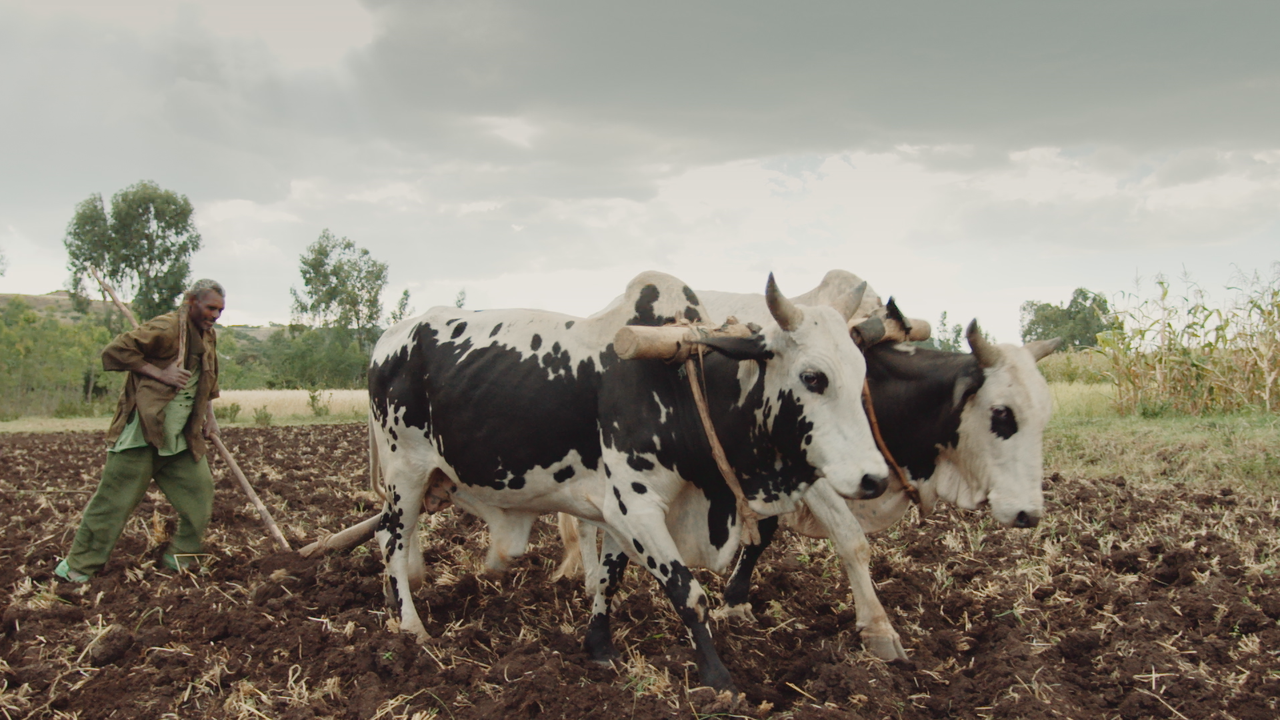
The other is Gebreyesus Tesfay. Under a government project helping small farmers improve soils, compost, intercrop and row-plant the grain teff, Tesfay is shown cultivating his land with a magnificent brace of oxen and a formidable handmade plough. Before, he says, they starved. Now they plant vegetables three times a year and are secure, although it is obviously still a tough life. As with Nanjiwa and Allen, self-sufficiency enlightened by the best of tradition and of small-scale science can work, if bad governance and skewed economics are held at bay.

Gebreyesus Tesfay on his farm in Ethiopia, featured in Land Grabbing.

Gebreyesus Tesfay on his farm in Ethiopia, featured in Land Grabbing.{credit}Wolfgang Thaler{/credit}

Globally, small farms number half a billion and support an estimated 2.5 billion people. They are, as these plays and films reveal, vulnerable; but they are centrally important as bulwarks against hunger. Meanwhile, the West’s demand for crammed supermarket aisles seems largely decoupled from a full understanding of the human dramas behind all that bounty. If tackling hunger is a ‘war’, it’s fought on many fronts; and it is winnable only if, in addition to appropriate technologies and sustainable innovation, richer societies fully grasp the politics that complicate this fraught issue.


See here for a Nature Podcast on Mouthful. For Nature’s full coverage of science in culture, visit www.nature.com/news/booksandarts.

A scintillating shortlist for the Royal Society prize

Libri_Vincent_van_Gogh

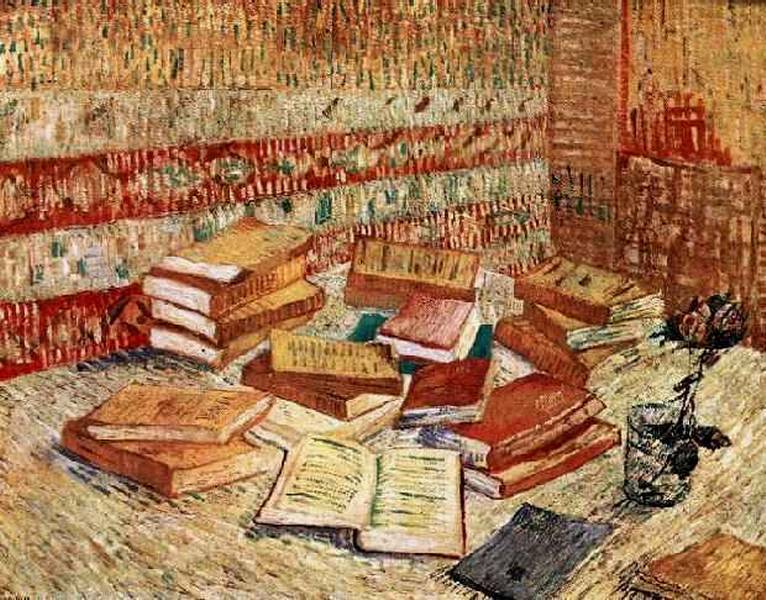
{credit}Still Life with French Novels and a Rose, Vincent Van Gogh (oil, 1887){/credit}

As the literati strive to predict the future of the book, one thing is clear in the here and now: the best of popular science writing is still all about clarity, rigour and brio. This year’s six-book shortlist for the Royal Society Winton Prize for Science Books bristles with that mix.

The Society’s annual prize, now worth £25,000, is awarded to the year’s “outstanding popular science books from around the world”. This half-dozen certainly delves into many worlds — the universe inside the skull, the cosmos of numbers, the subatomic, the gene, and the dynamic interplay between biology and quantum mechanics, and people and planet.

Meet the contenders (in alphabetical order of authors’ surnames).

The Man Who Couldn’t Stop by David Adam (Picador)

Seasoned science journalist (and Nature colleague) Adam’s searing study-cum-memoir, reviewed here, is a twin journey through his own knotted, traumatic experience of obsessive-compulsive disorder, and the evolving science surrounding it. A reflective eye on what Adam calls “our siege mentality”.

Alex Through the Looking-Glass: How Life Reflects Numbers and Numbers Reflect Life by Alex Bellos (Bloomsbury)

The erudite and engaging Bellos, a writer and speaker on mathematics, follows up his bestselling 2010 Alex’s Adventures in Numberland with this equally adroit interweaving of maths history, the peculiarities of day-to-day maths, and the mindscapes of mathematicians. (Why is 24 is better than 31 in the context of anti-dandruff shampoo? You’ll need to read the book.)

Smashing Physics: Inside the World’s Biggest Experiment by Jon Butterworth (Headline)

Butterworth, a particle physicist and CERN insider, here (writes my colleague Jo Baker) gives “a personal account of three years that shook his research field – from the switching on of the Large Hadron Collider at CERN in 2009 to the discovery of the Higgs boson in 2012. In a lucid treatment —  part memoir, part primer — he relates the ups, downs and minutiae of everyday life at the particle physics coalface and reflects on the public and political perceptions of science.”

Life’s Greatest Secret: The Story of the Race to Crack the Genetic Code by Matthew Cobb (Profile)
Zoologist Cobb masterfully recontextualises the 1953 discovery of the structure of DNA (reviewed here). One for the shelf bearing seminal early studies by James Watson and Horace Judson, Cobb’s treatment beautifully explicates the contributions of physics, biology and chemistry, and scientists from Oswald Avery to Rosalind Franklin.

Life on the Edge: The Coming of Age of Quantum Biology by Johnjoe Mcfadden and Jim Al-Khalili (Bantam Press)
Al-Khalili (a physicist) and McFadden (a molecular biologist) take on the vexed nexus of quantum weirdness and life itself in this exploration of an emergent field of scientific endeavour (reviewed here). From synthbio to quantum tunnelling inside enzymes, a trip into strange, and strangely compelling, realms of research.

Adventures in the Anthropocene: A Journey to the Heart of the Planet we Made by Gaia Vince (Chatto & Windus)
Writer, broadcaster and former Nature news editor Vince covered six continents over two years to craft this compilation (reviewed here). Bucking the trend to view the environmental challenges of the Anthropocene with terrified or jaundiced eye, she discovered innovators and pioneers working towards new models of adaptation and environmental ‘reverse engineering’. A grand survey of development endeavour through a science writer’s lens.

In looking through this list, it occurred to me anew how popular science writing remains one of the great exemplars of multidisciplinarity. It is the context to the findings — the history, the socioeconomic realities, the psychology of the players and their rivals, the leadup to discovery and the societal implications of its deployment — that reveals the real-world significance of the science.

Scientific storytelling is one of the great artforms of our age. Its roots may stretch back to Mary Somerville’s monumental On the Connexion of the Physical Sciences 181 years ago (reviewed here), but its heyday is now.

The judges of this year’s prize include chair Ian Stewart (mathematician and Royal Society Fellow), Guardian books editor Claire Armitstead, Channel 4 lead anchor Krishnan Guru-Murthy, electronics engineer Jo Shien Ng, science broadcaster and author Adam Rutherford, and novelist Sarah Waters. The winner will be announced at a Royal Society public event on 24 September, hosted by Brian Cox, Royal Society Professor for Public Engagement in Science.


For Nature’s full coverage of science in culture, visit www.nature.com/news/booksandarts.


Connotea Developer Tools

We’ve just released NPG’s first public web service for developers — the Connotea Web API.

Connotea is our web-based social bookmarking and reference management service. The release of the Web API now allows any developer to create an application or web site that interacts with Connotea’s database of references and links.

For those of you who are programmers, we’ve also released some Perl and Ruby libraries to allow you to get started quickly.

If you want explore what’s possible with the Web API in more depth, have a look at the documentation on the Connotea Community Pages, or get in touch with us on connotea@nature.com or via the connotea-code-devel mailing list.